
UK-US deal would allow MI5 to get chat, e-mails directly from US companies

Concern over “dumbing down” of protections because of UK’s weaker safeguards.

The UK and US governments are working on an agreement that would allow MI5 and other intelligence agencies to serve orders on US companies like Google and Facebook for live intercepts of conversations if they involve only British citizens. According to a report in The Washington Post, the UK would also be able to request stored data, such as e-mails. The agreement would be reciprocal, allowing the US to request similar data about Americans from UK companies.

If concluded, the agreement would help to resolve the difficult situation for US Internet companies, which are increasingly under pressure from the UK government to provide intercepts or stored data for domestic investigations of terrorist and criminal activities, but forbidden from doing so by US laws.

Currently, the only mechanism for obtaining this kind of information is through a mutual legal assistance treaty. As The Washington Post explains, this involves the UK making "a formal diplomatic request for the data and the Justice Department then seeks a court order on its behalf—a process that is said to take an average of 10 months." The proposed system would enable the UK and US governments to obtain intercepts through official channels more easily and more speedily. There is ample evidence that many other, more informal channels exist for exchanging information, but it may be that both governments would like to put things on a firmer legal basis.

Read 5 remaining paragraphs | Comments

PayPal blocks VPN, SmartDNS provider’s payments over copyright concerns

PayPal cuts off UnoTelly, which touts geo-blocking circumvention to customers.

(credit: PayPal)

PayPal has stopped accepting payments for Canadian outfit UnoTelly—a provider of VPN and SmartDNS services—because these might be used to facilitate copyright infringement.

UnoTelly said in an update on its website that Paypal had "severed payment processing agreement unilaterally and without prior warning." It added: "Paypal indicated that UnoTelly is not allowed to provide services that enable open and unrestricted Internet access."

Ars sought comment from PayPal on this story, however, it had not immediately got back to us at time of publication. We'll update this story, if the online payments giant does get in touch.

Read 6 remaining paragraphs | Comments

Europe’s top court mulls legality of hyperlinks to copyrighted content

Imagine having to check that none of your links’ links are unauthorized.

(credit: Hernán Piñera)

Europe's highest court is considering whether every hyperlink in a Web page should be checked for potentially linking to material that infringes copyright, before it can be used. Such a legal requirement would place an unreasonable burden on anyone who uses hyperlinks, thereby destroying the Web we know and love.

The current GS Media case examining hyperlinks builds on an earlier ruling by the European Union's Court of Justice (CJEU) in 2014. In that case, known as Svensson, the court decided that netizens didn't need a licence from the copyright holder to link to an article that had already been posted on the Internet, where previous permission had been granted by the copyright owner.

Although that was good news for the online world, it left open a related question: what would the situation be if the material that was linked to had not been posted with the copyright owner's permission? Would it still be legal under EU law to link to that pirated copy? Those are the issues that the latest CJEU case seeks to resolve for the whole of the 28-member-state bloc, and its 500 million citizens.

Read 5 remaining paragraphs | Comments

Putin’s top Internet adviser seems to own a piracy torrent site

Site owner is also head of Russia’s Internet Development Institute.

(credit: torrNADO.ru)

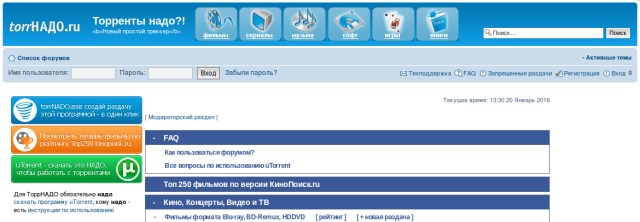
Vladimir Putin's special adviser on the Internet, German (Herman) Klimenko appears to be the owner of a Russian torrent website, according to an investigation by TorrentFreak. The site is torrNADO.ru, a pun on the Russian phrase "torrenti nado?"—do you need torrents? It offers the usual range of films, music, games, software, and e-books, all for free, and so presumably pirated.

As TorrentFreak discovered, the domain name is registered to a company called ECO PC Solutions, and the owner of ECO PC Solutions is a certain Alevtina Jacobson. "In December, ECO PC Integrated Solutions (with Jacobson at the helm) was announced as the operator of a brand new TV channel for MediaMetrics.ru, a service which measures Internet traffic to news stories from social media. Completing the circle, MediaMetrics is owned by Herman Klimenko and he admits that Alevtina Jacobson was his employee."

This would seem to confirm information obtained by the Russian-language business newspaper Vedomosti that Klimenko owned the torrNADO.ru site.

Read 5 remaining paragraphs | Comments
Court agrees, company can fire employee for Yahoo messaging after fair warning

But only if clear notice is given that private use of company resources is forbidden.

(credit: Phil Whitehouse)

The European Court of Human Rights (ECHR) has ruled that companies are allowed to monitor employees' Internet activities, including online chats, provided they have been warned beforehand that the private use of company resources is forbidden. Because this decision has been handed down by the ECHR, the highest human rights court in Europe, the ruling can affect almost every state in Europe (everywhere except Belarus and Kosovo).

This is the result of a case brought by a Romanian engineer, Bogdan Bărbulescu, who was fired for using a company's Yahoo Messenger account to chat with his fiancée and brother.

Bărbulescu had brought his case to the ECHR because he claimed that his dismissal was unfair, alleging "his employer’s decision to terminate his contract had been based on a breach of his right to respect for his private life and correspondence and that the domestic [Romanian] courts had failed to protect his right."

Read 5 remaining paragraphs | Comments

Facebook, Google, Microsoft, Twitter, Yahoo slag Snooper’s Charter

US Internet companies warn that harmful moves by the UK will have global impact.

(credit: Aurich Lawson / Thinkstock)

Facebook, Google, Microsoft, Twitter, and Yahoo have made an unusual collective submission of written evidence to the Draft Investigatory Powers Bill Joint Committee, in which they criticise a number of key elements of the UK government's proposed Snooper's Charter. They write: "We believe the best way for countries to promote the security and privacy interests of their citizens, while also respecting the sovereignty of other nations, is to ensure that surveillance is targeted, lawful, proportionate, necessary, jurisdictionally bounded, and transparent. These principles reflect the perspective of global companies that offer borderless technologies to billions of people around the globe."

As global companies, the group are particularly worried about the extraterritorial nature of the proposals: "Unilateral assertions of extraterritorial jurisdiction will create conflicting legal obligations for overseas providers who are subject to legal obligations elsewhere." There are two problems here. First, the five companies are already subject to US law; and second, if the UK government claims it has a right to instruct companies located outside the UK what to do, other nations—including places like China and Russia—will be able to do the same.

To resolve problems of clashing jurisdictions, the US companies suggest: "the Bill should consistently and explicitly state that no company is required to comply with any notice/warrant, which in doing so would contravene its legal obligations in other jurisdictions." In the longer term, the companies suggest "an international framework should be developed to establish a common set of rules to resolve these conflicts across jurisdictions."

Read 8 remaining paragraphs | Comments

Chinese company unveils world’s first passenger drone at CES

Would you trust your life to an autonomous flying vehicle?

(credit: Ehang)

The Chinese startup company Ehang unveiled yesterday at CES what it claims is the first passenger drone, capable of carrying one person for about 20 minutes. According to a report in The Guardian: "The cabin fits one person and a small backpack and is fitted with air conditioning and a reading light. It is designed to fit, with propellers folded, in a single parking spot." The company hopes to sell the device for $200,000 to $300,000 (£140,000 to £200,000) later this year.

The Ehang 184 Autonomous Aerial Vehicle (AAV) weighs 200 kilograms (440lbs), and has four sets of paired electric motors. The company claims the batteries can be charged in two to four hours. The drone is controlled via a tablet, which is used to set the flight path before take-off. According to the company's website: "Ehang 184 AAV flies in a inverted U shape. It takes off and lands vertically, point to point direct flight based on altitude and latitude of the origin and termination point. Take Off/Landing points are landing targets pre-set with Ehang Logo. The landing camera will position the landing targets automatically and accurately."

The Ehang 184 launch video.

Since the passenger has zero inflight control over the machine, safety is naturally a major concern. The company claims: "Even with one propeller malfunctions, it can still land in the nearest possible area safely." In addition, if any other components malfunction or disconnect, "the aircraft will immediately land in the nearest possible area to ensure safety."

Read 4 remaining paragraphs | Comments

The birth of Debian, in the words of Ian Murdock himself

Way back in 1999, I spoke to Murdock about Debian’s package-based genesis.

As we reported a few days ago, Ian Murdock, the creator of the Debian GNU/Linux distribution project, died in rather unclear circumstances last week. Until more details emerge, it seems wise to refrain from speculation about what really happened. Far better to celebrate what is not in doubt: his important contribution to free software at a critical period in its growth.

In November 1999, I spoke to Murdock at length, during one of the 50 interviews that form the backbone of my book Rebel Code: Linux and the Open Source Revolution. Inevitably, I was only able to use a few quotations from Murdock in the book's text, and now seems an appropriate moment to give a more complete version of how Murdock came to create Debian, told in his own words.

Murdock first came across GNU/Linux in 1993, when he was a 20-year-old student at Purdue University, studying accountancy: "This was around the time that PCs were just starting to get fast enough to actually run things like Unix. I'd been using Unix and I saw Linux as a way to have more convenient access to it." He said that the software at that time was "pretty rough around the edges," but that helping to fix that was part of the fun: "one of the great things about Linux is it was one of the first operating systems that you could actually not only see what it was doing but you could get in there and tinker around with it."

Read 16 remaining paragraphs | Comments

Dutch government: Encryption good, backdoors bad

Will also provide a grant of $537,000 to support the OpenSSL project.

(credit: Rainer Ebert)

The Dutch government has released a statement in which it says that "it is currently not desirable to take restricting legal measures concerning the development, availability and use of encryption within the Netherlands." It also notes that forcing companies to add backdoors to their products and services would have "undesirable consequences for the security of communicated and stored information," since "digital systems can become vulnerable to criminals, terrorists and foreign intelligence services."

The Dutch government's declaration, translated by Matthijs R. Koot, looks at both sides of encryption—the benefits it provides by allowing sensitive information to be protected, and the issues it raises for the police and security services. It recognises that crypto "enables everyone to ensure the confidentiality and integrity of communication, and defend against, for instance, espionage and cyber crime. Fundamental rights and freedoms as well as security interests and economic interests benefit from this."

But it also acknowledges that the use of encryption by criminals "complicates, delays, or makes it impossible to gain (timely) insight in communication for the purpose of protecting national security and the purpose of prosecuting criminal offenses. Furthermore, court hearings and the providing of evidence in court for a conviction can be severely hindered."

Read 5 remaining paragraphs | Comments

Bumbling would-be UK bomber asked Twitter followers for target suggestions

Once again, encryption was not used to cover tracks in any way.

(credit: Francis Tyers)

A would-be UK bomber and his wife have been found guilty by the Old Bailey court of plotting to carry out an explosion in London to mark the tenth anniversary of the 2005 suicide attacks that took place in the same city. Both been sentenced to life imprisonment: a minimum of 27 years for Mohammed Rehman, and a minimum of 25 years for his ex-wife Sana Ahmed Khan.

A report by The Guardian explains the case: "Mohammed Rehman, 25, who secretly wed Sana Ahmed Khan, 24, intended to commemorate the 10th anniversary of the 7/7 atrocities with blasts that would have inflicted mass casualties in either Westfield shopping centre, west London, or the London Underground."

Remarkably, Rehman took to Twitter to ask for advice on which of those two targets he should choose: "Westfield shopping centre or London underground?" Rehman asked. "Any advice would be appreciated greatly." The post carried a link to an al-Qaida press release about the 2005 London bombings. Sky News reports that Rehman's Twitter name was "Silent Bomber," with the handle @InService2Godd. As if that weren't enough, his Twitter bio read: "Learn how to make powerful explosives from the comfort of ones' bedroom." The Twitter account has since been suspended.

Read 6 remaining paragraphs | Comments