‘Tor and Bitcoin Hinder Anti-Piracy Efforts’

A new report published by the European Union Intellectual Property Office identifies a wide range of ‘business models’ that are used by pirate sites. The organization, which announced a new collaboration with Europol this week, signals Bitcoin and the Tor network as two key threats to ongoing anti-piracy efforts.

Source: TF, for the latest info on copyright, file-sharing, torrent sites and ANONYMOUS VPN services.

euipoTo avoid enforcement efforts, pirate sites often go to extremes to hide themselves from rightsholders and authorities.

Increasingly, this also means that they use various encryption technologies to increase their resilience and anonymity.

Several of these techniques are highlighted in a new report published by the European Union Intellectual Property Office (EUIPO).

The report gives a broad overview of the business models that are used to illegally exploit intellectual property. This includes websites dedicated to counterfeit goods, but also online piracy hubs such as torrent sites and file-hosting platforms.

EUIPO hopes that mapping out these business models will help to counter the ongoing threat they face.

“The study will provide enhanced understanding to policymakers, civil society and private businesses. At the same time, it will help to identify and better understand the range of responses necessary to tackle the challenge of large scale online IPR infringements,” EUIPO notes.

According to the research, several infringing business models rely on encryption-based technologies. The Tor network and Bitcoin, for example, are repeatedly mentioned as part of this “shadow landscape”.

“It more and more relies on new encrypted technologies like the TOR browser and the Bitcoin virtual currency, which are employed by infringers of IPR to generate income and hide the proceeds of crime from the authorities,” the report reads.

According to the report, Bitcoin’s threat is that the transactions can’t be easily traced to a person or company. This is problematic, since copyright enforcement efforts are often based on a follow-the-money approach.

“There are no public records connecting Bitcoin wallet IDs with personal information of individuals. Because of these Bitcoin transactions are considered semi-anonymous,” EUIPO writes.

Similarly, sites and services that operate on the darknet, such as the Tor network, are harder to take down. Their domain names can’t be seized, for example, and darknet sites are not subject to ISP blockades.

“Through the use of TOR, a user’s Internet traffic is encrypted and routed in specific ways to achieve security and anonymity,” the report notes.

While the report doesn’t list any names, it describes various popular torrent, streaming and file-hosting sites. In one specific case, it mentions an e-book portal that operates exclusively on the darknet, generating revenue from Bitcoin donations.

Most traditional pirate sites still operate on the ‘open’ Internet. However, several sites now allow users to donate Bitcoin and both The Pirate Bay and KickassTorrents both have a dedicated darknet address as well.

EUIPO is clearly worried about these developments, but the group doesn’t advocate a ban of encryption-based services as they also have legitimate purposes.

However, it signals that these and other trends should be followed with interest, as they make it harder to tackle various forms of counterfeiting and piracy online.

As part of the efforts to cut back various forms of copyright infringement, EUIPO also announced a new partnership with Europol this week. The organizations launched the Intellectual Property Crime Coordinated Coalition which aims to strengthen the fight against counterfeiting and piracy.

Source: TF, for the latest info on copyright, file-sharing, torrent sites and ANONYMOUS VPN services.

Steal This Show S01E13: Save P2P, Save The Internet!

Today we bring you the next episode of the Steal This Show podcast, discussing the latest file-sharing and copyright news. In this episode we discuss how proposed legislation threatens unrestricted VPN and BitTorrent use.

Source: TF, for the latest info on copyright, file-sharing, torrent sites and ANONYMOUS VPN services.

stslogoIn this emergency episode of STEAL THIS SHOW, Thomas Lohninger of Save The Internet and Holmes Wilson of Fight For The Future explain how practices like traffic management, zero rating and specialised services threaten P2P, VPNs and, more generally, our access to a free and open internet.

Click here to have your voice heard before it’s too late!

Steal This Show aims to release bi-weekly episodes featuring insiders discussing copyright and file-sharing news. It complements our regular reporting by adding more room for opinion, commentary and analysis.

The guests for our news discussions will vary and we’ll aim to introduce voices from different backgrounds and persuasions. In addition to news, STS will also produce features interviewing some of the great innovators and minds.

Host: Jamie King

Guests: Thomas Lohninger and Holmes Wilson

Produced by Jamie King
Edited & Mixed by Riley Byrne
Original Music by David Triana
Web Production by Siraje Amarniss

Source: TF, for the latest info on copyright, file-sharing, torrent sites and ANONYMOUS VPN services.

Nintendo Cracks Down on Pokémon Go Piracy

Millions of people around the world are totally caught up in the Pokémon Go craze. Interestingly, many of these are playing “pirated” copies of the game. Nintendo is now trying to address this issue by sending takedown requests, hoping to make at least make some pirate sources harder to find. It will be hard to catch ’em all.

Source: TF, for the latest info on copyright, file-sharing, torrent sites and ANONYMOUS VPN services.

pokeThe Pokémon Go game is taking the world by storm, despite the fact that it’s not yet officially released in most countries.

The game came out in Australia, New Zealand, and the United States last week, and over the past few days Germany and the UK joined in.

However, that doesn’t mean people elsewhere can’t play it yet.

As the craze spread, so did the various pirated copies, which have been downloaded millions of times already. The Internet is littered with unauthorized Pokémon Go files and guides explaining how to install the game on various platforms.

To give an indication of how massive Pokémon Go piracy is, research from Similarweb revealed that as of yesterday 6.8% of all Android devices in Canada and the Netherlands had the game installed.

In fact, it’s safe to say that unauthorized copies are more popular than the official ones, for the time being.

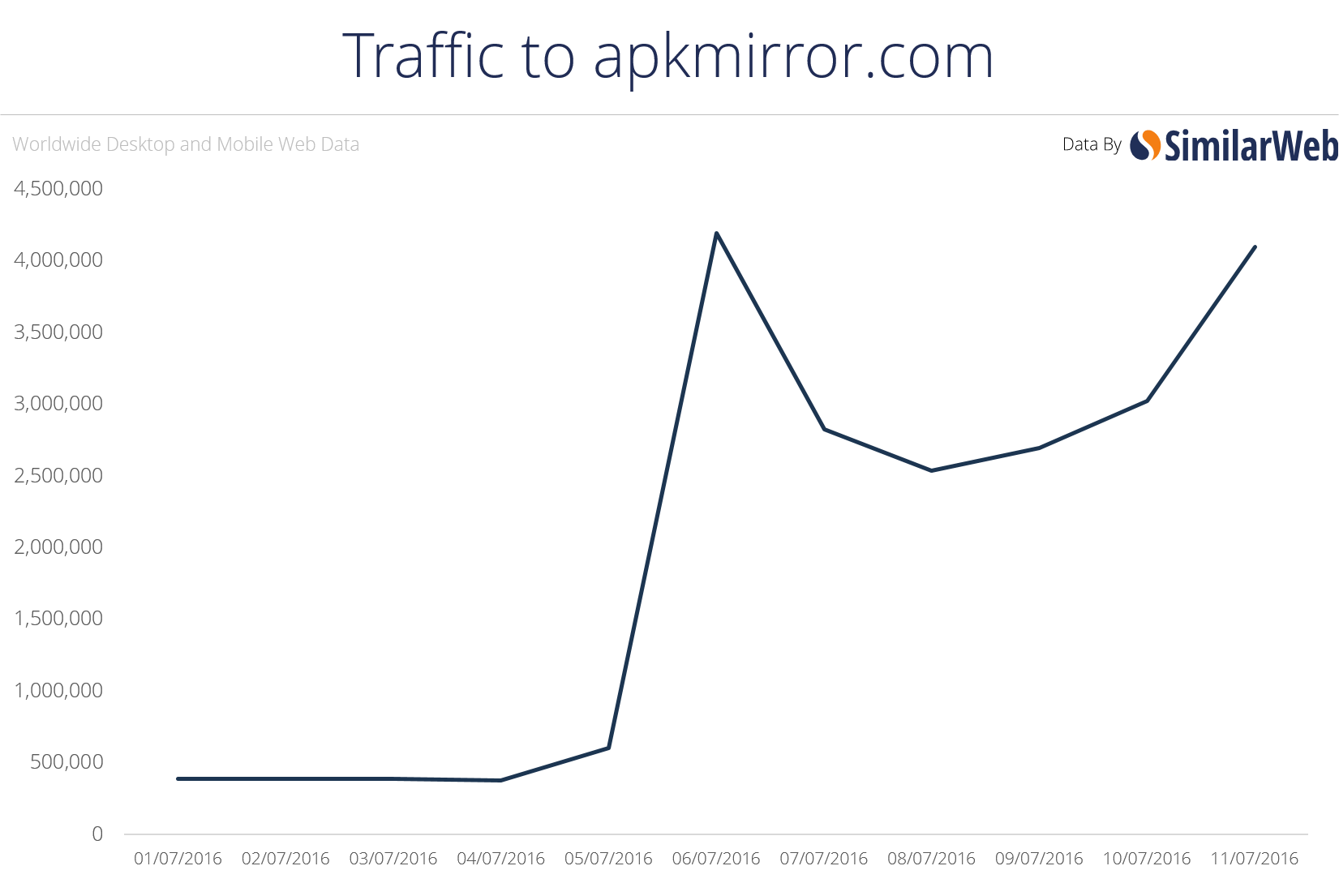
The APK files for Android are shared widely on torrent sites. At The Pirate Bay, for example, it’s the most shared Android game by far. Even more impressive, it also sent millions of extra daily visitors to APKmirror.com, which hosts copies of the game as well.

Most pirated Android games

pokepirate

Nintendo is obviously not happy with this black market distribution. Although it doesn’t seem to hurt its stock value, the company is targeting the piracy issue behind the scenes.

TorrentFreak spotted several takedown requests on behalf of Nintendo that were sent to Google Blogspot and Google Search this week. The notices list various links to pirated copies of the game, asking Google to remove them.

One of the takedown notices

pokedown

Thus far the efforts have done little to stop the distribution. The files are still widely shared on torrent sites and various direct download services. The copies on APKmirror.com remain online as well.

In fact, it’s virtually impossible to stop a game that’s gone viral from being shared online. Even if it issues thousands of takedown requests, Nintendo won’t be able to catch ’em all.

Nintendo probably has good reasons to roll Pokémon Go out gradually, but the best anti-piracy strategy is obviously to make the game available worldwide as quickly as possible.

Source: TF, for the latest info on copyright, file-sharing, torrent sites and ANONYMOUS VPN services.

Expanding Pirate Site Blocks Spark Censorship Fears

A Norwegian court has ordered ISPs to block subscriber access to eight pirate streaming sites, including WatchSeries, TUBE+, and CouchTuner. The new blockades are welcomed by Hollywood’s major studios, but the local Pirate Party fears a slippery blocking-slope leading to overbroad censorship.

Source: TF, for the latest info on copyright, file-sharing, torrent sites and ANONYMOUS VPN services.

blocked-censorLast year Norway joined the ranks of countries where ISPs are ordered to block access to websites on the behest of entertainment industry companies.
In a case started by the Motion Picture Association (MPA), a local court ordered Internet providers to block users’ access to several large ‘pirate’ websites to deter online copyright infringement.

As is often the case with these type of blockades, the Hollywood movie studios didn’t stop at one attempt. They recently went back to court asking for an expansion that would target eight “pirate” streaming sites.

The court granted this request, and as a result WatchSeries, Putlocker, TUBE+, CouchTuner, Watch32, SolarMovie, ProjectFreeTV and Watch Free were added to the national blocklist.

Rune Ljøstad, Partner at the MPA’s lawfirm Simonsen Vogt Wiig, is happy with the outcome which paves the way for similar blocking expansions in the future.

“Together, the decisions create a clear legal basis in Norway to block sites that make copyrighted works available to the public without permission,” Ljøstad says.

While Hollywood is understandably happy, the blocking efforts raise concerns as well. The local Pirate Party, which protested the initial blocks by launching a censorship free DNS server, fears a slippery blocking-slope that may lead to overbroad censorship.

“I’m afraid that blocking sites will have a domino effect,” says Tale Haukbjørk Østrådal, leader of the Norwegian Pirate Party.

“If we block copyright infringement now, what will be the next thing our society accepts to block? The path from blocking torrent sites to censorship is short, and I do not wish to go down that path,” she adds.

The Pirate Party sees blocking as a threat to democracy, as it’s a tool to filter and manipulate what information people can see.

“Censorship is toxic to a democracy. We need to keep the Internet free of censorship, because we need the Internet as a tool to make informed choices. A democracy is failing without informed citizens,” Østrådal notes.

There are alternatives to blocking, according to the Pirate’s leader. The entertainment industries should rethink their business models to compete with piracy, instead of trying to hide it.

“To find the best alternatives the entertainment industry must know why people are sharing, and change their business models. The question isn’t ‘How do we make people pay?’, it is ‘How do we let people pay and feel comfortable with our business model?'”

This means offering more content for a good price, without limitations or artificial boundaries. At the same time artists should use the Internet to connect with fans directly, cutting out the middle-man who profits from their work.

“Personally, I would love to tear down the whole entertainment industry and built it anew. The distributors were never the good guys. They have built an empire by making money from other people’s art,” Østrådal says.

“When we hear the word ‘artist’, we all think of a creative, poor person. It’s fucked up,” she adds.

The Pirate Party’s fears won’t stop Internet providers from complying with the most recent court order.

This means that the streaming sites in question are now a no-go zone. Whether the movie studios have concrete plans to expand the blocking efforts even further is unknown.

Source: TF, for the latest info on copyright, file-sharing, torrent sites and ANONYMOUS VPN services.

Google: Punishing Pirate Sites in Search Results Works

Google released an updated overview of its anti-piracy efforts today. The company notes that many pirate sites have lost the vast majority of their search traffic due to its downranking efforts. However, Google stresses that it won’t remove entire domain names from its search results, as this could lead to overbroad censorship.

Source: TF, for the latest info on copyright, file-sharing, torrent sites and ANONYMOUS VPN services.

googlefightspiracyOver the past few years the entertainment industries have repeatedly asked Google to step up its game when it comes to its anti-piracy efforts.

These calls haven’t fallen on deaf ears and Google has slowly implemented various new anti-piracy measures in response.

Today, Google released an updated version of its “How Google Fights Piracy” report. The company provides an overview of all the efforts it makes to combat piracy while countering some of the entertainment industry complaints.

One of the steps Google has taken in recent years aims to downrank the most egregious “pirate” sites.

To accomplish this, Google made changes to its core algorithms which punish clear offenders. Using the number of accurate DMCA requests as an indicator, these sites are now demoted in search results for certain key phrases.

Despite continuing critique from rightsholders, Google notes that this change has been very effective.

“This process has proven extremely effective. Immediately upon launching improvements to our demotion signal in 2014, one major torrent site acknowledged traffic from search engines had dropped by 50% within the first week,” Google writes, citing one of our articles.

More recently, Google’s own findings confirmed this trend. As a result of the demotion policy, pirate sites lose the vast majority of their Google Search traffic.

“In May 2016, we found that demoted sites lost an average of 89% of their traffic from Google Search. These successes spur us to continue improving and refining the DMCA demotion signal.”

Despite this success, entertainment industry groups have recently called for a more rigorous response. Ideally, they would like Google to remove the results from pirate sites entirely, and make sure that infringing links don’t reappear under a different URL.

However, Google doesn’t want to go this far. The company warns that removing entire sites is dangerous as it may lead to censorship of content that’s perfectly legal.

“Whole-site removal is ineffective and can easily result in the censorship of lawful material,” Google writes.

“Blogging sites, for example, contain millions of pages from hundreds of thousands of users, as do social networking sites, e-commerce sites, and cloud computing services. All can inadvertently contain material that is infringing.”

Similarly, Google doesn’t believe in a “takedown and staydown” approach, where the company would proactively filter search results for pirated content. This would be unfeasible and unnecessary, the company states.

“One problem is that there is no way to know whether something identified as infringing in one place and at one time is also unlawful when it appears at a different place and at a different time,” Google notes.

Instead, the company says that copyright holders should use the existing takedown procedure, and target new sites when they appear so these can be downranked as well.

Finally, Google stresses that search is not a major driver of traffic to pirate sites to begin with. Only a small fraction of users reach these sites through search engines.

While the company is willing to help alleviate the problem, search engines are not the only way to eradicate piracy.

“Search engines do not control what content is on the Web. There are more than 60 trillion web addresses on the internet, and there will always be new sites dedicated to making copyrighted works available as long as there is money to be made doing so.”

Instead of focusing on search, copyright holders should take a “follow the money” approach and make sure that pirate sites are cut off from their revenue sources, Google argues.

In addition, they shouldn’t forget to offer consumers plenty of legal alternatives to piracy.

Convincing the entertainment industries of its good intentions is easier said than done though. “This report looks a lot like “greenwash”,” says Geoff Taylor, Chief Executive of the music industry group BPI.

“Although we welcome the measures Google has taken so far, it is still one of the key enablers of piracy on the planet. Google has the resources and the tech expertise to do much more to get rid of the illegal content on its services,” he adds.

Source: TF, for the latest info on copyright, file-sharing, torrent sites and ANONYMOUS VPN services.

Sky Wins ‘Pirate’ Domain Name Dispute, Forgets to Take it Down

British broadcasting giant Sky has won a WIPO domain name dispute against a pirate site that was streaming their content without permission. WIPO’s arbitration commission handed over the skysportslive.tv domain to Sky a few weeks ago. However, even under Sky’s ownership it still links to pirated streams.

Source: TF, for the latest info on copyright, file-sharing, torrent sites and ANONYMOUS VPN services.

skylogoPirate sports streaming sites are a thorn in the side of Sky, the UK’s largest pay TV provider.

While it’s an impossible task to shut down these sites all at once, the company recently decided to take action against one that uses the Sky brand to advertise itself.

The site in question, Skysportslive.tv, has been online for several years offering free access to various sporting channels.

Earlier this year Sky ran out of patience. The company filed a complaint against the domain name owner at the World International Property Organization (WIPO), which has an arbitration panel to resolve domain name disputes.

In the complaint, Sky argued that the domain uses their trademark without permission, that the owner had no legitimate interest in the domain, and that the domain was registered in bad faith.

After a careful review, WIPO panelist Evan Brown sided with Sky. The domain name owner, a Pakistan resident, failed to respond but according to Brown there is no indication that the site is destined for legal purposes.

“Respondent is not using and has not used, or made demonstrable preparations to use, the disputed domain name in connection with a bona fide offering of goods or services,” the panelist writes.

Instead, it is apparent that the use of the Sky trademark is intended to confuse visitors into believing that the site is legitimate.

“In this case, it is clear that the purpose of registering the disputed domain name was primarily to rely on the value of the Mark in order to confuse Internet users,” the decision ads.

All in all a good outcome for Sky, which gained control over the domain name several weeks ago as the WHOIS entry clearly shows.

Sky now owns Skysportslive.tv

skydomain

However, the company appears to have missed the most crucial part of the arbitration process. That is, updating the domain’s old nameservers after it won.

This means that today, even after several weeks have passed, the now Sky-owned domain is still pointing people to pirated streams.

Those who access the domain are forwarded to crichd.in, another pirate streaming site. Crichd.in uses pretty much the same layout as the original site and is operated by the same people.

Question is, can this sports streaming portal still be characterized as a pirate site if Sky is linking to it?

Sky’s domain, linking to Crichd.in

crichd

Source: TF, for the latest info on copyright, file-sharing, torrent sites and ANONYMOUS VPN services.

BTDigg Shut Down Due to Torrent Spam, For Now

Popular torrent search engine BTDigg is showing signs of life after weeks of downtime. The site, which discovers new files through BitTorrent’s Distributed Hash Table (DHT), blames spam torrents for the sudden shutdown. The site’s operators will consider a comeback if they can find a way to deal with the issue effectively.

Source: TF, for the latest info on copyright, file-sharing, torrent sites and ANONYMOUS VPN services.

btdigglogoFive years ago a new kind of torrent indexing site appeared online.
Where most other sites rely on user uploads or pull their torrents from other sites, BTDigg took a different approach by using DHT to find new content.

Since then the site has become a regular destination for many people. With millions of pageviews per month, BTDigg listed itself among the larger torrent sites on the web.

Despite being blocked by court order in the UK, the site hasn’t faced any significant setbacks. However, a few weeks ago this suddenly changed as the site became unreachable for unknown reasons.

With a lack of updates on social media, the prolonged downtime was a mystery. TorrentFreak contacted the site’s operators on several occasions but didn’t hear back, until a few hours ago.

In a brief statement the BTDigg team says that the site will remain shut down for the time being. However, the downtime might not last forever.

“We closed the site temporarily, but it’s not hard to return,” BTDigg’s operators informs us.

A continued flood of spam torrents is the main reason for the sudden disappearance according to the team. They hope to resolve this with an ‘artificial intelligence’ that effectively filters out the problematic content, after which they plan to return.

“The main problem is ‘spam’ torrents. When we finish creating an AI that filters spam, we’ll reopen the site,” BTDigg says.

btdigg2

This pending return is positive news for BTDigg users. However, with no concrete ETA for the comeback they will have to find their daily torrent fix elsewhere for the time being.

Also, while a full return is an option, there’s also a chance that the site will move on under new management.

BTDigg’s team informed TorrentFreak that they are considering selling the site’s source code and a year of support to a third party. What that means for the site’s future has yet to be seen.

Source: TF, for the latest info on copyright, file-sharing, torrent sites and ANONYMOUS VPN services.

Top 10 Most Pirated Movies of The Week – 07/11/16

The top 10 most downloaded movies on BitTorrent are in again. ‘Warcraft’ tops the chart this week, followed by ‘Batman v Superman: Dawn of Justice’. ‘Me Before You’ completes the top three.

Source: TF, for the latest info on copyright, file-sharing, torrent sites and ANONYMOUS VPN services.

warcraftsThis week we have three newcomers in our chart.

Warcraft, which came out as a subbed HDrip this week, is the most downloaded movie.

The data for our weekly download chart is estimated by TorrentFreak, and is for informational and educational reference only. All the movies in the list are Web-DL/Webrip/HDRip/BDrip/DVDrip unless stated otherwise.

RSS feed for the weekly movie download chart.

Ranking (last week) Movie IMDb Rating / Trailer
torrentfreak.com
1 (4) Warcraft (subbed HDRip) 7.7 / trailer
2 (1) Batman v Superman: Dawn of Justice 7.0 / trailer
3 (6) Me Before You (Subbed Webrip) 7.7 / trailer
4 (2) Independence Day: Resurgence (HDTS) 5.6 / trailer
5 (…) The Legend of Tarzan (HDTS) 6.9 / trailer
6 (…) The Nice Guys (Subbed HDRip) 7.8 / trailer
7 (3) Finding Dory (HDTS) 8.1 / trailer
8 (5) Central Intelligence 6.9 / trailer
9 (7) X-Men: Apocalypse (HDCam/TC) 7.7 / trailer
10 (…) Barbershop: The Next Cut 6.0 / trailer

Source: TF, for the latest info on copyright, file-sharing, torrent sites and ANONYMOUS VPN services.

NBC Universal Scores Patent to Detect and Target Pirates

NBC Universal has patented a new technology that can detect high volume file-sharing swarms, including those using BitTorrent. The system is set up to detect popular pirated files and gathers data that can be used for anti-piracy purposes, business intelligence, and to help ISPs relieve strain on their networks.

Source: TF, for the latest info on copyright, file-sharing, torrent sites and ANONYMOUS VPN services.

nbcuniDespite the growing availability of legal services, unauthorized file-sharing remains one of the core threats for entertainment industry companies.

Over the past several years various anti-piracy tools have been deployed. Nonetheless, piracy is still very much alive today with hundreds of millions of people sharing infringing files every month.

While there’s no silver bullet to stop all piracy indefinitely, NBC Universal scored a new patent this month which it believes may help.

Titled “Early Detection of High Volume Peer-To-Peer swarms,” one of the patent’s main goals is to detect and target instances of online piracy before the problem spreads.

The patent (pdf) describes P2P in general as something that can be positive, but is often abused.

“While the P2P infrastructure has many advantages, it also has led to abuses. Piracy of digital assets on peer-to-peer networks incurs losses by content owners estimated in billions of dollars annually.”

The high volume traffic generated by BitTorrent pirates also poses a problem for ISPs. Pirates tend to strain the network, the patent explains, which can become costly in terms of resources.

To address these issues NBC Universal proposes to monitor file-sharing swarms. Once a swarm exceeds a threshold of a certain number of users, alarm bells will ring so appropriate action can be taken.

patuni

The patent summarizes the invention as “a system that provides for early identification of high risk swarms to enable a more proactive stance towards anti-piracy efforts.”

“The early detection provides for enhanced anti-piracy efforts, improved allocation of network resources, and better business decision-making,” it adds.

For example, the swarm data can be used to provide real-time business intelligence, to be utilized for business advantages. In addition, the anti-piracy efforts can include takedown messages to ISPs, which are already quite common today.

Most controversial is the suggestion to use swarm data to limit or block file-sharing traffic. According to the patent, this may be useful for ISPs to save costs.

“Alternatively, the network provider may proceed to diminish or cap network resources once some limit of data activity is met. In certain aspects the processing for the high risk swarms also indicate the high volume swarms and allows for traffic shaping for the ISPs.”

While Net Neutrality advocates are not going to be pleased with such an implementation, technically the current FCC rules allow ISPs to block file-sharing traffic as long as it’s “unlawful”.

Still, it’s doubtful that NBC Universal’s parent company Comcast will tread down this path anytime soon. The company previously faced significant pushback when it actively throttled BitTorrent traffic.

While there are some interesting suggestions and ideas in the patent, we have to admit that it feels a bit dated.

Perhaps that’s not a surprise since the application was submitted eight years ago. At the time, piracy monitoring technologies were relatively rare. Nowadays, however, it’s a multi-million dollar industry with dozens of companies.

Source: TF, for the latest info on copyright, file-sharing, torrent sites and ANONYMOUS VPN services.

Sony Pictures Tries to Censor Wikileaks With Dubious DMCA Notice

Daniel Yankelevits, one of the top legal executives at Sony Pictures Entertainment, has asked Google to remove a leaked email published by Wikileaks after the 2014 hack. The top executive used a copyright takedown notice to bury an email which exposes his personal salary, claiming “it’s not right.”

Source: TF, for the latest info on copyright, file-sharing, torrent sites and ANONYMOUS VPN services.

wikileaksLast year Wikileaks published a searchable database of the emails and documents that were exposed following the Sony Pictures Entertainment hack.

Journalists had already picked out the most juicy details during the months before, but Wikileaks opened it up to the public.

This also allowed search engines such as Google to index all leaked emails, which made them even more widely accessible.

At Sony they were not happy with the exposé and one of the company’s top executives recently decided to take action.

A few days ago Daniel Yankelevits, Senior Vice President Legal Affairs at Sony Pictures, sent a DMCA takedown request to Google asking the search engine to censor Wikileaks’ archive of the hacked emails.

Interestingly, this request appears to be personally motivated, as the only email highlighted is about Mr. Yankelevits himself.

Google search for Daniel Yankelevits

wikisalary

In the email, the human resources department informs the company’s chief counsel Leah Weil that Yankelevits’ salary will increase from $320,000 to $330,000, as his contract allows.

“Daniel’s contract provides for a discretionary annual increase on 3/1 and compensation has come back with a recommendation of 3.1% taking him from $320,000 to $330,000,” the email reads, asking Weil if she approves.

Sony Pictures’ VP of Legal Affairs is not happy that his salary details are now out in the open. Not least because it appears at the top of Google’s search results for his name.


goodan

While the desire to have this email scrubbed from the Internet is easily understood, using a copyright claim to achieve this is questionable.

First of all, the reason for the takedown request is that “it’s not right,” which is a rather meager motivation for the Senior Vice President Legal Affairs of such a large company.

“My salary is in Google due to Sony Hack wikileaks.org/sony/emails/emailid/103755 please remove the above on your results page. It’s not right,” it reads.

Secondly, the DMCA notice itself is inaccurate and incomplete.

Technically, the takedown request asks Google to remove the homepage of the leaked email archive, claiming that the email published by Wikileaks is the original content. In other words, even if Google did comply the email discussing the salary would remain online.

What raises the most eyebrows, however, is that the request is personally motivated and has very little to do with copyright. Yankelevits is neither the sender nor the recipient of the email, so even if copyright was an issue, the fact that his salary was exposed is totally irrelevant.

While Sony Pictures Entertainment is listed as the “copyright holder” in the DMCA notice, it’s unknown whether the company is aware of the takedown attempt.

Ironically, the takedown request is only destined to make matters worse for the Sony Pictures’ legal executive. Google has refused to remove the email, so instead of covering it up, Yankelevits has put a big spotlight on his salary. A classic example of the Streisand Effect.

Source: TF, for the latest info on copyright, file-sharing, torrent sites and ANONYMOUS VPN services.