isoHunt Founder Settles with Music Industry for $66 Million

After a decade of lawsuits, the iconic torrent site IsoHunt has settled its last remaining legal dispute. Gary Fung, the Canadian founder of the defunct search engine, has agreed to pay a $66 million settlement to the local music industry group and is glad he can move on with his life.

Source: TF, for the latest info on copyright, file-sharing, torrent sites and ANONYMOUS VPN services.

isohunt-fredomAfter years of legal battles, isoHunt and its founder Gary Fung are free at last.

Today, Fung announced that he has settled the last remaining lawsuit with Music Canada, formerly known as the Canadian Recording Industry Association (CRIA).

“After 10 long years, I’m happy to announce the end of isoHunt’s and my lawsuits,” Fung says, noting that he now owes the Canadian music group $66 million.

The multi-million dollar agreement follows an earlier settlement with the MPAA, for $110 million, on paper. While most site owners would be devastated, Fung has long moved beyond that phase and responds rather sarcastically.

“And I want to congratulate both Hollywood and CRIA on their victories, in letting me off with fines of $110m and $66m, respectively. Thank you!” he notes, adding that he’s “free at last”.

The consent order (pdf) signed by the Supreme Court of British Columbia prohibits isoHunt’s founder from operating any file-sharing site in the future.

It further requires Fung to pay damages of $55 million and another $10 million in aggravated punitive damages. The final million dollars is issued to cover the costs of the lawsuit.

Although isoHunt shut down 2013, it took more than two years for the last case to be finalized. The dispute initially began in the last decennium, when the Canadian music industry went after several prominent torrent sites.

In May 2008, isoHunt received a Cease and Desist letter from the CRIA in which they demanded that isoHunt founder Gary Fung should take the site offline. If Fung didn’t comply, the CRIA said it would pursue legal action, and demand $20,000 for each sound recording the site has infringed.

A similar tactic worked against Demonoid, but the isoHunt founder didn’t back down so easily. Instead, he himself filed a lawsuit against the CRIA asking the court to declare the site legal.

That didn’t work out as isoHunt’s founder had planned, and several years later the tables have been turned entirely, with the defeat now becoming final.

While the outcome won’t change anything about isoHunt’s demise, Fung is proud that he was always able to shield its users from the various copyright groups attacking it. No identifiable user data was shared at any point.

Fung is also happy for the support the site’s users have given him over the years.

“I can proudly conclude that I’ve kept my word regarding users’ privacy above. To isoHunt’s avid users, it’s worth repeating since I shutdown isoHunt in 2013, that you have my sincerest thanks for your continued support,” Fung notes.

“Me and my staff could not have done it for more than 10 years without you, and that’s an eternity in internet time. It was an interesting and challenging journey for me to say the least, and the most profound business learning experience I could not expect.”

The Canadian entrepreneur can now close the isoHunt book for good and move on to new ventures. One of the projects he just announced is a mobile search tool called “App to Automate Googling” AAG for which he invites alpha testers.

The original isoHunt site now redirects to MPAA’s “legal” search engine WhereToWatch. However, the name and design lives on via the clone site IsoHunt.to, which still draws millions of visitors per month – frustrating for the MPAA and Music Canada.

Source: TF, for the latest info on copyright, file-sharing, torrent sites and ANONYMOUS VPN services.

KickassTorrents Mirrors and Imposters Spring into Action

It has been just over a day since KickassTorrents (KAT) was shut down by the U.S. Government, following the arrest of the site’s alleged owner. While the official site is still offline mirrors and copies are being launched left and right, with some misleadingly claiming to be an “official” resurrection of KAT.

Source: TF, for the latest info on copyright, file-sharing, torrent sites and ANONYMOUS VPN services.

With an active community and millions of regular visitors, KickassTorrents has been the most used torrent site for quite some time.

This ended abruptly earlier this week, following the arrest of its alleged founder in Poland. A criminal complaint from the U.S. Government revealed that entire operation had been compromised by the Department of Homeland Security.

Starting a few hours ago, the first Kickass domain was signed over to the U.S. authorities. Others are expected to follow during the days to come.

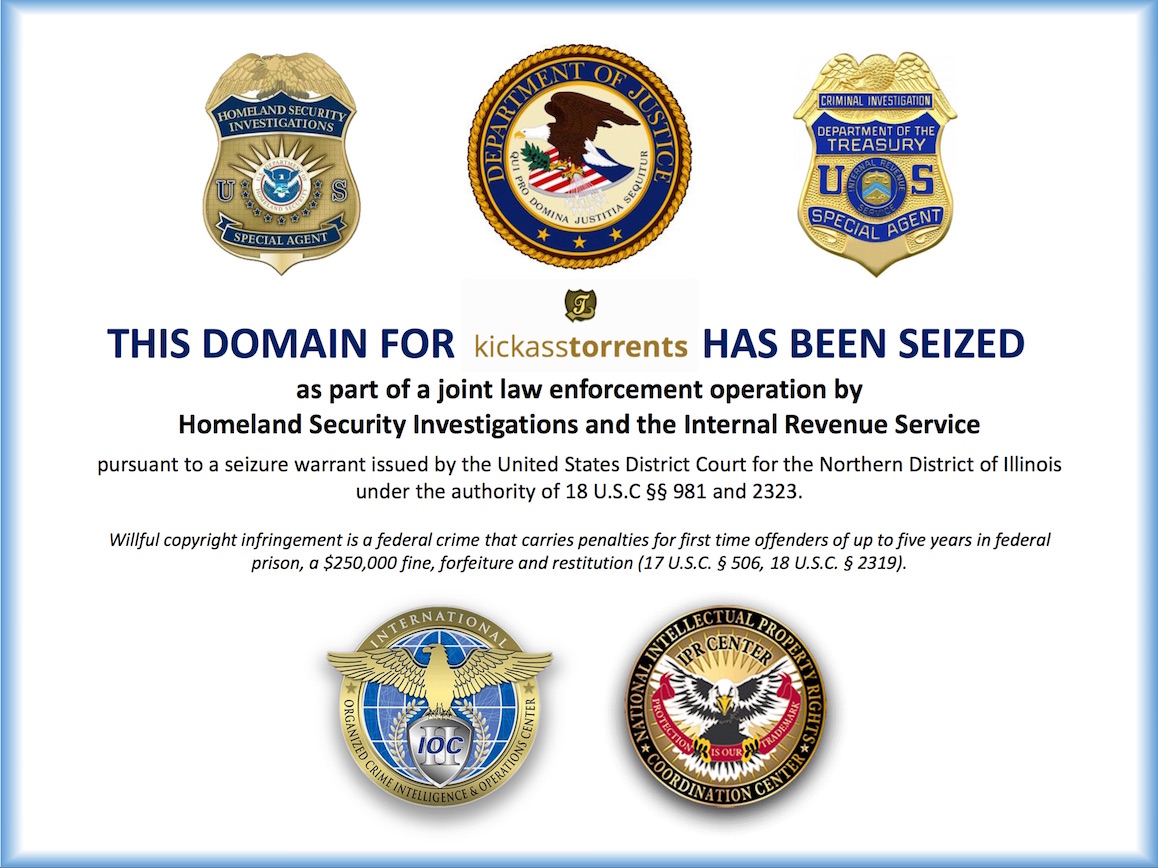
Kickass.to now displays a seizure notice, which means that the associated domain registry was quick to respond to the U.S. warrant. People who visit the Kickass.to address today will see the following banner, specifically tailored for KAT.

KAT’s seizure banner

psh_fullsize_distr

As expected, the U.S. authorities are not the only ones to ‘lift’ KAT’s logo, many others are doing the same, but for a different reason.

Shortly after KAT went offline dozens of people began promoting mirrors and copies of the site. Some are just trying to keep lost files accessible, but there’s also a group trying to take over the brand, similar to the efforts seen following YIFY’s demise.

For example, the operator of Kickass.la sent an email to several reporters promoting a new KAT address. In a follow-up, we were told that the site is an “official backup,” and that a copy of the database is in their possession.

However, the site appears to be little more than a partial copy and the person behind it later admitted that they are not related to KAT.

Only adding to the confusion are the many other copies and alternatives claiming to be the official resurrection of KAT. Some even advertise themselves as such, but most have been available for a longer time as proxy/mirror sites.

Kickasstorrents.to, for example, has been around for a long time, hosting cached pages of the original site. The latter is also true for others, such as Dxtorrent.com. But in any case, there is no true backup with freshly added content available.

Another mirror that has been widely discussed is kickasstorrents.website.

Unlike others, the people behind this site are very clear about the fact that they are not related to the original KAT team. Their copy currently lists torrent files from the past one and a half years, but like other mirrors it doesn’t have a working forum or upload functionality.

“It’s not perfect but if users need to save and archive something it’s time. We don’t know how long it can last, but at least it’s something,” the site’s operator told TorrentFreak.

The people behind the site, who describe themselves as a group of individuals who stand for freedom of the Internet, also launched a petition on Change.org calling for the release of KAT’s alleged owner Artem Vaulin.

“We are protesting against violent attack on our right to share information and arrest of Kat.cr founder Artem Vaulin. Our freedom to share is the human right which Artem Vaulin has been providing to millions of users from all over the world,” they say.

While a notable effort, the banner promoting the cause appears to show a photo of an entirely different Artem Vaulin. The image was removed from the petition after we pointed this out, but it’s still present in the manifesto at the time of writing and being shared in news articles and on social media.

What is clear is that former KAT users are grasping at straws to get their old community back. While mirrors and copies do look like their old home, without a working forum and new content they don’t provide much of an alternative.

For now, people are probably better off not trusting any “KAT resurrection” claims. The chance of getting your password stolen is higher than finding a site with a true backup of the user database.

Source: TF, for the latest info on copyright, file-sharing, torrent sites and ANONYMOUS VPN services.

Can KickassTorrents Make a Comeback?

Yesterday the U.S. Government delivered a massive blow to KickassTorrents. With its alleged founder arrested and pretty much the entire site’s operation compromised, it’s not obvious that there will be a Pirate Bay style comeback anytime soon.

Source: TF, for the latest info on copyright, file-sharing, torrent sites and ANONYMOUS VPN services.

kickasstorrents_500x500Founded in 2009, KickassTorrents (KAT) grew out to become the largest torrent site on the Internet with millions of visitors a day.

As a result, copyright holders and law enforcement have taken aim at the site in recent years. This resulted in several ISP blockades around the world, but yesterday the big hit came when the site’s alleged founder was arrested in Poland.

Soon after the news was made public KAT disappeared, leaving its users without their favorite site. The question that’s on many people’s minds right now is whether the site will make a Pirate Bay-style comeback.

While it’s impossible to answer this question with certainty, the odds can be more carefully weighed by taking a closer look at the events that led up to the bust and what may follow.

First off, KickassTorrents is now down across all the site’s official domain names. This downtime seems to be voluntary in part, as the authorities haven’t seized the servers. Also, several domains are still in the hands of the KAT-team.

That said, the criminal complaint filed in the U.S. District Court in Chicago does reveal that KAT has been heavily compromised (pdf).

According to the feds, Artem Vaulin, a 30-year-old from Ukraine, is the key player behind the site. Over the years, he obfuscated his connections to the site, but several security holes eventually revealed his identity.

With help from several companies in the United States and abroad, Homeland Security Investigations (HSI) agent Jared Der-Yeghiayan identifies the Ukrainian as the driving force behind the site.

The oldest traces to Vaulin are the WHOIS records for various domains, registered in his name early 2009.

“A review of historical Whois information for KAT….identified that it was registered on or about January 19, 2009, to Artem Vaulin with an address located in Kharkiv, Ukraine,” the affidavit reads.

This matches with records obtained from domain registrar GoDaddy, which indicate that Vaulin purchased three KAT-related domain names around the same time.

The agent further uncovered that the alleged KAT founder used an email address with the nickname “tirm.” The same name was listed as KAT’s “owner” on the site’s “People” page in the early days, but was eventually removed in 2011.

Tirm on KAT’s people page

KATpeople

The HSI agent also looked at several messages posted on KAT, which suggest that “tirm” was actively involved in operating the site.

“As part of this investigation, I also reviewed historical messages posted by tirm, KAT’s purported ‘Owner.’ These postings and others indicate that tirm was actively engaged in the early running of KAT in addition to being listed as an administrator and the website’s owner,” the HSI agent writes.

Assisted by Apple and Facebook the feds were then able to strengthen the link between Vaulin, tirm, and his involvement in the site.

Facebook, for example, handed over IP-address logs from the KAT fanpage. With help from Apple, the investigator was then able to cross-reference this with an IP-address Vaulin used for an iTunes transaction.

“Records provided by Apple showed that tirm@me.com conducted an iTunes transaction using IP Address 109.86.226.203 on or about July 31, 2015. The same IP Address was used on the same day to login into the KAT Facebook Account.”

In addition, Apple appears to have handed over private email conversations which reference KAT, dating back several years. These emails also mention a “kickasstorrent payment,” which is believed to be revenue related.

“I identified a number of emails in the tirm@me.com account relating to Vaulin’s operation of KAT. In particular, between on or about June 8, 2010, and on or about September 3, 2010,” the HSI agent writes.

More recent records show that an IP-address linked to KAT’s Facebook page was also used to access Vaulin’s Coinbase account, suggesting that the Bitcoin wallet also assisted in the investigation.

“Notably, IP address 78.108.178.77 accessed the KAT Facebook Account about a dozen times in September and October 2015. This same IP Address was used to login to Vaulin’s Coinbase account 47 times between on or about January 28, 2014, through on or about November 13, 2014.”

As for the business side, the complaint mentions a variety of ad payments, suggesting that KAT made over a dozen million dollars in revenue per year.

It also identifies the company Cryptoneat as KAT’s front. The Cryptoneat.com domain was registered by Vaulin and LinkedIn lists several employees of the company who were involved in the early development of the site.

“Many of the employees found on LinkedIn who present themselves as working for Cryptoneat are the same employees who received assignments from Vaulin in the KAT alert emails,” the complaint reads.

Interestingly, none of the other employees are identified or charged.

To gather further information on the money side, the feds also orchestrated an undercover operation where they posed as an advertiser. This revealed details of several bank accounts, with one receiving over $28 million in just eight months.

“Those records reflect that the Subject Account received a total of approximately €28,411,357 in deposits between on or about August 28, 2015, and on or about March 10, 2016.”

Bank account

bankkat

Finally, and crucially, the investigators issued a warrant directed at the Canadian webhost of KickassTorrents. This was one of the biggest scores as it provided them with full copies of KAT’s hard drives, including the email server.

“I observed […] that they were all running the same Linux Gentoo operating system, and that they contained files with user information, SSH access logs, and other information, including a file titled ‘passwd’ located in the ‘etc’ directory,” the HSI agent writes.

“I also located numerous files associated with KAT, including directories and logs associated to their name servers, emails and other files,” he adds.

Considering all the information U.S. law enforcement has in its possession, it’s doubtful that KAT will resume its old operation anytime soon.

Technically it won’t be hard to orchestrate a Pirate Bay-style comeback, as there are probably some backups available. However, now that the site has been heavily compromised and an ongoing criminal investigation is underway, it would be a risky endeavor.

Similarly, uploaders and users may also worry about what information the authorities have in their possession. The complaint cites private messages that were sent through KAT, suggesting that the authorities have access to a significant amount of data.

While regular users are unlikely to be targeted, the information may provide useful for future investigations into large-scale uploaders. More clarity on this, the site’s future, and what it means for the torrent ecosystem, is expected to become evident when the dust settles.

Source: TF, for the latest info on copyright, file-sharing, torrent sites and ANONYMOUS VPN services.


Feds Seize KickassTorrents Domains, Arrest Owner

The U.S. Government has arrested the alleged owner of KickassTorrents, the world’s largest torrent site. The 30-year-old Ukrainian was arrested in Poland today and is charged with criminal copyright infringement and money laundering. In addition, a federal court in Chicago has ordered the seizure of several KAT domain names.

Source: TF, for the latest info on copyright, file-sharing, torrent sites and ANONYMOUS VPN services.

kickasstorrents_500x500With millions of unique visitors per day KickassTorrents (KAT) has become the most-used torrent site on the Internet, beating even The Pirate Bay.

Today, however, the site has run into a significant roadblock after U.S. authorities announced the arrest of the site’s alleged owner.

The 30-year-old Artem Vaulin, from Ukraine, was arrested today in Poland from where the United States has requested his extradition.

In a criminal complaint filed in U.S. District Court in Chicago, the owner is charged with conspiracy to commit criminal copyright infringement, conspiracy to commit money laundering, and two counts of criminal copyright infringement.

The court also granted the seizure of a bank account associated with KickassTorrents, as well as several of the site’s domain names.

“Vaulin is charged with running today’s most visited illegal file-sharing website, responsible for unlawfully distributing well over $1 billion of copyrighted materials,” says Assistant Attorney General Caldwell, commenting on the announcement.

“In an effort to evade law enforcement, Vaulin allegedly relied on servers located in countries around the world and moved his domains due to repeated seizures and civil lawsuits. His arrest in Poland, however, demonstrates again that cybercriminals can run, but they cannot hide from justice.”

At the time of writing the main domain name Kat.cr has trouble loading, but various proxies still appear to work. KAT’s status page doesn’t list any issues, but we assume that this will be updated shortly.

TorrentFreak has reached out to the KAT team for a comment on the news and what it means for the site’s future, but we have yet to hear back.

Breaking story, updates will follow.

Source: TF, for the latest info on copyright, file-sharing, torrent sites and ANONYMOUS VPN services.

U.S. Government Sued for Software Piracy, Maker Claims $600m

The U.S. military is being accused of installing ‘pirated’ copies of 3D virtual reality software onto hundreds of thousands of computers without permission. Bitmanagement, the makers of the software, accuse the Navy of willful copyright infringement and are suing the Government for more than half a billion dollars in unpaid licenses.

Source: TF, for the latest info on copyright, file-sharing, torrent sites and ANONYMOUS VPN services.

usnavyIn recent years the U.S. Government has taken an aggressive stance towards copyright infringement, both at home and abroad.

However, that doesn’t mean that the Government always sticks to the rules, quite the contrary. In a recent lawsuit it stands accused of willful copyright infringement on a massive scale.

The case centers around “BS Contact Geo,” a 3D virtual reality application developed by the German company Bitmanagement. The Navy was enthusiastic about the geographical modeling capabilities of the software and in 2011 and 2012 it agreed to license its use for 38 computers.

“Those individual PC-based licenses authorized the Navy to install BS Contact Geo on a total of just 38 computers for the purposes of testing, trial runs, and integration into Navy systems,” the software vendor states in the federal claims court complaint (pdf).

After testing the application for a while, both parties started negotiating the licensing of additional computers. However, before any deals were made, the software maker learned that the Navy had already installed it on over 100,000 computers.

According to emails Bitmanagement executives received in 2013, the software had been rolled onto at least 558,466 computers on the Navy’s network, without their permission.

“Even as it negotiated with Bitmanagement over the proposed large-scale licensing of its product, the Navy was simultaneously copying and installing that software, without Bitmanagement’s advance knowledge or authorization, on a massive scale,” the complaint reads.

In addition, the Navy allegedly disabled the software that is supposed to track on how many computers the software is being used. This violation of the terms of service prevents the software vendor from stopping the unauthorized copying.

“To make matters worse, starting in 2014, the ‘Flexwrap’ software intended to track the Navy’s use and duplication of BS Contact Geo on Navy computers was disabled,” the complaint explains.

This change made it impossible for Bitmanagement to know the scope of the deployment and use of BS Contact Geo on unlicensed machines or to limit that use,” the company adds.

The software vendor says that the willful copyright infringement has caused injury to its business and rights. As a result, they’re now demanding compensation for the damage that was caused, to a total of nearly $600 million.

Installing BS Contact Geo onto a single PC cost roughly $1067 at the time, so Bitmanagement claims that it is entitled to at least $596,308,103 in unpaid licensing fees.

For comparison, that is more than the damages Kim Dotcom and Megaupload have caused copyright holders, according to the United States. And that case was billed by the FBI as one of the “largest criminal copyright cases” in history.

Interestingly this is not the first time that the U.S. military has been “caught” pirating software. A few years ago it was accused of operating unlicensed logistics software, a case the Obama administration eventually settled for $50 million.

Source: TF, for the latest info on copyright, file-sharing, torrent sites and ANONYMOUS VPN services.

Court: Google and Bing Don’t Have to Censor “Torrent” Searches

Google and Bing are not required to automatically filter “torrent” related searches to prevent piracy, the High Court of Paris has decided. The filter, requested by the local music industry group SNEP, would be too broad, ineffective, and target legitimate content as well.

Source: TF, for the latest info on copyright, file-sharing, torrent sites and ANONYMOUS VPN services.

google-bayFor years, entertainment industry groups have been demanding that search engines do something about “pirate sites” showing up in their search results.

In France, this prompted music industry group SNEP to take the matter to court. Representing three local artists, they demanded automated search engine filters from both Google and Microsoft.

Before the High Court of Paris the music group argued that, when paired with the artist names, “torrent” related searches predominantly link to pirated content.

To counter this, they demanded a filter that would block results for these searches for the keyword “torrent,” as well as websites that include the same word in their domain name.

SNEP based its request on Article L336-2 of France’s intellectual property code, which states that “all appropriate measures” are permitted to prevent copyright infringement. The same article has been used before to force Google and Bing to make various other pirate sites disappear.

However, in the present cases the High Court of Paris decided against the music industry group, Nextinpact reports.

In their defense Microsoft had warned that the broad filtering system requested by the music group would be imprecise, disproportionate and inefficient, something the court agreed with.

While French law permits far-reaching anti-piracy measures, it also states that it’s necessary to preserve the rights of individual Internet users, such as freedom of expression and communication. An overbroad filtering scheme would go against this principle.

“SNEP’s requests are general, and pertain not to a specific site but to all websites accessible through the stated methods, without consideration for identifying or even determining the site’s content, on the premise that the term ‘Torrent’ is necessarily associated with infringing content,” the Court writes in its order.

More specifically, the court notes that the word “torrent” has many legitimate uses, as does the BitTorrent protocol, which is a neutral communication technology. This means that blocking everything “torrent” related is likely to censor legal content as well.

“Yet [torrent] is primarily a common noun, with a meaning in French and in English; it also refers to a neutral communication protocol developed by the company Bittorrent that enables access to lawfully downloaded files.

“The requested measures are thus tantamount to general monitoring and may block access to lawful websites,” the High Court order adds.

Part of the Bing order

snepgoo

The case against Google, which was similar in nature, also ended in favor of the search engine. The High Court dismissed this case on the grounds that it would only protect the interests of three artists, Kendji Girac, Shy’m and Christophe Willem.

For Article L336-2 to be invoked, the preventive anti-piracy measures have to protect a wider range of artists and rightsholders.

This means that both “torrent” filtering requests have not been rejected. Instead, the music group has been ordered to pay Microsoft and Bing 10,000 to cover legal fees and costs.

Interestingly, French media highlights that TorrentFreak would have been automatically censored if Google and Microsoft would have lost their case. After all, our URL includes the word torrent.

This means that a mere mention of the artists’ names would have been enough to make an article disappear from the search results.

Source: TF, for the latest info on copyright, file-sharing, torrent sites and ANONYMOUS VPN services.

Accused “Pirate” Questions Dallas Buyers Club’s Copyright Claim

Several companies behind the Oscar-winning movie Dallas Buyers Club are fighting over the movie’s proceeds, as well as the profits from copyright trolling endeavors. This confusing situation has prompted an accused pirate to question the legitimacy of the claim against him, which could get interesting.

Source: TF, for the latest info on copyright, file-sharing, torrent sites and ANONYMOUS VPN services.

dallasMovie studio Voltage Pictures is no stranger to suing BitTorrent users.

The company has filed lawsuits against alleged pirates in the United States, Europe, Canada and Australia, and is estimated to have made a lot of money doing so.

Most of these cases target downloaders of the Oscar-winning movie Dallas Buyers Club. Voltage Pictures is one of the production companies behind the film, but as is common in Hollywood, it’s not the sole rightsholder.

In fact, another company named “Dallas Buyers Club LLC” (DBC) has also filed dozens of cases against pirates. While one might think that both rightsholders are working in tandem, they are in fact fighting over the anti-piracy loot behind the scenes.

In a case DBC and Truth Entertainment filed against Voltage Pictures last year (pdf), the latter is accused of various deceptive practices, including breach of contract and fraud.

The two plaintiffs suggest that Voltage has been holding back money from foreign proceeds. They further state that the production company hasn’t been open about its practices.

Aside from claims that money has gone missing, its anti-piracy methods are also under the spotlight. According to DBC, Voltage hasn’t provided any details on enforcement actions, nor has it shared any of the proceeds from its anti-piracy efforts.

“DBC entered into an Agreement with Voltage to act as its agent to enforce Anti-piracy actions against people who have illegally downloaded or otherwise obtained the ability to watch the movie without paying for the right to watch it,” the filing reads.

“The only updates DBC receives are thorough, mostly negative, media reports about the actions of Voltage around the World. DBC has not received any funds, reports, updates or any information from Voltage on the status numerous lawsuits filed around the World in the name of DBC.”

Where’s the anti-piracy bounty?

voltagedbc

While the paperwork doesn’t explicitly state that both parties agreed to share the anti-piracy bounty, the claims above suggest that this is the case. Most interesting, perhaps, is that it’s unclear whether all enforcement actions are ultimately driven by Voltage.

This confusing situation is casting doubt over the legitimacy of these piracy lawsuits, as FCT highlights. This prompted Nicholas Ranallo, attorney for an accused “pirate”, to ask a California federal court for an extra safeguard.

Ranallo mentions that there is doubt over who owns the movie and he cites the legal battle between Dallas Buyers Club LLC, in whose name his defendant was sued, and Voltage.

“It is unclear what rights (if any) are actually held by Voltage Pictures or the suing entities, though it is abundantly clear that Voltage Pictures controls the litigation and keeps the proceeds collected on behalf of the purported plaintiffs,” Ranallo writes.

The amended complaint against the accused pirate identifies Dallas Buyers Club LLC as the owner, but the original complaint listed Truth LLC as such. Then again, the DVD cover and other material list Voltage as the copyright holder.

“Various advertising and promotional materials cast further doubt about the claims that Dallas Buyers Club LLC owns the relevant copyright(s), and reveal a myriad of entities that have, at one time or another, claimed copyright in the film.”

As a safeguard, Ranallo asks the court to require Dallas Buyers Club to post a $50,000 bond (pdf), to secure costs and attorney fees if the suspicions do indeed hold ground.

While it’s not uncommon for several companies to have a stake in a single movie, it will be interesting to see if this case leads to more clarity over the rights they have to pursue a copyright claim in court.

Source: TF, for the latest info on copyright, file-sharing, torrent sites and ANONYMOUS VPN services.

Top 10 Most Pirated Movies of The Week – 07/18/16

The top 10 most downloaded movies on BitTorrent are in again. ‘Central Intelligence’ tops the chart this week, followed by ‘Warcraft’. ‘The Purge: Election Year’ completes the top three.

Source: TF, for the latest info on copyright, file-sharing, torrent sites and ANONYMOUS VPN services.

centintThis week we have two newcomers in our chart.

Central Intelligence is the most downloaded movie.

The data for our weekly download chart is estimated by TorrentFreak, and is for informational and educational reference only. All the movies in the list are Web-DL/Webrip/HDRip/BDrip/DVDrip unless stated otherwise.

RSS feed for the weekly movie download chart.

Ranking (last week) Movie IMDb Rating / Trailer
torrentfreak.com
1 (8) Central Intelligence 6.9 / trailer
2 (1) Warcraft (subbed HDRip) 7.7 / trailer
3 (…) The Purge: Election Year (subbed HDRip) 6.3 / trailer
4 (5) The Legend of Tarzan (HDTS) 6.9 / trailer
5 (2) Batman v Superman: Dawn of Justice 7.0 / trailer
6 (…) Hardcore Henry 6.9 / trailer
7 (7) Finding Dory (HDTS) 8.1 / trailer
8 (3) Me Before You (Subbed Webrip) 7.7 / trailer
9 (4) Independence Day: Resurgence (HDTS) 5.6 / trailer
10 (9) X-Men: Apocalypse (HDCam/TC) 7.7 / trailer

Source: TF, for the latest info on copyright, file-sharing, torrent sites and ANONYMOUS VPN services.

Google Wipes Record Breaking Half Billion Pirate Links in 2016

Copyright holders asked Google to remove more than 500,000,000 allegedly infringing links from its search engine in 2016 thus far. This nearly equals the number of takedown notices it received for the whole of 2015. Rightsholders see the surge as evidence of a failing system, but Google clearly disagrees.

Source: TF, for the latest info on copyright, file-sharing, torrent sites and ANONYMOUS VPN services.

google-bayCopyright holders continue to overload Google with DMCA takedown requests, targeting “pirate links” in the company’s search results.

In recent years the number of notices has exploded, breaking record after record.

Data analyzed by TorrentFreak reveals that Google recently received its 500 millionth takedown request of 2016.

The counter currently displays more than 523,000,000, which is yet another record. For comparison, last year it took almost the entire year to reach the same milestone.

If the numbers continue to go up at the same rate throughout the year, Google will process a billion allegedly infringing links during the whole of 2016, a staggering number.

According to Google roughly 98% of the reported URLs are indeed removed. This means that half a billion links were stripped from search results this year alone. However, according to copyright holders, this is still not enough.

googlenotices500m

Entertainment industry groups such as the RIAA, BPI and MPAA have pointed out repeatedly that many files simply reappear under new URLs.

“It’s like ‘Groundhog Day’ for takedowns,” RIAA CEO Cary Sherman said previously.

This week Google addressed the issue in its updated “How Google Fights Piracy” report. In it, the company provides an overview of all the efforts it makes to combat piracy while countering some of the entertainment industry complaints.

According to Google, the increase shows that the system is working and the company notes that it takes less than six hours to remove content.

“The growing number of notices sent to Google by an increasing volume of different copyright owners and enforcement agents demonstrates the effectiveness and success of the notice-and-take-
down system.”

“As the internet continues to grow rapidly, and as new technologies make it cheaper and faster for copyright owners and enforcement agents to detect infringements online, we can expect these numbers to continue to increase,” Google adds.

Still, rightsholders are not impressed and continue to demand a tougher stance from Google when it comes to piracy. Shortly after Google released its report this week, BPI CEO Geoff Taylor already dismissed it.

“This report looks a lot like ‘greenwash’. Although we welcome the measures Google has taken so far, it is still one of the key enablers of piracy on the planet,” Taylor said.

By now it has become clear that the entertainment industry groups and Google are not going to reach an agreement anytime soon. The issue has been going on for years now and both sides continue to make the same arguments.

Various industry are now hoping that the Government will intervene at some point. Whether that will happen has yet to be seen but in the meantime, rightsholders will continue to report millions of pirate links per day.

Source: TF, for the latest info on copyright, file-sharing, torrent sites and ANONYMOUS VPN services.

Photographers Take “Pirating” News Outlets to Court

Major news outlets don’t always stick to the rules when it comes to licensing photos for their articles. Photographers often see their work featured by prominent publishers, without credit or compensation. Increasingly, they are standing up for their rights in court. In recent weeks several independent photographers have launched cases targeting Yahoo.com, Verizon.com, MSN.com, MTV.com, Gawker.com and others.

Source: TF, for the latest info on copyright, file-sharing, torrent sites and ANONYMOUS VPN services.

photoWhen it comes to online piracy most attention usually goes out to music, TV-shows and movies. However, photos are arguably the most-infringed works online.


While most photographers spend little time battling piracy, a few are willing to take the matter to federal court.

Recently we’ve seen a trend emerge on this front. A handful of independent photographers have teamed up with attorney Richard Liebowitz in order to demand damages from a variety of publishers, mostly prominent news outlets.

One of the photographers taking a stand is Christopher Sadowski, who noticed his work being featured on Gizmodo.com and Gawker.com. Sadowski sued Gawker media for using his photo of an UBER car in two articles. In neither case he was rewarded or recognized for his work, the complaint alleges.

“Gawker did not license the Photograph from Plaintiff for its articles, nor did Gawker have Plaintiff’s permission or consent to publish the Photograph on its Websites. Upon information and belief, Gawker removed Sadowski’s gutter credit and did not attribute the Photograph to anyone.”

It’s unclear how the photo ended up on Gawker but the complaint states that it was properly licensed to The New York Post earlier. Gawker has yet to respond to the claims and at the time of writing the photo is still online.

The allegedly infringing image on Gizmodo

gizpirate

Sadowski is not alone as several lawsuits have also been filed on behalf of other photographers in recent weeks. For example, photographer John Mantel sued a variety of news publishers including tech companies Verizon, AOL and Microsoft, for using his work without permission in news articles.

Similarly, Steve Sands launched lawsuits against IGN.com (Ziff Davis) and MTV.com, Steven Hirsch sued Heavy.com, Allesandro Masi took Yahoo.com to court and Angel Chevrestt went after CBS. And that’s just a small selection of the ongoing cases.

Sands vs. Ziff Davis

ziff

In all cases, the publishers are accused of copyright infringement and the common theme is that the news outlets use photos in their articles without properly licensing them. Most of the time the photographers in question are not even credited.

None of the accused news outlets have been found liable yet, but it’s very likely that at least some of them are breaking the law. According to the defense attorney, these news outlets are clearly profiting from the work of his clients.

“Copyright infringement is an ongoing issue. Companies are using other people’s hard work and profiting off of it. It is important for photographers and the creative community to unite and stand up for their rights and protect their work,” Liebowitz tells TorrentFreak.

In the complaints the photographers all seek compensation, which could go up to $150,000 in statutory damages per work. It is expected, however, that most will be settled for a lower amount at some stage to avoid expensive litigation.

The costs involved with these cases is also one of the main reasons why photographers typically don’t file lawsuits. Starting a federal case with proper representation is quite costly, while the outcome is rather uncertain.

However, this may change soon. This week, Congressman Hakeem Jeffries introduced a new bill that will give rightsholders a cheaper option to pursue these cases.

The CASE Act, short for Copyright Alternative in Small-Claims Enforcement, proposes a small claims court to resolve copyright disputes outside the federal courts. This means that legal costs will be significantly reduced.

This is not the first time that a small claims court for copyright issues has been proposed but this time the plan has significant backing from Professional Photographers of America, a trade organization with roughly 30,000 members

For now, however, Liebowitz and his client will have to take their cases to federal court. Considering the stream of new complaints being filed, this strategy may still pay off.

Source: TF, for the latest info on copyright, file-sharing, torrent sites and ANONYMOUS VPN services.