TorrentFreak Turns Ten Today

TorrentFreak turned ten years old today, but even after 8,477 articles and nearly a million comments we’re really just getting started. A special thanks goes out to everyone who’s helped to make this such an enjoyable ride so far.

Source: TorrentFreak, for the latest info on copyright, file-sharing, torrent sites and ANONYMOUS VPN services.

tfoldlogoTen years ago I decided to install WordPress to start a blog about the intriguing world of BitTorrent and file-sharing.

Motivated by the lack of news reporting and information on the relatively new technology, TorrentFreak was born on November 12, 2005.

Today, TF is still here and bigger than I could have ever imagined.

I’m not the type of person to write a lengthy essay about how it all came to be, but with this post I would like to thank all the people who helped to get the site were it is right now.

Although the number of visitors has steadily grown over the years the core TF team is still very small. With two main writers and no editorial staff we’re just a tiny operation compared to most other news sites.

Andy joined TF roughly a year after it started and without him the site wouldn’t be where it is today. His passion for news and the ability to spot and break the right stories has played a central role in the site’s evolution.

Long-time contributor Ben also helps to moderate the comments behind the scenes, aided by a handful of dedicated volunteers. And then there’s our server hamster and his loyal keeper, who have managed to keep the site online during the most demanding times.

TF is also grateful to have many reliable sources who are always willing to confirm news, provide comments, or send in leads. We couldn’t have come this far without them.

Finally, thanks to everyone who has helped us in any way, shape or form, especially the readers and all of our dedicated followers. Let’s add another ten years.

Onwards!

Source: TorrentFreak, for the latest info on copyright, file-sharing, torrent sites and ANONYMOUS VPN services.

Blizzard Sues Bot Maker For Copyright Infringement

Blizzard Entertainment is taking a stand against popular cheating bots for World of Warcraft, Diablo 3 and Heroes of the Storm. The game company is suing the creators behind a series of popular bots for copyright infringement and accuses them of ruining the gaming experience for legitimate players.

Source: TorrentFreak, for the latest info on copyright, file-sharing, torrent sites and ANONYMOUS VPN services.

blizzOver the years video game developer and publisher Blizzard Entertainment has released many popular game titles.

However, to the disappointment of the developer and the majority of its customers there exists a small subgroup of players who are happy to deceive their opponents to get an edge in Blizzard’s games. Through hacks and cheats these players are often able to dominate the competition with minimal effort.

In an attempt to stamp out this type of abuse Blizzard has now filed a lawsuit against James Enright (aka “Apoc”), the individual behind a popular series of gaming bots. Enright’s software allows users to cheat in World of Warcraft, Diablo and Heroes of Storm, among others.

In a complaint filed at a California federal court, Blizzard notes that the “HonorBuddy,” “DemonBuddy” and “StormBuddy” bots infringe on its copyrights. In addition, the bots ruin the fun for other players, which causes financial damage to the company.

“The Bots created by Enright and his team have caused, and are continuing to cause, massive harm to Blizzard. Blizzard’s business depends upon its games being enjoyable and balanced for players of all skill levels,” the complaint (pdf) reads.

“The Bots that Enright has programmed and helps distribute destroy the integrity of the Blizzard Games, alienating and frustrating legitimate players, and diverting revenue from Blizzard to Defendants,” they add.

Blizzard believes that the bots cause legitimate players to lose interest, costing the company millions in lost revenue. The bot maker, meanwhile, is generating a significant profit.

“As a result of Enright’s conduct, Blizzard has lost millions or tens of millions of dollars in revenue and in consumer goodwill. Meanwhile, Enright and his team have been massively and unjustly enriched at Blizzard’s expense,” Blizzard adds.

Blizzard believes that Enright may have made millions through the bot sales, which start at €24.98 ($27) for the most basic World of Warcraft version.

The WoW Honorbot

honotbuddy

Aside from breach of contract, by violating the EULA which prohibits the use of bots and cheats, Enright and his team are accused of copyright infringement.

“Defendants have infringed, and are continuing to infringe, Blizzard’s copyrights by reproducing, adapting, distributing, and/or authorizing others to reproduce, adapt, and distribute copyrighted elements of the Blizzard Games without authorization,” Blizzard writes.

Blizzard asks the court to issue an order against the defendants to prevent them from distributing the software. In addition, they demand actual or statutory damages for the alleged copyright infringements, which could add up to tens of millions of dollars.

The company’s claimed losses are supported by research which has shown that WoW bots can create a massive amount of in-game gold, which raises the prices of items for legitimate users. These users may then lose their motivation and stop playing, hurting Blizzard’s revenue.

At the time of writing the Buddy Forum and the associated website remain operational, claiming that “botting is not against any law.”

Source: TorrentFreak, for the latest info on copyright, file-sharing, torrent sites and ANONYMOUS VPN services.

Destroyed Piracy Tracking Code Should End Lawsuit, Cox Says

Internet provider Cox Communications has asked a Virginia federal court to dismiss the copyright infringement lawsuit filed by several music companies last year. The case relies on evidence collected by piracy tracking firm Rightscorp, which Cox says is unusable after the anti-piracy outfit destroyed older versions of its piracy tracking code.

Source: TorrentFreak, for the latest info on copyright, file-sharing, torrent sites and ANONYMOUS VPN services.

rightscorpLast year BMG Rights Management and Round Hill Music sued Cox Communications arguing that the ISP fails to terminate the accounts of subscribers who frequently pirate content.

The companies, which control publishing rights to songs by Katy Perry, The Beatles and David Bowie among others, claim that Cox gave up its DMCA safe harbor protections due to this inaction.

The case revolves around data gathered by Rightscorp and Cox believes that the anti-piracy company is the driving force behind it, in part to retaliate for Cox’s refusal to forward their infringement notices.

Both parties have been preparing for trial but Cox now believes that one isn’t needed. A few weeks ago the court ruled that Rightscorp spoiled evidence by failing to preserve historical versions of its piracy tracking code. As a result, Cox insists that the entire case should now be dropped.

According to the ISP all evidence of direct copyright infringement relies on Rightscorp’s system. Without the option to assess the accuracy of the tracking technology, it’s impossible to review the reliability and accuracy of the accusations.

“Cox cannot analyze, and the jury cannot assess, the operation or accuracy of Rightscorp’s pivotal systems. That is because Rightscorp intentionally destroyed every version of its technological systems that existed prior to July 15, 2015,” the ISP writes in its motion (pdf).

According to Cox’s legal team the copyright holders and Rightscorp’s failure to keep track of the code changes did not occur by accident.

“Despite actively planning this lawsuit for over three years, Plaintiffs and their litigation agent, Rightscorp, knowingly and intentionally failed to preserve the most critical evidence in the case.”

“As a result of that misconduct, as Judge Anderson found, it is literally impossible for Cox or the jury ‘to know how the Rightscorp system operated during the relevant time period’,” Cox adds.

While Magistrate Judge Anderson ruled that Rightscorp did indeed spoil crucial evidence, he referred a decision of specific evidentiary sanctions to District Court Judge O’Grady.

In its motion Cox is clear about what the final decision should be. The ISP sees a dismissal of the entire case as the most fitting outcome. It’s impossible for a jury to review how reliable some of the most crucial evidence is, so the case should be dismissed, Cox argues.

“In these circumstances, the most appropriate sanction is dismissal, particularly given that Judge Anderson’s factual findings effectively defeat Plaintiffs’ claims in
any event. For the many reasons Cox addresses below, this case should end now,” the motion reads.

The motion will be discussed at an upcoming hearing. In a reply, BMG Rights Management and Round Hill Music have already objected to the request, describing it as an untimely motion for summary judgment.

Source: TorrentFreak, for the latest info on copyright, file-sharing, torrent sites and ANONYMOUS VPN services.

MPAA: Online Privacy Hurts Anti-Piracy Enforcement

The MPAA has submitted an overview of international “trade barriers” to the U.S. Government, which they see as harmful to the video and movie industries. Online privacy is listed as a serious problem, as it prevents copyright holders and local authorities from going after online pirates.

Source: TorrentFreak, for the latest info on copyright, file-sharing, torrent sites and ANONYMOUS VPN services.

mpaa-logoEvery year the United States Trade Representative (USTR) inventorizes what problems local industries face when doing business abroad.

The major Hollywood studios, represented by the MPAA, just submitted their latest overview listing trade barriers across the globe.

The MPAA points out that many countries don’t do enough to deter piracy. This is also a common theme in Europe, where privacy laws and regulations make it harder for copyright holders to go after online pirates.

“Privacy has always been a major issue in the European Union. EU Member States have implemented a number of privacy directives to protect individuals’ personal data,” MPAA writes.

According to the MPAA, European privacy rules are extremely complex and difficult. As a result they are often used against efforts that could help to prevent copyright infringement.

For example, IP-addresses are protected as private personal information in several countries including Italy, where they can only be used in criminal cases.

“All EU Member States have detailed data protection laws. These rules, often very strict, are subject to the interpretation of the national data protection authorities,” MPAA notes (pdf).

“Most of them consider IP addresses as personal data and believe that the privacy rules apply to their use,” they add.

The MPAA points out that privacy rights of citizens often trump the rights of copyright holders, which they believe is a “very problematic” development.

As a result, Internet providers often refuse to cooperate with copyright holders claiming that this violates the privacy of their users. This makes it hard for the content industries to cooperate with these companies in various anti-piracy efforts.

“Telecommunications operators and ISPs constantly invoke data protection rules to avoid any meaningful cooperation with the content sector,” MPAA writes.

“Such restrictive interpretations preclude meaningful cooperation with Internet intermediaries, such as telecommunications operators and ISPs, in particular cooperation to combat IP theft.”

In addition, the MPAA is not happy with the EU Court of Justice decision to no longer make data retention mandatory. As a result, many ISPs no longer keep extensive IP-address logs.

The movie studios believe that data retention is an important law enforcement tool, suggesting that it’s harder to track down online pirates without logs.

“Data retention remains a very valuable tool for law enforcement. Rights holders have always claimed the need for reasonable rules and legal certainty. This decision has created even more legal uncertainty in this field.

“Member States have started to respond to the consequences of this decision with legislation and some have invalidated their rules,” MPAA adds.

The data retention argument is not new, but it’s worth noting that the U.S. itself has no mandatory data retention laws. This makes it hard for the U.S. Government to demand that other countries adopt them.

It’s clear though, that the MPAA is not happy with the increased interest in online privacy. With or without help from the U.S. government, they will continue to try and minimize the impact it has on their enforcement efforts.

Source: TorrentFreak, for the latest info on copyright, file-sharing, torrent sites and ANONYMOUS VPN services.

Top 10 Most Pirated Movies of The Week – 11/07/15

The top 10 most downloaded movies on BitTorrent are in again. ‘Ant Man.’ tops the chart this week, followed by ‘The Man from U.N.C.L.E.’ ‘Inside Out’ completes the top three.

Source: TorrentFreak, for the latest info on copyright, file-sharing, torrent sites and ANONYMOUS VPN services.

antmanThis week we have three newcomers in our chart.

Ant Man is the most downloaded movie.

The data for our weekly download chart is estimated by TorrentFreak, and is for informational and educational reference only. All the movies in the list are BD/DVDrips unless stated otherwise.

RSS feed for the weekly movie download chart.

Ranking (last week) Movie IMDb Rating / Trailer
torrentfreak.com
1 (…) Ant-Man (Webrip) 7.7 / trailer
2 (1) The Man from U.N.C.L.E. 7.5 / trailer
3 (2) Inside Out 8.4 / trailer
4 (…) Maze Runner: The Scorch Trials (Subbed HDrip) 6.8 / trailer
5 (4) Everest (Subbed HDRip) 7.3 / trailer
6 (…) The Assassin 6.8 / trailer
7 (5) No Escape 6.9 / trailer
8 (3) Hitman Agent 47 (HDRip) 5.9 / trailer
9 (7) Minions 6.5 / trailer
10 (6) Southpaw 7.6 / trailer

Source: TorrentFreak, for the latest info on copyright, file-sharing, torrent sites and ANONYMOUS VPN services.

Government Owned ISP Runs a Public Torrent Tracker

With the most-used torrent tracker about to fold, the BitTorrent ecosystem is in need of a stable and reliable alternative. Unfortunately, good trackers are hard to find. However, there’s a glimmer of hope as we just spotted one that’s operated by the largest Kazakh ISP, which in turn is owned by the local government.

Source: TorrentFreak, for the latest info on copyright, file-sharing, torrent sites and ANONYMOUS VPN services.

kazThe Internet is littered with torrent indexes and search engines, all offering a wide range of content to their visitors.

For this content to travel from A to B the BitTorrent ecosystem needs reliable trackers. Sadly, good public torrent trackers are a rarity these days.

Earlier this year OpenBitTorrent and PublicBitTorrent disappeared for good, and the same is about to happen to Demonii. This means that all trackers with more than 30 million active peers are gone.

So who will fill this gap? Running a large standalone tracker doesn’t come cheap, but this week we spotted a worthy contender.

To our surprise, the largest telecoms company in Kazakhstan is running a fully functioning tracker powered the well-known Opentracker software.

Kazakhtelecom, which has the local Government as a majority shareholder, can certainly afford to run it. The company has a yearly revenue of half a billion U.S. dollars.

kaztracker

At the time of writing the ISP already tracks 461,274 torrents, coordinating the transfers of more than 2.5 million people worldwide. The tracker can be used by anyone and supports both http and udp connections.

The retracker.telecom.kz:80/announce URL appears in torrents of all shapes and sizes and had been in use for at least a few months.

It’s not clear whether the ISP’s higher level management is aware of the tracker, or if it was configured by a torrent-friendly employee, but for now it works just fine.

The connection to the Kazakh Government may become a problem though, since peer-to-peer services and torrent trackers are not allowed under current law. Whether the Government will enforce that policy against itself has yet to be seen.

Source: TorrentFreak, for the latest info on copyright, file-sharing, torrent sites and ANONYMOUS VPN services.

UK Piracy Police Deprioritize Domain Suspension Requests

Suspending pirate domain names is no longer a priority for City of London Police’s Intellectual Property Crime Unit (PIPCU). After ICANN ruled that registrars don’t have to suspend domain names without a valid court order, the police have decided to put more emphasis on other enforcement tactics.

Source: TorrentFreak, for the latest info on copyright, file-sharing, torrent sites and ANONYMOUS VPN services.

cityoflondonpoliceDeterring online piracy has become one of the main goals of City of London Police in recent years.

In September 2013 the Police Intellectual Property Crime Unit was founded, marking the start of a broad enforcement campaign to decrease online piracy rates.

PIPCU initially began by sending out warning letters to pirate site owners, asking them to go legit or shut down. This was soon followed by a campaign targeted at domain registrars, asking them to suspend the domain names of several “illegal” sites.

The domain suspension requests haven’t been particularly effective. Information obtained by TorrentFreak following a Freedom of Information request filed last year revealed that only 5 out of 70 domain registrars complied with police requests.

This year we asked PIPCU for an update to see if any progress was being made, but months passed by without a response. Normally, police must respond within 20 working days but this request proved to be more difficult.

After several delays and passed deadlines we finally received a response this week. However, it was not the number of rejected domain suspensions we asked for. Instead, PIPCU sent a statement explaining that domain suspensions are no longer a top priority.

“Whilst PIPCU continues to make domain suspension requests as a component of Op Creative, more emphasis is now placed onto other disruption activities,” they note.

“This decision was taken following an adverse response by ICANN to a challenge to our domain suspension requests.”

This response suggests that the police changed their strategy after a successful challenge by domain registrar EasyDNS, who they accused of facilitating criminal activity by its refusal to suspend several websites.

In response EasyDNS took the matter to the overseeing body ICANN which ruled that registrars are not required to suspend a domain name without a valid court order.

ICANN’s decision was a blow to the police who therefore decided to place less emphasis on domain suspension efforts.

However, even though PIPCU has changed its enforcement priorities we previously learned that it still sent shutdown requests for 317 ‘pirate’ domain names, which is much more than the year before.

Again, we asked PIPCU how many of these were rejected.

Just before publishing we received what appears to be the final answer. Despite earlier indications that the numbers are available, PIPCU now says they are no longer recorded.

One thing’s obvious though, the efforts weren’t very effective.

“Whilst information is recorded on the number of suspension requests sent out, information is no longer recorded on registrar responses to individual domain suspension requests, however as a guide these requests have predominantly refused,” PIPCU concludes.

Source: TorrentFreak, for the latest info on copyright, file-sharing, torrent sites and ANONYMOUS VPN services.

U.S. Judge Explores Return of Megaupload Data

There’s a chance that after four years Megaupload users may be reunited with their lost files. U.S. District Court Judge Liam O’Grady has asked several stakeholders to chime in on the possible return of the Megaupload servers, which also holds crucial evidence for Kim Dotcom’s defense.

Source: TorrentFreak, for the latest info on copyright, file-sharing, torrent sites and ANONYMOUS VPN services.

megaupload-logoNearly four years have passed since Megaupload’s servers were raided by U.S. authorities. Since then very little progress has been made in the criminal case.

Kim Dotcom and his Megaupload colleagues are currently awaiting the result of their extradition hearing in New Zealand and have yet to formally appear in a U.S. court.

Meanwhile, more than 1,000 Megaupload servers from Carpathia Hosting remain in storage in Virginia, some of which contain crucial evidence as well as valuable files uploaded by users. The question is, for how long.

In August QTS, the company that now owns the servers after acquiring Carpathia, asked the court if it can get rid of the data which is costing them thousands of dollars per month in storage fees.

This prompted a response from a former user who wants to preserve his data, as well as Megaupload, who don’t want any of the evidence to be destroyed.

For its part the U.S. Government denied any responsibility for the servers stating that they already copied all the crucial evidence.

Faced with these different positions, U.S. District Court Judge Liam O’Grady now has to decide how to move forward. A few days ago he sent off a set of questions to the relevant stakeholders, including Megaupload, the U.S. Government and the MPAA.

The questions deal with the logistics and financial implications of a possible return of the data, as well as the concerns and problems that may arise.

For example, the hosting company was asked if the data stored on the servers is recoverable at all. Several years have passed, which may mean that some hard drives have degraded significantly.

Also, the Judge wants to know how much Megaupload is willing to pay for the servers and how it would preserve these while protecting any confidential data.

Previously Megaupload offered to buy back the servers for $1 million, but in their latest submission Dotcom’s legal team suggested that the U.S. Government should bear the costs.

Judge O’Grady’s questions (pdf)

serverqs

The Judge also asked the MPAA about its concerns regarding the copyrighted material stored on the servers, which may become an issue if users are granted access to their data.

Finally, Judge O’Grady asks all parties to estimate the costs of returning the files to innocent users, and how they would go about contacting them.

The questions suggest that the servers could indeed be opened up in the near future. This is good news for users who still hope to retrieve their files, and also for Kim Dotcom and the other Megaupload defendants who say they contain crucial evidence.

The responses to the full set of questions are due before the end of next week and the court is likely to issue an order soon after.

Source: TorrentFreak, for the latest info on copyright, file-sharing, torrent sites and ANONYMOUS VPN services.

YTS / YIFY Signs Unprecedented Settlement With MPAA

For several years YTS/YIFY has been one of Hollywood’s biggest arch-rivals but both sides came to an unprecedented agreement in recent weeks. Instead of going to trial over the alleged widespread piracy facilitated by the site, the MPAA signed a deal with its operator, ending a multi-million dollar lawsuit before it really got started.

Source: TorrentFreak, for the latest info on copyright, file-sharing, torrent sites and ANONYMOUS VPN services.

YTSThis week the MPAA ended the mystery surrounding the unexpected shutdown of the torrent site YTS.to and its associated release group YIFY.

While the announcement answered a lot of questions it also raises a few more.

The alleged mastermind behind the operation, a New Zealand citizen, was facing a multi-million dollar lawsuit. However, the dispute was already settled before the case got properly underway.

Sources have informed TorrentFreak that the operator and the movie studios reached a private agreement. It’s unclear what the terms are but judging from previous deals it’s likely to involve a damages payment as well as some type of information sharing

The news of a quick resolution is corroborated by local MPAA representatives who informed the NZ Herald that the case against the YTS/YIFY operator was settled out of court.

To many this deal comes as a surprise, as the MPAA previously preferred to send a strong and deterring message. In this case, however, other factors may have weighed stronger.

It could be that the operator has very valuable information to trade. It’s also possible that the MPAA wanted to avoid another piracy case besides Megaupload in New Zealand. Or they might simply want to settle the case without incurring large legal fees.

Whatever the case, the settlement is unprecedented when compared to other MPAA cases that dragged on for years, including the ones against isoHunt, Hotfile and TorrentSpy.

It also stands in sharp contrast to the criminal referrals the MPAA made against Megaupload, NinjaVideo and the IMAGiNE release group.

Since YTS/YIFY was both a release group and a major torrent site, it was certainly just as big of a target as the aforementioned, if not bigger.

TF contacted the MPAA for information on the decision to settle as well as further details on the agreement. The movie group said it couldn’t comment.

Thus far the YTS operator has remained silent. Perhaps we’ll hear the true story from him one day a few years from now…

Source: TorrentFreak, for the latest info on copyright, file-sharing, torrent sites and ANONYMOUS VPN services.

Google’s “Pirate Update” Fails to Punish Streaming Sites

A new report released by streaming search engine JustWatch has revealed that Google’s “Pirate Update” drastically decreased the visibility of torrent sites in search results. However, the algorithm changes failed to punish illegal streaming portals, which still draw billions of visitors from search engines.

Source: TorrentFreak, for the latest info on copyright, file-sharing, torrent sites and ANONYMOUS VPN services.

google-bayOver the past few years the entertainment industries have repeatedly asked Google to step up its game when it comes to anti-piracy efforts.

These remarks haven’t fallen on deaf ears and in response Google has slowly implemented various new anti-piracy measures.

Last year Google made changes to its core algorithms aimed at lowering the visibility of “pirate” sites. Using the number of accurate DMCA requests as an indicator, these sites are now demoted in search results for certain key phrases.

This “Pirate Update” hit torrent sites hard, as early analysis previously showed. However, new research from streaming search engine JustWatch shows that the effect is limited.

Using search engine visibility data from SearchMetrics as well as SimilarWeb’s page statistics, the company evaluated how much search engine traffic the top torrent and streaming sites received before and after the algorithm change.

The findings confirm that torrent sites did indeed lose a lot of Google traffic. The graph below shows the search engine visibility ranking for the top 20 torrent sites including The Pirate Bay, KickassTorrents and Torrentz.

Torrent site search engine visibility

googletorup

However, while Google’s update had a dramatic effect on torrent sites, frequently visited streaming portals are seemingly unaffected by the change.

The graph below shows that on average the top streaming sites increased their search engine presence. This means that these streaming portals, including Solarmovie, Couchtuner and Movie4k, remain frequently featured in the top search results.

Streaming sites remain strong

googleplusstream

While SearchMetrics data doesn’t directly measure traffic, the report estimates that the visibility of streaming sites is 15 times larger than that of torrent sites.

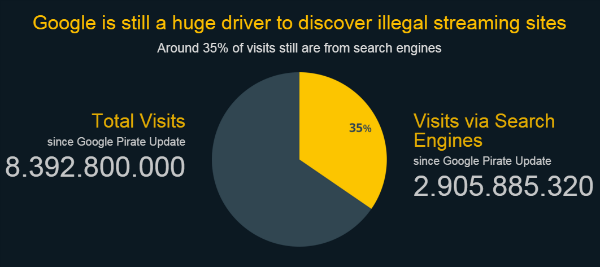
Translated to a traffic number, JustWatch estimates that roughly a third of all visits to the top streaming sites come from search engines, which number nearly three billion since Google’s “pirate” update.

Search engine traffic to illegal streaming sites

googbeforeafter

The critique is not new. In recent months several entertainment industry groups have urged Google to improve its downranking methods or completely remove pirate sites from search results.

Google, however, has stated that removing entire domain names goes too far and could possibly be counterproductive.

As a streaming search engine JustWatch of course has a significant interest in the results they report. Perhaps unsurprisingly, they also encourage Google to improve.

“Google should stand by their word to use the DMCA takedown requests per domain and factor it stronger into their ranking signals,” JustWatch CEO David Croyé tells TF.

According to JustWatch pirate streaming sites still dominate the top search results when people enter phrases such as “300 watch online”

Croyé understands that the algorithms want to rank pirate sites higher, because this is actually what people are looking for. However, that makes it harder for legal services to compete.

“We are a self funded startup that wants to connect fans with their favorite movie content worldwide and make it easier also for Google to show more legal offers. We’ve already aggregated them in a structured way for them”

“So it’s in our own interest as a startup to be able to compete with free, but illegal alternatives on Google,” Croyé adds.

Source: TorrentFreak, for the latest info on copyright, file-sharing, torrent sites and ANONYMOUS VPN services.