UK Anti-Piracy ‘Education’ Campaign Launched, Quietly

After a long wait the UK’s broad anti-piracy effort operated by ISPs and copyright holders has finally launched. The UK Government-funded program aims to warn and educate illegal file-sharers in the hope of decreasing piracy rates over time, but thus far the response has been rather underwhelming.

Source: TorrentFreak, for the latest info on copyright, file-sharing, torrent sites and ANONYMOUS VPN services.

uk-flagIn an effort to curb online piracy, early last year the movie and music industries reached agreement with the UK’s leading ISPs to send ‘warnings’ to alleged pirates.

Under the new system copyright holders will monitor illegal P2P file-sharing activity with a strong focus on repeat offenders.

The warning program is part of the larger Creative Content UK (CCUK) initiative which also includes an educational component. Though various PR campaigns the coalition hopes to change people’s attitudes towards piracy.

CCUK was launched after years of negotiating and the plans were widely discussed in the media. However, when the first campaign launched a few weeks ago there was a remarkable silence.

The first education campaign is called “Get It Right from a Genuine Site.” It encourages people to stay clear from pirate sites and use licensed services instead, so that copyright holders and industry employees are properly compensated.

The campaign was promoted alongside an ad which aired during the UK version of The X-Factor and elsewhere late October. In the high-profile advertising spot, which isn’t cheap, viewers were encouraged to duck dodgy sites and go legit.

“Get the stuff you love from genuine sites and support creativity. Download or stream from dodgy sites and contribute nothing. It’s your choice,” it says.

Get It Right from a Genuine Site

CCUK is encouraging the public to use the hashtag #genuine to promote the initiative. However, thus far the response has been rather underwhelming with only a handful of tweets, mostly from industry insiders.

Today, the hashtag is mostly used in totally unrelated tweets and on other social media the project isn’t really taking off either. The official Facebook page of the campaign has only 114 likes.

The only Facebook comment responding to the campaign ad is not very encouraging either. “It’s not 2003. No one’s getting pirated music from IRC or whatever,” it reads.

In addition to the ad, CCUK is also backing a large street art project. It’s not entirely clear how this offline project relates to online piracy, but perhaps it’s an effort to appeal to the target audience.

TorrentFreak asked CCUK for a comment on the first campaign, but at the time of writing we haven’t heard back.

A CCUK spokesperson previously informed us that their ultimate goal is to bring down local piracy rates. During the months following the rollout the file-sharing habits of UK Internet users will be frequently polled to measure the impact of the campaign.

“The aim of Creative Content UK is to encourage greater use of legal content services and to reduce online copyright infringement. There will be regular measurements of legal and illegal consumption of content throughout the duration of the initiative, which will be compared with levels before the launch of the program,” CCUK told TF.

Considering the response and exposure thus far, there’s still a long way to go.

Source: TorrentFreak, for the latest info on copyright, file-sharing, torrent sites and ANONYMOUS VPN services.

MPAA ‘Softens’ Movie Theater Anti-Piracy Policy, Drops Bounty

The MPAA has issued an updated version of its best practices for the prevention of movie piracy in theaters. While much remains the same, theater managers are no longer required to call the police for every incident. In addition, the long-standing pirate hunting bounty program has disappeared.

Source: TorrentFreak, for the latest info on copyright, file-sharing, torrent sites and ANONYMOUS VPN services.

recillegalThe MPAA sees illegally recorded movies as one of the biggest piracy threats and goes to extremes to stop it.

During pre-release screenings and premieres, for example, employees are often equipped with night-vision goggles and other spy tech to closely monitor movie goers.

In some cases members of the public have been instructed to hand over all recording-capable devices including phones and Google glasses.

Through these measures the MPAA hopes to prevent pirates from camcording movies or recording audio in theaters. The underlying policy is drafted in cooperation with the National Association of Theatre Owners (NATO), and a few days ago the most recent version was released.

At first sight not much has changed. The MPAA still recommends theater owners to keep an eye on suspect movie goers while prohibiting the use of any recording devices including phones.

“Preventative measures should include asking patrons to silence and put away their phones and requiring they turn off and stow all other devices capable of recording, including wearable technology capable of recording.

“If individuals fail or refuse to put any recording device away, managers—per your theater’s policy — can ask them to leave,” the recommendation reads.

There are several subtle changed throughout the document though, especially regarding the involvement of police. Previously, theater employees were encouraged to detain suspect visitors and hand them over to the authorities.

This is explicitly stated in the following snippet taken from the 2014 version of the best practices.

“Theater managers should immediately alert law enforcement authorities whenever they have clear indications that prohibited activity is taking place—the proper authorities will determine what laws may have been violated and what enforcement action should be taken.”

In the new document, however, it’s no longer a requirement to call the police. Instead, this is now optional.

“Theater managers have the option to immediately alert law enforcement authorities whenever they have clear indications that prohibited activity is taking place or managers can the stop the activity without law enforcement assistance.”

Similar changes were made throughout the document. Even reporting incidents to the MPAA no longer appears to be mandatory, which it still was according to last year’s text.

“After your theater manager has contacted the police, your theater manager should immediately call the MPAA 24/7 Anti-Camcording Hot Line to report the incident.”

The language above has now been changed to a less urgent option of simply reporting incidents, should a theater manager deem it appropriate.

“Your theater manager can also call the MPAA 24/7 Anti-Camcording Hot Line to report the incident.”

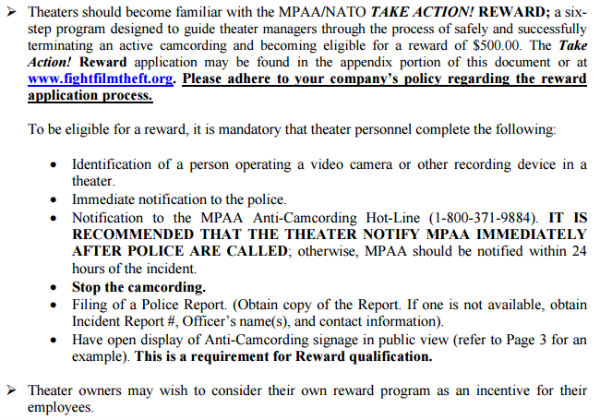
Aside from the softer tone there’s another significant change to the best practices. The $500 “reward” movie theater employees could get for catching pirates is no longer mentioned.

The old Take Action Award mention

takeactionreward

In fact, the entire “take action award” program appears to have been discontinued. The NATO page where it was listed now returns a 404 error and the details on FightFilmTheft have been removed as well.

This stands in stark contrast to the UK where the rewards for a similar program were doubled just a few weeks ago, with officials describing it as a great success.

The question that remains unanswered is why the MPAA and NATO have implemented these changes. Could it be that there were too many false positives being reported to the police, or is there an image problem perhaps?

In recent years several questionable police referrals resulted in a media backlash. A 19-year-old girl was arrested for recording a 20 second clip from the movie “Transformers,” which she wanted to show to her brother, for example.

And just last year the FBI dragged a man from a movie theater in Columbus, Ohio, after theater staff presumed his wearing of Google Glass was a sign that he was engaged in camcorder piracy.

Meanwhile, reports of real pirates being apprehended in a similar fashion have been notable by their absence.

Best Practices to Prevent Film Theft

Source: TorrentFreak, for the latest info on copyright, file-sharing, torrent sites and ANONYMOUS VPN services.

Top 10 Most Pirated Movies of The Week – 11/30/15

The top 10 most downloaded movies on BitTorrent are in again. ‘Maze Runner: The Scorch Trials.’ tops the chart this week, followed by ‘Ant Man’ ‘Another World’ completes the top three.

Source: TorrentFreak, for the latest info on copyright, file-sharing, torrent sites and ANONYMOUS VPN services.

mazeThis week we have two newcomers in our chart.

Maze Runner: The Scorch Trials is the most downloaded movie for the second week in a row.

The data for our weekly download chart is estimated by TorrentFreak, and is for informational and educational reference only. All the movies in the list are BD/DVDrips unless stated otherwise.

RSS feed for the weekly movie download chart.

Ranking (last week) Movie IMDb Rating / Trailer
torrentfreak.com
1 (1) Maze Runner: The Scorch Trials 6.8 / trailer
2 (2) Ant-Man 7.7 / trailer
3 (3) Another World (Web-DL) 5.3 / trailer
4 (8) Criminal Activities (Web-DL) 5.8 / trailer
5 (7) The Man from U.N.C.L.E. 7.5 / trailer
6 (4) Ronaldo 6.7 / trailer
7 (10) The 33 (Web-DL) 7.0 / trailer
8 (…) Hotel Transylvania 2 (Webrip) 7.0 / trailer
9 (9) Inside Out 8.4 / trailer
10 (…) Talvar 8.6 / trailer

Source: TorrentFreak, for the latest info on copyright, file-sharing, torrent sites and ANONYMOUS VPN services.

Cox Can’t Describe Rightscorp As “Extortionists” and “Trolls” During Trial

Internet provider Cox Communications is not allowed to use derogatory terms to describe Rightscorp during their upcoming trial. Terms such as “copyright troll,” “blackmailer,” and “extortionist” are off-limits and the same is true for Rightscorp’s dire financial position.

Source: TorrentFreak, for the latest info on copyright, file-sharing, torrent sites and ANONYMOUS VPN services.

trollsignNext week marks the start of a crucial trial that may define how U.S. Internet providers deal with pirating subscribers in the future.

Internet provider Cox Communications is facing a lawsuit from BMG Rights Management and Round Hill Music, who accuse the company of failing to terminate the accounts of subscribers who frequently pirate content.

This week the court ruled on several requests and concerns about the upcoming trial. Several of these motions relate to Rightscorp, the company which sends out infringement notices with settlement demands for the rightsholders.

In previous filings Cox described Rightscorp as a copyright-trolling outfit that uses extortion and blackmail-like practices to pressure alleged pirates into settling. This language concerned the music companies, who asked the court to exclude it from trial.

This week Judge O’Grady agreed, ordering that Cox is prohibited from introducing irrelevant information about Rightscorp (pdf).

Among other things, the proposed order specifies that the Internet provider can’t reference Rightscorp’s business practices after 2011, including evidence from phone scripts or call recordings.

Rightscorp’s precarious financial position is also off-limits, as well as any allegations that the company violates debt collection or private investigation laws.

Finally, the aforementioned extortion and troll references are banned during trial as well.

“Defendants are prohibited from using derogatory terms such as ‘troll,’ ‘blackmailer,’ and ‘extortionist’ in reference to Rightscorp or Plaintiffs and are prohibited from using terms like ‘extortion’ or ‘blackmail’ to describe the companies’ communications or business practices,’ the order reads.

In addition to this order, Cox faced another setback.

The ISP previously asked the court to prevent the copyright holders from using any material claiming that BitTorrent equals piracy. According to Cox, BitTorrent has plenty of legitimate uses, but the motion was denied by Judge O’Grady.

On the upside, the court agreed with Cox that Rightscorp destroyed crucial evidence by deleting older versions of its piracy tracking code.

While this is not enough to dismiss the entire case, sanctions are appropriate and Cox is allowed to reference the destroyed evidence during its opening statement (pdf).

These new developments, as well as the earlier order declaring that Cox is not entitled to DMCA safe-harbor protections, show how much is at stake for both sides. The trial is expected to start in a few days and will be closely followed by other copyright holders and Internet providers.

Source: TorrentFreak, for the latest info on copyright, file-sharing, torrent sites and ANONYMOUS VPN services.

Pirates Can Now Rip 4K Content From Netflix and Amazon

Pirates have found a new loophole that allows them to copy 4k movies and TV-shows from Netflix and Amazon. Up until recently these high quality 4K resolution rips were nonexistent, but a flurry of new releases from various groups show that something has changed.

Source: TorrentFreak, for the latest info on copyright, file-sharing, torrent sites and ANONYMOUS VPN services.

amazonnetflixWhile the average consumer is generally not equipped to play 4K content on their TV or computer, many video geeks are looking forward to every new release.
Thus far the physical offerings have been limited to adult content mostly, with just a handful of mainstream productions. However, with the adoption of a Blu-Ray standard for Ultra High Definition video more releases will follow soon.

4K streaming releases have been available for a while already though, with Netflix and Amazon as the two key vendors in this market.

These online streams were always well protected against pirates. The High-Bandwidth Digital Copy Protection (HDCP) version 2.2 or higher is still believed to be secure today, but there are signs that pirates have found a way to bypass the protection.

Earlier this year the first 4K Netflix leak surfaced. After that it went quiet. However, a few days ago something changed, as many more releases started to appear online.

TorrentFreak spoke to a release group insider who confirmed that this is a significant change.

“Many groups started releasing 4K rips recently and they are working perfectly. I expect that 4K resolution releases will become more popular now,” TorrentFreak was told.

The new 4K leaks come from both Netflix and Amazon, suggesting that there’s a general loophole that allows pirates to circumvent the copy protection on both services.

Up until recently this was impossible to do. There were a handful of upscaled releases floating around with a lot of pixelation and low bitrates, but these don’t come close to real 4K.

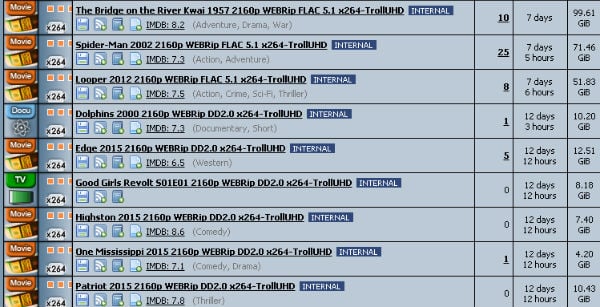
The new releases are true 4K and include Amazon’s The Man in the High Castle as well as the recent pilots Edge, Good Girls Revolt, Highston, One Mississippi
and Patriot.

Amazon’s 4k leaks

amazon4kpilots

Another series of high-profile 4K leaks that came out this week are of Netflix’s Jessica Jones. As with the other rips the file-sizes are much larger than traditional HD-releases, well over 10 gigabytes for a single episode.

Netflix’ Jessica Jones 4k leaks

jessi

The media info for one of the Jessica Jones leaks show that it’s 4K, at a 32.5 Mbps bitrate. Unfortunately, that doesn’t necessarily mean that the video quality is always exceptional.

“For example for Marvel’s Jessica Jones new TV series from Netflix the 4K captures look bad, because the master from Netflix is probably bad,” we were told by an insider.

Jessica Jones 4k (large)

jessica jones

Downloading a 4K release from Amazon or Netflix and getting a pirated copy out is not something that’s easily done. The original rips are often well over 100 gigabytes in size. Still, many groups are jumping on the 4K bandwagon.

The main question that remains is how the groups are able to circumvent the copy protection. Our source says that Amazon’s Fire TV and Roku 4K are likely sources, as they may not be as well protected as some believe.

Amazon’s Fire TV uses the weaker HDCP 1.4b protection and 23.976 frames/s, which only supports Amazon 4K releases and not Netflix.

Roku recently released their new streaming player with 4K support and native refresh rate switching, which can play Netflix’s 4K library. It arrived in stores early November, just before the 23.976 frames/s 4k rips started coming out.

Whatever the source is, the stream of new releases is unprecedented and marks the start of a new era of high quality video releases.

In recent years many people have been downloading higher quality rips already, but it will probably take a few years before 4K becomes the new standard. Overall, however, pirating video geeks will be happy with the news.

Source: TorrentFreak, for the latest info on copyright, file-sharing, torrent sites and ANONYMOUS VPN services.

Anti-Piracy Group Stops Prolific KickassTorrent’s Uploader

A KickassTorrents user who uploaded more than 750 pirated files has been ordered to cease his activities by a Dutch court, or face thousands of euros in fines. The case was launched by the local anti-piracy group BREIN, which actively monitors and targets prolific uploaders.

Source: TorrentFreak, for the latest info on copyright, file-sharing, torrent sites and ANONYMOUS VPN services.

KATNetherlands-based anti-piracy group BREIN is one of few such outfits to directly go after both the operators and users of pirate sites.

The Hollywood-backed group doesn’t target random file-sharers but focuses on prolific uploaders, who share hundreds or thousands of files.

This month these efforts led to another victory for the organization. A Breda court ruled in favor of BREIN in an ex-parte case against a 20-year-old student, who uploaded over 750 torrents to KickassTorrents.

Most torrents were targeted at the Dutch public, including a full season of The Walking Dead and the film Avengers: Age of Ultron, both with subtitles.

BREIN argued that the man’s infringing activities were causing irreparable damage for the various copyright holders involved. In addition, his efforts help frustrate the growth of legal services such as Spotify and Netflix.

The court agreed with BREIN’s assessment and ordered the uploader to stop sharing pirated content on KickassTorrents (pdf). Refusing to do so will result in a €2,000 fine per day, with a maximum of €50,000.

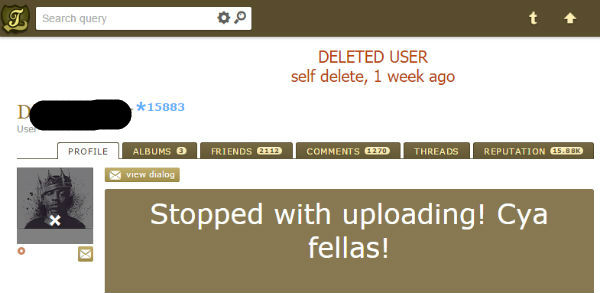
Responding to the verdict, the man, whose name is not made public, deleted his account as well as all uploads.

TorrentFreak tracked down what appears to be the user in question. This person frequently uploaded torrents with Dutch subtitles, some of which were mentioned in the case.

The deleted profile

kickassuser

BREIN notes that the student also agreed to pay compensation to the copyright holders as well as costs for the legal proceedings. While calculating the appropriate ‘damages’ figure BREIN took the man’s personal circumstances into account.

This means that the uploader has gotten off relatively unharmed, when compared to the million dollar claims we’ve seen elsewhere at least.

It’s not clear how BREIN tracked down the uploader. The anti-piracy group is known to scour the Internet for information that can identify infringers, some of whom are surprisingly easy to find.

In addition, BREIN also uses previously convicted file-sharers to gather intelligence, and rival uploaders also rat out their competitors voluntarily every now and then.

“We do get anonymous tips regarding offenders and from time to time it is clear that a tip comes from a ‘competitor. It’s just like with other crime on any turf,” BREIN’s Tim Kuik told us previously.

Looking ahead, BREIN is planning to intensify its efforts to hold prolific uploaders responsible. Not just those who upload to torrent sites, but also those who simply download and share.

Last week NOS reported that BREIN is preparing to monitor IP-addresses systematically to identify prolific sharers, which they then hope to identify through their Internet providers.

Source: TorrentFreak, for the latest info on copyright, file-sharing, torrent sites and ANONYMOUS VPN services.

Huge Security Flaw Can Expose VPN Users’ Real IP-Adresses

A newly discovered vulnerability can expose the real IP-addresses of VPN users with relative ease. The issue, which affects all VPN protocols and operating systems, was uncovered by Perfect Privacy who alerted several affected competitors to the threat before making it public.

Source: TorrentFreak, for the latest info on copyright, file-sharing, torrent sites and ANONYMOUS VPN services.

ip-addressFor the past several years interest in encrypted and anonymous communications has spread to a much wider audience.

VPN providers are particularly popular among BitTorrent users, who by default broadcast their IP-addresses to hundreds of people when downloading a popular file.

The goal of using a VPN is to hide one’s ISP IP-address, but a newly discovered vulnerability shows that this is easily bypassed on some providers.

The problem, uncovered by VPN provider Perfect Privacy (PP), is a simple port forwarding trick. If an attacker uses the same VPN as the victim the true IP-address can be exposed by forwarding traffic on a specific port.

The security flaw affects all VPN protocols including OpenVPN and IPSec and applies to all operating systems.

“Affected are VPN providers that offer port forwarding and have no protection against this specific attack,” PP notes.

For example, if an attacker activates port forwarding for the default BitTorrent port then a VPN user on the same network will expose his or her real IP-address.

The same is true for regular web traffic, but in that case the attacker has to direct the victim to a page that connects to the forwarded port, as Perfect Privacy explains in detail.

The vulnerability affected the setup of various large VPN providers, who were warned last week. This included Private Internet Access (PIA), Ovpn.to and nVPN, who have all fixed the issue before publication.

PIA informs TorrentFreak that their fix was relatively simple and was implemented swiftly after they were notified.

“We implemented firewall rules at the VPN server level to block access to forwarded ports from clients’ real IP addresses. The fix was deployed on all our servers within 12 hours of the initial report,” PIA’s Amir Malik says.

In addition, PIA complimented Perfect Privacy for responsibly disclosing the vulnerability prior to making it public and awarded their competitor with a $5,000 bounty under its Whitehat Alert Security Program.

Not all VPN providers were tested so it is likely that many others are still vulnerable. Hopefully, these will address the issue in the near future.

Source: TorrentFreak, for the latest info on copyright, file-sharing, torrent sites and ANONYMOUS VPN services.

Supreme Court Opens Door for Pirate Site Blockades in Germany

The German Supreme Court has today opened the door for ISP blockades of copyright infringing sites. In a landmark decision the court ruled that ISPs can be required to block websites if copyright holders fail to identify their operators or hosting providers.

Source: TorrentFreak, for the latest info on copyright, file-sharing, torrent sites and ANONYMOUS VPN services.

stop-blockedDomain name blocking has become one of the entertainment industries’ go-to methods for reducing online copyright infringement.

Blocking requests from both the music and movie sector are widespread around Europe, but until now Germany has been excluded.

However, this may soon change. In a landmark ruling the Supreme Court has today opened the door to German pirate site blockades.

The origin of the ruling dates back seven years when German music rights group GEMA, known for its aggressive anti-piracy stance, found music tracks on major file-hosting sites being distributed via the music linking site 3DL.am.

After GEMA failed in its efforts to contact 3DL’s operators to deal with the infringement, the music group tried another tactic.

In a subsequent complaint, GEMA demanded that in order to reduce further copyright infringement, leading German ISP Deutsche Telekom should take technical steps to stop its customers from accessing 3DL.am.

The ISP refused, stating that as a mere ‘dumb pipe’ it has nothing to do with the infringement on the site. Furthermore, blocking one site would simply lead to increasing numbers of similar demands, the ISP argued.

Together with a similar lawsuit against the site Goldesel.to, the case eventually ended up at the Supreme Court which ruled on the issue today.

In its order the court argues that an ISP blockade is warranted if copyright holders have exhausted all their options to identify the operators or hosting providers of pirate sites.

The court also noted that it doesn’t matter if users can circumvent blockades. Simply rendering sites more difficult for the general public to access is sufficient.

GEMA is delighted with the decision and says it will be a great tool to combat online piracy.

“We welcome the judgment of the Supreme Court. This landmark decision was long overdue, since it leads the way in protecting our copyrights in the digital music market,” GEMA CEO Harald Heker says.

“At last we have legal clarity about the fact that ISP blockades of websites that offer illegal copyrighted music works en masse, are permitted. An important step to combat Internet piracy,” he adds.

It’s expected that the first blocking requests will be filed in the near future. While 3DL.am is no longer online, other high-profile pirate sites including The Pirate Bay and KickassTorrents are probably high on GEMA’s wish list.

Source: TorrentFreak, for the latest info on copyright, file-sharing, torrent sites and ANONYMOUS VPN services.

MPAA Wins $10.5 Million Piracy Damages From MovieTube

A group of major Hollywood studios have won a default judgment against the operators of MovieTube and several associated websites. The movie studios have been awarded a total of $10.5 million in statutory damages and control over a few dozen MovieTube domains, which were taken offline earlier this year.

Source: TorrentFreak, for the latest info on copyright, file-sharing, torrent sites and ANONYMOUS VPN services.

movietubeUnauthorized movie streaming sites have been a thorn in the side of Hollywood for many years.

Responding to this threat the MPAA decided to take one of the most prominent players to court earlier this year.

MPAA members 20th Century Fox, Columbia Pictures, Disney, Paramount, Universal and Warner Bros filed a lawsuit against a group of MovieTube affiliated websites, which were operating from more than two dozen domain names.

In the complaint the MPAA listed several popular websites including MovieTube.cc, TuneVideo.net, Watch33.tv, MovieTube.cz, Anime1.tv, MovieTube.pm, FunTube.co, MovieTube.la and KissDrama.net, which were all believed to be operated by the same people.

Despite facing millions of dollars in damages, the site’s operators remained silent. They swiftly pulled the targeted sites offline after the compliant was filed, but never responded to any of the claims in court.

Due to this inaction the MPAA requested a default judgment at a New York federal court, demanding a permanent injunction as well as millions of dollars in damages.

This week a federal court judge ruled in favor of the MPAA, finding MovieTube liable for copyright infringement, federal trademark counterfeiting, and unfair competition (pdf).

The court agreed to statutory damages for willful copyright infringement in the amount of $75,000 per work, which brings the total to $10.5 million.

MTdama

The default judgment also includes a permanent injunction that prohibits MovieTube’s operators from offering or linking to any copyright infringing material. In addition, the movie studios will now take ownership of all domain names.

Dean Marks, the MPAA’s Executive Vice President, is happy with the outcome and says it helps to protect the livelihood of movie industry workers.

“By shutting down these illegal commercial enterprises we are protecting not only our members’ creative work and the hundreds of innovative, legal digital distribution platforms, but also the millions of people whose jobs depend on a vibrant motion picture and television industry.”

“This court order will help ensure the sites stay down and are not transferred to others for the purposes of continuing a piracy operation on a massive scale.”

While shutting down the MovieTube sites is a significant win for the MPAA, they are unlikely to see any of the money that’s been awarded to them. The true operators of the MovieTube sites remain unknown and will do their best to keep it that way.

The full list of domain names that will be signed over to the MPAA is as follows:

MovieTube.tw, MovieTube.ph, TVStreaming.cc, MovieTube.sx, MovieTube.pw, MovieTubeNow.com, MovieTube.tf, MovieTube.co, MovieOnDrive.com, MovieTube.vc, TuneVideo.net, MovieTube.mn, MovieTube.cc, Watch33.tv, MovieTube.cz, Anime1.tv, MovieTube.pm, FunTube.co, MovieTube.la, KissDrama.net, MovieTube.so, MovieTube.click, MovieTubeHD.co, MovieTubeHD.net, MovieTubeHD.org, MovieTubeHD.tv, MovieTubeHD.us, MovieTubenow.in and TuneMovie.me.

Source: TorrentFreak, for the latest info on copyright, file-sharing, torrent sites and ANONYMOUS VPN services.

Insurer Refuses to Cover Cox in Massive Piracy Lawsuit

Trouble continues for one of the largest Internet providers in the United States, with a Lloyds underwriter now suing Cox Communications over an insurance dispute. The insurer is refusing to cover legal fees and potential piracy damages in Cox’s case against BMG Rights Management and Round Hill Music.

Source: TorrentFreak, for the latest info on copyright, file-sharing, torrent sites and ANONYMOUS VPN services.

cox-logoFollowing a ruling from a Virginia federal court that Cox is not protected by the safe-harbor provisions of the DMCA, the Internet provider must now deal with another setback.

Beazley, a high risk insurance underwriter for Lloyds, is refusing to cover legal costs related to the “repeat infringer” case which goes to trial next week.

It’s a crucial case that could define how Internet providers must handle copyright infringement complaints. At the moment it’s rare for ISPs to disconnect pirating users but the case has the potential to alter the landscape.

The case also exposes Cox to dozens if not hundreds of millions in potential piracy damages plus substantial legal fees. The Internet provider hoped to cover some of the costs under an insurance policy at Lloyd’s but the insurer is refusing to cooperate.

In a request for a declaratory judgment (pdf) Lloyd’s underwriter asks the court to rule that it doesn’t have to cover the costs, which have already exceeded $1 million in legal fees alone.

In the complaint Beazley states that Cox was well aware of the potential liabilities. Rightscorp, the company that sends the copyright infringement notices, had already warned the ISP over its precarious position several years ago.

“By letter dated January 9, 2012, Cox was advised by an agent of copyright holders that if it did not forward those notices to its customers, it would be exposed to claims of contributory and vicarious copyright infringement,” the insurer writes.

Cox, however, refused to forward the millions of notices as they were bundled with settlement demands, which are seen by some as extortion. This refusal eventually lead to the lawsuit filed by music rights companies BMG and Round Hill.

“Cox continued to intentionally ignore the notices and did not forward them to its customers,” the complaint notes.

In light of the above, Beazley argues that the lawsuit is the result of an intentional business policy rather than the act of rendering Internet services, which is what the insurance policy covers.

“…the BMG Claim arose out of Cox’s policy and practice of ignoring and failing to forward infringement notices and refusing to terminate or block infringing customers’ accounts, not acts in rendering internet services.”

In addition Beazley point out that the piracy lawsuit was filed November last year, several days before the December 1, 2014 date the insurance policy began.

If the court grants Beazley’s request for declaratory judgment then Lloyd’s policy will not cover any of the costs related to the lawsuit. This will be a costly setback for the ISP if it loses the piracy lawsuit.

Source: TorrentFreak, for the latest info on copyright, file-sharing, torrent sites and ANONYMOUS VPN services.