Busted Kickass and Pirate Bay Uploaders Crowdfund ‘Fines’

Two Dutch men busted by local anti-piracy group BREIN for uploading to The Pirate Bay and KickassTorrents are asking the public to help cover their ‘fines’. BREIN is not happy with the crowdfunding campaigns and suggests that it may take further action in response.

Source: TorrentFreak, for the latest info on copyright, file-sharing, torrent sites and ANONYMOUS VPN services.

uploadDutch anti-piracy outfit BREIN has been very active recently, targeting several prolific KickassTorrents and Pirate Bay uploaders.

Most recently it tracked down two members of the DMT (Dutch Movie Theater) group, who shared thousands of torrents on these popular torrent sites.

BREIN settled out of court with both men and said it took their personal circumstances into account while calculating the appropriate ‘damages’.

The final amount was not disclosed by the anti-piracy group. However, both users have now started a crowdfunding campaign to cover the costs, revealing how much they owed.

The crowdfunding campaigns were announced by a fellow KAT user, who is encouraging people to chip in. According to the campaign pages the 20-year old DisasterZany has to pay €1,750, while ipod020 owes BREIN €2,000 in total.

“Since €1,750 is an amount that I can’t really miss as a student, I want to ask you for a small contribution. Any amount is welcome and will be very very appreciated,” DisasterZany writes, sharing part of the settlement agreement.

DisasterZany’s settlement

zanysett

BREIN is not pleased with crowdfunding efforts, Tweakers reports. According to BREIN chief Tim Kuik this changes the personal circumstances on which the settlement amount was based.

Kuik suggests that BREIN may take further action, but according to Dutch ICT lawyer Arnoud Engelfriet it’s unlikely that anything will change unless crowdfunding was specifically prohibited in the settlement agreement.

For BREIN it’s important send a strong message and deter others from sharing copyrighted files online. If both uploaders can easily cover their ‘fines’ through a crowdfunding campaign, this hurts their efforts.

At the time of writing both uploaders still have some ground to cover before their costs are fully paid. DisasterZany has raised €105 thus far, while ipod020’s campaign is at €485.

Source: TorrentFreak, for the latest info on copyright, file-sharing, torrent sites and ANONYMOUS VPN services.

Pirate Bay’s .org Domain Suspended Pending ICANN Verification

Pirate Bay’s original .org domain was suspended by EuroDNS a few hours ago, after the registrant failed to verify the contact details. Even though it’s no longer the main domain name for the site, the bookmark was still in use by many people as a redirect to Pirate Bay’s latest home base.

Source: TorrentFreak, for the latest info on copyright, file-sharing, torrent sites and ANONYMOUS VPN services.

pirate bayThe Pirate Bay’s original .org domain name has stopped working due to an administrative problem.

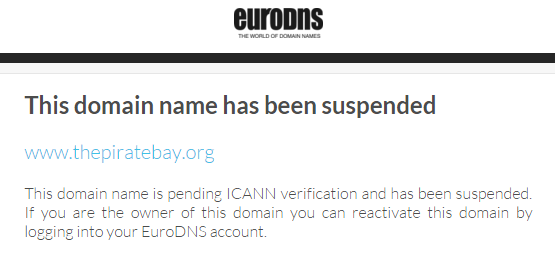
Many people still used the .org as a redirect to one of the latest Pirate Bay domains, but for the past few hours they’ve been greeted by a message from its registrar EuroDNS instead.

The person managing the domain name has failed to verify the contact details and until this is done the domain name will stop functioning.

“This domain name is pending ICANN verification and has been suspended. If you are the owner of this domain you can reactivate this domain by logging into your EuroDNS account,” reads the notice that appears.

tpborg

For the site’s users the issue doesn’t cause any problems. The Pirate Bay site is still reachable via the .se domain name, which redirects visitors to several other official TPB domain names.

Pirate Bay’s .org domain still has plenty nostalgic value though. It was unofficially retired in 2012 when TPB’s operator switched to a .se domain, fearing that the U.S. government could seize the .org.

TorrentFreak reached out to The Pirate Bay team but we have yet to hear back. It’s expected that the issues will be swiftly resolved once the contact details are verified.

The .org domain name is currently registered to Pirate Bay co-founder Fredrik Neij, who’s also the official contact person for many other Pirate Bay related domains.

A few days before the EuroDNS message first appeared the .org domain was already unreachable. Whether this had anything to do with the pending ICANN verification is unknown.

Source: TorrentFreak, for the latest info on copyright, file-sharing, torrent sites and ANONYMOUS VPN services.

Top 10 Most Pirated Movies of The Week – 12/07/15

The top 10 most downloaded movies on BitTorrent are in again. ‘Maze Runner: The Scorch Trials.’ tops the chart this week, followed by ‘Goosebumps’ ‘Another World’ completes the top three.

Source: TorrentFreak, for the latest info on copyright, file-sharing, torrent sites and ANONYMOUS VPN services.

mazeThis week we have four newcomers in our chart.

Maze Runner: The Scorch Trials is the most downloaded movie for the third week in a row.

The data for our weekly download chart is estimated by TorrentFreak, and is for informational and educational reference only. All the movies in the list are BD/DVDrips unless stated otherwise.

RSS feed for the weekly movie download chart.

Ranking (last week) Movie IMDb Rating / Trailer
torrentfreak.com
1 (1) Maze Runner: The Scorch Trials 6.8 / trailer
2 (…) Goosebumps (Webrip) 6.8 / trailer
3 (…) Hate Story 3 (DVDscr) 5.0 / trailer
4 (…) Absolutely Anything 6.0 / trailer
5 (5) The Man from U.N.C.L.E. 7.5 / trailer
6 (4) Criminal Activities (Web-DL) 5.8 / trailer
7 (2) Ant-Man 7.7 / trailer
8 (3) Another World (Web-DL) 5.3 / trailer
9 (9) Inside Out 8.4 / trailer
10 (…) The Walk (Webrip) 7.7 / trailer

Source: TorrentFreak, for the latest info on copyright, file-sharing, torrent sites and ANONYMOUS VPN services.

uTorrent and BitTorrent Serve Over 200 Million Ads Per Day

BitTorrent Inc, the parent company of the popular file-sharing client uTorrent, serves more than 200 million advertisements per day through its software. But despite the dazzling numbers, overall revenue is relatively modest as the ad rates are far from premium.

Source: TorrentFreak, for the latest info on copyright, file-sharing, torrent sites and ANONYMOUS VPN services.

utorrent-logo-newIn an effort to increase its revenues BitTorrent Inc. added advertising to its uTorrent and Mainline clients three years ago.

While users can dive into the advanced settings and remove all ads, most don’t seem to be bothered by the occasional advertisement.

A few weeks ago BitTorrent Inc. invited its bundle publishers to use the ads to promote their content, referring them to their DIY advertising network.

“Artists and publishers can now advertise with BitTorrent, getting your work in front of millions of fans of music, movies and software around the world,” the company wrote in an email.

BitTorrent’s advertising platform lists several statistics that reveal some interesting details on users of the uTorrent and Mainline clients.

For example, the clients have roughly 170 million active users per month. The vast majority (92%) are male, with the prime demographic being educated and tech savvy 18-34 year-olds.

The advertising network also shows some interesting stats on the number of ad impressions the two clients have available. BitTorrent Inc. currently supports two ad formats which each have an estimated 3,397,615,000 views per month, based on statistics from the last 30 days.

That’s good for well over 100 million impressions per banner format per day, and over 200 million in total.

BitTorrent’s ad options

btads

While these numbers are certainly impressive, the revenue is relatively modest. BitTorrent sells its worldwide traffic for 7 cents per 1,000 views, which is one of the lowest tiers in the ad industry.

That said, if all banner spots were to be sold, BitTorrent Inc. would make over $14,000 per day, which is still pretty decent. It’s also possible that there are better rates for certain kinds of ads that are sold outside the advertising network.

In addition to banner advertising the uTorrent client also generates revenue through bundled software. BitTorrent Inc. doesn’t publish any figures but it’s known that these type of offers can reach $1 per install.

For some users these revenue sources are cause for complaints. BitTorrent Inc. is aware of this critique and has recently announced that it is exploring other options, including direct financial support from users.

For now, however, uTorrent and the Mainline client will continue to serve hundreds of millions of ads every day.

Source: TorrentFreak, for the latest info on copyright, file-sharing, torrent sites and ANONYMOUS VPN services.

PayPal Bans File-Sharing Classic Soulseek… After 14 Years

After banning several of the largest file-hosting sites, PayPal is now taking aim at one of the oldest file-sharing applications around. After 14 years doing business together, the payment processor has just cut off classic P2P tool Soulseek, noting that file-sharing tools require pre-approval, even though the mentioned policy didn’t exist at the time.

Source: TorrentFreak, for the latest info on copyright, file-sharing, torrent sites and ANONYMOUS VPN services.

paypalPayPal is widely known for its aggressive stance towards BitTorrent sites, Usenet providers and file-hosting services, and it appears that P2P software is now receiving the same treatment.

Most recently, PayPal took action against Soulseek, a file-sharing network that’s mostly used for sharing music. Soulseek has been around for a decade and a half, when Napster was still in its prime and years before BitTorrent came around.

The Soulseek client that was targeted had been using PayPal to receive donations for 14 years. It never ran into trouble and PayPal even sent personal Christmas cards to the operators, but a few weeks ago things changed.

“PayPal suddenly and unceremoniously decided to end a very friendly working relationship with us that lasted 14 years,” Soulseek’s Roz and Nir Arbel explain.

The San Francisco based Soulseek team tried to get more information on the sudden change of heart, but without much luck.

“We have asked repeatedly for an explanation of this behavior, but we have been stonewalled at every turn, and have received only form emails telling us that we needed to be ‘pre-approved’ for an account,” they explain.

While PayPal doesn’t want to comment in detail, Soulseek appears to be classified under the “file-sharing” category now. These type of sites and services have to adhere to strict rules.

This policy has been in force since 2012 and has resulted in PayPal banning many file-sharing related services.

paypalp2p

In the case of Soulseek it would have been hard to ask for pre-approval as they were already a user many years before the policy came into effect.

That said, PayPal has made it clear that Soulseek is not allowed to use their services anymore.

“When we asked what we need to do to be pre-approved, they emailed back and said that they are ‘not granting pre-approval at this time’,” the Soulseek team notes.

Soulseek is not the first company to be banned by PayPal’s rigorous policy, and it won’t be the last. Another service that suffered the same fate recently is the TV-guide Myepisodes.com.

Even though the service doesn’t link to or host any infringing material, it was kicked off due to a “copyright issue” and because wasn’t “pre-approved.”

While PayPal hasn’t commented on the disconnections in public, it seems likely that it took action after complaints from copyright holders or industry groups, who fear that file-sharing related sites and services hurt their revenues.

Source: TorrentFreak, for the latest info on copyright, file-sharing, torrent sites and ANONYMOUS VPN services.

Steal This Show S01E02: Rebel Librarians & Pirate Academics

Today we bring you the second episode of the Steal This Show podcast, discussing the latest file-sharing and copyright news. In this episode we talk about anti-piracy campaigns and why a group of academics are promoting file-sharing, among other things.

Source: TorrentFreak, for the latest info on copyright, file-sharing, torrent sites and ANONYMOUS VPN services.

steal240In this second episode we discuss why pirates have always attracted extra-territorial law enforcement; the UK’s current anti-piracy campaign and the coolest anti-piracy campaigns of all time; and the cases again Libgen, Sci-Hub etc., and why they’re not just immoral, but also doomed to fail.

Finally we talk about a group of academics who are saying that file-sharing should be the future of knowledge creation – and are asking their peers to become peer-to-peers.

Steal This Show (STS) is a TF-supported initiative produced and hosted by Jamie King.

STS aims to release bi-weekly episodes featuring insiders discussing copyright and file-sharing news. It complements our regular reporting by adding more room for opinion, commentary and analysis.

The guests for our news discussions will vary and we’ll aim to introduce voices from different backgrounds and persuasions. In addition to news, STS will also produce features interviewing some of the big innovators and minds, one-on-one.

Host: Jamie King

Guests: Lawrence Liang and Tomislav Medak

Produced by Jamie King
Edited & Mixed by Eric Bouthiller
Original Music by David Triana

Topics being discussed this week:

Custodians.online
Megaupload Programmer Already Freed From U.S. Prison
UK Anti-Piracy ‘Education’ Campaign Launched, Quietly
The Cases Against Sci-Hub and Libgen

Source: TorrentFreak, for the latest info on copyright, file-sharing, torrent sites and ANONYMOUS VPN services.

Feds Drop Case Against Torrent Site, ‘Return’ Domain After 5 Years

After more than five years the Department of Justice has released the Torrent-Finder.com domain, which is now back in the hands of the original owner. The authorities had a very weak case and decided to accept the torrent site’s “offer in compromise.”

Source: TorrentFreak, for the latest info on copyright, file-sharing, torrent sites and ANONYMOUS VPN services.

dojThis week the FBI announced that it had helped take down 37,479 websites, most of which sold counterfeit goods.

The enforcement action was a continuation of operation “In Our Sites” which began in 2010. At the time, several piracy related websites were among the prime targets including torrent search engine Torrent-Finder.com.

The torrent site, which didn’t host or link to any infringing content, had its domain name seized for allegedly infringing copyrights and the authorities announced that an investigation was ongoing.

Torrent-Finder’s owner Waleed Gadelkareem was genuinely surprised by the actions of the US authorities and became determined to fight the seizure. He had never run into copyright issues before and maintained that his Egypt-based business was perfectly legal.

With help from U.S. lawyer David Snead, TorrentFinder decided to appeal the seizure. The Department of Justice (DoJ) opted to do this outside of court, through an administrative enforcement process.

This process lasted nearly half a decade and a few days ago the authorities informed TorrentFinder that they would no longer pursue the case. The DoJ accepted the torrent site’s “offer in compromise,” which among other things states that it will comply with takedown requests.

The seizure banner

ICE-seized

The Torrent-Finder.com domain was officially released late November and is now in the hands of the original owner again, who is redirecting it to the torrent section of his new search engine AIO.

While the authorities don’t officially endorse the site, it’s clear that their case against it wasn’t strong enough to follow-up with a prosecution.

Despite the positive outcome, Torrent-Finder’s former lawyer David Snead says that it’s disappointing that it took the authorities half a decade to reach their final decision. Avoiding a court battle actually slowed down the process.

“The procedure we used was presented to us as an alternative to litigation, and possibly speedier,” Snead told TF this week.

“The length of time that it took for this matter to be resolved is very troubling. It indicates that the domain name seizure process does not have built into it respect for due process that is the hallmark of the U.S. legal system.”

Due process is important as Torrent-Finder’s traffic was hit hard by the seizure, a drop many other websites may not have survived. The torrent search engine didn’t give up though, and it’s successor is still around today.

We spoke to Torrent-Finder’s operator who told us that he’s happy to have his domain back. Still, he’s not pleased with how the U.S. Government handled the case.

According to Gadelkareem the entire case was based on inaccuracies and mistakes. A lot of the evidence was factually incorrect, something he could only highlight after his domain was taken away.

“A child would have made a stronger case. I think they did not expect any response from my side. That is how they came up with the most hilarious evidence you could imagine,” Gadelkareem says.

The evidence summed up in the affidavit (pdf) was indeed weak. For example, Homeland Security’s Special Agent Reynolds cited several articles from Torrent-Finder’s news section as proof of criminal copyright infringement.

“I was able to view posts by the user ‘Torrent Finder,’ including ‘Top 10 Most Pirated Movies on BitTorrent,’ ‘Piracy in The Music Industry,’ ‘The First Episode of ‘The Walking Dead’ Leaks to BitTorrent,’ and ‘Piracy domain seizure bill gains support,’ he wrote.

Torrent-Finder allegations

torrentfinderaff

The cited articles were actually copies of TorrentFreak news. These were automatically pulled from our RSS feed and of course did not link to any copyright infringing material.

While Torrent-Finder.com is now in the hands of its original owner once again, it was almost scooped up strangers. The DoJ remained sloppy until the end and simply let the domain expire instead of transferring it as promised.

“I kind of expected this to happen, so I created a backup account to catch the domain if it expired, and that is where the domain ended up,” Gadelkareem says.

“If I didn’t create that backorder then I would not have the domain name back right now.”

TorrentFinder’s operator is still frustrated about the trouble he’s had to go to but is glad that he can now put the matter behind him. Defeating copyright infringement claims from the U.S. Government is quite an achievement and seeing the feds run into problems of their own helped to ease the pain.

“Seeing scandals such as the NSA spying program brought me some peace in the end,” he concludes.

Source: TorrentFreak, for the latest info on copyright, file-sharing, torrent sites and ANONYMOUS VPN services.

Austrian Pirate Bay Blockade Censors Slovak Internet

Many Slovak Internet subscribers have been unable to access The Pirate Bay in recent days due to an unintended consequence of an injunction handed down in an entirely different country. An Austrian blockade of The Pirate Bay spread to Slovakia because a local ISP uses a datacenter in Vienna for its DNS server.

Source: TorrentFreak, for the latest info on copyright, file-sharing, torrent sites and ANONYMOUS VPN services.

pirate bayCopyright holders are increasingly demanding that ISPs should block access to pirate sites in order to protect their business.

As the bastion of online piracy The Pirate Bay has become one of the main targets. The site has been blocked in over a dozen countries already, mostly in Europe.

Austria is one of the latest countries to take similar action. After a lengthy legal battle the Commercial Court of Vienna ordered local ISPs to stop subscribers accessing the infamous torrent site.

This week, however, news broke that the court’s decision has had an effect well beyond Austria’s borders. Over the past several days subscribers of the Slovak Internet provider UPC were unable to access the torrent site as well.

Initially it was unclear why the site had been rendered inaccessible as there are no blocking orders against the site locally. However, it soon became apparent that the problems were an unintended consequence of the Austrian censorship efforts.

As it turns out, the Slovak branch of UPC uses a DNS server that’s based in Austria. The IP-address in question, 195.34.133.21, resolves to viedns09.chello.at and points to a datacenter in Vienna.

According to UPC spokesman Jaroslav Kolar the block is not deliberate. He confirmed that it’s the result of the Austrian blockade and the ISP promised to resolve the matter as soon as possible.

“Access to The Pirate Bay through several DNS servers is blocked in the datacenter in Vienna on the basis of a court decision. Since UPC’s DNS server is hosted in the data center, access to some sites may be limited for our users,” Kolar said.

In addition to The Pirate Bay, Austrian ISPs also block access to other “structurally infringing” sites including Isohunt.to and 1337x.to, which broadens the problems.

According to local reports the blockade was lifted for many users yesterday. Those still experiencing issues can bypass UPC’s DNS by switching to a third-party provider such as Google DNS or OpenDNS.

Fixed or not, the news shows the risks and unintended consequences of DNS blocking. The Internet is by definition a global network, so DNS filtering and other forms of censorship can easily carry over to places and sites that shouldn’t be blocked.

Source: TorrentFreak, for the latest info on copyright, file-sharing, torrent sites and ANONYMOUS VPN services.

Popcorn Time Developers Poke MPAA with A New Fork

A new group of Popcorn Time developers has officially launched a “Community Edition” of the popular application. What started as a relatively simple fix to get the most used fork working again has turned into a fork of its own, challenging the MPAA’s efforts to bring Popcorn Time down.

Source: TorrentFreak, for the latest info on copyright, file-sharing, torrent sites and ANONYMOUS VPN services.

popcorntA few weeks ago the main Popcorn Time fork, operating from the PopcornTime.io domain name, shut down its servers.

The MPAA took credit for the fall announcing that it had filed a lawsuit against several of the developers in Canada. In response to these legal threats several key developers backed out.

However, that doesn’t mean the application is no longer available. Several other forks (variants) are still online and more recently a group of new developers launched the Popcorn Time Community Edition.

It all started with a fully working fix for the .io fork which was circulated on Reddit, as we reported earlier. This gained a lot of attention, which prompted the developers to start their own website.

This week Popcorntime.ml launched, which offers instructions on how to revive the .io fork plus fully operational installers for the new and improved Popcorn Time Community Edition (PTCE).

“Now we have taken it a step further and created a web site where people can find more information about the Community edition project and links to the working installers or other relevant information,” the PTCE teams tells TF.

PTCE

The new group of developers are not involved with the .io fork, they simply revived it. If there’s enough interest, the team will probably continue to expand and improve their own version.

“In the beginning it was just so people still could use the version from Popcorntime.io and continue to enjoy this great software. But as long as people use it and we have people to drive this project forwards it will probably continue to evolve in future as well,” they tell us.

Although the PTCE team is just a few weeks old, it has already lost two members. Last week Dutch anti-piracy group BREIN announced that it settled with two developers, who risk a €2,000 per day fine if they violate their agreement.

The PTCE team mourns their loss, but is not eager to comment on the legal side of the project.

“We wish the two developers all the best and we really miss them, other than that we have no comment on that or the legal debate regarding this software,” they say.

The message to copyright holders and anti-piracy outfits is clear though. Legal pressure or not, the Popcorn Time phenomenon is not going away anytime soon.

“Popcorn Time will probably never go away, despite the efforts made by organizations such as BREIN, the MPAA and others. Instead of fighting this great software they should embrace it,” PTCE tells TF.

In addition to the new Community Edition, the original Popcorntime.io fork is still working on a comeback of its own.

Source: TorrentFreak, for the latest info on copyright, file-sharing, torrent sites and ANONYMOUS VPN services.

Court: Cox Willingly Failed to Disconnect Pirating Subscribers

District Court Judge Liam O’Grady has just issued a detailed memorandum explaining why Cox isn’t entitled to a safe harbor defense. He ruled that Cox willingly failed to disconnect repeat or flagrant ‘pirate’ subscribers, a decision that could have an enormous impact on all U.S. Internet providers.

Source: TorrentFreak, for the latest info on copyright, file-sharing, torrent sites and ANONYMOUS VPN services.

cox-logoToday marks the start of a crucial trial that may define how U.S. Internet providers deal with pirating subscribers in the future.

Internet provider Cox Communications is facing a lawsuit from BMG Rights Management which accuses the ISP of failing to terminate the accounts of subscribers who frequently pirate content.

BMG claimed that Cox gave up its DMCA safe harbor protections due to this inaction, something District Court Judge Liam O’Grady agreed on last week in a summary judgment.

This order puts the Internet provider at a severe disadvantage while facing millions of dollars in damages. In a memorandum published a few hours ago Judge Liam O’Grady justified his decision.

According to the court there is enough evidence to conclude that Cox did not terminate the access of repeat infringers under appropriate circumstances.

“The record conclusively establishes that before the fall of 2012 Cox did not implement its repeat infringer policy. Instead, Cox publicly purported to comply with its policy, while privately disparaging and intentionally circumventing the DMCA’s requirements,” the memorandum (pdf) reads.

Judge O’Grady notes that Cox had a policy in place to deal with repeat infringers, but that in reality these users would simply be reconnected upon request. They would then start over with a clean slate.

“Cox employees followed an unwritten policy put in place by senior members of Cox’s abuse group by which accounts used to repeatedly infringe copyrights would be nominally terminated, only to be reactivated upon request.”

“Once these accounts were reactivated, customers were given clean slates, meaning the next notice of infringement Cox received linked to those accounts would be considered the first in Cox’s graduate response procedure,” O’Grady adds.

The Judge cites several emails and other communication from Jason Zabek, Cox’s Manager of Customer Abuse Operations, who instructs employees not to be too harsh. Keeping customers on board appears to be a prime motivation.

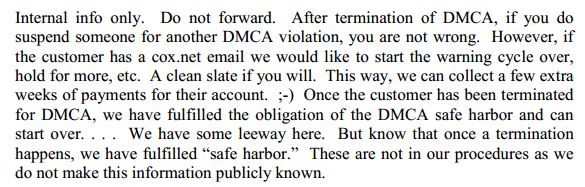
Below is a snippet from an email Zabek sent to a group of employees:

“After termination of DMCA, if you do suspend someone for another DMCA violation, you are not wrong. However, if the customer has a cox.net email we would like to start the warning cycle over, hold for more, etc. A clean slate if you will. This way, we can collect a few extra weeks of payments for their account. ;-)”
abusegroup

In other emails asking about whether repeat infringers should be reconnected Zabek replied with statements such as “It is fine. We need the customers,” “DMCA = reactivate,” and “You can make him wait a day or so if you want. ;-).”

In 2012 Cox abandoned this unofficial reactivation policy but that didn’t have a positive impact on the number of account terminations, on the contrary in fact.

The record shows that the number of disconnections dropped significantly, to less than one per month on average. In addition, emails show instances where Cox prefers to keep frequently pirating customers on board as they provide a significant revenue stream.

“BMG has identified specific instances in which Cox knew accounts were being used repeatedly for infringing activity yet failed to terminate,” Judge O’Grady writes.

“Cox does not seriously challenge these examples. Labeling them as ‘nothing more than conjecture and hyperbole,’ Cox argues that these snippets of conversations do not show what actions call centers actually took against accounts,” he adds.

For its part, Cox argued that it’s up to a court to decide that the appropriate response to infringement is the termination of the account of a subscriber, noting that copyright holder complaints may not always be accurate.

But Judge O’Grady disagrees and notes that when an ISP has actual knowledge that an account holder is a persistent pirate, his or her account should be terminated.

“Appropriate circumstances arise when an account holder is repeatedly or flagrantly infringing copyrights. Thus, when Cox had actual knowledge of particular account holders who blatantly or repeatedly infringed, the responsibility shifted to Cox to terminate their accounts,” he writes.

While BMG also submitted several other arguments, Judge O’Grady found the above sufficient to rule that Cox is not entitled to DMCA safe harbor protection.

The ruling means that it will be more difficult for Cox to defend itself against BMG’s copyright infringement claims. However, it will also raise alarm bells at various other U.S. Internet providers. At the moment it’s rare for ISPs to disconnect pirating users and this case has the potential to alter the landscape.

Source: TorrentFreak, for the latest info on copyright, file-sharing, torrent sites and ANONYMOUS VPN services.