
Accused ‘Pirates’ Win Class-Action Settlement From Rightscorp and Warner Bros

Piracy monetization firm Rightscorp and several copyright holders, including Hollywood studio Warner Bros, have agreed to settle a class-action lawsuit over intimidating robo-calls. The defendants will set aside $450,000 to cover the costs and more than 2,000 accused pirates are eligible for a $100 settlement each.

Source: TorrentFreak, for the latest info on copyright, file-sharing, torrent sites and ANONYMOUS VPN services.

piratekayPiracy monetization firm Rightscorp has often been criticized for its aggressive attempts to obtain settlements from allegedly pirating Internet users.

Little over a year ago, these claims were accumulated in a class-action lawsuit filed in California, where the company was accused of breaking several laws in their attempt to extract settlements on behalf of Warner Bros, BMG and other copyright holders.

One of the main accusations was the repeated use of robo-calls to alleged infringers. This bombardment of harassing robo-calls is a violation of the Telephone Consumer Protection Act (TCPA), the complaint alleged.

Over the past few months there haven’t been any significant updates in the case but behind the scenes the parties have been working hard to reach an agreement. This week they announced to the court that a settlement had been reached (pdf).

Although Rightscorp, Warner Bros. and the other defendants don’t admit to any wrongdoing, they agreed to take a loss and reserve a substantial amount of money to compensate hundreds of thousands of accused pirates.

This week both parties submitted the proposed settlement to the California federal court, asking for approval. According to the paperwork Rightscorp, Warner Bros and the other defendants will set aside $450,000 to resolve the matter.

“The settlement provides for a substantial benefit to the Settlement Class Members and makes available $450,000, minus Settlement Costs, to the estimated 2,059 Settlement Class Members established through pre-mediation discovery, as well as a valuable release of alleged claims Defendants have of copyright infringement for each individual class member,” the filing reads.

As part of the settlement all members of the class are entitled to $100 in compensation.

“Under the proposed settlement agreement, Defendants will contribute $450,000.00 to the Settlement Fund, and each Qualified Class Member who submits a claim and executes an Affidavit of Non-Infringement will receive approximately $100.00.”

The funds also have to cover other costs such as administration and attorney fees, so the actual compensation may have to be reduced depending on how many accused pirates claim their share.

As part of the settlement all accused pirates have to declare that they didn’t infringe any of the copyrighted works. Warner Bros and the other rightsholders will subsequently drop all copyright claims against them.

The $100 is substantially less than the damages that are generally awarded for a violation of the TCPA, which range between $500 and $1,500.

However, the paperwork points out that the accused pirates benefit from the fact that they are now off the hook for any potential copyright counter-claims, which could run into the billions for the entire class.

“Rightscorp identified 126,409 separate acts of alleged infringement, which implicate a theoretical range of $94.8 million to $19 billion in statutory damages,” the paperwork reads.

In addition to compensating the alleged pirates, Rightscorp also promises to prevent similar calls in the future without the recipient’s prior consent. This may make it harder for Rightscorp to extract settlements, which is another win for the class action members.

Source: TorrentFreak, for the latest info on copyright, file-sharing, torrent sites and ANONYMOUS VPN services.

Premier League Expands UK Pirate Site Blockades

Major UK Internet providers have been ordered to block access to dozens of domain names belonging to popular sports streaming sites. The Football Association and Premier League recently submitted several new domain names that link to previously blocked sites, to expand the scope of the national piracy blocklist.

Source: TorrentFreak, for the latest info on copyright, file-sharing, torrent sites and ANONYMOUS VPN services.

premierleagueOver the past several years hundreds of domain names have been blocked in the UK for facilitating copyright infringement, and this list is getting longer and longer.
The blocks are somewhat effective, at least in preventing subscribers from accessing the domains directly. However, many site operators and supporters launch alternative domains to bypass the restrictions.

This is also true for several sports streaming sites that were blocked by the High Court following complaints from the Football Association and Premier League Limited, including Firstrow, Rojadirecta, LiveTV and Drakulastream.

The football organizations recently submitted an extensive list of new domains and subdomains which were added to existing ISP filters, including 3pmstream.com, ifirstrowuk.eu and rojadirecta.es (full list below).

With the new blockades they hope to make it harder for UK citizens to stream unauthorized sports broadcasts. However, FirstRow’s operator previously told TorrentFreak that domain blocking is not going to be very effective as the streaming sources remain available.

“Our site uses third-party players, so blocking FirstRow will not stop the streams, as these will still be accessible online. They are saying that FirstRow is illegal, but our site is indexing streams that are available on the web, which is free information,” FirstRow’s owner told us.

“FirstRow will remain accessible for all other countries, and UK users can use proxies or the thousands of other websites like ours that remain open,” he added.

The site’s owner has a point. Interestingly, FirstRow’s most popular site in the UK appears to be Firstrows.eu. This site is not listed among the newly blocked URLs, so the game of Whack-A-Mole will is bound to continue.

The UK is not the only country where sports streaming sites are being targeted, the same is happening in Italy and Spain.

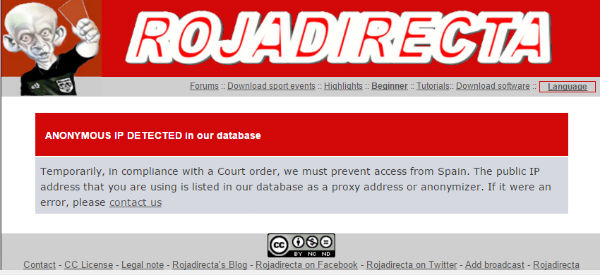
A few months ago a La Coruna court forbid Rojadirecta from linking to unauthorized streams of sports games. The streaming site, which is based in Spain, complied with the order and now blocks visitors from Spanish IP-addresses as well as various VPNs and proxies.

However, even with the site itself complying with orders from the court, success is not guaranteed. In recent weeks various Rojadirecta knockoffs have appeared online, providing unrestricted access to sports streams in Spain.

And so the game continues.

The list of newly blocked domains in the UK (including their original domain names) is as follows:

3pmstream.com
firstrowuk.eu
firstrowsports.eu
webfirstrow.eu
firstrowus.eu
firstrow1.eu
firstrowuk1.eu
firstrownow.eu
firstrowus1.eu
gofirstrow.eu
gofirstrowuk.eu
gofirstrowus.eu
ifirstrow.eu
ifirstrowuk.eu
sportsfeed365.eu
p2p4u.se
firstrowit.eu
firstrownow.se
gofirstrow.se
webmaster.firstrownow.eu
thefirstrow.se
ifirstrowus.eu
firstrowne.eu
firstrowau.eu
firstrowas.eu
firstrowfr.eu
firstrowpt.eu
firstrowir.eu
firstrowca.eu
firstrowes.eu
firstrowge.eu
firstrowgr.eu
ifirstrowpt.eu
ifirstrowit.eu
firstrow.is
webmaster.webfirstrow.eu
cssfiles.thefirstrow.eu
web.thefirstrow.eu
drakulastream.eu
realstreamunited.com
live.realstreamunited.com
rojadirectaes.me
rojadirecta.me
rojadirecta.eu
it.rojadirecta.eu
rojadirecta.org
it.rojadirecta.org
ita.rojadirecta.org
rojadirecta.com
rojadirecta.es
rojadirecta.cat

Source: TorrentFreak, for the latest info on copyright, file-sharing, torrent sites and ANONYMOUS VPN services.

Steal This Show S01E04: The Future of P2P?

Today we bring you the fourth episode of the Steal This Show podcast, discussing the latest file-sharing and copyright news. In this episode we talk with two co-founders of the peer-to-peer startup The Distributed Library Of Alexandria.

Source: TorrentFreak, for the latest info on copyright, file-sharing, torrent sites and ANONYMOUS VPN services.

steal240In this episode we’re joined by Devon Read and Ryan Taylor, co-founders of peer-to-peer startup The Distributed Library Of Alexandria.

This week we discuss the blockbuster hack of Amazon’s Fire TV stick, the increasing power of pirate movie release groups, and doomy announcements from China’s 3DM cracking group about the future for cracked games.

We also take a deep dive into the Alexandria project, which sees its mission as providing an censorship-proof safe haven for indie creators and “truth speech” alike – although, as we discover, pirates may well be able to hitch a ride.

Steal This Show aims to release bi-weekly episodes featuring insiders discussing copyright and file-sharing news. It complements our regular reporting by adding more room for opinion, commentary and analysis.

The guests for our news discussions will vary and we’ll aim to introduce voices from different backgrounds and persuasions. In addition to news, STS will also produce features interviewing some of the big innovators and minds, one-on-one.

Host: Jamie King

Guests: Devon Read and Ryan Taylor.

Produced by Jamie King
Edited & Mixed by Eric Bouthiller
Original Music by David Triana
Web Production by Siraje Amarniss

Source: TorrentFreak, for the latest info on copyright, file-sharing, torrent sites and ANONYMOUS VPN services.

Top 10 Most Pirated Movies of The Week – 01/11/16

The top 10 most downloaded movies on BitTorrent are in again. ‘The Big Short.’ tops the chart this week, followed by ‘The Revenant’ ‘The Martian’ completes the top three.

Source: TorrentFreak, for the latest info on copyright, file-sharing, torrent sites and ANONYMOUS VPN services.

bigshortThis week we have three newcomers in our chart.

The Big Short is the most downloaded movie.

The data for our weekly download chart is estimated by TorrentFreak, and is for informational and educational reference only. All the movies in the list are BD/DVDrips unless stated otherwise.

RSS feed for the weekly movie download chart.

Ranking (last week) Movie IMDb Rating / Trailer
torrentfreak.com
1 (2) The Big Short (DVDscr) 8.1 / trailer
2 (3) The Revenant (DVDscr) ?.? / trailer
3 (1) The Martian 8.2 / trailer
4 (9) The Intern 7.4 / trailer
5 (…) Solace 6.4 / trailer
6 (8) Burnt 6.7 / trailer
7 (4) Spectre (DVDscr) 7.1 / trailer
8 (6) Bridge of Spies (DVDscr) 7.9 / trailer
9 (…) Sisters (Webrip) 6.5 / trailer
10 (…) Goosebumps (WEB-DL) 6.5 / trailer

Source: TorrentFreak, for the latest info on copyright, file-sharing, torrent sites and ANONYMOUS VPN services.

Iranian State TV Broadcasts Movie From Pirate Site

Piracy is rampant in many countries around the world, but an example that reached us from Iran recently is one of the most blatant displays we’ve seen recently. Iranian state TV showed a movie to its viewers that clearly originated from a pirate website, which ironically is blocked by the Iranian Government.

Source: TorrentFreak, for the latest info on copyright, file-sharing, torrent sites and ANONYMOUS VPN services.

iribIn Iran IRIB TV3 is one of the channels operated by the Islamic Republic of Iran Broadcasting.

It’s often dubbed the youth channel as a lot of its programming attracts a younger audience, including sports events and foreign movies and TV-shows.

Perhaps in line with this philosophy, the television channel broadcasted the 2013 Hong Kong film “Saving General Yang” a few days ago. Not a regular copy though, but a pirated one.

Several Iranian viewers noticed that aside from the IRIB TV3 logo in the top right corner, there was another ‘watermark’ at the bottom. This read Tinymoviez.co, which is a popular site in Iran where people can download pirated copies of movies and TV-shows.

This oddity was picked up in the local media, which shared screenshots of the unusual sight.

Tinymoviez on Iranian national TV (credit)

iribpirate

Ironically, the Tinymoviez website and other Persian pirate sites such as Ganool are censored by the Iranian Government because they contain nudity. However, just like many citizens, Iran’s state TV appears to have found a backdoor.

IRIB TV3 is not the only channel to show pirated movies. According to the Iranian Student News Agency this is quite common as pirate watermarks also appeared elsewhere on movies such as Django Unchained, Tower Heist, and Jack the Giant Slayer.

In addition, TV broadcasters often use music from popular TV-shows such as Game of Thrones and Dexter on their own footage, reportedly without authorization.

Ganool.com mark on The Tower Heist broadcast (credit)

heist

But there’s more.

Apparently Iranian State TV isn’t limiting its pirate broadcasts to movies and TV-shows. They also broadcasted a soccer match, recorded from Al Jazeera, which prompted FIFA to threaten them with legal action.

While this blatant unauthorized use is quite a shocker in the west, in Iran it’s less of a problem. The country’s copyright law is set up to protect all copyrighted works produced by Iranians, but not necessarily those by creators from other countries.

Since 2001 Iran has been a member of the WIPO, and has acceded to several WIPO treaties. However, the Iranian Government never signed the WIPO copyright treaty and other international copyright agreements that would make copying of foreign products unlawful.

As a result, broadcasting unlicensed media has become quite common.

While ‘piracy’ appears to be rampant in Iran, there have been similar incidents elsewhere too. A few years ago Netflix accidentally used ‘pirate’ fansubs on the Canadian-American science fiction series Andromeda, for example.

Similarly, Saudi Airlines previously listed a pirated movie in its in-flight entertainment system, where passengers had the option to watch “Killers 2010 BDRiP AC3 XViD-ILOVE.”

Pirates all around.

Source: TorrentFreak, for the latest info on copyright, file-sharing, torrent sites and ANONYMOUS VPN services.

Pirates Fail to Prevent $38 Billion Box Office Record

Hollywood tends to leave no opportunity unused in its quest to show that online piracy is devastating the movie industry. However, this supposed devastation is not visible at the box office this year. In 2015 worldwide box office grosses surpassed $38 billion, while North American theaters raked in more that $11 billion for the first time in history.

Source: TorrentFreak, for the latest info on copyright, file-sharing, torrent sites and ANONYMOUS VPN services.

piratefishToday, watching pirated movies is arguably easier than it has ever been before.

Pirates can choose from hundreds of torrent, streaming and direct download sites, and there are dedicated applications that allow people to stream the latest blockbusters without paying a cent.

Movie industry insiders are doing whatever they can to contain piracy. This appears to be a near impossible task as many unauthorized sites and services are operated by anonymous owners.

As a result the MPAA and other groups warn that hundreds of thousands of jobs are at stake, while the economy is losing billions due to piracy. Illegal downloads, they say, are slowly killing their creative industry.

Interestingly, these stark warnings are not reflected in last year’s box office revenues.

Recent numbers show that the movie industry just broke the magic $11 billion barrier, generating more revenue than ever before at the North American box office. The revenue for 2015 totals $11.3 billion, which is roughly a 9% change compared to last year.

The worldwide grosses also reached an all-time record according to research from Rentrak, which estimates the global grosses at a staggering $38 billion based on data from 25,000 theaters across the globe.

Another sign that business is going well, at least for some, is the increase in the number of tickets that were sold. In 2015 theaters increased their ticket sales by more than 5% in North America.

Of course, the above doesn’t prove that illegal downloads have no effect at all. It could be that the movie industry would make even more money if all pirate sites disappeared overnight, as some studies suggest.

Also, the movie industry isn’t by any means limited to the box office. DVD sales and various streaming platforms impact the bigger picture as well.

That said, piracy has certainly not destroyed the movie business just yet. There are still plenty of people who are going to the movie theater to pay for their entertainment. Perhaps pirates should up their game?

Source: TorrentFreak, for the latest info on copyright, file-sharing, torrent sites and ANONYMOUS VPN services.

Movie Studios Target Torrent users Over Leaked Screeners

Hollywood studios have sent thousands of warnings to Internet subscribers whose connections were used to share leaked DVD screeners. The warnings have no immediate consequences for the affected subscribers but are meant to deter pirates from sharing the high profile leaks.

Source: TorrentFreak, for the latest info on copyright, file-sharing, torrent sites and ANONYMOUS VPN services.

hatefIn recent weeks more than a dozen high quality screener copies leaked online, including The Big Short and The Hateful Eight.

Most of the leaks originated from release group Hive-CM8. The group promised to leak 40 screeners but stopped at 14, after offering an apology in release notes last week.

Apology or not, the FBI is still trying to catch the perpetrators and has already traced The Hateful Eight leak back to a Hollywood executive.

Various movie companies have also started to issue takedown requests to various websites in the hope that this will prevent at least some people from downloading their films without permission. And it doesn’t stop there.

Over the past few days the movie studios have also sent out a flurry of takedown notices targeted at individual BitTorrent users. TorrentFreak has seen several notices, which all come in the standard format.

Through its anti-piracy partner IP-Echelon, Paramount Pictures instructs Internet providers to ensure that the account holder associated with the infringing IP-address stops the unauthorized distribution.

“We are requesting your immediate assistance in removing and disabling access to the infringing material from your network. We also ask that you ensure the user and/or IP address owner refrains from future use and sharing of Paramount materials and property,” the notices read.

Paramount targets downloaders of DVD screeners of both The Big Short and Anomalisa. Roadshow Films uses the same messages to contact subscribers who allegedly pirated The Hateful Eight.

Notice for The Big Short screener

bigshortnotice

Twentieth Century Fox is working with Irdeto to track down and report people who share “Joy” screeners and instructs Internet providers to relay the alerts to the associated account holders.

“These are serious offenses which could lead to legal consequences for the account holder,” the warnings read.

In addition, the notice suggests that ISPs may want to take additional measures such as disconnecting the accounts of repeat infringers, or they could be held liable as well.

The language in the notices is similar to other DMCA notices that are commonly sent out. Despite the stark warnings, the studios in question are not known to go after individual downloaders.

Instead, the companies hope that the warnings will deter some from downloading similar leaks in the future.

Whether that will have any effect has yet to be seen. Popular screeners such as The Hateful Eight and The Big Short have been downloaded million of times already and remain quite popular.

Source: TorrentFreak, for the latest info on copyright, file-sharing, torrent sites and ANONYMOUS VPN services.

The Pirate Bay Switches on New .MS Domain

The Pirate Bay has put a new domain name into circulation. Starting this week TPB has officially switched on the Montserrat-based domain name ThePirateBay.ms. The new addition is welcome since the torrent site recently lost control over most of its active domain names.

Source: TorrentFreak, for the latest info on copyright, file-sharing, torrent sites and ANONYMOUS VPN services.

pirate bayThe Pirate Bay has gone through a lot of domain changes over the past year.

When the operators found out that Swedish authorities might confiscate their .se domain as the result of a legal battle, the torrent site added six new alternatives last Spring.

In the months that followed this “hydra” was carefully destroyed as registrars and registries suspended the domain names in question. This most likely happened in response to copyright holder complaints.

Ironically, this meant that TPB was back to square one relying on the older .se and .org domains. However, starting this week the torrent site has added a new domain option.

The notorious torrent site is now also accessible from the Montserratian .MS TLD. Both the .SE and .ORG domains pointed to the new domain earlier, but this redirect has been turned off at the time of writing.

With the latest addition TPB now has three generic TLDs, as well as the .onion version which is exclusively available through the Tor network. Pirate Bay’s official forum has also added ThePirateBay.ms to the list of official domains.

Pirate Bay’s active domains

tpblocations

The TPB team registered the .MS extension several years ago but it hasn’t been used as a primary domain until now. Strangely enough the domain name is linked to the same registrar who previously suspended the other domains.

While TPB remains widely accessible some related issues remain. TPB’s Pirate Browser domains piratebrowser.com, piratebrowser.net and piratebrowser.org remain suspended due to an ICANN verification issue, for example.

There’s currently no known alternative domain for The Pirate Browser but the application can still be downloaded by visiting the site’s direct IP-address. Adding a new domain would be relatively easy but it appears that the TPB-crew has other priorities at the moment.

Time will tell how long the new .MS domain lasts. It’s expected that TPB’s operators will register additional domain names in the future to make sure that the site doesn’t run out of options.

Source: TorrentFreak, for the latest info on copyright, file-sharing, torrent sites and ANONYMOUS VPN services.

Startup Leverages DMCA Notices As Artist Marketing Tool

Every day millions of pirates are being tracked by companies working for the entertainment industries. This data is often used to warn or even sue alleged offenders, but a new startup is taking a different route. Instead of punishing pirates they treat them as fans, allowing artists to use DMCA notices as a marketing tool.

Source: TorrentFreak, for the latest info on copyright, file-sharing, torrent sites and ANONYMOUS VPN services.

traceFor more than two decades online piracy has been a hot topic in the music industry.
The problem has motivated people to sue downloaders or target them with DMCA takedown requests, which are sometimes bundled with settlement demands.

Muzit is a new startup which also tracks millions of BitTorrent pirates. However, instead of punishing downloaders they take a more gentle approach. Muzit uses DMCA notices as a means to connect artists and fans.

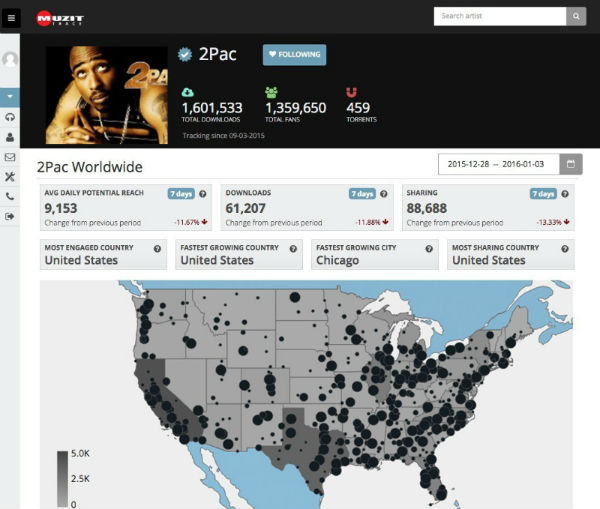
Muzit’s TRACE platform keeps track of where illegal downloads occur across the world and the company shares these insights with artists. They can then choose to alert the alleged pirates through DMCA notices and include a marketing message in these emails.

“Muzit was created for copyright owners who want to reach out and build a positive relationship with their fans. As long as it’s friendly, artists can send any type of message they want,” Muzit CEO Tommy Funderburk tells TF.

Funderburk is a music industry veteran with a keen interest in file-sharing. He used the same BitTorrent tracking technology in a previous startup called PayArtists where a similar system was used to demand settlement payments from alleged file-sharers.

This punishment approach has now been swapped for a system that embraces P2P distribution, hoping to connect artists and fans. As part of this positive attitude the company also dropped the use of the term “pirate.”

“At Muzit we have eliminated the word ‘pirate’ from our vocabulary. We choose to regard individuals who use P2P as fans and potential customers.‘Fans not Foes’ as we like to say,” Funderburk says.

Muzit’s artist dashboard

muzit1

Muzit is currently working with several copyright holders including The Mavericks and the estates of James Brown and Isaac Hayes. Typical “offers” they send to downloaders include exclusive music downloads, merchandise and unique artist memorabilia.

“Recently The Mavericks used Muzit TRACE to encourage people to sign up for their fan club by offering a free giveaway of an autographed guitar. In this campaign, they were able to reach out to around 200,000 new fans,” Funderburk tells TF.

The Mavericks are happy with the results of their campaigns so far and see them as an ideal tool to reach an audience which they haven’t been able to connect with in the past.

“We were blown away. We had no idea we had this whole other world of fans sharing our music on P2P. It works and it sure beats the hell out of an email sign up sheet at the door,” Raul Malo, leader of The Mavericks, says.

Thus far Muzit’s database includes 8.6 million file-sharers but they will continue to expand. The company also makes it clear that artists can only connect to the people who have shared their work.

The company certainly takes an interesting approach, but it’s also an odd way to use the DMCA notification system. DMCA notices are generally not intended to include all sorts of additional messages. While some downloaders may appreciate hearing from artists, others may see it as a form of spam.

Still, that beats the settlement demands companies such as Rightscorp send out.

Source: TorrentFreak, for the latest info on copyright, file-sharing, torrent sites and ANONYMOUS VPN services.

U.S. Govt Reviews Impact and Efficacy of DMCA Safe Harbor

The U.S. Government has launched a public consultation to evaluate the effectiveness of the DMCA’s Safe Harbor provisions. The study aims to signal problems with the current takedown procedures and also addresses the repeat infringer issue that affects ISPs, copyright takedown abuses, and the ever-increasing volume of DMCA notices.

Source: TorrentFreak, for the latest info on copyright, file-sharing, torrent sites and ANONYMOUS VPN services.

us-united-america-flagSigned into law by President Bill Clinton in 1998, the Digital Millenium Copyright Act (DMCA) aimed to ready copyright law for the digital age.
The law introduced a safe harbor for Internet services, meaning that they can’t be held liable for their pirating users as long as they properly process takedown notices and deal with repeat infringers.

Today, the DMCA is perhaps more in the news than ever before. Just last month Internet provider Cox Communication was ordered to pay $25 million because it failed to disconnect subscribers whose connections were repeatedly used to pirate content.

In addition, millions of takedown notices are sent out every day while copyright holders and Internet services openly debate the effectiveness of the current DMCA takedown procedures.

To hear the growing concerns from all sides the U.S. Copyright Office has launched a public consultation in order to evaluate the impact and effectiveness of the DMCA’s safe harbor provisions.

“Among other issues, the Office will consider the costs and burdens of the notice-and-takedown process on large- and small-scale copyright owners, online service providers, and the general public. The Office will also review how successfully section 512 addresses online infringement and protects against improper takedown notices,” the Copyright Office writes.

Various stakeholders, including the public, are invited to answer a wide variety of questions. How effective takedown notices are in deterring piracy, for example, how costly the process is, and whether more should be done to assure that links don’t reappear elsewhere.

The latter issue was brought to the forefront recently when Google rejected the idea to ban entire domain names from its search results, or implement a system that would prevent content from reappearing under a new URL.

The consultation also mentions the “repeat infringer” issue which is a major concern for ISPs. At the moment it’s not common for Internet providers to disconnect subscribers who repeatedly pirate content, as there’s no clear definition of what a repeat infringer is.

Demanding a tougher stance, several copyright holders argue that notices without any repercussions are not going to be very effective.

The automated takedown tools which often lead to incorrect removals are raised as well. The same is true for more serious forms of abuse, where takedown notices are used to silence critics or stifle free speech.

“Service providers and advocacy groups have raised concerns about fraudulent and abusive section 512 notices that may restrain fair use, free speech, or otherwise misuse the notice-and-takedown process,” the Copyright Office notes.

“Some of the concerns arise from takedown notices for content that appears to constitute an obvious fair use of a copyright work. Others relate to efforts to remove criticism or commentary—such as negative reviews—under the guise of copyright.”

For their part, copyright holders believe that many Internet services are simply hiding behind their safe harbor protections. A more proactive stance to deal with various forms of piracy is required, they argue.

Considering the parties involved and the stakes at hand, copyright holders, Internet services and ISPs will leave no resource untapped to have their views heard. In any event, the Copyright office will have to plow through a lot of contrasting opinions.

Source: TorrentFreak, for the latest info on copyright, file-sharing, torrent sites and ANONYMOUS VPN services.