
Netflix Exempts U.S. Military Bases From Copyright Geo-Blocks

Netflix is increasingly blocking users who circumvent geo-restrictions though VPNs and proxies. This issue worries many U.S. soldiers stationed oversees, but according to Netflix American military bases will still be able to access the content library of their home country.

Source: TF, for the latest info on copyright, file-sharing, torrent sites and ANONYMOUS VPN services.

us-united-america-flagEarlier this month Netflix announced that it would increase its efforts to block subscribers who circumvent geo-blockades.

This means that it will be harder to use VPN services and proxies to access Netflix content from other countries, as movie studios have requested.

With the application of commercial blacklist data Netflix blocks IP-addresses that are linked to such services. The announcement caused concern among many people who live and work abroad, including U.S. military personnel.

Many soldiers stationed in the Middle East and elsewhere use Netflix in combination with a VPN, to feel ‘at home.’ Soon, this may no longer be possible, at least not for those who live off-base.

While Netflix is determined to take stronger action against VPN-pirates, the company also says that all U.S. military bases are exempt from blockades, Stars and Stripes reports

“Netflix always exempts U.S. military bases around the world. They will still be able to access the U.S. catalog,” Netflix spokesperson Anne Marie Squeo said.

This is an interesting decision, since most military bases abroad are not considered U.S. soil. Also, we are not aware of a similar treatment for other oversees workers or military bases of non-U.S. countries.

Still, for most soldiers this gesture is not enough, as they live off-base.

Jesse Fowler, a hospital corpsman stationed in Bahrain, says he’s not disappointed with the local offering of Netflix but relies on a VPN to access some shows that are not available.

“…I’m mad if I can’t change where my Internet is so I can’t watch my own shows,” Fowler says.

This sentiment is shared by the Bahrain-stationed Navy counselor Eric Cutright. “My VPN hasn’t been blocked. But if it does, I will be pissed. Netflix Bahrain is trash,” he said.

TorrentFreak has kept a close eye on the recent developments and Netflix has indeed started to block more VPN providers. However, blocking all of them appears to be a difficult task, especially because several providers continue to add new IP-addresses.

Ironically, many soldiers may switch to piracy again when Netflix is no longer an option, turning the clock back half a decade.

Source: TF, for the latest info on copyright, file-sharing, torrent sites and ANONYMOUS VPN services.

South American Pirates Transfer 789 Petabytes Per Year

New research shows that online piracy is widespread in South America. Nearly half of all Internet users have used pirate sites and services, transferring a healthy 789 petabytes per year. Unlike in other regions, direct download sites are consistently more popular than P2P-based solutions such as BitTorrent.

Source: TF, for the latest info on copyright, file-sharing, torrent sites and ANONYMOUS VPN services.

cassetteCommissioned by the copyright TV industry group Alianza, research firm NetNames has just released a comprehensive report on the scope of online piracy in South America.

The study is a follow-up on the global “Sizing the Piracy Universe” report released two years ago. It combines data from various sources to estimate the local piracy landscape.

Analyzing data from Argentina, Brazil, Chile, Colombia, Ecuador, Peru, Paraguay, Uruguay and Venezuela, the report concludes that nearly half of the population has visited pirate sites or services in the period of a month.

“Of the approximately 222.3 million Internet users in South America, nearly 50%, or 110 million, accessed a site that distributed pirated audiovisual content by means of either a cyberlocker, peer-to-peer network or illegal IPTV streaming site,” the report reads.

Contrary to the worldwide picture, direct download sites receive more visitors and generate more bandwidth than peer-to-peer sharing such as BitTorrent. This may in part be due to lower Internet speeds, which are not optimal for P2P transfers.

Per year cyberlocker traffic accounts for more than half of all piracy traffic, 442 petabytes, compared to 265 petabytes of peer-to-peer traffic. NetNames also includes data for pirated live IPTV broadcasts, which adds another 82 petabytes.

In total the South American piracy landscape generates 789 petabytes per year. Or put differently, a whopping 2.3 million gigabytes per day.


sapiracy

While these bandwidth numbers may look impressive they pale in comparison to other regions. For example, NetNames previously found that piracy accounted for roughly 20,000 petabytes of bandwidth per year in North America, and a massive 26,000 petabytes in Europe.

NetNames notes that it is nonetheless a considerable proportion, since the local Internet infrastructure is underdeveloped, and warns that copyright holders may face even higher levels of piracy if Internet penetration and speeds increase.

The report is expected to serve as an important lobbying tool to convince local lawmakers to take steps to prevent copyright infringement. Michael Hartman, Senior Vice President of DIRECTV Latin America, believes it is key to raise awareness.

“Online piracy represents a significant threat to the protection of intellectual property rights,” Hartman says.

“This is the first step necessary to raise awareness of the problem. It will enable Alianza members to educate others about the problem and develop strategies to combat this form of piracy.”

The full NetNames report is available on the Alianza website.

Source: TF, for the latest info on copyright, file-sharing, torrent sites and ANONYMOUS VPN services.

“My Little Pony” Sued For Using a Pirated Font

Typeface company Font Brothers has filed a lawsuit against Hasbro claiming that My Little Pony uses one of its fonts without permission. According to the complaint, Harbro refuses to pay the required licenses while it continues to use the font in its My Little Pony merchandise and products.

Source: TF, for the latest info on copyright, file-sharing, torrent sites and ANONYMOUS VPN services.

mlpPiracy comes in all shapes and sizes and even large multinationals can sometimes cross the line.

According to Font Brothers, American toy multinational Hasbro did so when it started to use the “Generation B” font for its My Little Pony products, without permission.

The Generation B font was created by Harold Lohner and is commercially exploited by Font Brothers.

One of the best known uses of the font is for the popular My Little Pony toys and videos. However, according to a complaint filed at a New York federal court Hasbro failed to obtain a proper license, so My Little Pony is using a pirated font.

“Defendant Hasbro has used or instructed others to use unauthorized copies of the Generation B Font in the creation of, but not limited to, all products, goods, merchandise, television and film properties, and advertising materials connected with the ‘My Little Pony’ product line..,” the complaint reads.

“Defendant Hasbro has created unauthorized and infringing copies of the Generation B Font Software and impermissibly distributed the same to third parties,” it adds (pdf).

Font Brothers claim that the font is being used across a wide variety of products and the company list various examples.

While small differences can sometimes be tricky to prove that an unauthorized font is used, in this case it is also used on Hasbro’s website. The stylesheet of the website specifically mentions the Generation B and a copy of the font stored and distributed through Hasbro’s servers.

My Little Pony website using the Generation B font

mlp-generationb

In the complaint Font Brothers write that they contacted Hasbro about the infringing use, but the toy maker refused to license the font for My Little Pony products and merchandise.

“Defendant has refused to comply with Plaintiff’s reasonable request for appropriate software licensing fees given the services already rendered by Plaintiff’s GENERATION B type font software, despite several demands for such action.”

As a result, Minnesota-based Font Brothers are claiming substantial damages and requesting a jury trial to resolve the matter.

“Font Brothers has lost, and will continue to lose, substantial revenue from Defendant’s wrongful use, copying, distribution, and creation of unauthorized infringing works based upon the GENERATION B font software.”

Considering the scope of the alleged infringements, which affect pretty much the entire My Little Pony line, the potential damages run into the millions. In addition, Font Brothers demand the destruction of all products and material which utilize the infringing font.

Source: TF, for the latest info on copyright, file-sharing, torrent sites and ANONYMOUS VPN services.

Top 10 Most Pirated Movies of The Week – 01/25/16

The top 10 most downloaded movies on BitTorrent are in again. ‘Spectre.’ tops the chart this week, followed by ‘The Big Short’ ‘The Revenant’ completes the top three.

Source: TF, for the latest info on copyright, file-sharing, torrent sites and ANONYMOUS VPN services.

spectre1This week we have two newcomers in our chart.

Spectre is the most downloaded movie.

The data for our weekly download chart is estimated by TorrentFreak, and is for informational and educational reference only. All the movies in the list are BD/DVDrips unless stated otherwise.

RSS feed for the weekly movie download chart.

Ranking (last week) Movie IMDb Rating / Trailer
torrentfreak.com
1 (2) Spectre 7.9 / trailer
2 (1) The Big Short (DVDscr) 8.1 / trailer
3 (3) The Revenant (DVDscr) ?.? / trailer
4 (5) The Intern 7.4 / trailer
5 (7) Black Mass (Web-DL) 7.1 / trailer
6 (6) The Martian 8.2 / trailer
7 (…) The Veil 5.0 / trailer
8 (4) Bridge of Spies 7.9 / trailer
9 (9) The Last Witch Hunter (WEB-DL) 6.0 / trailer
10 (…) Legend 7.1 / trailer

Source: TF, for the latest info on copyright, file-sharing, torrent sites and ANONYMOUS VPN services.

World’s Oldest Torrent Is Still Being Shared After 4,419 Days

A fan-created ASCII version of the 1999 sci-fi classic The Matrix is the oldest known torrent that’s still active. Created more than 12 years ago, the file has outlived many blockbuster movies and is still downloaded a few times a week, even though the site from where it originated has disappeared.

Source: TF, for the latest info on copyright, file-sharing, torrent sites and ANONYMOUS VPN services.

matrix-ascii-smallBitTorrent is an excellent distribution mechanism, but for a file to live on at least one person has to keep sharing it.

This means that most torrents eventually die after the public loses interest. However, some torrents seem to live on forever.

More than ten years ago TorrentFreak reported on a fan-made ASCII version of The Matrix, describing it as a really old torrent. This torrent had survived for 696 days, which was a rarity.

At the time BitTorrent had only a fraction of the users it has now so it was harder to keep them active. A lot of things have changed in the decade since, but the torrent in question is still going strong.

The torrent file of The Matrix ASCII was created more than 12 years ago (4,419 days) on December 20, 2003. Even though the original site is no longer online, it still has 8 active seeders at the time of writing.

There are also people actively downloading the file, most likely after they found a copy of the release on one of the torrent sites where it remains available. To the best of our knowledge, this means that The Matrix ASCII is the oldest torrent that’s still being actively shared.

The.Matrix-ASCII screencapmatrix-ascii-large

The 12-year-old release of The Matrix ASCII comes with a DVD cover and insert. While there are no accurate statistics available it is believed to have been downloaded by tens of thousands of people over its lifetime.

Perhaps worried that Hollywood wouldn’t appreciate the effort, the torrent includes a small disclaimer.

“This work is a parody. As such I do not believe that this DVD has any possibility of competing with the original in any market. It is not for sale,” the disclaimer reads.

Prospective downloaders have very little to worry about though. Warner Bros. is not known to go after this type of fan-art that’s created for non-commercial use and the creator has never been targeted either.

The people who’ve downloaded a copy of The Matrix have thus far responded mostly positively after watching the ASCII movie. That is, those who knew what to expect. Those looking for the original Matrix movie are less appreciative.

“Dude, tell me what to do with this Matrix ASCII, cause the picture is all green n stuff, can’t even see what’s going on. And, its in 4 VOB files, but why?” was the response of one unhappy downloader.

The fact that this torrent has been able to survive for so long is a testament to the resilience of BitTorrent. For us, The Matrix ASCII has become an iconic release and we’ll certainly keep an eye on how it fares in the future.

Source: TF, for the latest info on copyright, file-sharing, torrent sites and ANONYMOUS VPN services.

Creative Kids Turn MIT Website Into a ‘Piracy’ Haven

In recent weeks the music industry has started to target the Massachusetts Institute of Technology (MIT) website over tens of thousands of copyright infringements. The deviant behavior doesn’t come from typical pirates though, but from children using the Scratch project to share ‘their’ creative expressions.

Source: TF, for the latest info on copyright, file-sharing, torrent sites and ANONYMOUS VPN services.

spongepirateKids love to be creative and in today’s world, tablets and computers offer a wealth of options to do so.
One of these creative playgrounds is the visual programming language Scratch, which has been in development at the Massachusetts Institute of Technology (MIT) for over a decade.

“With Scratch, you can program your own interactive stories, games, and animations — and share your creations with others in the online community,” the project explains.

Scratch targets children between the ages of 8 and 16, who can create and remix works of art through an easy to use web-based interface. The tool has become quite popular in recent years with over 12 million projects being shared.

More recently, however, it also gained the attention of copyright holders. Over the past months music industry group BPI sent tens of thousands of takedown notices targeting the creative playground, pointing out the use of various pirated tracks.

Indeed, upon closer inspection it appears that many kids projects feature songs of popular artists.

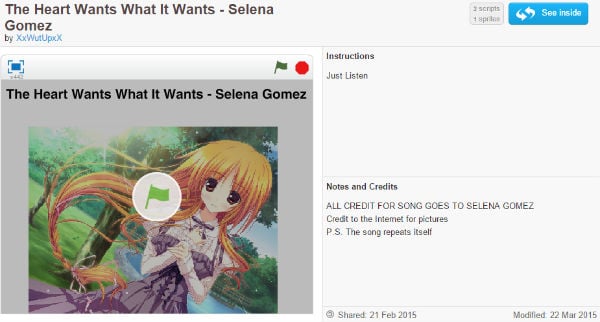
“Credit to the Internet for pictures”

creditinternet

Many of the young creators may not be aware of their infringing acts, but the major music labels certainly are. MIT doesn’t publish any details on takedown notices but Google alone has received close to 40,000 alerts referencing infringing “scratch.mit.edu” URLs.

This makes the MIT website one of the top pirate sites on the Internet, and definitely the most infringing educational domain.

Interestingly, the youngsters are not completely oblivious to the concept of copyright. One user addresses the issue in the Scratch forums, asking whether it’s okay to use copyrighted music in his creations.

Other members quickly chimed in concluding that this type of use is permitted.

“Yep! Scratch has a special license that lets you use copyrighted music and other things – just be sure to give credit to anything you don’t own,” one commenter wrote.

“We’re technically protected under fair use because scratch is ‘educational’,” another comment added.

While this may sound reassuring it’s also a bit misguided. Scratch certainly doesn’t have a license to use all copyrighted music and even the educational argument could be contested in court.

The people behind the Scratch project seem to be aware of the potential issues. The site has a DMCA takedown policy in place which allows rightsholders to remove content, but not before giving it a second thought.

“In assessing whether or not a Scratch user has violated your copyrights, please keep in mind that Scratch is an educational and not-for-profit initiative, seeking to aid children’s learning by providing the tools for them to learn and express themselves using digital technology,” the Scratch project writes.

“We hope you also see Scratch not only as a good way of popularizing your creations/website but also as an opportunity to do something good for children’s education,” it adds.

If copyright holders still want to take down the kids’ creations they are welcome to do so, but they should think of the children first…

Luckily for the BPI and other copyright groups Scratch isn’t all bad. They would certainly appreciate this home-made anti-piracy PSA created by one Scratcher, for example.

“Don’t steal things”

scratchpirate

Source: TF, for the latest info on copyright, file-sharing, torrent sites and ANONYMOUS VPN services.

EFF Warns Against Broad “Stay Down” Anti-Piracy Filters

Copyright holders want websites to implement strict filters to guarantee that content stays down after a DMCA notice is received. The EFF warns against these demands, arguing that they will lead to a “filter everything” approach. According to the EFF this will result in more abuse and mistakes from often automated takedown bots.

Source: TF, for the latest info on copyright, file-sharing, torrent sites and ANONYMOUS VPN services.

targetmissThis month the U.S. Government’s Copyright Office launched a public consultation to evaluate the effectiveness of the DMCA’s Safe Harbor provisions.

The study aims to signal problems with the current takedown procedures and addresses the repeat infringer issue that affects ISPs, copyright takedown abuses, and the ever-increasing volume of DMCA notices.

An issue that’s been high on the agenda are requests from copyright holder groups to ensure that content “stays down” after it’s removed. For example, when Google removes a copyrighted image from its search results, it should ensure that it doesn’t reappear under another URL.

This “take down, stay down” approach is being pushed by industry groups including the MPAA and RIAA who believe that the current takedown procedures are not effective.

However, not everyone welcomes tighter rules. In particular, the recent proposals struck a nerve with the Electronic Frontier Foundation (EFF) who warn against such broad copyright filters.

“Now, some lobbyists think that content filtering should become a legal obligation: content companies are proposing that once a takedown notice goes uncontested, the platform should have to filter and block any future uploads of the same allegedly infringing content,” the EFF’s Elliot Harmon notes.

“Filter-everything would effectively shift the burden of policing copyright infringement to the platforms themselves, undermining the purpose of the safe harbor in the first place.”

One of the problems is that copyrighted content may be infringing on one site, but not on another. For example, a video creator may want to take down infringing copies of his work, but that doesn’t mean that all the licensed versions should be removed from the web too.

In addition, the EFF points out that automated takedown tools are far from perfect. The takedown ‘robots’ that copyright holders employ often make mistakes, removing access to content that’s not infringing at all.

“Here’s something else to consider about copyright bots: they’re not very good,” Harmon writes.

“Content ID routinely flags videos as infringement that don’t copy from another work at all. Bots also don’t understand the complexities of fair use. In September, a federal appeals court confirmed that copyright holders must consider fair use before sending a takedown notice,” he adds.

The EFF does agree with copyright holders that the DMCA notice-and-takedown procedure isn’t perfect. But, instead of more strict filtering they would like more safeguards to ensure that free speech and fair use are protected. This is not the case at the moment.

“You don’t need to look far to find examples of copyright holders abusing the system, silencing speech with dubious copyright claims,” Harmon notes.

“Under the filter-everything approach, legitimate uses of works wouldn’t get the reasonable consideration they deserve. Even if content-recognizing technology were airtight, computers would still not be able to consider a work’s fair use status,” he adds.

The above clearly shows that there’s a great divide on how the DMCA takedown process should operate and what changes the U.S. Government should implement.

Considering the parties involved and the stakes at hand, copyright holders, Internet services and ISPs will do everything in their power to convince the Copyright Office that they know what’s best for the future of the Internet.

Source: TF, for the latest info on copyright, file-sharing, torrent sites and ANONYMOUS VPN services.

Piracy Can Boost Digital Music Sales, Research Shows

A new academic paper published by the Economics Department of Queen’s University examines the link between BitTorrent downloads and music album sales. The study shows that depending on the circumstances, piracy can hurt sales or give it a boost through free promotion.

Source: TF, for the latest info on copyright, file-sharing, torrent sites and ANONYMOUS VPN services.

cassetteFor more than a decade researchers have been looking into the effects of online music piracy on the revenues of the record industry, with mixed results.

By now it’s clear that there’s no universal positive or negative effect of piracy on sales. The results depend on the type of artist, music genre and media, among other variables.

A newly published study by Jonathan Lee, researcher at Queen’s University Department of Economics, sheds an interesting light on these differences and unravels another piece of the puzzle.

In a working paper titled Purchase, Pirate, Publicize: The Effect of File Sharing on Album Sales, he examined the effect of BitTorrent piracy on both digital and physical music sales.

The goal of the study is to find out whether piracy’s sales displacement (piracy hurts sales) or the promotion component (piracy boosts sales) has a stronger effect.

“In theory, piracy could crowd out legitimate sales by building file sharing capacity, but could also increase sales through word-of-mouth,” Lee explains.

Drawing on a data set of 250,000 albums and 4.8 million downloads from a popular private BitTorrent tracker, he found some interesting effects. The overall results show a modest negative impact on album sales, as music industry executives would expect.

“From the results, I conclude that file sharing activity has a statistically significant but economically modest negative effect on legitimate music sales,” Lee writes.

Interestingly, however, this negative result is largely driven by physical sales. For many artists, piracy actually boosts digital sales, presumably because it serves as free advertising.

“This relationship varies by medium: file sharing decreases sales of physical copies but boosts sales of digital ones for top-tier artists, suggesting that the word-of-mouth effect is most relevant for the digital market.”

In addition, the popularity of the artists is an important factor too. More popular artists do relatively well as the boost in digital album sales compensates for the loss on the physical side.

“Top-tier artists lose sales, but the loss is partially offset by an increase in digital sales and the overall effect is small,” Lee writes.

Links between piracy and sales across various artists tiers

piracysales

For their part, artists who are somewhat popular actually benefit from piracy while lesser knows musicians are hurt the most. The latter may be explained by the fact that these artists simply aren’t good enough for people to buy their work.

“Mid-tier artists are helped slightly and bottom-tier artists are significantly hurt by file sharing, which could indicate that file sharing helps lesser-known artists only if they are actually talented,” Lee notes.

The study adds to the never-ending debate on the effect of piracy on sales. It’s a good illustration that file-sharing can have both a positive and a negative impact.

One of the downsides is that the data itself is relatively old, from 2008, and the music industry has changed a lot since then. This means that the results may have been different today.

Also, it’s worth noting that the download numbers come from a BitTorrent tracker that counts a relatively high share of music aficionados. They may also act differently than the general file-sharer.

That said, the paper offers a unique and unprecedented analysis of BitTorrent piracy on music sales. It clearly disputes the general argument that music piracy exclusively hurts album sales, and suggests that BitTorrent piracy can act as promotion under certain circumstances.

Source: TF, for the latest info on copyright, file-sharing, torrent sites and ANONYMOUS VPN services.

Netflix Wants to Be a Great Carrot For ‘Real’ Pirates

Netflix CEO Reed Hastings has responded to the recent backlash over the company’s VPN crackdown. Netflix doesn’t expect the measures to have any impact revenue wise and says that it wants to be a carrot for ‘real’ online pirates instead. Recent numbers suggest that the company is on the right path.

Source: TF, for the latest info on copyright, file-sharing, torrent sites and ANONYMOUS VPN services.

netflix-logoLast week Netflix announced that it would increase its crackdown against VPN and proxy users who circumvent the company’s geographical restrictions.

In an earnings interview Netflix CEO reed Hastings commented on this decision, admitting that it was made at the behest of copyright holders.

While VPN providers and users have criticized the tougher restrictions, Netflix itself doesn’t expect that it will cause an exodus of paying subscribers.

“I don’t think we will see any impact,” Hastings said.

“We’ve always enforced proxy blocking with a blacklist. Now we’ve got an expanded and enhanced blacklist, so I don’t think we’re going to see any huge change,” he adds.

According to Hastings it’s perfectly reasonable for copyright holders to demand tougher action against VPN and proxy users. However, this use is only a small fraction of the ‘real’ piracy problem.

“It’s not a big contributor to overall global piracy,” Hastings notes.

The real challenge is to convert those who use pirate sites and applications such as Popcorn Time. Netflix wants to be a carrot for these users which means that offering good content is high on the anti-piracy agenda.

“Overall global piracy is a big problem and we’re working with all the content owners, partially to be a great carrot, and also to have the other services like HBO and Amazon be great carrots,” Hastings said.

In a letter to the company’s shareholders Netflix notes that quite a bit of progress has been made in recent years.

Drawing on data from the broadband management company Sandvine, it shows that Netflix and other over‐the‐top services continue to grow their share of Internet peak traffic at the expense of BitTorrent.

netflixpirates

“A closer look at the Sandvine data shows that the entire Over‐the‐Top category is growing as consumers increasingly embrace Internet TV and on demand viewing and, even better, this growth is coming at the expense of piracy,” the letter reads.

While blocking VPN users may not reverse this trend right away, it certainly doesn’t make Netflix a more appealing carrot. In fact, it looks more like a stick to scare paying subscribers.

In the long-term the company hopes to make the entire geo-blocking discussion obsolete by offering movies and TV-shows worldwide. Netflix is already doing this for its own originals, but whether Hollywood will come along for the ride remains to be seen.

Source: TF, for the latest info on copyright, file-sharing, torrent sites and ANONYMOUS VPN services.

Portugal’s Piracy Blocklist Censors U.S. Game Developer

The voluntary anti-piracy agreement between anti-piracy groups and ISPs in Portugal has resulted in some unusual collateral damage. In addition to hundreds of pirate sites, the blocklist now also targets the website of Carbon Games, an American indie game company.

Source: TF, for the latest info on copyright, file-sharing, torrent sites and ANONYMOUS VPN services.

carbongamesIn recent months Portuguese Internet providers have started to block hundreds of websites that allegedly link to copyright infringing content.

The voluntary blocking regime was formalized last summer through an agreement between several parties including the Ministry of Culture and the Association of Telecommunication Operators.

The agreement allows copyright holders to add new pirate sites without any intervention or oversight from a court, something which has now led to some rather unusual collateral damage.

This week several people noticed that the website of indie game developer Carbon Games was blocked as well. Instead of access to the company’s website, visitors in Portugal see the following message.

“The site that you’re trying to reach was blocked due to an order from the Regulator Agency”.

The blocking message

ptblock

The issue was first reported by Revolução dos Bytes, which confirmed that the blockade is active across several large ISPs including NOS, MEO and Vodafone.

Generally speaking sites are added following complaints from copyright holders. The reported sites are then investigated by local anti-piracy group MAPINET and will end up on the blocklist if there’s enough evidence of systematic infringing activity.

Sites that fall into this category should contain at least 500 links to infringing material or have one-third of the site dedicated to facilitating copyright infringement. This doesn’t appear to be the case for the Carbon Games site.

The good news for Portuguese gaming fans is that the blockade is easily circumvented. In addition to using the non-www address which isn’t blocked, people can change their DNS to something that doesn’t rely on their ISP, such Google DNS or OpenDNS.

MAPINET has yet to comment publicly on the unusual blockade and we will update this article when we find out more.

Source: TF, for the latest info on copyright, file-sharing, torrent sites and ANONYMOUS VPN services.