Fansubbers Take Anti-Piracy Group BREIN to Court

A group of fan-made subtitle creators are taking the Hollywood-backed anti-piracy group BREIN to court. The fansubbers want a Dutch court to decide whether their activities are protected by freedom of expression and if BREIN is permitted to crack down on their work.

Source: TF, for the latest info on copyright, file-sharing, torrent sites and ANONYMOUS VPN services.

free-subtitlesFan-made subtitles are commonly created for two purposes – to let foreigners understand English-speaking entertainment or to provide the deaf with a way to comprehend audio.

Every day millions of people enjoy homemade subtitles but if it was up to some copyright holder groups, the websites offering these files would all cease to exist.

This has created a fair amount of tension between both sides and several subtitle websites have had to close shop as a result of this pressure. In the Netherlands, however, a group of subtitle fanatics has decided to go on the offensive.

A group of fansubbers united in the “Free Subtitles Foundation” (Stichting Laat Ondertitels Vrij – SLOV) and raised $15,000 over the past two years for a legal campaign against the local anti-piracy group BREIN, which is about to kick off.

BREIN, who represent the major Hollywood studios and various other film companies, has previously threatened legal action against subtitle sites on several occasions and the Free Subtitles Foundation hopes to bring an end to this.

TorrentFreak contacted Camiel Beijer, the group’s lawyer, who informed us that the case revolves around two issues.

“The main question is whether the creation and publishing of film subtitles is an act only reserved to the maker of the film work in question,” Beijer says.

“The second issue concerns a review of the conduct of BREIN against people who create and reproduce subtitles. The Free Subtitles Foundation anticipates that a court verdicts will shed more light on these two themes.”

The foundation will send out the summons next week and believes that the case is essential for the future of fansubbing in the Netherlands. It hopes that the court will side with their view that the right to freedom of expression and information trumps copyright.

The fansubbers and BREIN have discussed their differences outside of court in the past but haven’t been able to come to terms. The anti-piracy group maintains that distributing subtitles on a large-scale, or distributing subtitles that can do relatively great damage, should not be permitted.

“Creating and distributing subtitles requires permission from the copyright holder,” BREIN chief Tim Kuik tells TorrentFreak.

BREIN stresses that there are exceptions where fansubbing is allowed, when a film is in the public domain for example. However, it believes that most subtitle sites create subtitles from pirated sources to make these accessible for the Dutch market.

“BREIN can not allow that copyright infringing subtitles are distributed when they harm its members, authors, rightsholders and all others who whose income depends on legal distribution of films and TV series,” Kuik notes.

For their part the Free Subtitles Foundation argues that BREIN shouldn’t be able to threaten subtitle makers with high penalties and fines, without a clear legal basis.

The case between the fansubbers and BREIN is expected to be heard in court later this year.

Source: TF, for the latest info on copyright, file-sharing, torrent sites and ANONYMOUS VPN services.

Torrent Tracker Knocked Offline by ‘Faulty’ Takedown Requests

An Indian film production company is overloading hosting companies with takedown notices, asking the providers to take down some of the largest torrent trackers in the world. While the notices are not the most accurate, they have already led to a temporary disconnection of a large public tracker.

Source: TF, for the latest info on copyright, file-sharing, torrent sites and ANONYMOUS VPN services.

opentrackerAt any given point in time, millions of people are sharing files via BitTorrent, transfers that are often coordinated by external torrent trackers.

Technically speaking a standalone tracker is similar to a DNS provider, it’s a ‘phone book’ which points people to content without knowing what it is.

The trackers themselves don’t host any files nor do they have a searchable index. However, that doesn’t mean that copyright holders will leave them alone.

Increasingly, trackers are asked to block infringing hashes from their service, which several do. This group includes the popular “Trackerfix” tracker. However, despite honoring removal requests the service got into trouble a few days ago.

The problems started with a wave of takedown requests sent by the Indian film production company Thirrupathi Brothers, which owns the rights to the Tamil movie Rajini Murugan.

The film company is not happy with a torrent being shared on the torrent site LimeTorrents so in order to stop it from being distributed Thirrupathi Brothers targeted a wide range of external trackers.

In a series of takedown notices sent to a variety of trackers’ internet services including CloudFlare, OVH, Private Layer, Plus Server, Velia, Host Europe, Godaddy and NetSAAP it demands an immediate shutdown of the infringing activity.

As a result of the series of requests, the Trackerfix tracker suffered several hours of downtime.

Part of the takedown notice

trackertakedown

TorrentFreak spoke with the operator of the popular Trackerfix tracker who is fed up with the whole situation. Even though they had already blocked the hash from their service, the threatening language resulted in their hosting company pulling the plug.

The downtime lasted a few hours but was eventually resolved. What’s most problematic, according to the tracker operator, is that the notice itself is inaccurate and overbroad.

The email indeed appears to be missing parts and is confusing, to say the least. For one, it requests the takedown of several third-party torrent trackers for one infringing hash, out of the millions they track.

This is similar to requesting a DNS server to be taken down because it points people to The Pirate Bay.

“These torrents, videos, URL links are fraudulent/infringing material of the Tamil movie Rajini Murugan. The movie is illegally released around the web… want to stop fraudulent materials on web. The pirated videos are used your bittorrent tracker service for torrent fraudulent material transmission,” the broken English email reads.

In addition, the takedown notice references a combination of Dutch and U.S. regulations, even though several of the targeted companies are located outside of this jurisdiction.

“This letter is official notification under the Foundation for Internet Domain Registration in the Netherlands (SIDN) Dutch Copyright Act, protection of authors’ rights […] and the Digital Millennium Copyright Act (‘DMCA’), and I seek the removal of the aforementioned infringing material from your servers.”

At the time of writing the Trackerfix service is back online but the owner fears that he may have to search for a new hosting company if the takedown demands continue.

It’s not clear whether any of the other torrent trackers mentioned in the takedown requests were also pulled offline, but according to Trackerfix it’s certainly not getting easier to operate a torrent tracker.

Source: TF, for the latest info on copyright, file-sharing, torrent sites and ANONYMOUS VPN services.

YouTube Is Not Liable for Pirating Users, Court Rules

YouTube has won its most recent legal battle against German music rights group GEMA. The Higher Regional Court of Munich ruled that YouTube is not liable for content uploaded by its users, even when it profits from videos that are clearly copyright infringing.

Source: TF, for the latest info on copyright, file-sharing, torrent sites and ANONYMOUS VPN services.

sadyoutubeYouTube has been battling music rights group GEMA in several court cases for more than half a decade.

In one of the most prominent cases the music group, which claims to represent 70,000 artists, argued that YouTube is liable for the content its users upload.

As such, the music group demanded Google’s video service to pay 0.375 euro cents per view for a selection of copyrighted music videos.

Before the weekend the Higher Regional Court of Munich announced its verdict in the case, resulting in a clear win for Google. According to the court YouTube is not liable for the infringing material uploaded by its users.

The verdict, which confirmed a ruling from a lower court last summer, comes as a disappointment to GEMA. The music rights group believes that services such as YouTube are profiting from piracy.

“Today’s decision is most regrettable. The court has obviously followed YouTube’s argument that it is only the uploaders who are responsible for the contents that are retrievable via the service,” says Tobias Holzmüller, GEMA’s General Counsel.

“We consider this to be wrong. Furthermore, the decision is not justified from an economic perspective, as it continues to enable YouTube to generate high advertising revenues without passing them on to musical authors,” he adds.

The court’s decision is in line with the safe harbor principle which holds that user-generated content services are automatically not responsible for the actions of their users.

However, in recent months various music industry groups have called on lawmakers to reconsider this position. The European music group IFPI, for example, argued that these sites and services must obtain proper licenses.

In line with GEMA, IFPI chief executive Frances Moore previously called out YouTube for not playing fair, accusing it of benefiting from piracy.

“It is true that artists and record producers are not being paid fairly for the use of their music. This is because user upload platforms, such as SoundCloud and YouTube, are taking advantage of exemptions from copyright laws that simply should not apply to them,” Moore said.

“There should be clarification of the application of ‘safe harbors’ to make it explicit that services that distribute and monetize music do not benefit from them.”

GEMA says it’s reviewing the decision from the Higher Regional Court Munich, which it expects to appeal in the near future.

Source: TF, for the latest info on copyright, file-sharing, torrent sites and ANONYMOUS VPN services.

Top 10 Most Pirated Movies of The Week – 02/01/16

The top 10 most downloaded movies on BitTorrent are in again. ‘The Big Short.’ tops the chart this week, followed by ‘Spectre’ ‘Ride Along 2’ completes the top three.

Source: TF, for the latest info on copyright, file-sharing, torrent sites and ANONYMOUS VPN services.

bigshortThis week we have four newcomers in our chart.

The Big Short is the most downloaded movie.

The data for our weekly download chart is estimated by TorrentFreak, and is for informational and educational reference only. All the movies in the list are BD/DVDrips unless stated otherwise.

RSS feed for the weekly movie download chart.

Ranking (last week) Movie IMDb Rating / Trailer
torrentfreak.com
1 (2) The Big Short (DVDscr) 8.1 / trailer
2 (1) Spectre 7.9 / trailer
3 (…) Ride Along 2 5.8 / trailer
4 (3) The Revenant (DVDscr) ?.? / trailer
5 (6) The Martian 8.2 / trailer
6 (4) The Intern 7.4 / trailer
7 (…) Creed (DVDscr) 8.0 / trailer
8 (8) Bridge of Spies 7.9 / trailer
9 (…) Lazer Team 7.1 / trailer
10 (…) Sisters (Webrip) 6.5 / trailer

Source: TF, for the latest info on copyright, file-sharing, torrent sites and ANONYMOUS VPN services.

Today Show Sued Over Copyright Infringement

NBC Universal is known to chase pirates, but this week it’s on the receiving end of a copyright lawsuit. Texan photographer Alexander Stross has sued the company for multiple infringements. The Today Show allegedly used Stross’ work on-air, on their website, and on Twitter, all without permission.

Source: TF, for the latest info on copyright, file-sharing, torrent sites and ANONYMOUS VPN services.

todayCopyright is a double-edged sword, and those who sharpen one side often get cut by the other.

In recent years NBC Universal has fiercely protected its copyrights. The company warned file-sharers of criminal prosecutions, pursued The Pirate Bay in court, and even tried to censor TorrentFreak with an inaccurate takedown notice.

This week, however, the company is on the receiving end of a copyright dispute. Photographer Alexander Stross filed a lawsuit at a Texas federal court accusing the Today Show of infringing his work through multiple venues.

In the complaint (pdf) Stross explains that a series of photos he took of micro houses in Texas gained mainstream new attention earlier this year. It was also covered in a segment of The Today Show, reaching an audience of millions of people.

However, the photos shown on air were used without permission from the photographer. In addition, one of the photos was posted in a tweet without attribution, which is still online today.

“The same day as the On-Air Segment, The Today Show ‘Tweeted’ about the story – reproducing one of the Photographs, with no attribution at all,” the complaint states.

A day later this coverage was followed by an article on The Today Show website, again featuring the infringing photos. To make matters worse these were credited to a third party.

“Defendant ascribed a false and misleading credit to each Photograph stating ‘Courtesy of Matt Garcia Design,’ as reflected below,” the complaint adds.

Screenshot from the complaint

houdetodaytiny

In an attempt to resolve the matter Stross contacted The Today Show, notifying it about the incorrect credits. After he didn’t hear back for a month, he emailed again, but without a response.

Only after the photographer hired legal representation did a producer of the show reply, arguing that the architect of the houses gave permission to use the material. However, according to internal correspondence no permission was given at the time the material was used.

“Defendant knowingly published the Photographs in the Web Article with a false and misleading credit to [the architect] – before it ever received anything from Garcia.”

“When contacted by counsel, Defendant lied about the source of the Photographs, and its alleged belief that it had advance authorization to use them,” the complaint mentions.

Even more so, The Today Show knew that the credit was incorrect as it mentioned Stross as the author of the photos in the original segment. Nonetheless, they never contacted him to obtain permission.

According to Stross it is clear that The Today Show infringed on his copyrights and he demands both statutory and actual damages as compensation.

With eight photos in total the damages could reach a million dollars but of course, NBC Universal should be well aware of that already.

Source: TF, for the latest info on copyright, file-sharing, torrent sites and ANONYMOUS VPN services.

Strike Torrent Search Goes Open Source, After RIAA Debacle

The popular torrent search engine Strike has shut down permanently. Following a lawsuit from the RIAA, developer Andrew Sampson decided to stay away from torrent released projects. To mark the end of a turbulent period, he has now released the search engine’s source code to the public.

Source: TF, for the latest info on copyright, file-sharing, torrent sites and ANONYMOUS VPN services.

strikelLast December, Aurous developer Andrew Sampson settled his legal dispute with the RIAA for a massive $3 million, according to the legal paperwork.
The legal trouble also affected another popular project Sampson ran, the torrent search engine Strike. While it was not specifically mentioned in the settlement agreement the Florida-based developer decided to pull the plug on this project too.

While the site has been offline for weeks, interest in the project hardly waned. Sampson informs TorrentFreak that over a million visitors still landed on the site, which served pages cached by CloudFlare. In addition, many external services called on the site’s defunct API.

This prompted the developer to make the code available for others, releasing it under an open source license.

“I don’t want to leave thousands of developers hanging; the API received over 25,000,000 unique requests a month, not to mention the millions of unique users we received every month,” Sampson tells us.

“I wanted to leave something, it may not be the prettiest thing, but the least I can do is extend an olive branch and give people a small tool set for hosting their own search engines.”

With the code anyone can set up a custom torrent search engine, replicating the Strike service. The only thing that’s missing are the actual torrent scrapers. After consulting his lawyers, Sampson decided not to make those public.

The past few weeks have been rough for the developer, who says he suffered mentally from his run-in with the RIAA.

“After dealing with this lawsuit I’m a bit taxed mentally, I hit a really low point for a while, depression kind of overwhelmed me, I lost a decade long friendship, a lot of my savings, I just became kind of bitter and angry,” Sampson notes.

However, he’s slowly starting to get a grip on reality again and is looking forward to working on new projects. While he still has a healthy interest in P2P and BitTorrent, he will stay away from anything remotely infringing.

“I’d much rather focus my energy on work and building open source tools that don’t cross grey lines. It is a lot less stressful and feels great.”

The release of Strike’s source code offers the developer the closure he needs, so he can move on to other things.

Currently he’s working on a new project called Ulterius. This is an open source C# based framework that allows users to manage windows based systems from any HTML5 enabled browser.

“I received a lot of support from the community during this, I can only hope they like what I make next. I’m 20 years old, so I’m just getting started,” he concludes.

Source: TF, for the latest info on copyright, file-sharing, torrent sites and ANONYMOUS VPN services.

Steal This Show S01E05: P2P takes on Ebay

Today we bring you the fifth episode of the Steal This Show podcast, discussing the latest file-sharing and copyright news. In this episode we talk with the co-founder of P2P marketplace Open Bazaar and the founder of torrent client Frostwire.

Source: TF, for the latest info on copyright, file-sharing, torrent sites and ANONYMOUS VPN services.

steal240In this episode we’re joined by Washington Sanchez, co-founder of P2P marketplace Open Bazaar, and Angel Leon, founder of popular torrent client Frostwire and OpenBazaar contributor.

This week we discuss Netflix and the use of VPNs by its content-hungry customers to evade geoblocking; the increasingly businesslike and quite possibly criminal vibe from some large torrent sites; and the fact that Vladimir Putin’s Internet Adviser is running a filesharing site.

Finally, we delve into how Open Bazaar is creating a peer-to-peer network that will put the “d” in “decommerce”.

Steal This Show aims to release bi-weekly episodes featuring insiders discussing copyright and file-sharing news. It complements our regular reporting by adding more room for opinion, commentary and analysis.

The guests for our news discussions will vary and we’ll aim to introduce voices from different backgrounds and persuasions. In addition to news, STS will also produce features interviewing some of the great innovators and minds.

Host: Jamie King

Guests: Washington Sanchez and Angel Leon.

Produced by Jamie King
Edited & Mixed by Eric Bouthiller
Original Music by David Triana
Web Production by Siraje Amarniss

Source: TF, for the latest info on copyright, file-sharing, torrent sites and ANONYMOUS VPN services.

U.S. Govt: Excessive Piracy Punishments Should Be Avoided

The U.S. Department of Commerce’s Internet Policy Task Force has released a set of copyright reform proposals. The Government recommends Congress to implement various changes to avoid excessive damages awards and stresses that copyright trolling should not be tolerated.

Source: TF, for the latest info on copyright, file-sharing, torrent sites and ANONYMOUS VPN services.

us-united-america-flagThree years ago the Department of Commerce’s Internet Policy Task Force started to explore various ways that current copyright law could be improved.

Following extensive discussions and a public consultation process it finalized its recommendations this week, releasing a whitepaper (pdf) with several concrete proposals.

One of the main topics covers the ‘penalties’ for online piracy, which can currently reach $150,000 per copied work. These statutory damages can lead to excessive awards, as shown in two RIAA cases.

The Task Force notes that the award amount doesn’t have to be lowered, as it may be appropriate as a deterrent for online piracy in extreme cases. However, steps should be taken against disproportionate punishments and copyright trolling.

“It is important to avoid excessive and inconsistent awards that risk encouraging disrespect for copyright law or chilling investment in innovation. And the abusive enforcement campaigns reported by commenters should not be tolerated,” the paper reads.

Instead of changing the maximum statutory damages the Task Force recommends an update to current legislation with a list of factors for courts and juries to consider when determining the amount of a damages award.

Possible factors include the financial situation of the defendant. Someone who’s unemployed should not pay the same amount in damages as a billion dollar company for the same offense.

“The Task Force recognizes the concern that some awards of statutory damages can be far beyond the capacity of the defendant to pay – whether an individual or a start-up business. Requiring juries and judges to consider the defendant’s financial situation when assessing the level of the award will help address that concern,” the recommendation reads.

The value of the infringed work and the harm it causes the copyright holder should also be taken into account. This means that leaking a pre-release copy of a blockbuster movie should receive a higher punishment than sharing a B-film usually offered at a discount.

“An award that takes into account the likely heightened magnitude of harm to the market for a pre-release work may enable the copyright owner to receive a more appropriate level of compensation than an award of actual damages.”

Taking the value of the work into account may also help to deter copyright trolls, who generally sue people over adult content and other niche material.

“On the other hand, when the infringed work is of minimal commercial value, a lower award may be appropriate. This can help address concerns about holders of low-value copyrights … using the threat of statutory damages to turn litigation threats into a profit center,” the Task Force adds.

The paper further recognizes that the “abusive enforcement actions” of copyright trolls are harmful to the copyright system as well as the judicial system.

Some stakeholders suggested to tackle this problem by lowering the maximum of $150,000 in statutory damages, so copyright trolls can’t use it as a threat. However, the Task Force believes that the courts have other means to address these excesses, as they’ve done with Righthaven and Prenda Law.

“The unfair tactics used by certain litigants should be curbed without cutting back a remedy that serves legitimate purposes of compensation and deterrence. The courts are well positioned to evaluate such tactics and have sanctioned counsel and parties who pursue baseless, reckless, or vexatious claims,” the paper reads.

The Government’s proposed changes don’t leave statutory damages completely untouched though. In cases of non-willful secondary liability of online services, the paper proposes to move away from the strict “per work” rule.

This means that a court may issue a lower damages award against a site or service if the number of infringed works is very high, which now automatically results in hundreds of millions in potential damages.

Overall the proposals are well-balanced. The whitepaper strikes a careful balance between proponents and opponents of decreased statutory damages, reflected in positive comments from both sides.

Source: TF, for the latest info on copyright, file-sharing, torrent sites and ANONYMOUS VPN services.

“Piracy Harms” Are Now Part of U.S. Education Law

Last month President Barack Obama signed the Every Student Succeeds Act into law, making $1 billion dollars available for educational technology spending. In addition, the new law ensures that educators are aware of the piracy harms new technologies introduce.

Source: TF, for the latest info on copyright, file-sharing, torrent sites and ANONYMOUS VPN services.

obamaessaWith bipartisan support, the Every Student Succeeds Act (ESSA) became law late last year, outlining what U.S. public education policy looks like in the years to come.

One of the key changes to its predecessor is a stronger focus on technology. If fully funded, school districts can receive up to a billion dollars to spend on education technology.

What hasn’t been mentioned in any mainstream coverage, however, is that this technology part includes a piracy component.

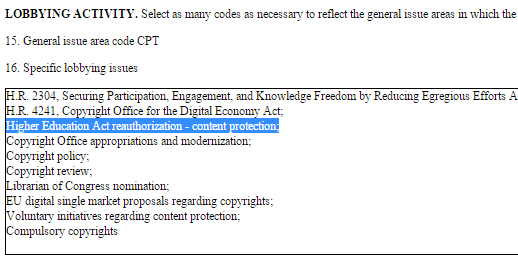
It turns out that various entertainment industry lobby groups have kept a close eye on the bill. In its most recent disclosure the MPAA lists “content protection” as a lobbying topic related to ESSA, and this hasn’t been in vain.

When reading through the final text we see several mentions of “piracy harms,” always related to education technology. For example, the available funds can be used for all sorts of educational training and development related to the “harms of copyright piracy”

“(i) effectively integrate technology into curricula and instruction (including education about the harms of copyright piracy),” one reference reads.

Piracy harms…

essapiracy

The law doesn’t go into detail on what the harms of online piracy are. This might turn into some interesting discussions down the road as academic studies show varying results.

The addition of the piracy related language is celebrated by the entertainment industries, including the MPAA-backed organization Creative Future. The group lists a thank you note on its website allowing the public to forward the message to Congress.

“Congress did the right thing! [ESSA], which sets new educational standards for our country, ensures that teachers, parents, and staff who are learning about new technologies in order to instruct the next generation of digital citizens must also understand the harms associated with piracy.”

“There is no better time to help students understand copyright than when they are learning how to use the Internet! Now, technology training for educators will also include this important pro-creativity message,” Creative Future adds.

In recent years the MPAA and RIAA have already started to get involved in copyright education. As part of the Center of Copyright Information they helped to create a new curriculum for California schools.

Initially the lesson materials were rather one-sided, lacking a proper mention of issues such as fair use and alternatives to standard copyright licenses. After a public outcry, this was eventually changed in an updated version of the lesson materials.

Continuing down this path, it’s expected that various copyright groups will now reach out to educators to assist them with training and education related to the harms of piracy.

Source: TF, for the latest info on copyright, file-sharing, torrent sites and ANONYMOUS VPN services.

Cox Should Expose Pirating Subscribers, Court Hears

After winning a $25 million judgment last month, music publisher BMG has requested a permanent injunction against Cox Communications, requiring the Internet provider to expose the personal details of pirating subscribers. For its part, Cox has asked the court to reconsider the guilty verdict or grant a new trial.

Source: TF, for the latest info on copyright, file-sharing, torrent sites and ANONYMOUS VPN services.

cox-logoLast month a Virginia federal jury ruled that Internet provider Cox Communications was responsible for the copyright infringements of its subscribers.
The ISP was found guilty of willful contributory copyright infringement and must now pay music publisher BMG Rights Management $25 million in damages.

BMG held the ISP responsible for tens of thousands of copyright infringements. During trial hearings it was revealed that tracking company Rightscorp downloaded more than 150,000 copies of their copyrighted works directly from Cox subscribers.

The verdict was a massive victory for the music company and a disaster for Cox, but the case is not over yet.

This week Cox renewed its motion for judgment as a matter of law, hoping to escape the jury verdict. Alternatively, the ISP wants the court to grant a new trial.

BMG opposes this motion and has submitted a request for a permanent injunction instead. According to the music publisher, Cox has failed to take any action to prevent further copyright infringements.

“Now, more than a month later, Cox’s network continues to be the site of massive, ongoing infringement of BMG’s copyrights. This ongoing infringement inflicts irreparable harm on BMG,” the music publisher writes.

When contacted on the matter, Cox’s legal counsel informed BMG that the ISP was still analyzing all aspects of its processes and procedures. However, the music publisher doesn’t want to wait any longer and has requested a permanent injunction from the court, ordering the Internet provider to take action.

Besides forwarding all future takedown notices to subscribers whose accounts are linked to copyright infringements, BMG also requests an overview of the actions Cox takes to prevent further infringements.

In addition, BMG also wants the personal details of all associated account holders, including their names, email addresses and phone numbers.

The Proposed Injunction

bmginjunction

BMG does not state how it intends to use these personal details, but given its relationship with Rightscorp it’s likely that the associated subscribers may be contacted to pay a settlement fee.

The music publisher believes that the proposed injunction is fair, considering the alleged harm it continues to suffer from the mass infringements on Cox’s network.

“Requiring Cox to prevent further use of its network for infringement by specified infringers at identified IP addresses imposes no undue burden on Cox and is narrowly tailored to reduce the enormous and irreparable harm that BMG suffers from infringement over Cox’s network,” the company writes.

It is now up to Judge O’Grady to review the requests from both parties.

If he sides with BMG then Cox will have to share the personal details of potentially tens of thousands of subscribers. If Cox has its way the jury verdict may be moot, or alternatively there will be a new trial.

Source: TF, for the latest info on copyright, file-sharing, torrent sites and ANONYMOUS VPN services.