U.S. Copyright Law Forces Wikimedia to Remove “Public Domain” Anne Frank Diary

This year The Diary of Anne Frank entered into the public domain in the Netherlands, allowing millions of people around the world to read it for free. However, under U.S. law the book remains copyrighted, which prompted the Wikimedia Foundation to remove a copy of the book from its servers, under protest.

Source: TF, for the latest info on copyright, file-sharing, torrent sites and ANONYMOUS VPN services.

anneThe Diary of Anne Frank is one of the best known literary works in history, written by a young Dutch girl hiding from the Nazis during World War II.

Anne Frank died in 1945 which means that the book was elevated into the public domain in the Netherlands on January 1, 2016, 70 years after her death.

Despite some dispute over its copyright status, several copies of the book have been published online. Also at Wikisource, a digital library of free texts maintained by the Wikimedia Foundation, which also operates Wikipedia.

However, since this week Anne Frank’s diary is no longer available, as U.S. copyright law dictates that works are protected for 95 years from date of publication.

Jacob Rogers, Legal Counsel for the Wikimedia Foundation, labels the removal as an overreach of U.S. copyright law but believes that they have no other option than to comply.

“Today, in an unfortunate example of the overreach of the United States’ current copyright law, the Wikimedia Foundation removed the Dutch-language text of The Diary of a Young Girl,” Rogers notes.

“We took this action to comply with the United States’ Digital Millennium Copyright Act (DMCA), as we believe the diary is still under US copyright protection under the law as it is currently written,” he adds.

The Wikimedia Foundation did not receive a takedown request for the book. Instead, it responded to email discussions that were sent to the organization. Based on these emails the foundation has either “actual” or “red flag” knowledge that the book was hosted on its servers.

Since the servers fall under the U.S. jurisdiction local copyright law applied, meaning that the book remains in copyright for 95 years after publication.

As a result Wikimedia is not allowed to host a copy of the book before 2042. While the organization has complied with U.S. law it’s not happy with the decision and calls for shorter copyright terms.

“Nevertheless, our removal serves as an excellent example of why the law should be changed to prevent repeated extensions of copyright terms, an issue that has plagued our communities for years,” Rogers writes.

Despite the voluntary removal by the Wikimedia Foundation, the Dutch version of Anne Frank’s diary remains widely available elsewhere. The Internet Archive still hosts a copy, as does pretty much every torrent site.

Source: TF, for the latest info on copyright, file-sharing, torrent sites and ANONYMOUS VPN services.

Warner Pays $14 Million For Illegitimate “Happy Birthday” Claims

After raking in dozens of millions in licensing fees, Warner/Chappell has admitted that it doesn’t own the rights to the song “Happy Birthday”. The music company has agreed to set aside a $14 million settlement fund for people who paid to use Happy Birthday in public. In addition, the court has been asked to enter the song into the public domain.

Source: TF, for the latest info on copyright, file-sharing, torrent sites and ANONYMOUS VPN services.
copyright-brandedHappy Birthday is one of the best known songs worldwide and up until a few months ago Warner/Chappell music claimed to own the rights.

The melody was originally written before 1893 by sisters Mildred and Patty Hill, but the rights to the song were later transferred to Summy Co., which was eventually acquired by Warner/Chappell.

For decades, Warner continued to demand licensing fees from filmmakers, artists and other people who used the song in public, generating an estimated $2 million annually.

However, in 2013 a group of artists including musician Rupa Marya sued Warner’s music division claiming that the company doesn’t hold the rights to the song. Aside from missing agreements, the filmmakers argued that it’s not clear what the true origins of the song are.

Before even reaching a trial, Judge George King awarded a groundbreaking victory to the plaintiffs last fall. After a careful review of several agreements the court concluded that there is no evidence that the Hill sisters ever transferred their rights to Summy Co.

As a result Warner saw no other option than to settle the case. The settlement was announced last December and this week the terms were made public.

Under the terms (pdf) Warner agrees to create a $14 million settlement fund to compensate persons who paid Warner/Chappell Music or one of its predecessors licensing fees for Happy Birthday, since 1949.

In addition, Warner officially declares not to own any rights to the song.

“Defendants and Intervenors agree that, upon the Final Settlement Date, they will relinquish their ownership claims to the Song and all their rights to the Song,” the agreement reads.

Warner further agrees not to oppose a request from the artists to officially enter the Happy Birthday song into the public domain.

“Defendants and Intervenors will not oppose Plaintiffs’ request that the Final Judgment and Order include a declaratory judgment that, as of the Final Settlement Date, the Song will be in the public domain,” it reads.

settlehappy

Technically, Happy Birthday is now an orphan work which means that an unknown party could still step up to claim ownership. However, Warner/Chappell and the artists are both unaware of any outstanding copyright claims.

While $14 million is a significant amount, it’s relatively low considering that Warner probably made dozens of millions more from the song over the past 66 years.

The settlement marks the end of one of the most prominent copyright disputes in recent history. It also means that everyone is free to sing Happy Birthday in public, without having to look over their shoulders.

Source: TF, for the latest info on copyright, file-sharing, torrent sites and ANONYMOUS VPN services.
Non-Existent ‘Pirate Site’ Added to National Blocklist

The voluntary anti-piracy agreement between anti-piracy groups and ISPs in Portugal has resulted in more collateral damage. The country’s piracy blocklist was recently updated with a non-existent domain name, presumably after one of the parties involved made a typo.

Source: TF, for the latest info on copyright, file-sharing, torrent sites and ANONYMOUS VPN services.

stop-blockedIn recent months Portuguese Internet providers have started to block hundreds of websites that allegedly link to copyright infringing content.

The voluntary blocking regime was formalized last summer through an agreement between several parties including the Ministry of Culture and the Association of Telecommunication Operators.

The agreement allows copyright holders to add new pirate sites without any intervention or oversight from a court, something which has now led to some unusual blocks in recent weeks.

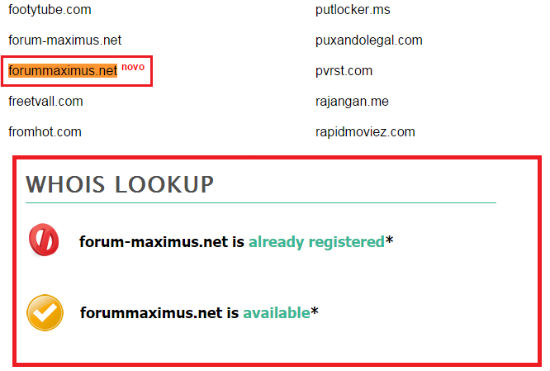
Aside from barring sites on questionable grounds, it appears that a simple typo can also get a website blocked. A few days ago a local news site spotted that one of the blocked domains is Forummaximus.net, which didn’t even exist at the time it was added.

Copyright holders were probably trying to block Forum-maximus.net, with a hyphen, but somewhere in the process someone made a mistake.

Forummaximus.net Not registered (image via)

ptblock

As a result, Portugal’s blocklist included a domain that wasn’t even registered at the time. After the news broke someone eventually registered the URL, but without any infringing purposes it seems.

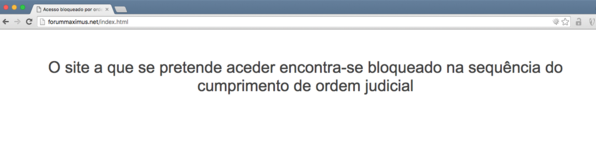
Still, visitors who try to reach the newly registered domain get the following error message (translated):

“The site that you’re trying to reach was blocked due to an order from the Regulator Agency.”

ZBMaCLm

At the time of writing the correct site has been blocked as well, but the ‘typo’ error has yet to be corrected.

In this case the collateral damage is limited. However, it’s worrying that the lack of oversight from a court or third party organization can result in non-existent domain names being blocked.

It’s a fine example of how slippery the blocking slope can get.

TorrentFreak has reached out to local anti-piracy group MAPINET, who investigate the sites that are reported, to find out more about what went wrong. Thus far we haven’t heard back.

Source: TF, for the latest info on copyright, file-sharing, torrent sites and ANONYMOUS VPN services.

Canada Is a Hotbed for Online Piracy, Rightsholders Claim

The MPAA, RIAA and other entertainment industry groups are unhappy with how the Canadian Government is approaching the problem of online piracy. The country remains very appealing to pirate sites, they claim, while ISPs often fail to warn infringing subscribers effectively.

Source: TF, for the latest info on copyright, file-sharing, torrent sites and ANONYMOUS VPN services.

canadaThe International Intellectual Property Alliance (IIPA) has just published its latest submission to the U.S. Government, providing an overview of countries it believes should better protect the interests of the copyright industry.

The IIPA, which includes a wide range of copyright groups including the MPAA, RIAA, BSA and ESA, has listed its complaints against a whole host of countries. As in previous years, Canada was discussed in detail with the recommendation to put it on the 2016 Special 301 ‘watch list.’

Like previous years, the rightsholders’ group points out that many of the top pirate sites have connections to Canada, labeling it as a safe haven for online piracy.

“Canada still has far to go to rectify its reputation as a safe haven for Internet pirates. Indeed, a number of the world’s most popular Internet sources dedicated to online theft of copyright material retain connections to Canada,” IIPA writes.

The group highlights KickassTorrents as one of the prime offenders but also mentions other sites and services including Sumotorrent.sx, Seedpeer.eu, Zippyshare.com, Tuebl.com and Solarmovie.is.

“This includes the biggest BitTorrent site in the world in terms of visitors and popularity, Kat.cr, along with the various other incarnations that the so-called ‘Kick Ass Torrents’ operation has assumed in its domain-hopping peregrinations over the past eight years.”

In addition, the IIPA signals a relatively new group of infringing services with ties to Canada, including Popcorn Time, which run on people’s desktop computers but are also sold pre-loaded onto set-top boxes.

“A disturbing recent trend is the emergence of stand-alone BitTorrent applications that employ an attractive, user-friendly interface that enables users to illegally stream and download infringing movies and TV programs,” the report reads.

There is also some positive new to report. Two years ago Canada adopted the Copyright Modernization Act, and according to the IIPA a new provision (27, 2.3) helped to target the Canadian developers behind the popular PopornTime.io fork.

“In October 2015, a Canadian Federal Court issued a sweeping injunction against the Canadian developers of PopcornTime,” IIPA writes.

“The court relied, in part, on claims that the defendants had provided services primarily for the purpose of enabling acts of copyright infringement, in violation of the newly enacted provision,” the group adds.

Still, the new copyright act doesn’t go far enough according to the copyright holders, and new legislation is required to address ongoing problems.

“In other respects, however, the Copyright Modernization Act simply fails to respond adequately to the challenge of online piracy,” the IIPA notes.

Canada’s new “notice and notice” system, through which ISPs are obliged to warn pirating subscribers, is not very effective, they claim. Especially when there are no consequences for subscribers who continue to pirate.

In addition, they point out that Canadian law lacks a “notice-and-takedown” regime where hosting companies can be held liable if they fail to disable access to pirated material.

The IIPA believes that in the current legal environment online pirates, even those who fall into the criminal category, can roam free. The U.S. Government should therefore keep Canada on the “watch list,” encouraging it to change its laws.

“The consistent absence of any criminal enforcement in Canada against even the most blatant forms of online theft complete the picture of a system that is still not up to the challenge,” the IIPA writes.

“Canada should review the effectiveness of its current regime, and consider alternatives to remedy its shortcomings and the current lack of incentives to stimulate full inter-industry cooperation against online piracy,” they add.

The IIPA’s full 2016 Special 301 recommendation report is available here. This also includes assessments for more than a dozen other countries, including Brazil, China, India, Russia, Switzerland and Ukraine.

Source: TF, for the latest info on copyright, file-sharing, torrent sites and ANONYMOUS VPN services.

Beware: Piracy Defense Lawyers Can Be “Trolls” Too

Every month hundreds of people are sued for sharing copyrighted media through file-sharing networks, mostly BitTorrent. This practice is big business for copyright holders and lawyers alike. Unfortunately, however, not all defense attorneys appear to have the best interests of their clients at heart.

Source: TF, for the latest info on copyright, file-sharing, torrent sites and ANONYMOUS VPN services.

trollsignLawsuits against file-sharers are commonplace in the United States. Hundreds of thousands of people have been accused in recent years, most after using standard BitTorrent clients.

The cases barely make the news anymore but for copyright holders and law firms they are still big business, with many cases ending in out of court settlements.

As is the case in any legal dispute, lawyers from both sides can profit. The ones representing the copyright holders usually get rewarded with attorney fees and a piece of the settlement award, and those on the other side get paid for the defense.

To many, the attorneys representing the alleged pirates are seen as “the good guys.” However, several insiders believe that not all attorneys have the best interests of their clients at heart.

TorrentFreak spoke with defense lawyer Robert Cashman, who has represented many accused pirates over the past five years. He recently sounded the alarm bell warning people about attorneys whose main motivation is earning a few bucks.

Cashman is one of the attorneys who comes recommended by the EFF. While many defense attorneys are indeed a great help, there are also several who run a “settlement factory” by settling cases on a routine basis, with minimal investment.

“The ‘settlement factory’ attorney problem began years ago, even when there were only 20 of us on the EFF’s subpoena defense list,” Cashman says.

While Cashman confronted several colleagues with his observations, the problem still exists and got worse over time.

“They run a volume-based business where in a number of cases, they have hired multiple attorneys to take calls for their firm as a result to some Google AdWords or online marketing program they just spent who knows how much to attract these ‘leads’.”

“The attorneys they hire are tasked with convincing a person who filled out their online web form to settle the claims against them, even when settling is not in the best interests of the client,” Cashman adds.

In addition to active advertising campaigns, these attorneys also approach defendants who have already retained counsel elsewhere, encouraging them to go for them as a cheaper option.

According to Cashman the “settlement factory” attorneys are able to offer their services cheaply, because they spend minimal time on the cases and run a volume-based business. While this may result in lower legal fees, it might not help an eventual settlement.

Cashman previously confronted a colleague he was mentoring for selling his services short and received a telling reply.

“He explained to me that he actually only spent a few MINUTES on each case because he already prearranged with the plaintiff attorney to settle claims for a certain amount using their boilerplate contract, and thus $300 for him was a windfall.”

The main problem is that instead of looking at the unique aspects of every case, settlement factories often agree to higher settlement amounts, driving up the ‘price’ for everyone.

“The result is that because these attorneys are willing to pay higher prices when settling cases, they “drive up” the prices for all of us other attorneys who are trying to negotiate for a significantly lower amount,” Cashman notes.

Instead of actually looking for ways to negotiate a lower settlement, exploring viable defenses, or considering other individual characteristics, they go for a quick solution.

“The client is getting served on a golden platter to the copyright trolls who are extorting money from them, and it is the very attorneys in whom they are placing their trust who are allowing them to be cheated,” Cashman says.

At the end of the day the defendant is poorly represented, must pay a higher settlement, while driving up the settlement amounts for other defendants in the process.

In part, Cashman’s plea is in his own interest. He runs a business as well and needs to make a profit. So when colleagues get all the work at a cheaper rate, that hurts business.

However, he believes that every attorney should still serve the client to the best of his ability, and the settlement factory attorneys only seem to make matters worse.

“The goal of the defense attorney should not simply be profit off of the problem, but to take steps to make the lawsuits go away in the first place,” Cashman concludes

Source: TF, for the latest info on copyright, file-sharing, torrent sites and ANONYMOUS VPN services.
Top 10 Most Pirated Movies of The Week – 02/08/16

The top 10 most downloaded movies on BitTorrent are in again. ‘Ride Along 2′ tops the chart this week, followed by ‘The Big Short’ ‘The Good Dinosaur’ completes the top three.

Source: TF, for the latest info on copyright, file-sharing, torrent sites and ANONYMOUS VPN services.

ridealongThis week we have three newcomers in our chart.

Ride Along 2 is the most downloaded movie.

The data for our weekly download chart is estimated by TorrentFreak, and is for informational and educational reference only. All the movies in the list are BD/DVDrips unless stated otherwise.

RSS feed for the weekly movie download chart.

Ranking (last week) Movie IMDb Rating / Trailer
torrentfreak.com
1 (3) Ride Along 2 5.8 / trailer
2 (1) The Big Short (DVDscr) 8.1 / trailer
3 (2) Spectre 7.9 / trailer
4 (4) The Revenant (DVDscr) ?.? / trailer
5 (…) Kung Fu Panda 3 (Telesync) 8.0 / trailer
6 (5) The Martian 8.2 / trailer
7 (7) Creed (DVDscr) 8.0 / trailer
8 (…) Steve Jobs 7.4 / trailer
9 (6) The Intern 7.4 / trailer
10 (…) The Good Dinosaur 6.9 / trailer

Source: TF, for the latest info on copyright, file-sharing, torrent sites and ANONYMOUS VPN services.

God Can Stop Piracy, Research Finds

The MPAA, RIAA and various other anti-piracy groups have been trying to stop piracy for decades, without much result. A newly published paper on piracy and religion suggests that this is hardly surprising, as God appears to be one of the few who can really change people’s attitude towards piracy.

Source: TF, for the latest info on copyright, file-sharing, torrent sites and ANONYMOUS VPN services.

freeman“Thou shalt not steal” is one of the Ten Commandments many Christians hold in high regard.

However, the general public generally doesn’t view piracy as outright stealing. In fact, many people see piracy as morally justified.

To examine this contradiction more closely, a new study (paywall) published by researchers from Australia looked at the relationship is between religious attitudes and piracy.

The study was conducted among members of a Christian mega-church in Indonesia who were divided into various categories, based on the strength of their religion. The results shed an interesting light on how piracy and religion interact.

The first interesting result is that people’s attitudes towards piracy correlate with how religious they are. That is, people who are more religious have less favorable opinions about digital piracy.

“… consistent with our expectation, it was found that the highly religious respondents have a stronger attitude against digital piracy than those who are less religious,” the paper reads.

The questions above covered general attitudes towards piracy. For example, that it hurts the music industry or that it’s against the law. A second set of questions focused on actual behavioral change.

Here, the same people were asked whether they would be less likely to pirate if X told them to. The X differed per question ranging from their pastor, friends, religion to God himself.

The responses to these questions are quite revealing, showing that only God himself can make a strong impact on people’s piracy habits.

“Among the four referents (pastor, friends, religion, God) included in this study, only God was the referent with the strongest influence that could discourage respondents from buying pirated media,” the researchers report.

While God can impact the behavior of less, moderately and highly religious people, he has the strongest impact on the latter. Interestingly, however, even highly religious people won’t change their behavior if their pastor or religion tells them to.

“No significant differences were found in items relating to ‘religion’ and ‘my pastor,’ implying that respondents’ motivation to comply with these referents are not influenced by the extent of their religiosity.”

According to the researchers the effect can be explained by the fact that many people don’t view piracy as unethical. This is reflected in previous research as well as their study, which found that respondents generally don’t see digital piracy behavior as sinful.

“Previous studies found that those who are actively involved in digital piracy do not view piracy as being illegal or unethical and only 10% of American teenagers believe that digital piracy is morally wrong,” the researchers write.

To address this, the researchers suggest “instilling moral values about digital piracy” at a very young age.

“Religious institutions, in cooperation with educational institutions, could work together to communicate a strong message against digital piracy,” the researchers propose in their paper.

Copyright holders will appreciate the suggestion, and they are already working on educating young kids early on, both in the U.S and the UK.

Traditional anti-piracy efforts also continue, including a planned campaign featuring none other than Morgan Freeman, who coincidentally played God in a few movies and is currently working on a documentary series featuring the Almighty.

Source: TF, for the latest info on copyright, file-sharing, torrent sites and ANONYMOUS VPN services.

Movie Industry Demands €1.2 Billion Piracy Damages from Dutch Govt

The Dutch movie industry is holding the local government responsible for the country’s high piracy rates, claiming it tolerated and even encouraged unauthorized downloading for years. In response, a coalition of movie companies is demanding damages for the losses that they’ve suffered over the past decade, totaling more than a billion euros.

Source: TF, for the latest info on copyright, file-sharing, torrent sites and ANONYMOUS VPN services.

piratekayCompared to many other countries around the world, pirating movies and TV-shows is hugely popular in the Netherlands.

Up to a third of the population is estimated to download and stream copyrighted content without paying for it.

This high percentage is not surprising as the Netherlands has traditionally been a relative safe haven for pirates. Downloading movies without permission was not punishable by law until the European Court of Justice spoke out against the tolerant stance two years ago.

As a result the Dutch government quickly outlawed unauthorized downloading. However, breaking the habits of a large section of the population will take more than that and local piracy rates still remain high.

This has prompted Dutch filmmakers and distributors to hold the Government responsible and they’re now demanding compensation for the piracy losses they claim to have suffered.

In a letter sent to Secretary of State for Justice, Klaas Dijkhoff, a coalition of film industry companies claim 1.2 billion euros ($1.34 billion) to compensate for damages dating back to 2004.

“The Dutch State has maintained for years that copying from illegal sources was allowed. The result was that an entire generation of consumers believes that downloading without paying for it is simply allowed,” the filmmakers write (via Tweakers).

“Through this letter we hold the Dutch government liable for the damage. We want the Dutch State to take responsibility for its unlawful legislation and the resulting damage,” they add.

The companies base their billion euro claim on research from Considerati, which estimates the losses at 78 million euros per year. Including rent that comes to a total of 1.2 billion euros.

However, according to the movie companies the losses may amount to more.

“The actual damage is expected to be even higher. Recent figures show that the revenue from video-on-demand have dropped off massively in 2014 and 2015, compared to 2013,” the letter adds.

Among other things, the movie companies suggest using the damages for various anti-piracy campaigns. In addition, they suggest stronger enforcement against copyright infringers.

The Dutch government has until later this month to respond or else the movie industry companies will take legal steps.

Source: TF, for the latest info on copyright, file-sharing, torrent sites and ANONYMOUS VPN services.

PayPal Starts Banning VPN and SmartDNS Services

After cutting off file-hosting sites and Usenet providers, PayPal is now taking aim at VPN and SmartDNS services. The payment processor states that services which can be used to bypass measures to prevent copyright infringement, such as geo-blockades, are violating its terms of service.

Source: TF, for the latest info on copyright, file-sharing, torrent sites and ANONYMOUS VPN services.

paypaldeniedPayPal is widely known for their aggressive stance towards BitTorrent sites, Usenet providers and file-hosting services, but VPN, proxy and SmartDNS providers might now suffer the same fate too.

This week PayPal stopped accepting payments for a company that provides VPN and SmartDNS tools, stating that these may facilitate copyright infringement.

So-called “unblocker” tools can be used to bypass geo-filtering blockades which Netflix and other video platforms have in place.

According to the message PayPal sent to UnoTelly and possibly others, these services are against the company’s policies because they help users to bypass copyright restrictions.

“Under the PayPal Acceptable Use Policy, PayPal may not be used to send or receive payments for items that infringe or violate any copyright, trademark, right of publicity or privacy, or any other proprietary right under the laws of any jurisdiction,” PayPal’s email reads.

“This includes transactions for any device or technological measure that descrambles a scrambled work, decrypts an encrypted work or otherwise avoids, bypasses, removes, deactivates or impairs a technological measure without the authority of the copyright owner.”

PayPal informs the affected business(es) that their accounts have been permanently limited and that this decision can’t be appealed. This means that they have to switch to other payment processing providers.

UnoTelly informs TorrentFreak that the decision came as a shock, without any type of prior notice. The company is disappointed and sees the move as a direct attack on open and unrestricted Internet access.

“We are disappointed at PayPal’s unilateral action and the way it acted without prior warning. We provide both DNS resolution and secure VPN services. Our services are network relays that connect people around the world,” UnoTelly’s Nicholas Lin says.

Under PayPal’s policy every VPN and SmartDNS service is at risk of losing its PayPal account. However, it seems likely that the company will mainly take action against companies that market themselves as an “unblocker” service.

UnoTelly, for example, specifically mentions its ability to bypass geo-blocks imposed by streaming sites such as Netflix and Hulu.

PayPal’s actions are not an isolated incident. They come a few weeks after Netflix started to increase its crackdown on VPN services and other unblockers, as requested by copyright holders. It would be no surprise if copyright holders are also behind PayPal’s recent move.

—-

PayPal’s email:

paypal.email-vpndns

Source: TF, for the latest info on copyright, file-sharing, torrent sites and ANONYMOUS VPN services.

MPAA Takes Over Popcorn Time Domain

The MPAA is now the owner of Popcorntime.io, the domain name which was the home of the most used Popcorn Time fork up until last November. The change of ownership suggests that the Hollywood group reached a settlement with one of the key developers, but has yet to comment on the recent developments.

Source: TF, for the latest info on copyright, file-sharing, torrent sites and ANONYMOUS VPN services.

popcorntLate last year the main Popcorn Time fork, operating from the PopcornTime.io domain name, shut down its website unexpectedly.

The MPAA took credit for the fall announcing that it had filed a lawsuit against several of the developers in Canada. In response to these legal threats several key developers backed out.

Since the initial announcement there haven’t been any official updates on the case. TorrentFreak learned, however, that several of the accused developers have been negotiating a deal to settle the dispute out of court.

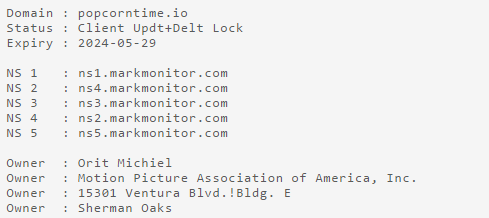
This week came the first public signs that the case is indeed moving towards a resolution. On Tuesday the PopcornTime.io domain changed ownership from Popcorn Time developer and defendant David Lemarier, to the MPAA.

This means that Hollywood is now officially in control of what was once the most popular Popcorn Time domain.

Whois Popcorntime.io

popio

TorrentFreak reached out to the MPAA and Lemarier for more details several days ago, but both have yet to reply. The other defendants we contacted preferred not to comment on the case.

From the information we were able to gather in recent weeks it appears that the movie studios prefer a settlement over a full court battle. Perhaps to save costs, perhaps to avoid attracting more attention to the Popcorn Time phenomenon.

This would be similar to how they approached their case against YIFY/TYS, which was arguable the most prominent piracy group of the past half decade. However, instead of taking the operator to court the movie studios quickly arranged an out of court settlement.

With the PopcornTime.io domain now in the hands of the MPAA it is safe to conclude that this fork is not coming back.

Previously the software’s developers maintained that they were not involved in any infringing activity. Theoretically, some of the accused may still choose to put up a fight but considering the recent developments this has become less likely.

Meanwhile, several other Popcorn Time forks continue to operate, launching new features and services as if nothing ever changed.

Source: TF, for the latest info on copyright, file-sharing, torrent sites and ANONYMOUS VPN services.