Cox Denies Liability for Pirating Subscribers, Appeals $25 Million Verdict

Internet provider Cox Communications maintains that it’s not responsible for copyright infringements carried out by its subscribers. The company has announced that it will appeal the $25 million damages verdict in its case against music publisher BMG.

Source: TF, for the latest info on copyright, file-sharing, torrent sites and ANONYMOUS VPN services.

cox-logoLast December a Virginia federal jury ruled that Internet provider Cox Communications was responsible for the copyright infringements of its subscribers.

The ISP was found guilty of willful contributory copyright infringement and must pay music publisher BMG Rights Management $25 million in damages.

The verdict was a massive victory for the music company and a disaster for Cox, but the case is not closed yet.

After a failed motion for judgment as a matter of law earlier this month, the ISP has now informed the court that it will take the case to the U.S. Court of Appeals for the Fourth Circuit.

Cox denies any wrongdoing and hopes to get a judgment in its favor at the appeals court.

Cox’s appeal notice

coxappeal

Considering the gravity of the case, Cox’s move is not surprising. The liability verdict has come as a shock to the Internet provider industry, as it suggests that providers have to actively disconnect repeat infringers.

At the moment, many ISPs don’t have a solid policy in place where repeat copyright infringers lose their subscription. In fact, the law doesn’t prescribe when and based on what evidence an ISP has to terminate an account.

Up until now, several Internet providers argued that only a court could determine if a subscriber is a repeat infringer, but with the Cox verdict this has now become uncertain.

After the appeal, which is expected to take several months at least, both Cox and BMG still have the option to take the case to the Supreme Court.

Meanwhile, anti-piracy outfit Rightscorp is using the current verdict to threaten other ISPs to forward their notices. Thus far, however, this doesn’t appear to have had much effect.

Source: TF, for the latest info on copyright, file-sharing, torrent sites and ANONYMOUS VPN services.

Indian Piracy Blocks Scare Torrent Users With 3-Year Prison Sentence

Blocking torrent portals and other pirate sites is nothing new in India, but a recently updated blocking message is causing panic among torrenters. According to a new blocking notification, torrent users face a prison sentence up to three years and a hefty fine if they continue downloading copyright infringing content.

Source: TF, for the latest info on copyright, file-sharing, torrent sites and ANONYMOUS VPN services.

stop-blockedStarting a few days ago, many Indian Internet users noticed that their favorite torrent websites were blocked and displaying a rather scary message.

The blocks themselves are nothing new. For years Indian copyright holders have sought to protect their content from unauthorized online distribution.

This has mainly taken the form of so-called ‘John Doe’ orders where access to sites such as The Pirate Bay or ExtraTorrent is restricted to protect copyrighted content from being freely shared.

However, the warning message that’s currently presented when attempting to access blocked sites has a lot of people worried.

The notice reads that the site in question has been blocked per instruction of the Government or through a court order, similar to what it said before. In addition, it adds that those who still access the content in question may face up to three years in prison and a hefty fine.

“Viewing, downloading, exhibiting or duplicating an illicit copy of the contents under this URL is punishable as an offence under the laws of India, including but not limited to under Sections 63, 63-A, 65 and 65-A of the Copyright Act, 1957 which prescribe imprisonment for 3 years and also fine of up to Rs. 3,00,000/-.”

The new blocking message

indiablock

A relatively small change, but one with widespread impact it seems.

Several Indian news outlets have started to warn their readership that the threat is real. India Today, for example, reports that merely downloading a torrent file or viewing a copyrighted image from a file-hosting site may land people in prison.

“You don’t have to download a torrent file, and then the actual videos or other files, which might have copyright. Just accessing information under a blocked URL will land you in jail and leave your bank account poorer by Rs 3 lakh,” the news site reports.

While the warning message can be interpreted in various ways, very little appears to have changed. There’s no new law that introduces higher sentences. In fact, the message clearly quotes India’s 1957 Copyright Act.

In addition, there are no signs that the authorities are planning to crack down on individual file-sharers. Let alone people who merely download a torrent file, not the infringing content itself.

There is a recent court case that may have spurred the recent change though.

Earlier this year the Government’s Department of Electronics and Information Technology actually intervened in one of the “John Doe” cases on behalf of the public, arguing against site-wide blocks.

In this case, the High Court decided against the Government, arguing that broad blockades are warranted. Among other things, the Court found that it is the “duty of the government” to “assist in the enforcement of court orders.”

In this light it could be that the Government “assisted” in updating the language of the blocking message.

From the information we’ve seen thus far, the wording of the blocking notification is the only thing that has changed so far. But, considering the response from the media and public, this is already quite effective as a deterrent.

Source: TF, for the latest info on copyright, file-sharing, torrent sites and ANONYMOUS VPN services.

Top 10 Most Pirated Movies of The Week – 08/22/16

The top 10 most downloaded movies on BitTorrent are in again. ‘Now You See Me 2′ tops the chart this week, followed by ‘Independence Day: Resurgence’. ‘The Legend of Tarzan’ completes the top three.

Source: TF, for the latest info on copyright, file-sharing, torrent sites and ANONYMOUS VPN services.

nowyouseeThis week we have three newcomers in our chart.

Now You See Me 2 is the most downloaded movie.

The data for our weekly download chart is estimated by TorrentFreak, and is for informational and educational reference only. All the movies in the list are Web-DL/Webrip/HDRip/BDrip/DVDrip unless stated otherwise.

RSS feed for the weekly movie download chart.

Ranking (last week) Movie IMDb Rating / Trailer
torrentfreak.com
1 (…) Now You See Me 2 6.8 / trailer
2 (1) Independence Day: Resurgence (Subbed HDRip) 5.6 / trailer
3 (2) The Legend of Tarzan (Subbed HDRip) 6.6 / trailer
4 (…) Neighbors 2 6.0 / trailer
5 (…) Imperium 6.7 / trailer
6 (3) The Jungle Book 7.8 / trailer
7 (6) Suicide Squad (HDTS) 6.9 / trailer
8 (4) Warcraft 7.7 / trailer
9 (7) Jason Bourne (CAM/TS) 7.4 / trailer
10 (5) The Nice Guys 7.7 / trailer

Source: TF, for the latest info on copyright, file-sharing, torrent sites and ANONYMOUS VPN services.

Fail: Anti-Piracy Outfits Send Takedown Request For Non-Existent Torrents

HBO, Paramount Pictures and other copyright holders are sending takedown notices for torrent links that have never existed. The notices accuse sites of distributing recent movies and TV-shows. However, the services in question have been down for a year, showing that anti-piracy groups automatically generate links based on hashes without any verification.

Source: TF, for the latest info on copyright, file-sharing, torrent sites and ANONYMOUS VPN services.

failOver the past years a lot has been said about the effectiveness and accuracy of DMCA takedown practices.

Rightsholders often complain that it’s impossible to keep content offline, while critics warn about mistakes caused by automated takedown bots.

The latter has been illustrated anecdotally, but we recently stumbled upon a rather worrying development that illustrates just how far anti-piracy groups are prepared to go when it comes to fabricating “evidence”.

One of the companies involved is IP-Echelon, which sends takedown notices on behalf of HBO and Paramount Pictures, among others.

Looking through their recent submissions we see notices targeting sites that allegedly distribute popular content such as recent episodes of Game of Thrones, Ballers, and Silicon Valley.

Among the sites reported are The Pirate Bay, ExtraTorrent and various lesser known sites. However, our eye was drawn to Zoink.it and Torrage.com.

The latter two have been operating as so-called torrent caches for a long time. These don’t have a searchable index of torrents, but serve as a hosting platform for torrent sites, identifying torrents by their unique hash.

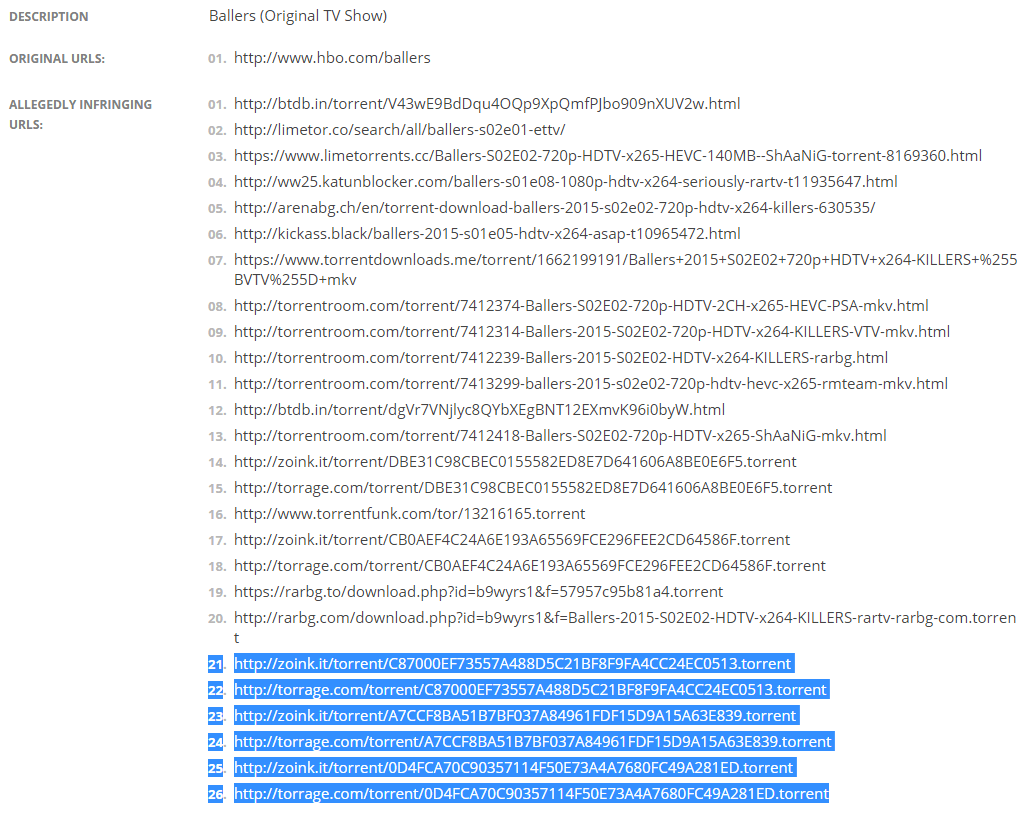
For example, a torrent for an episode of Ballers that aired a few weeks ago has the hash C87000EF73557A488D5C21BF8F9FA4CC24EC0513. This file would then be available at Zoink under the following url:

zoink.it/torrent/C87000EF73557A488D5C21BF8F9FA4CC24EC0513.torrent.

We say would be, because Zoink.it was shut down at the end of 2014. The same is true for the other torrent cache, Torrage, which has been offline for quite a while as well.

However, the takedown notices IP-Echelon sends on behalf of HBO and Paramount pictures still list these sites with hashes of new torrents, which never existed when the sites were still online.

ballers

How can this be? Well, it seems obvious that IP-Echelon is fabricating URLs based on torrent hashes without checking if they even exist. This isn’t an isolated mistake either, as the company is sending dozens of these fabricated notices per month.

In this case, no harm has been done. The sites in question are offline and can’t be punished by Google’s downranking algorithm. However, the fact that they keep fabricating links more than a year after sites have disappeared, shows that there is little oversight.

TorrentFreak spoke to the former hosting provider of Zoink and Torrage who confirms that both sites remain targeted, and not just by IP-Echelon.

Indian anti-piracy outfit MarkScan is also sending takedown notices to Zoink and Torrage’s former hosting provider on a regular basis, we were informed. In addition, the company is also sending takedown requests to Google for new torrents, as does Rico Management.

It’s safe to say that these anti-piracy outfits are quite sloppy, to say the least. Of course, copyright holders have the right to protect their content, but they have to play by the rules.

Making up evidence certainly doesn’t look good in this regard.

Source: TF, for the latest info on copyright, file-sharing, torrent sites and ANONYMOUS VPN services.

Dallas Buyers Club Lawyer Calls Out “Copyleft” TorrentFreak

In an attempt to uncover various BitTorrent pirates, Dallas Buyers Club attorney James Davis asked an Oregon District Court for permission to interrogate Internet subscribers whose connections were used to pirate the film. In his request the lawyer warns against an aggressive “BitTorrent defense bar,” which apparently uses the Pirate Party and TorrentFreak to push a dangerous copyleft agenda.

Source: TF, for the latest info on copyright, file-sharing, torrent sites and ANONYMOUS VPN services.

dallasThe makers of Dallas Buyers Club have sued thousands of BitTorrent users over the past few years.

Many of these cases end up being settled for an undisclosed amount. This usually happens after the filmmakers obtain the identity of the Internet account holder believed to have pirated the movie.

The tactics used by Dallas Buyers Club (DBC) are often described as “copyright trolling,” and equated to the abusive practices of Prenda Law.

However, according to Dallas Buyers Club attorney James S. Davis this is certainly not the case. In a recent filing requesting the deposition of an alleged pirate, he distances his enforcement actions from Prenda’s previous practices.

“In these cases, Plaintiffs would offer settlements for a sum calculated to be just below the cost of defense, creating a situation in which a Defendant would reluctantly pay rather than have their names associated with illegally downloaded porn,” DBC’s lawyer writes (pdf).

“This was a pattern of clear abuse and is well recognized,” he adds.

It’s quite unusual for a lawyer to open his filing by scolding his former ‘colleagues,’ but in this case it serves a higher purpose.

The problem, according to Davis, is that Prenda’s actions gave rise to an “aggressive BitTorrent Defense Bar.” This group of individuals and organizations is actively protests all related copyright enforcement actions, including DBC’s cases.

This group of torrent defenders apparently uses TorrentFreak and other sites to spread their message to the public.

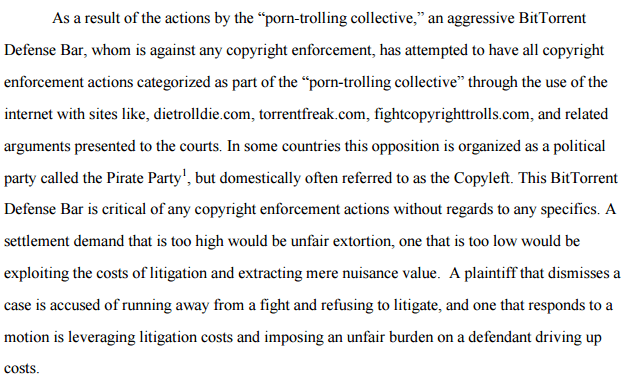
“[An] aggressive BitTorrent Defense Bar, whom is against any copyright enforcement, has attempted to have all copyright enforcement actions categorized as part of the ‘porn-trolling collective’ through the use of the internet with sites like, dietrolldie.com, torrentfreak.com, fightcopyrighttrolls.com, and related arguments presented to the courts,” Davis writes.

As if that wasn’t enough, the “defense bar,” which is apparently against all copyright enforcement, also organizes itself on a political level through the “copyleft” Pirate Party.

“In some countries this opposition is organized as a political party called the Pirate Party, but domestically often referred to as the Copyleft. This BitTorrent Defense Bar is critical of any copyright enforcement actions without regards to any specifics,” Davis writes.
copyleft

Davis tells the court that copyright holders can’t do anything right in the eyes of these torrent defenders. If settlement amounts are too high it’s seen as extortion, and if they’re too low they exploit the costs of litigation and their nuisance value.

Dallas Buyers Club’s lawyer hopes that the court will see through these arguments and judge the cases on their merit.

“On scrutiny, the courts are finding that current enforcement practices used by counsel, are not to ‘plunder the citizenry,’ ‘exploit individuals,’ monetizing, or profiting from illegal downloading, but truly motivated by Plaintiff’s desire to protect its copyrights interests and fight piracy,” he writes.

At TorrentFreak we were surprised to see ourselves mentioned in relation to a mysterious copyleft BitTorrent defense bar that rallies against all copyright enforcement.

While we have our opinions, we do not recognize ourselves in the description given by DBC’s lawyer. In fact, without copyright enforcement we would have very little to write about.

We contacted Davis for a comment on the allegations but unfortunately he hasn’t replied to our request, perhaps worried that we would unleash our inner copyleftists.

Luckily for him, however, his arguments did convince the court. Judge Jacqueline Scott granted his request to interrogate various alleged BitTorrent pirates, which he can use to find out more about the actual copyright infringers.

Some would say that such depositions can be abused as another instrument to pressure defendants into settling, but those concerns are unwarranted according to Davis, of course.

Source: TF, for the latest info on copyright, file-sharing, torrent sites and ANONYMOUS VPN services.

Scammers Use Harvard Education Platform to Promote Pirated Movies

Spammers are using Harvard’s educational sharing tool H2O to promote pirated movies. Thousands of links to scammy sites have appeared on the site in recent weeks. Copyright holders are not happy with this unintended use and are targeting the pages with various takedown notices.

Source: TF, for the latest info on copyright, file-sharing, torrent sites and ANONYMOUS VPN services.

harvardlawH2O is a tool that allows professors and students to share learning material in a more affordable way.

This is very welcome in a time where textbook and other educational costs continue to rise year after year.

Developed by the Berkman Center and the Harvard Law School Library, the H2O platform is mainly geared towards law professors but anyone with an .edu email address is allowed to join.

“H2O allows users – faculty or students – to develop, remix, and share online textbooks and casebooks under a Creative Commons license,” Harvard Law School explains.

H2O is a welcome system that’s actively used by many renowned scholars. However, in recent weeks the platform was also discovered by scammers. As a result, it quickly filled up with many links to pirated content.

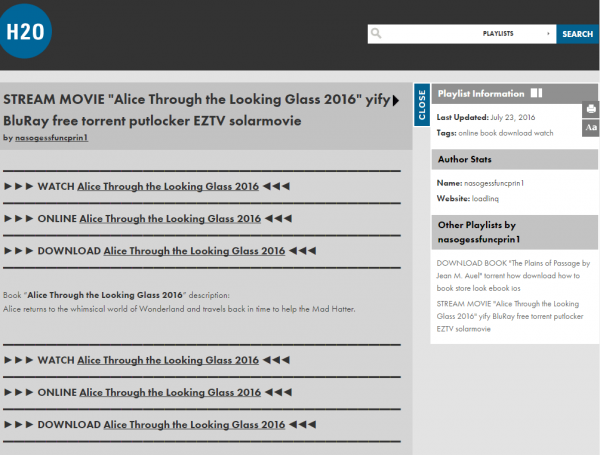
Instead of course instructions and other educational material, the H2O playlists of these scammers advertise pirated movies. Below is an example of one of these dubious entries, but there are thousands more.

The scammers in question are operating from various user accounts and operate much like traditional spam bots, offering pages with movie links and related keywords such as putlocker, megashare, viooz, torrent and YIFY.

A “pirate” H2O playlist

hardvardspam

While most students won’t mind free access to the latest blockbusters, the links provided are not leading to regular pirate sites and services.

Instead they point to scammy portals, many of which require a credit card to signup, which undoubtedly leads to disappointment. These kinds of scams are nothing new, but seeing them listed on a Harvard website is a new development.

Access?

scamsignup

With links from the official Harvard domain name, the pages are an SEO goldmine and do very well in Google’s search results. This is something copyright holders have noticed too..

Over the past few weeks movie studios including Lionsgate, Sony Pictures, Columbia and Magnolia Pictures have sent dozens of DMCA notices trying to get the pages removed from the search engine.

Interestingly, Google has thus far chosen to take no action, which means that the pages remain indexed in search results. Whether the movie studios have sent DMCA notices to Harvard directly is unknown, but since the H2O playlists are still online this seems unlikely.

Although the movie link pages don’t meet the standards of a typical Harvard course, they do serve as a crash course on how to recognize piracy scams and avoid them in the future. That’s worth something too.

Source: TF, for the latest info on copyright, file-sharing, torrent sites and ANONYMOUS VPN services.

BREIN Tracks Down Facebook Music Pirate, Settles for €7,000

Anti-piracy group BREIN has tracked down a prolific cyberlocker uploader who shared pirated music in a dedicated Facebook group. The man agreed to sign a €7,000 settlement and left the group, which shut down soon after. In addition, Facebook closed several other groups that were focused on sharing copyright infringing links.

Source: TF, for the latest info on copyright, file-sharing, torrent sites and ANONYMOUS VPN services.

facebook-shareDutch anti-piracy group BREIN has targeted operators of pirate sites for over a decade but more recently it began going after individual file-sharers as well.

The rightsholder-backed group has targeted Pirate Bay and KickassTorrents uploaders, for example, as well as a prolific Usenet uploader.

Today BREIN announces another success in its ongoing anti-piracy quest. The group obtained an ex-parte court order against a man who uploaded music to a cyberlocker which he then shared to a Facebook group.

According to BREIN the man and other members of the Dutch Facebook group shared pirated music as a hobby, gaining recognition for the links they posted.

Presented with the court order, the man agreed to stop his activities and pay a €7,000 settlement. In a message posted to the Facebook group he announced the reason for his sudden departure.

“Ladies and gentlemen, by order of BREIN I have to stop uploading music. I will therefore quit effective immediately. In addition, I will leave the group today, both as administrator and as a member.”

“I wish everyone all the best,” he concludes, noting that he faces an additional fine up to €50,000 if he continues sharing links to pirated content.

The €7,000 settlement is lower than those negotiated in previous cases closed by BREIN. The anti-piracy group says that it bases the amount on the financial circumstances of the uploaders, suggesting that the man has a lower income than some of the previous defendants.

BREIN doesn’t explain how it tracked down the uploader in question, but it seems likely that his Facebook account exposed him. Whether Facebook also assisted in the investigation is unknown.

Initially, the Facebook music sharing group continued to operate, but it was closed shortly thereafter. In addition, Facebook closed several similar groups after reports from BREIN.

It’s clear that the anti-piracy group is targeting uploaders of all shapes and sizes. In addition, it continues to keep its eyes on linking sites and cyberlockers.

“Among cyberlockers are many who deceitfully use the limitation of liability for hosting services. They have ineffective Notice & Takedown policies, which ensure that their main source of revenue, unauthorized entertainment content, continues to exist,” BREIN notes.

Source: TF, for the latest info on copyright, file-sharing, torrent sites and ANONYMOUS VPN services.

Anti-Piracy Firm Rightcorp Continues to Lose Big Money

Piracy monetization firm Rightscorp continues to lose money. Revenue over the most recent quarter has dropped significantly compared to last year and the company is still miles away from turning a profit. Instead of generating more money from alleged pirates, Rightscorp must set aside $200,000 to settle accused file-sharers it allegedly harassed.

Source: TF, for the latest info on copyright, file-sharing, torrent sites and ANONYMOUS VPN services.

rightscorpFor several years, piracy monetization firm Rightscorp has been trying to turn piracy into profit.

The company sends DMCA notices to ISPs and bundles these with settlement demands, intended for Internet subscribers who allegedly shared pirated content. If the accused subscribers pay $30, they avoid further trouble.

Rightscorp works with prominent copyright holders including music licensing group BMG and movie studio Warner Bros. However, thus far they haven’t been able to turn their scheme into a success.

Instead, the company has been turning a loss quarter after quarter, a trend that continues with its most recent financial figures published this week.

According to the latest financial report, Rightscorp generated just $146,043 in revenue during the second quarter of 2016. That’s 38% less than the $233,816 it made during the same period last year.

The costs during the same period were substantial, $671,781, meaning that Rightscorp recorded a loss of over half a million during the past three months. A significant amount, but due to reduced operating expenses it’s better than the $1,7 million loss it recorded last year.

rightcorrevenue

One of Rightscorp’s problems, as previously highlighted, is that many ISPs refuse to forward their settlement requests. Some Internet providers flat-out refuse to forward Rightscorp’s notices and others, such as Comcast, remove the settlement part.

ISPs’ refusal to forward notices is also one of the reasons that was given for the disappointing numbers for the most recent quarter.

Rightscorp recently celebrated a court success, where Cox was ordered to pay $25 million because they failed to properly respond to its DMCA notices. This prompted the anti-piracy firm to threaten every ISP in the country, but whether that will have any effect has yet to be seen.

Under U.S. law Internet providers are not required to forward DMCA notices to their subscribers, and if they choose to do so they can remove the settlement request. With this in mind, Rightscorp’s aggressive stance may actually work against them.

After losing the court case Cox has started to process Rightscorp’s notices, but whether they also forward the settlement requests is unknown.

Interestingly, the biggest settlement news of the year actually goes against Rightscorp. The company and several copyright holders, including Hollywood studio Warner Bros, previously agreed to settle a class-action lawsuit over intimidating robo-calls.

As a result, more than 2,000 accused pirates are eligible for a $100 settlement each, and according to the quarterly report Rightscorp has set aside $200,000 to cover these costs.

Ironically, that’s more than the revenue the company itself generated from settlements over the past several months.

Source: TF, for the latest info on copyright, file-sharing, torrent sites and ANONYMOUS VPN services.

International Olympic Committee Cracks Down on Periscope Pirates

The International Olympic Committee is cracking down on Periscope users who share footage of the 2016 summer Olympics. From the opening ceremony, through athletics to basketball, hundreds of homemade rebroadcasts are being swiftly pulled offline.

Source: TF, for the latest info on copyright, file-sharing, torrent sites and ANONYMOUS VPN services.

perigoneThe International Olympic Committee (IOC) is known to maintain a tight grip on its intellectual property rights.

Using an image of the Olympic rings or even just the world ‘Olympic’ can lead to legal trouble, especially in a commercial context.

Most valuable, however, are the broadcast rights. With literally billions of dollars at stake, the IOC is going all out to prevent people from streaming its events without permission.

In previous years we’ve seen a crackdown on torrents, with the IOC targeting The Pirate Bay. Nowadays, however, live streaming appears to be a bigger target, including homemade rebroadcasts using Twitter’s Periscope.

Over the past week the IOC has sent hundreds of takedown notices to Periscope, targeting live streams of the 2016 Rio Olympics.

While most Periscope streams are of a horrible quality, with only a few dozen viewers, they’re seen as a legitimate threat. As a result, the IOC has hired a dedicated team of investigators to track down and report these and other unauthorized streams.

At the time of writing, Periscope has received around 1,000 takedown requests from the IOC for infringing footage from Rio, and this number continues to rise.

Periscope Olympics

perisoly

Periscope is the only live streaming service that publicly shares its takedown notices with the Lumen database but it’s safe to say that the IOC also targets other sites and services. These include dedicated sports streaming sites offering high-quality streams.

Besides the rebroadcasting of the official TV-signal, the IOC also explicitly forbids the use of Periscope and similar apps to broadcast footage at official Olympic venues. This means that visitors and accredited persons are not allowed to live-stream inside any of the stadiums.

“Broadcasting images via live-streaming applications (e.g. Periscope, Meerkat) is prohibited inside Olympic venues,” IOC’s digital media guidelines state (pdf).

Rules or no rules, it appears that thousands of Periscope users are happily streaming live events. And even if they all stopped, the anti-piracy efforts seem rather futile.

Besides homebrew live-streams there are numerous dedicated streaming sites that continue to offer high-quality footage of the Olympics.

Source: TF, for the latest info on copyright, file-sharing, torrent sites and ANONYMOUS VPN services.

Nintendo Pressure Shuts Down Fan-Made Pokémon Uranium Game

In an effort to protect its copyrights, Nintendo has managed to shut down yet another fan-made game that took years to develop. After generating over a million downloads in just a few days, the makers of the popular RPG Pokémon Uranium decided to cave in to legal pressure from the game giant.

Source: TF, for the latest info on copyright, file-sharing, torrent sites and ANONYMOUS VPN services.

pokeuraniumAfter nearly ten years of development, the fan-made RPG Pokémon Uranium was finally released last week.

In no time the game was downloaded over a million times, in part leveraging on the success of this summer’s Pokémon hype.

Unfortunately for the makers it wasn’t just fans that jumped on the release, Nintendo’s lawyers quickly sprang into action too. Claiming copyright infringement, they asked the game’s hosting provider(s) to stop distributing the game.

While the developers themselves were not contacted directly, they decided to pull the release offline to avoid legal problems.

“After receiving more than 1,500,000 downloads of our game, we have been notified of multiple takedown notices from lawyers representing Nintendo of America,” Pokémon Uranium’s makers write in a statement.

“While we have not personally been contacted, it’s clear what their wishes are, and we respect those wishes deeply. Therefore, we will no longer provide official download links for the game through our website.”

Within a matter of days, nearly a decade of hard work now appears to have been ‘for nothing.’ Those who look hard enough can still find unofficial download links scattered online, but it’s only a matter of time before Nintendo begins clearing these up as well.

While the game’s makers and players are disappointed, Nintendo’s actions don’t come as a surprise. The company is known to go after fan projects that use Nintendo trademarks or copyrights, including Game Boy emulators and Mario inspired browser games.

Just last week, Nintendo’s lawyers pressured the makers of a fan-made Metroid 2 remake to pull their game offline. As with Pokémon Uranium, several years of hard work will now stay hidden from the public if the game maker has its way.

Nintendo is of course allowed to protect their rights, and they do have a good case to prohibit these fan-made games from being distributed. However, considering the enthusiastic response from the public, Nintendo could also learn something from these fan projects.

Why shut down a great project and waste hundreds of hours of work if you can use it to your advantage? This sentiment is widely shared online.

“It’s their business, I can understand it, but what I want more than anything is that they learn from their ‘competition’ instead of just destroying it,” sw9876 writes on Reddit.

“Honestly, this may be my favorite Pokemon game ever. The story is great, and long. The Pokemon designs are sweet and were made to look distinct from already existing Pokemon without being dumb. At any rate, this game is great. I hope the talent, effort and creativity put into it doesn’t go to waste.”

In part, Nintendo may already be doing this. In 2013 Nintendo pulled down the popular fan-made game “Full Screen Mario” and a few months later the company announced its new “Mario Maker” which included many similar features.

According to developer Josh Goldberg, his game may have inspired the Nintendo release, without him being credited.

“I think it’s too much of a coincidence that in the fall they take down a fan site that was too popular for them, then in the spring and summer they release a trailer for this product,” he previously told The Washington Post in an interview.

In any case, it’s safe to say that developers who plan to release a game inspired by a Nintendo release should refrain from using any trademarked or copyrighted material. Or else it’s doomed to be shut down sooner or later.

Source: TF, for the latest info on copyright, file-sharing, torrent sites and ANONYMOUS VPN services.