YouTube Copyright Complaint Kills Harvard Professor’s Copyright Lecture (Update)

YouTube has removed access to a copyright lecture from Harvard Law professor William Fisher, following a takedown request from Sony Music. While the online course includes snippets of well-known Jimi Hendrix covers, the clearly educational use makes this a perfect example of fair use.

Source: TF, for the latest info on copyright, file-sharing, torrent sites and ANONYMOUS VPN services.

youtubefaceWeek in and week out automated bots detect and report millions of alleged copyright infringements, which are then processed by the receiving site without a human ever looking at them.

Unfortunately this process is far from flawless, resulting in many false and inaccurate takedown requests.

For regular Internet users YouTube’s Content-ID is particularly problematic. We highlighted this issue a few years ago but in recent months opposition has been swelling.

Google recognizes the problems and recently offered to pay the legal bills of several people who argued that their removed videos are protected by ‘fair use’ legislation. However, this has had little impact on the Content-ID system which still flags a lot of legal content.

Most recently, Harvard Law professor William Fisher had one of his courses pulled from YouTube following a takedown request submitted by Sony Music. Ironically, the video in question has the rather fitting title: “The Subject Matter of Copyright: Music.”

The video in question

youremove

As pointed out by Techdirt, the course is still available on the CopyrightX project website. A more detailed look shows that it does indeed include some music clips, all covers of Jimi Hendrix’s Little Wing.

None of the tracks, which include covers by Joe Cocker, Santana and Stevie Ray Vaughan, are played in full. Instead, Fisher highlights small segments ranging from 15 to roughly 40 seconds.

Given the educational nature of the clip, this would be an excellent example of fair use. However, the video in question was flagged and subsequently removed from public view by YouTube’s system.

The ‘takedown’ is likely to be an automated one, but that doesn’t make it less of an issue. There appears to be very little oversight of YouTube takedowns, if any, and with more copyright holders joining the Content-ID program the problems may get worse.

Perhaps Professor Fisher could make a case out of this. His colleague Lawrence Lessig did the same a few years ago, with success, and apparently Google is interested in picking up the legal fees.

Ultimately, however, YouTube should consider giving its publishers more tools to counter inaccurate requests. As long as a cat purring is still flagged as copyright infringement, there’s plenty of room for improvement.

Update: The video in question is now accessible again. It was unavailable for more than a day, but apparently the mistake was corrected after it was pointed out in public.

Source: TF, for the latest info on copyright, file-sharing, torrent sites and ANONYMOUS VPN services.

MPAA-Hunted Popcorn Time Makes Surprise ‘Comeback’

The popular Popcorn Time fork that was shutdown by the MPAA is showing signs of life. While most developers have left the project the official GitHub and Twitter accounts are now promoting a new release, announcing it with “Hail Hydra.” Ironically, part of the infrastructure used for the surprise return is owned and controlled by the MPAA.

Source: TF, for the latest info on copyright, file-sharing, torrent sites and ANONYMOUS VPN services.

hydrapopLate last year the main Popcorn Time fork, operating from the PopcornTime.io domain name, shut down its website unexpectedly.

The MPAA took credit for the fall announcing that it had filed a lawsuit against several of the developers in Canada. In response to these legal threats several key developers backed out.

Since the initial announcement there hasn’t been much news about the project. However, that changed a few hours ago.

It began when the outdated versions of the PopcornTime.io fork received a surprise update, noting that “Hail Hydra” was installed. Following this update the application became fully operational again without any significant issues.

The main changes in the new version appear to be that it’s based on the code from Popcorn Time’s ‘legal’ spin-off Butter and that it no longer promotes the VPN service VPN.ht.

Soon after the update there was additional confirmation of a ‘comeback.’ The official GitHub repository was updated with a new working version and now points to PopcornTime.sh as the new home, as does the official Twitter account.

PopcornTime.io’s former Twitter account

popcomtweet

The MPAA is not going to be happy with the surprise return, but indirectly they did take part in it. The code used to update the old application used the Its.pt domain name (mirror).

This domain uses four nameservers (ptn.sh, ptn.re. ptn.wf and ptm.pm) which are all controlled and owned by the MPAA. The MPAA obtained these domains as a result of the legal action in Canada and could have updated them.

The MPAA probably isn’t behind the comeback, but who is? TorrentFreak spoke with most key members of the old Popcorntime.io team, some of who were sued by the MPAA, and all deny being behind it.

Popcorn Time developer Wally, who also founded the VPN.ht service, previously told us that he was working on a comeback. He is one of the members of the core team that wasn’t sued by the MPAA, although his name was mentioned in the complaint.

However, when asked about the current comeback Wally denied all involvement.

What’s clear is that the new PopcornTime version is signed with the same private keys as the previous .io fork, keys that belong to the PopcornTime.io project.

After going around in circles it appears that no one is willing to take credit for the return. Perhaps wise, as the MPAA will be watching the developments closely. At the same time, however, this mystery may also be a bit uneasy for the software’s users.

While some may see it as a victory the comeback also adds to an increasingly complex Popcorn Time web. With several forks and new domain names popping up, shutting down and targeting each other in recent months, it has been hard to keep up.

Source: TF, for the latest info on copyright, file-sharing, torrent sites and ANONYMOUS VPN services.

Kanye West’s The Life of Pablo Sparks Piracy Craze

Kanye West’s latest album is making headlines in the news, and this buzz is directly translating to various pirate site. Over a half million people have downloaded a pirated copy of The Life of Pablo a day after its release, in part fueled by the album’s limited availability.

Source: TF, for the latest info on copyright, file-sharing, torrent sites and ANONYMOUS VPN services.
lifeofpabloKanye West has been dominating the news this week with a combination of absurd statements and the release of his new album The Life of Pablo.

In a surprise move West released his album exclusively on Tidal and his personal website. This limited availability angered many fans who refuse to sign up for an expensive monthly subscription.

And even those who signed up for Tidal had issues getting their hands on the album. Tidal’s support desk has been flooded with complains from people who failed to receive a copy due to issues with the service’s payment system.

Then, a few hours ago, Kanye West fueled the controversy by claiming that his latest album will never be for sale.

“My album will never never never be on Apple. And it will never be for sale… You can only get it on Tidal,” he wrote.

Not for sale

kanyesale

Kanye’s statement received a lot of pushback from fans, several of whom had already noticed the various unauthorized copies of The Life of Pablo that have been floating around on the Internet.

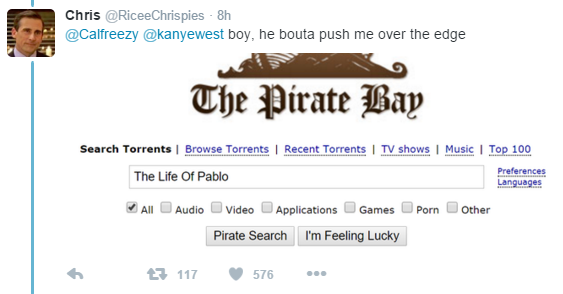
Soon after the album was released pirated copies started to populate many torrent and direct download sites, something many people on social media were quick to point out.

Arrr

kanyebay

TorrentFreak has been keeping a close eye on the popularity of the album on BitTorrent and after the first day an estimated 500,000 people have already grabbed a copy.

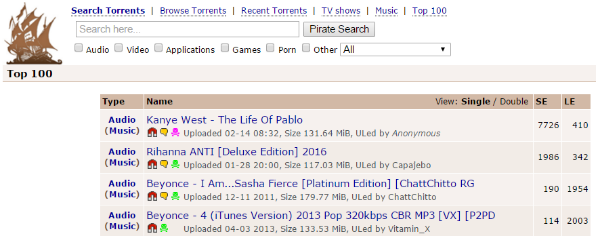
The album is currently leading The Pirate Bay’s list of most shared music torrents by a landslide. At the time of writing close to 10,000 people were sharing a copy of the most popular torrent simultaneously, something we haven’t seen with a music release before.

Aside from torrent sites, the album is also being widely distributed on various direct download services and hosting sites, increasing the overall piracy numbers even further.

The Life of Pablo

pablo

The Life of Pablo was a highly anticipated album which would have resulted in a lot of piracy anyway, but it’s safe to say that the limited release boosted these numbers significantly.

On the flip side, Tidal most likely received tends of thousands of new subscribers, so it’s hard to draw any strong conclusions in terms of revenue. But perhaps Mark Zuckerberg can jump in if the results are disappointing.

Thus far Kanye hasn’t commented on the piracy issue, but the RIAA is working hard to take links to pirated content down. Many of the torrents that were uploaded yesterday have been removed, but these are soon replaced by new ones.

Source: TF, for the latest info on copyright, file-sharing, torrent sites and ANONYMOUS VPN services.
Steal This Show S01E06: Revolutionizing Hollywood

Today we bring you the sixth episode of the Steal This Show podcast, with feature guest Lance Weiler. In this episode we discuss upsides of piracy and how digital distribution revolutionized indie filmmaking.

Source: TF, for the latest info on copyright, file-sharing, torrent sites and ANONYMOUS VPN services.
steal240This special episode features Lance Weiler – writer, director & experience designer. Lance is the creator of movies The Last Broadcast (1998) and Head Trauma (2005). WIRED magazine named him ‘one of 25 people helping to re-invent entertainment and change the face of Hollywood.’

As well as zooming through Lance’s career, Jamie and Lance discuss how digital distribution revolutionized indie filmmaking, while filmmakers resisted it; how Lance sees piracy as a positive; the challenges for discovery and attention when everyone’s a creator; and how to hijack Sherlock Holmes.

Steal This Show aims to release bi-weekly episodes featuring insiders discussing copyright and file-sharing news. It complements our regular reporting by adding more room for opinion, commentary and analysis.

The guests for our news discussions will vary and we’ll aim to introduce voices from different backgrounds and persuasions. In addition to news, STS will also produce features interviewing some of the great innovators and minds.

Host: Jamie King

Guess: Lance Weiler.

Produced by Jamie King
Edited & Mixed by Eric Bouthiller
Original Music by David Triana
Web Production by Siraje Amarniss

Source: TF, for the latest info on copyright, file-sharing, torrent sites and ANONYMOUS VPN services.

Cox Refuses to Spy on Subscribers to Catch Pirates

Cox Communications is objecting to a broad permanent injunction requested by music publisher BMG. The music group wants the ISP to spy on its subscribers and take action against those who download pirated material. Cox informs the court that these demands are overbroad, vague and possibly illegal.

Source: TF, for the latest info on copyright, file-sharing, torrent sites and ANONYMOUS VPN services.

cox-logoLast December a Virginia federal jury ruled that Internet provider Cox Communications was responsible for the copyright infringements of its subscribers.

The ISP was found guilty of willful contributory copyright infringement and must pay music publisher BMG Rights Management $25 million in damages.

The verdict was a massive victory for the music company and a disaster for Cox, but the case is not closed yet.

A few weeks ago BMG asked the court to issue a permanent injunction against Cox Communications, requiring the Internet provider to terminate the accounts of pirating subscribers and share their details with the copyright holder.

In addition BMG wants the Internet provider to take further action to prevent infringements on its network. While the company remained vague on the specifics, it mentioned the option of using invasive deep packet inspection technology.

Last Friday, Cox filed a reply pointing out why BMG’s demands go too far, rejecting the suggestion of broad spying and account termination without due process.

“To the extent the injunction requires either termination or surveillance, it imposes undue hardships on Cox, both because the order is vague and because it imposes disproportionate, intrusive, and punitive measures against households and businesses with no due process,” Cox writes (pdf).

For one, Cox believes that the proposed injunction is vague. It doesn’t specify what a repeat infringer is and ignores false positives or other complicating situations.

“What if, for example, the subscriber’s computer was infected with malware, the user’s network password was stolen, or a neighbor or guest accessed the user’s account? BMG’s motion and proposed order are silent on these critical questions,” Cox writes.

The Internet provider also rejects the mass-surveillance suggestion. Aside from it being a privacy violation, Cox says it can’t identify and block individual files its subscribers send.

While some measures can be taken to detect overall BitTorrent traffic, its tools can’t easily pinpoint pirated content flowing through its network.

“The evidence at trial showed that Cox cannot use deep packet inspection or other tools to police its users’ activities because surveillance to detect the contents of user transmissions is likely illegal,” Cox writes.

“The evidence showed that Cox does not track where users go on the Internet; that Cox does not know what content passes over its system, and that Cox cannot identify, much less block, which files a subscriber accesses or shares using BitTorrent,” they add.

The spying element is not the only privacy invasion, according to Cox. The copyright holder also asked for the injunction to require the ISP to hand over the personal details of copyright infringers.

Cox notes that this request clearly violates the DMCA. In addition, it threatens the public interest by exposing personal details of subscribers to an “abuser” such as the piracy settlement outfit Rightscorp.

“BMG’s proposed injunction threatens the public interest. It blindly punishes consumers by terminating their Internet access based on mere accusations, invading their privacy, and forcing them into a relationship with known abuser Rightscorp.”

Taking the above into account, Cox is asking the court to deny the proposed injunction, or limit it so it would not require any monitoring or the handing over of private subscriber details.

The court will now review the request from both sides and is expected to rule on the matter during the weeks to come.

Source: TF, for the latest info on copyright, file-sharing, torrent sites and ANONYMOUS VPN services.

Top 10 Most Pirated Movies of The Week – 02/15/16

The top 10 most downloaded movies on BitTorrent are in again. ‘Creed’ tops the chart this week, followed by ‘Ride Along 2′ ‘The Big Short’ completes the top three.

Source: TF, for the latest info on copyright, file-sharing, torrent sites and ANONYMOUS VPN services.

creed1This week we have one newcomer in our chart.

Creed, which came out as BluRay rip this week, is the most downloaded movie.

The data for our weekly download chart is estimated by TorrentFreak, and is for informational and educational reference only. All the movies in the list are BD/DVDrips unless stated otherwise.

RSS feed for the weekly movie download chart.

Ranking (last week) Movie IMDb Rating / Trailer
torrentfreak.com
1 (7) Creed 8.0 / trailer
2 (1) Ride Along 2 5.8 / trailer
3 (2) The Big Short (DVDscr) 8.1 / trailer
4 (3) Spectre 7.9 / trailer
5 (10) The Good Dinosaur 6.9 / trailer
6 (4) The Revenant (DVDscr) ?.? / trailer
7 (…) The Forest 5.1 / trailer
8 (6) The Martian 8.2 / trailer
9 (5) Kung Fu Panda 3 (Telesync) 8.0 / trailer
10 (9) The Intern 7.4 / trailer

Source: TF, for the latest info on copyright, file-sharing, torrent sites and ANONYMOUS VPN services.

U.S. ISPs and Rightsholders Work on Improved Anti-Piracy Measures

The MPAA, RIAA and five large U.S. Internet providers have extended the “Six Strikes” anti-piracy system until late next month, TorrentFreak has learned. The agreement expired last summer but has been extended several times while the parties involved work towards making it future-proof.

Source: TF, for the latest info on copyright, file-sharing, torrent sites and ANONYMOUS VPN services.

pirate-runningDuring the summer of 2011 the MPAA and RIAA teamed up with five major Internet providers in the United States, announcing their a plan to “educate” BitTorrent pirates.

The parties launched the Center for Copyright Information (CCI) and agreed on a system through which Internet account holders are warned if their connections are used to download pirated content.

After five or six warnings ISPs take a variety of repressive measures, including bandwidth throttling and temporary disconnections.

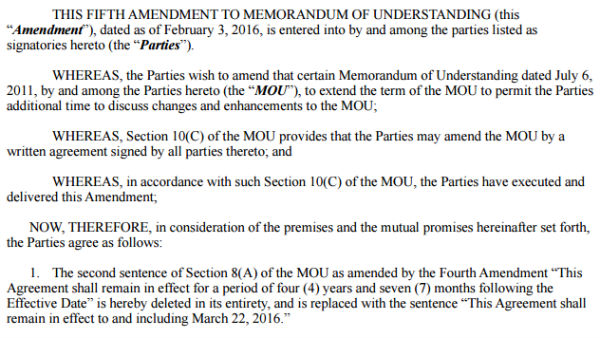
The system has been in place for several years now and last summer the agreement was set to expire. However, the CCI informs TorrentFreak that the program will continue and earlier this month it was extended again until March 22.

This is a relatively short extension, suggesting that the parties are close to a new agreement. However, CCI was not able to confirm this.

“While this extension is shorter than prior extensions, it is still a matter of routine business that will allow us to maintain the program as we work together to refine the system,” a spokesperson informed us.

cciext

The negotiations have been ongoing for months so it’s clear that the new deal will include some changes. We can only speculate what these are, but it would be no surprise if the MPAA and RIAA have asked for more serious consequences for repeat infringers.

Under the current system a user will no longer receive any warnings after the 6th copyright alert, and permanent disconnections are not part of the program.

This made sense five years ago when the original terms were negotiated. However, just a few weeks ago Cox Communications was held liable for pirating customers because they failed to terminate their accounts, which puts the old agreement in a new light.

There has also been explicit critique from some copyright holders. A few months ago several independent movies studios called for an end to the “six strikes” scheme, describing it as an ineffective “sham”.

According to the movie studios the copyright alerts are highly ineffective because only a small fraction of the piracy notices are forwarded to the Internet providers.

Time will tell whether any of the upcoming changes will address these concerns.

For CCI, however, the core task remains educating consumers and shifting norms and behavior, pointing them towards legal sites and services.

“The members of CCI are committed to this voluntary effort to educate consumers about copyright and how they can access and enjoy digital content. We are proof positive that collaboration can work, and we are excited about the future of the organization,” CCI’s spokesperson says.

Source: TF, for the latest info on copyright, file-sharing, torrent sites and ANONYMOUS VPN services.

Hollywood Escalates “DVD Ripping” Case to International Incident

A group of Hollywood studios and technology partners have asked the U.S. Government to assist in solving a long-running court battle against the Antigua based software company SlySoft. Despite an earlier conviction SlySoft continues to offer its DVD and BluRay ripping tools. To progress the matter, rightsholders have asked the U.S. to place Antigua on the Priority Watch List.

Source: TF, for the latest info on copyright, file-sharing, torrent sites and ANONYMOUS VPN services.

slysoftAACS, the decryption licensing outfit founded by a group of movie studios and technology partners including Warner Bros, Disney, Microsoft and Intel, has targeted several DRM-circumvention tools in recent years.

The company sued the makers of popular DVD ripping software DVDFab in the U.S and also went after the Antigua-based company SlySoft, known for its AnyDVD software.

The latter case was first referred to the criminal enforcement authorities in 2007, and after seven years of proceedings it resulted in a clear win for the licensing company.

An Antiguan court found Slysoft owner Giancarla Bettini guilty of six charges under the 2003 Copyright Act and ordered him to pay a fine of $5,000 per offense. Failure to pay would result in a six months in jail for each offense.

However, despite this positive outcome not much changed. SlySoft’s owner immediately filed an appeal which effectively put the convictions on hold. After two years the appeal has yet to begin and AnyDVD remains widely available.

In what appears to be a last-ditch effort, AACS is now asking the United States Trade Representative to take on the matter. The licensing company is asking the Government to place Antigua on its copyright Priority Watch List.

“Circumvention through programs such as SlySoft’s AnyDVD HD is a source for widespread, large-scale and commercial copyright infringement by users located in the United States, as well as Antigua & Barbuda, and many other countries,” AACS writes (pdf).

“Such circumvention also harms the legitimate consumer electronics and information technology companies that build compliant content playback devices that ‘play by the rules’.”

In the letter AACS describes its efforts to address the matter through the Antiguan legal system, but notes that the earlier conviction failed to resolve the problem.

“SlySoft has continued to operate on essentially the same basis as before the conviction, with no interruption of its ‘business’ and no relief for AACS LA and the content companies whose movies are the subject of SlySoft’s circumvention activities,” the group writes.

According to AACS the DVD ripping software has been downloaded by “tens of thousands of individuals” over the past two years, while categorizing the harm it’s done as “extremely high.”

Placing Antigua on the Priority Watch List is a logical next step, according to AACS, which will put pressure on the Caribbean island and permit the parties involved to carefully investigate the matter.

“AACS LA respectfully requests that the USTR place Antigua on its Priority Watch List, which will permit AACS LA and the USTR’s Office to evaluate Antigua’s activities in the coming months, including its prosecution of SlySoft and its founder.”

It’s not common for a single court case to escalate into an “international incident” so it’s not clear whether the U.S. Government will take on the recommendation.

That said, this is not the first trade dispute between Antigua and the United States.

In 2005 the WTO ruled that the US refusal to let Antiguan gambling companies access their market violated free-trade, as domestic companies were allowed to operate freely. In 2007 the WTO went a step further and granted Antigua the right to suspend U.S. copyrights up to $21 million annually.

In response Antigua opted to start their own pirate site, with permission from the World Trade Organization. This pirate site never saw the light of day and both countries are reportedly still working on a resolution.

Source: TF, for the latest info on copyright, file-sharing, torrent sites and ANONYMOUS VPN services.

uTorrent Debuts Ad-Free Client for $4.95 Per Year

The uTorrent team has introduced a new ad-free version of the popular file-sharing client. Users can now buy a yearly $4.95 subscription to download the latest torrents without being subjected to ads. The new client is part of an experiment to optimize the user experience.

Source: TF, for the latest info on copyright, file-sharing, torrent sites and ANONYMOUS VPN services.

utorrent-logo-newWith well over 150 million active users a month uTorrent is by far the most used BitTorrent client around.

The application generates income by bundling software “offers” during the install process and through in-app banner advertising.

The banner advertisements are relatively new. Parent company BitTorrent Inc. decided to include these in 2012 in order to increase its revenues, causing uproar among some of its users.

This week the company has reintroduced an ad-free version of its uTorrent client. In addition to the free ad-supported version there’s now a paid client as well, for which users are charged $4.95 per year.

Through a paid subscription users can support the developers directly without constantly being subjected to advertising.

“We’ve been busy experimenting with new ways to improve uTorrent for our users while financially supporting the amazing team that works every day to make uTorrent free for millions of people around the world,” BitTorrent’s Jordy Berson notes.

uTorrent versions

utorrent-options

The $4.95 version doesn’t come with any of the advanced features that are available in the 19.95 Pro version, but is considerably cheaper.

“This gives users the option of avoiding any and all ads in the client. It’s exciting to us because it gives users the ability to avoid advertising at 25% of the cost that it used to be – about 5 dollars a year instead of 20 dollars,” Berson says.

The price setting is definitely reasonable for an application that millions of people use on a daily basis. However, not all BitTorrent users are eager to pay for the products they consume.

But instead of pirating a copy of uTorrent, these users can also disable the advertisements in the free version of the client, for now at least. The uTorrent team hasn’t said whether this will change in the future.

The release of the paid tier is part of uTorrent’s efforts to move away from invasive advertisements and bundled software, which led to bad PR in the past.

“We’ve never been satisfied with this revenue model. It requires compromises that detract from a premium user experience. We want to find a model that adds value to our product and our users. We want to find a better way,” the uTorrent team previously said.

Time will tell whether a paid subscription is the way to go.

Source: TF, for the latest info on copyright, file-sharing, torrent sites and ANONYMOUS VPN services.

Torrents-Time Faces Security Concerns

Torrents-Time, the browser plug-in which allows people to stream torrents from The Pirate Bay and KickassTorrents, has been flagged as insecure by several developers. Responding to the criticism, Torrents-Time just released an update with several fixes and improvements.

Source: TF, for the latest info on copyright, file-sharing, torrent sites and ANONYMOUS VPN services.

torrents-timeOver the past two weeks Torrents-Time has made headlines on hundreds of news sites.

While streaming torrents is nothing new, it quickly reached a mainstream audience when several of the largest torrent sites adopted the technology.

Earlier this week TorrentFreak learned that the implementation hadn’t gone flawlessly on all sites. For example, The Pirate Bay is now vulnerable to XSS attacks.

This allows outsiders to execute code on the site, as shown by this example.

While Torrents-Time isn’t necessarily to blame for this issue, the software’s popularity also prompted some developers to look for other possible security concerns in the application.

Aurous and Strike developer Andrew Sampson took the software apart and summarized several findings on his personal website, ultimately characterizing Torrents-Time as unsafe.

Among other things, the software is accused of running as root on OSX, leaking private information, and making it possible for outsiders to launch torrents without the user’s knowledge.

“It’s like leaving your door open, if not worse, giving a complete stranger the keys to your house, with no background check and blindly trusting them,” Sampson tells TorrentFreak.

While some of the issues are indeed causing concern, Torrents-Time’s developers counter that several reports contain incorrect statements and half-truths.

The XSS vulnerability was triggered by The Pirate Bay’s implementation, they say, and some of the privacy issues being highlighted apply to most sites and services.

Torrents-Time does acknowledge that it was possible for third parties to start torrents without the user’s knowledge. This will be fixed in an automatic update later today, after which users have to grant explicit permission.

It’s also true that Torrents-Time has root access on OSX, but according to the Torrents-Time team this is required to integrate the VPN service.

Torrents-Time’s full response to Sampson’s article is available here.

Meanwhile, Torrents-Time is also receiving pushback from other angles. AVG is now categorizing the application as Adware, possibly because it links to a VPN advertisement. In addition, ad-blockers have started to flag the streaming links on The Pirate Bay, hiding them from users.

Nevertheless, the developers are confident that they can deliver a quality product.

“We are more than eager to have an efficient and safe product. We undertake to rectify any flaw and deal with any threat to users and sites alike,” the Torrents-Time team informs us.

Perhaps it’s a no-brainer, but users visiting torrent sites should always proceed with care and with Torrents-Time the situation is no different.

Source: TF, for the latest info on copyright, file-sharing, torrent sites and ANONYMOUS VPN services.