Pirate Android App ‘Store’ Member Jailed For 46 Months

A unique FBI operation carried out four years ago targeted several pirate Android app marketplaces, seizing their domains and arresting their operators. This month saw the first conviction, with SnappzMarket’s ‘PR manager’ Scott Walton receiving a 46-month prison sentence for conspiracy to commit copyright infringement.

Source: TF, for the latest info on copyright, file-sharing, torrent sites and ANONYMOUS VPN services.

snappzAssisted by police in France and the Netherlands, the FBI took down the “pirate” Android stores Appbucket, Applanet and SnappzMarket during the summer of 2012.

The domain seizures were the first ever against “rogue” mobile app marketplaces and followed similar actions against BitTorrent and streaming sites.

During the years that followed several people connected to the Android app sites were arrested and indicted, but progress has been slow. Today, we can report on what we believe to be the first sentencing in these cases.

Earlier this month, Scott Walton of Lovejoy, Georgia, was found guilty of conspiracy to commit copyright infringement and sentenced to 46 months in prison.

The sentence hasn’t been announced publicly by the Department of Justice, but paperwork (pdf) obtained by TorrentFreak confirms that it was handed down by Georgia District Court Judge Timothy Batten.

The Judgement

walton

According to the prosecution, one of Walton’s primary tasks was to manage public relations for SnappzMarket.

“In this role, defendant Walton monitored the Facebook fan page for SnappzMarket, provided responses to support inquiries, developed new ideas for SnappzMarket, and assisted with finding solutions to technical problems,” the indictment reads.

“In addition, defendant Walton searched for and downloaded copies of copyrighted apps, burned those copies to digital media such as compact discs, and mailed them to defendant Gary Edwin Sharp.”

The sentencing itself doesn’t come as a surprise, but it took a long time to be finalized.

Together with several co-defendants, Walton had already pleaded guilty two years ago, when he admitted to being involved in the illegal copying and distribution of more than a million pirated Android apps with a retail value of $1.7 million.

Before sentencing, Walton’s attorney Jeffrey Berhold urged the court to minimize the sentence. Citing letters from family and friends, he noted that his client can be of great value to the community.

“The Court can make this world a better place by releasing Scott Walton sooner rather than later,” Berhold wrote.

Whether these pleas helped is unknown. The 46-month sentence is short of the five years maximum, but it remains a very long time.

Initially, Walton was able to await his sentencing as a free man, but last year he was incarcerated after violating his pretrial release conditions. This means that he has already served part of his sentence.

The two other SnappzMarket members who were indicted, Joshua Ryan Taylor and Gary Edwin Sharp, are expected to be sentenced later this year. The same is true for co-conspirator Kody Jon Peterson.

Source: TF, for the latest info on copyright, file-sharing, torrent sites and ANONYMOUS VPN services.

Europe’s Net Neutrality Doesn’t Ban BitTorrent Throttling

Today, the Body of European Regulators of Electronic Communication (BEREC) published its implementation guidelines for Europe’s net neutrality rules. While public protests resulted in several positive changes from a net neutrality perspective, BitTorrent throttling is still allowed.

Source: TF, for the latest info on copyright, file-sharing, torrent sites and ANONYMOUS VPN services.

netneutralityWhen the European Parliament adopted Europe’s first net neutrality rules late last year, many net neutrality proponents were not happy with the outcome.

The rules, which are included in the Telecoms Single Market (TSM) regulation, would still allow targeted throttling of BitTorrent and other traffic, under the guise of network management.

In addition, opponents warned that the rules left the door open for ISPs to charge for fast lanes and restrict or slow down access to parts of the Internet for commercial reasons.

To change this, various activist groups launched a “EU Slowdown” campaign through which they got half a million people to respond to a public consultation that was held by BEREC.

Today, BEREC presented its final guidelines on the implementation of Europe’s net neutrality rules. Compared to earlier drafts it includes several positive changes for those who value net neutrality.

For example, while zero-rating isn’t banned outright, Internet providers are not allowed to offer a “sub Internet” service, where access to only part of the Internet is offered for ‘free.’

However, not all traffic is necessarily “neutral.” ISPs are still allowed to throttle specific categories for “reasonable” network management purposes, as the second subparagraph of article 3 reads.

“In order to be deemed to be reasonable, such measures shall be transparent, non-discriminatory and proportionate, and shall not be based on commercial considerations but on objectively different technical quality of service requirements of specific categories of traffic.”

article3ber

This means that network management practices, including bandwidth throttling, could possibly target BitTorrent transfers under a broader file-sharing category, or VPNs as encrypted traffic.

“The requirement for traffic management measures to be non-discriminatory does not preclude providers of internet access services from implementing, in order to optimize the overall transmission quality, traffic management measures which differentiate between objectively different categories of traffic,” BEREC’s guidelines clarify.

In other words, it would still be possible for ISPs to throttle BitTorrent traffic if that would improve the overall “transmission quality.” This is not a far-fetched argument since torrent traffic can be quite demanding on a network.

While it’s not expected that BitTorrent or VPN traffic will be targeted any more than it is right now, the option remains open. This will be a welcome decision by networking specialists and ISPs in general, which have argued that selectively targeting congestion is a more sensible approach.

Setbacks aside, net neutrality activists have also generally responded positively. Their main goal was to prevent so-called “fast lanes,” which is largely achieved.

“The victory here is that Europe is clearly banning ISPs from creating paid fastlanes, as the US did. That was the biggest threat, because ISPs could have actually *profited* by slowing down our Internet, and then charging sites or apps for a fastlane,” Fight For The Future’s Holmes Wilson tells TorrentFreak.

“My understanding is that the rules still allow throttling under the guise of traffic management. But thanks to the ban on fastlanes, ISPs won’t have the same incentive to throttle, and regulators could stop ISPs from throttling in cases where it clearly had nothing to do with preventing future congestion,” he adds.

The full guidelines and additional background information are available at BEREC’s website.

Source: TF, for the latest info on copyright, file-sharing, torrent sites and ANONYMOUS VPN services.

Grumpy Cat Wants $600k From ‘Pirating’ Coffee Maker

Grumpy Cat is not pleased, yet. Her owners have asked a California federal court to issue a $600,000 judgment against a coffee maker which allegedly exploited their copyrights. In addition, they want damages for trademark and contract breach, and a ban on the company in question from selling any associated Grumpy Cat merchandise.

Source: TF, for the latest info on copyright, file-sharing, torrent sites and ANONYMOUS VPN services.

grumpcatThere are dozens of celebrity cats on the Internet, but Grumpy Cat probably tops them all.

The cat’s owners have made millions thanks to their pet’s unique facial expression, which turned her into an overnight Internet star.

Part of this revenue comes from successful merchandise lines, including the Grumpy Cat “Grumppuccino” iced coffee beverage, sold by the California company Grenade Beverage.

The company licensed the copyright and trademarks to sell the iced coffee, but is otherwise not affiliated with the cat and its owners. Initially this partnership went well, but after the coffee maker started to sell other “Grumpy Cat” products, things turned bad.

The cat’s owners, incorporated as Grumpy Cat LLC, took the matter to court last year with demands for the coffee maker to stop infringing associated copyrights and trademarks.

After Grenade Beverage failed to properly respond to the allegations, Grumpy Cat’s owners moved for a default, which a court clerk entered early June. A few days ago they went ahead and submitted a motion for default judgment.

A memorandum (pdf) supporting the new motion repeats many of the allegations that were listed in the original complaint. Among other things, it accuses the coffee maker of manufacturing and selling Grumpy Cat merchandise without permission.

“Not only was the Infringing Product never approved by Plaintiff under the License Agreement, but the packaging and marketing materials for the Infringing Product, as depicted in the example below, primarily and exclusively incorporate Plaintiff’s exclusive intellectual property, including the Grumpy Cat Copyrights and the Grumpy Cat Trademarks,” the memorandum reads.

Allegedly infringing Grumpy Cat coffee

grumpcoffee

At the time of writing, the coffee maker’s Grumpy Coffee website is offline. In addition, the associated social media accounts also went quiet late last year, when the lawsuit was first announced.

Nevertheless, Grumpy Cat and her owner still hold the company responsible for its previous infringements. In their motion they list four copyrights, claiming the maximum of $150,000 in statutory damages for each.

“Here, the magnitude of Grenade’s willful infringement of Plaintiff’s Grumpy Cat Copyrights, willful disregard of this Court’s authority, and refusal to stop its blatant infringement renders Plaintiff entitled to a $150,000 statutory damages award for each of the Grumpy Cat Copyrights, in a total amount of $600,000,” the motion reads.

This number is repeated in the proposed default judgment (pdf) as well, which the court still has to sign off on.

Proposed injunction, $600,000 copyright damages

600kgrumpy

In addition to the copyright infringements, Grumpy Cat also asks for actual and treble damages for trademark infringements, damages for contract breach, and injunctive relief to prevent the coffee maker from selling Grumpy Cat products in the future.

Since it’s a request for a default judgment, there is a good chance that the judge will approve the demands. While it’s unlikely that Grumpy Cat herself will care, her owners will definitely be happy if that’s the case.

Still, a default judgment doesn’t mean the end of the Grumpy Cat dispute. Defendants Paul and Nick Sandford, who are affiliated with Grenade Beverage, did respond to the original complaint and are not yet throwing in the towel.

Together with the non-party company Grumpy Beverage, they filed a counterclaim asking for declaratory judgments affirming that they are the rightful owner of various Grumpy Cat coffee-related trademarks and copyrights, as well as several disputed domain names.

Source: TF, for the latest info on copyright, file-sharing, torrent sites and ANONYMOUS VPN services.

Top 10 Most Pirated Movies of The Week – 08/29/16

The top 10 most downloaded movies on BitTorrent are in again. ‘Now You See Me 2′ tops the chart this week, followed by ‘Blood Father’. ‘Independence Day: Resurgence’ completes the top three.

Source: TF, for the latest info on copyright, file-sharing, torrent sites and ANONYMOUS VPN services.

nowyouseeThis week we have two newcomers in our chart.

Now You See Me 2 is the most downloaded movie for the second week in a row.

The data for our weekly download chart is estimated by TorrentFreak, and is for informational and educational reference only. All the movies in the list are Web-DL/Webrip/HDRip/BDrip/DVDrip unless stated otherwise.

RSS feed for the weekly movie download chart.

Ranking (last week) Movie IMDb Rating / Trailer
torrentfreak.com
1 (1) Now You See Me 2 6.8 / trailer
2 (…) Blood Father 7.1 / trailer
3 (2) Independence Day: Resurgence (Subbed HDRip) 5.6 / trailer
4 (…) The Conjuring 2 7.8 / trailer
5 (3) The Legend of Tarzan (Subbed HDRip) 6.6 / trailer
6 (4) Neighbors 2 6.0 / trailer
7 (9) Jason Bourne (HDTC) 7.4 / trailer
8 (6) The Jungle Book 7.8 / trailer
9 (8) Warcraft 7.7 / trailer
10 (5) Imperium 6.7 / trailer

Source: TF, for the latest info on copyright, file-sharing, torrent sites and ANONYMOUS VPN services.

Indian ISPs Speed Up BitTorrent by ‘Peering’ With a Torrent Site

Several Internet providers in India have found a clever way to reduce the load BitTorrent transfers put on their network, while pleasing their torrenting subscribers at the same time. They’ve teamed up with Torbox.net which offers a fully fledged torrent search engine that connects users to ‘local’ peers to guarantee maximum download speeds.

Source: TF, for the latest info on copyright, file-sharing, torrent sites and ANONYMOUS VPN services.

torboxlogoFrom a networking perspective most Internet providers are generally not very happy with BitTorrent users.
These users place a heavy load on the network and can reduce the performance experienced by other subscribers. In addition, the huge amount of data transferred outside the ISPs’ own networks is also very costly.

Some ISPs are trying to alleviate the problem by throttling or otherwise meddling with BitTorrent traffic, but there is a more customer-friendly solution.

Instead of working against their torrenting subscribers, various Internet providers in India have found a win-win solution. They help users to download content faster by linking them to local peers in their own network.

ISPs such as Alliance Broadband, Excitel, Syscon Infoway and True Broadband, have been offering accelerated torrents for a while. Some have had their own custom ‘caching’ setups but increasingly they are teaming up with the torrent search engine Torbox.

While not well-known in the rest of the world, Torbox is a blessing for many Indians who are lucky enough to have an ISP that works with the site.

Through Torbox they can download torrents at speeds much higher than their regular Internet connection allows. This is possible because Torbox links them to peers in the local network, which means that the traffic is free for the ISP.

torboxubuntu

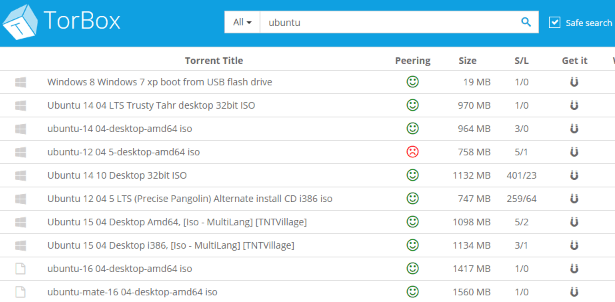
Most people who visit Torbox will see a notice that their ISP doesn’t have a peering agreement. However, for those who have a supporting ISP the torrent site returns search results ordering torrents based on the proximity of downloaders.

Torbox uses downloaders’ IP-addresses to determine who their ISP is and directs them to torrents with peers on the same network.

“It’s a highly sophisticated IP technology based on network proximity,” Torbox explains, adding that every ISP is welcome to sign a peering agreement.

“Then based on your IP address TorBox can estimate how well you are connected to peers who have the content in question. It’s quite a tough job but luckily it works,” they add.

The downloads themselves go through a regular torrent client and don’t use any special trackers. However, the torrent swarms often connect to dedicated “cache peers” as well, which serve bits and pieces to speed up the swarm.

Torbox itself doesn’t get involved in the traffic side, they only point people to the “peering” torrents. The actual peering is handled by other services, such as Extreme Peering, which is operated by Extreme Broadband Services (EBS).

TorrentFreak spoke with EBS director Victor Francess, who says that with this setup most torrent data is served from within the ISP’s own network.

“It all creates a very powerful user experience, so in fact just about 10-20% of all torrent traffic comes from the upstream and everything else is local,” Francess says.

As for the content, Torbox links to the torrents you would generally find on a torrent site. It even has a handy catalog page featuring some recent blockbusters and other popular videos. This page also advertises Strem.io as a service that can be used to stream video torrents directly.

torboxcatalog

TorrentFreak spoke to several Indian Torbox users at different ISPs, who are all pretty happy with the service. It allows them to download torrents at much faster rates than their regular Internet speed.

One user told us that his downloads sometimes reach a 10 MBps download speed, while his Internet connection is capped at 4 MBps.

The ISPs themselves are not too secretive about their peering agreements either. Excited previously advertised the Torbox peering on its main site and others such as Sifi Broadband still do.

torboxpl

Alliance Broadband still lists Torbox in its FAQ at the time of writing, describing it as a “local content search engine” through which subscribers receive files “at ultra-high speed from the other peering users.”

For most outsiders it’s intriguing to see ISPs publicly cooperating with a torrent site, but in India it’s reality.

The question is, however, how long this will last. In recent months piracy has become a hot topic in India, with Bollywood insiders linking it to massive losses and even terrorism.

Ironically, many ISPs have also been ordered by courts to block access to hundreds of piracy sites, including many torrent search engines. For now, however, Torbox remains freely accessible.

Source: TF, for the latest info on copyright, file-sharing, torrent sites and ANONYMOUS VPN services.

Library of Congress Might Become a Piracy Hub, RIAA Warns

The U.S. Copyright Office is considering expanding the mandatory deposit requirement for publishers, so that record labels would also have to submit their online-only music to the Library of Congress. The Library would then allow the public to access the music. The RIAA, however, warns that this plan introduces some serious piracy concerns.

Source: TF, for the latest info on copyright, file-sharing, torrent sites and ANONYMOUS VPN services.

cassetteWith an impressive collection of more than 160 million items, the Library of Congress is the second largest library in the world.

The Library also serves as a legal repository for the copyright office. By law, everyone who publishes a copyrighted work in the U.S. is required to deposit two copies at the library.

This also applies to music and videos but up until now, content produced in an online-only format has been exempted from this mandatory deposit requirement.

However, now that digital is becoming the standard for more copyrighted works, the Copyright Office is considering a change. As a result, music publishers will be required to submit all digital works to the Library of Congress.

These files will then become freely accessible to the public through a secured system.

“Under any rule requiring mandatory deposit of online-only sound recordings, the Library would provide public access to such recordings,” the Copyright Office writes in its proposal.

“The Library currently has a system by which authorized users can access and listen to digitized copies of physical sound recordings collected through other means at the Madison Building of the Library of Congress.”

This proposal has been met with scrutiny by the music industry group RIAA, which states that it has “serious concerns.”

According to the RIAA, there is a risk that content hosted by the Library may be exploited by pirates, who could copy the music and share it on various pirate sites. This could then crush the major record labels’ revenues.

“It is well-established that the recorded music industry has been inundated with digital piracy,” the RIAA writes.

“If sound recordings available through the Library – whether on-premises or online – were managed in a way that patrons could use those recordings for uploading to pirate web sites and unlicensed streaming services or if the Library’s collection of sound recordings were made electronically available to the public at large, that could have a devastating impact on our member companies’ revenues.”

The RIAA further states that the current proposal lacks information on what security measures would apply to the storage of and access to sound recordings.

In addition to a general concern that the public could copy sound recordings in the library, the RIAA notes that there’s also a risk that the entire Library of Congress database could be hacked if people are allowed to access it over the Internet.

Should this happen, millions of digital sound recordings may leak to the public.

“In an age where servers are hacked on a regular basis, no electronic server is secure. Government servers are no different,” the RIAA writes.

“Given the inherent vulnerability of servers believed to be secure, we question the need for anyone to have remote access to a server that stores commercially valuable digital sound recordings.”

Since people have so many options to enjoy digital music nowadays, the RIAA sees no reason for the Library of Congress to allow electronic copying or distribution of the sound recordings of its members.

If the Copyright Office goes ahead, the RIAA urges it to consult the record labels to make sure that state of the art technological protection measures are deployed to secure their work.

RIAA’s full comments are available here (pdf).

Source: TF, for the latest info on copyright, file-sharing, torrent sites and ANONYMOUS VPN services.

FBI-Controlled Megaupload Domain Now Features Soft Porn

As part of its criminal case against Megaupload, the U.S. Government seized several domain names belonging to Kim Dotcom’s file-hosting service. Nearly five years later the authorities still control the domains but they haven’t done a very good job of securing them. Megaupload.org now links to a soft porn portal.

Source: TF, for the latest info on copyright, file-sharing, torrent sites and ANONYMOUS VPN services.

fbiantiMegaupload was shutdown nearly half a decade ago, but all this time there has been little progress on the legal front.

Last December a New Zealand District Court judge ruled that Kim Dotcom and his colleagues can be extradited to the United States to face criminal charges, a decision that will be appealed shortly.

With the criminal case pending, the U.S. Government also retains control over several of the company’s assets.

This includes cash, cars, but also over a dozen of Megaupload’s former domain names, including Megastuff.co, Megaclicks.org, Megaworld.mobi, Megaupload.com, Megaupload.org, and Megavideo.com.

Initially, the domains served a banner indicating they had been seized as part of a criminal investigation. However, those who visit some of the sites today are in for a surprise.

This week we discovered that Megaupload.org is now hosting a site dedicated to soft porn advertisements. Other seized domains are also filled with ads, including Megastuff.co, Megaclicks.org, and Megaworld.mobi.

Megaupload?

megauploaorg

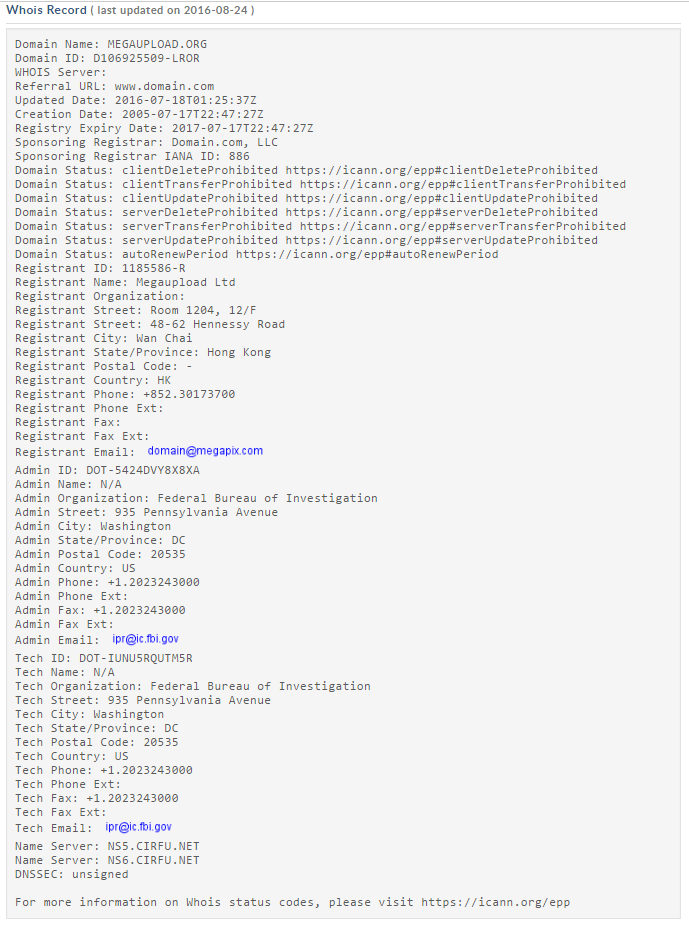
Interestingly, this all happened under the watch of the FBI, which is still listed as the administrative and technical contact for the domain names in question.

So how can this be?

Regular readers may recall that something similar happened to the main Megaupload.com domain last year. At the time we traced this back to an expired domain the FBI used for their nameservers, Cirfu.net.

After Cirfu.net expired, someone else took over the domain name and linked Megaupload.com to scammy ads. The U.S. authorities eventually fixed this by removing the nameservers altogether, but it turns out that they didn’t do this for all seized domains.

A few weeks ago the Cirfu.net domain expired once more and again it was picked up by an outsider. This unknown person or organization parked it at Rook Media, to generate some cash from the FBI-controlled domains.

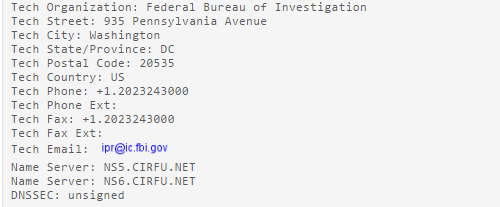
As can be seen from the domain WHOIS data, Megaupload.org still uses the old Cirfu.net nameservers, which means that an outsider is now able to control several of the seized Megaupload domain names.

cirfu

The ‘hijacked’ domains don’t get much traffic but it’s still quite embarrassing to have them linked to ads and soft porn. Commenting on our findings, Kim Dotcom notes that the sloppiness is exemplary of the entire criminal case.

“Their handling of the Megaupload domain is a reflection of the entire case: Unprofessional,” Dotcom tells us.

What’s clear is that the U.S. authorities haven’t learned from their past mistakes. It literally only takes a few clicks to update the nameserver info and reinstate the original seizure banner. One would assume that the FBI has the technical capabilities to pull that off.

Source: TF, for the latest info on copyright, file-sharing, torrent sites and ANONYMOUS VPN services.

U.S. Government Indicts Three Alleged KickassTorrents Operators

The U.S. Government has followed up its criminal complaint against KickassTorrents with the indictment of three alleged operators of the site. In addition to their involvement with the popular torrent site, they are also linked to other ‘pirate’ sites including Leechmonster.com, Solarmovie, iWatchfilm.com, Hippomovies.com and Torcache.

Source: TF, for the latest info on copyright, file-sharing, torrent sites and ANONYMOUS VPN services.

kickasstorrents_500x500Last month, Polish law enforcement officers arrested Artem Vaulin, the alleged owner of KickassTorrents, who’s been held in a local prison since.
Polish authorities acted on a criminal complaint from the U.S. Government which contained several damning allegations.

This week, the Department of Justice (DoJ) followed up the complaint with a full grand jury indictment, which presents several new allegations.

In addition to Vaulin, it charges two other defendants, Ievgen Kutsenko and Oleksandr Radostin. The three men, all from Ukraine, are charged with several counts of copyright infringement and money laundering.

“Kickass Torrents, or ‘KAT,’ was a commercial website that facilitated and promoted the reproduction and distribution of copyrighted content over the Internet without authorization of the copyright owners,” the DoJ writes.

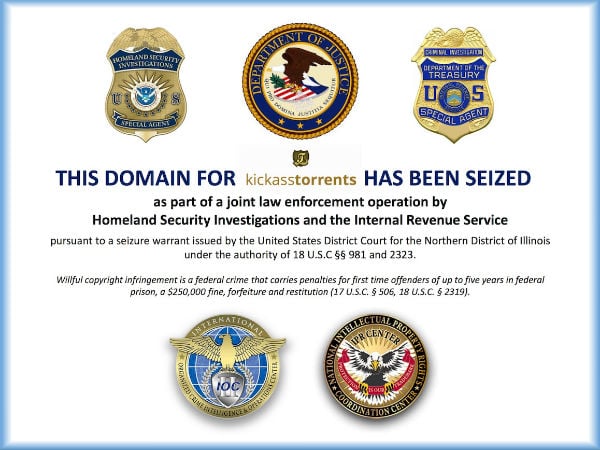
KAT’s seizure banner

katseized

According to the indictment, the ‘KAT conspiracy’ involved a variety of piracy-related websites. It mentions that the torrent storage service Torcache.net, which went offline together with KAT, was operated by the same people.

In addition, the defendants were involved in a variety of direct download sites where users could download or stream copyright-infringing content, sometimes in exchange for payments.

These sites include the popular streaming portal Solarmovie, which disappeared last month, as well as the defunct torrent leeching service Leechmonster.

“Leechmonster.com, rolly.com, solarmovie.com, solarmovie.ph, iwatchfilm.com, movie2b.com, hippomovies.com, bino.tv, and moviepro.net were commercial websites that enabled registered users to download or stream copyrighted movies and other media directly from the website,” the indictment reads.

katindictment

According to the U.S. Government, the three men used the sites to generate millions of dollars in revenue.

“…defendants […] and others designed, developed, and operated KAT, torcache.net, and the direct download websites in order to encourage, induce, facilitate, engage in, and generate millions of dollars from the unlawful reproduction and distribution of copyright-protected media,” the indictment states.

The authorities describe KickassTorrents as a site that was developed purposefully to facilitate copyright infringements. Among other things, this included the sorting of torrents by genre, so they would be easier to find.

In addition, the defendants are also accused of developing a BitTorrent client to facilitate piracy, and of operating the subtitle repository Subtitlesource.com.

On the money laundering side, the indictment includes various examples of advertising payments that were made to bank accounts that were operated by the defendants. This includes a payment from an undercover IRS investigator, who posed as an advertiser.

The Department of Justice has yet to comment on the indictment and it’s currently unknown where the two additional defendants reside and if they have been arrested. The court record shows that two warrants were submitted yesterday, but these remain sealed for now.

Meanwhile, Artem Vaulin is still being held in a Polish prison, awaiting his extradition process.

His lawyer previously asked the Department of Justice to release his client. The defense argued that Vaulin can’t be held responsible for the potentially infringing actions of the KAT’s users, since criminal secondary or indirect copyright infringement does not exist under U.S. law.

A copy of the full indictment obtained by TorrentFreak is available here.

Source: TF, for the latest info on copyright, file-sharing, torrent sites and ANONYMOUS VPN services.

Cloudflare Fights RIAA’s Piracy Blocking Demands in Court

Cloudflare has made it clear that the company isn’t going to block piracy sites without a proper court order. In addition, it now opposes an injunction requested by the RIAA, under which it would have to disconnect alleged MP3Skull accounts based on a keyword and IP-address.

Source: TF, for the latest info on copyright, file-sharing, torrent sites and ANONYMOUS VPN services.

skullRepresenting various major record labels, the RIAA filed a lawsuit against MP3Skull last year.
With millions of visitors per month the MP3 download site had been one of the prime sources of pirated music for a long time, frustrating many music industry insiders.

Although the site was facing a claim of millions of dollars in damages, the owners failed to respond in court. This prompted the RIAA to file for a default judgment, with success.

Earlier this year a Florida federal court awarded the labels more than $22 million in damages. In addition, it issued a permanent injunction which allowed the RIAA to take over the site’s domain names.

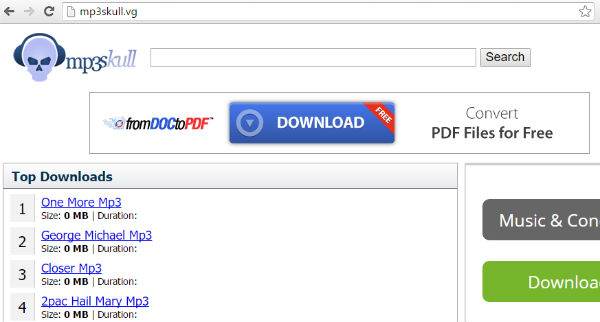
However, despite the million dollar verdict, MP3Skull still continues to operate today. The site actually never stopped and simply added several new domain names to its arsenal, with mp3skull.vg as the most recent.

MP3Skull’s most recent home

mp3skullvg

The RIAA is not happy with MP3Skull’s contempt of court and has asked Cloudflare to help out. As a CDN provider, Cloudflare relays traffic of millions of websites through its network, including many pirate sites.

According to the RIAA, Cloudflare should stop offering its services to any MP3Skull websites, but the CDN provider has thus far refused to do so without a proper court order.

To resolve this difference of opinion, the RIAA has asked the Florida federal court for a “clarification” of the existing injunction, so it applies to Cloudflare as well.

In practice, this would mean that Cloudflare has to block all currently active domains, as well as any future domains with the keyword “MP3Skull,” which are tied to the site’s known IP-addresses.

“Cloudflare should be required to cease its provision of services to any of the Active MP3Skull Domains, as well as any website at either 89.46.100.104 or 151.80.100.107 that includes ‘MP3Skull’ in its name,” RIAA argued.

RIAA’s request

riaareq

However, Cloudflare believes that this goes too far. While the company doesn’t object to disconnecting existing accounts if ordered to by a court, adding a requirement to block sites based on a keyword and IP-address goes too far.

The proposed injunction goes well beyond the scope of the DMCA, the CDN provider informs the court in an opposition brief this week (pdf).

“…Plaintiffs’ proposed injunction would force Cloudflare —which provides services to millions of websites— to investigate open-ended domain letter-string and IP address combinations to comply with the injunction.

“Cloudflare believes that this Court should hold the Plaintiffs accountable for following clear rules of the road,” Cloudflare adds.

The company suggests that the court could require it to terminate specific accounts that are found to be infringing, but doesn’t want to become the RIAA’s copyright cop.

“What Cloudflare cannot do, and which the Court should not require, is to serve as a deputy for the Plaintiffs and their RIAA trade association in investigating and identifying further targets of an injunction.”

To outsiders the difference between RIAA’s request and what Cloudflare suggests may seem small, but the company draws a clear line to prevent having to scan for pirate sites, proactively. This could turn into a slippery censorship slope, they feel.

This isn’t the first time that the RIAA has requested a keyword ban. In a similar case last year Cloudflare was ordered to terminate any accounts with the term “grooveshark” in them. However, in this case the RIAA owned the trademark, which makes it substantially different as it doesn’t involve the DMCA.

The EFF applauds Cloudflare’s actions and hopes the court will properly limit the scope of these and other blocking efforts.

“The limits on court orders against intermediaries are vital safeguards against censorship, especially where the censorship is done on behalf of a well-financed party,” EFF’s Mitch Stoltz writes.

“That’s why it’s important for courts to uphold those limits even in cases where copyright or trademark infringement seems obvious,” he adds.

The Florida court is expected to rule on the RIAA’s injunction demands during the days to come, a decision that will significantly impact future blocking requests.

Source: TF, for the latest info on copyright, file-sharing, torrent sites and ANONYMOUS VPN services.

Cloudflare Faces Lawsuit For Assisting Pirate Sites

In recent months CloudFlare has been called out repeatedly for offering its services to known pirate sites, including The Pirate Bay. These allegations have now resulted in the first lawsuit after adult entertainment publisher ALS Scan filed a complaint against CloudFlare at a California federal court.

Source: TF, for the latest info on copyright, file-sharing, torrent sites and ANONYMOUS VPN services.

cloudflareAs one of the leading providers of DDoS protection and an easy to use CDN service, Cloudflare is used by millions of sites across the globe.
This includes many “pirate” sites who rely on the U.S. based company to keep server loads down.

The Pirate Bay is one of the best-known customers, but there are literally are thousands of other ‘pirate’ sites that use services from the San Francisco company.

As a result, copyright holders are not happy with CloudFlare’s actions. Just recently, the Hollywood-affiliated group Digital Citizens Alliance called the company out for helping pirate sites to stay online.

Adult entertainment outfit ALS Scan agrees and has now become the first dissenter to take CloudFlare to court. In a complaint filed at a California federal court, ALS describes piracy as the greatest threat to its business.

The rise of online piracy has significantly hurt the company’s profits, they argue, noting that “pirate” sites are not the only problem.

“The problems faced by ALS are not limited to the growing presence of sites featuring infringing content, or ‘pirate’ sites. A growing number of service providers are helping pirate sites thrive by supporting and engaging in commerce with these sites,” ALS writes (pdf).

These service providers include hosting companies, CDN providers, but also advertising brokers. The lawsuit at hand zooms in on two of them, CloudFlare and the advertising provider Juicy Ads.

According to the complaint, both companies have failed to cut their ties with alleged pirate sites, even though they received multiple takedown notices.

CloudFlare and Juicy Ads’ terms state that they terminate accounts of repeat infringers. However, according to ALS both prefer to keep these sites on as customers, so they can continue to profit from them.

“Even though the law requires parties to terminate business with repeat infringers, and even though both Juicy Ads and Cloudflare’s own terms
state that they will terminate business with repeat infringers, neither Juicy Ads nor Cloudflare has terminated its business accounts with these chronic direct infringers.

“On information and belief, this is because Juicy Ads and Cloudflare make money by continuing to do commerce with sites that draw traffic through the lure of free infringing content,” the company writes.

The complaint lists Imgchili.net, Slimpics.com, Cumonmy.com, Bestofsexpics.com and Stooorage.com and CloudFlare customers that host copyright infringing material from ALS, and as of today these sites are still using the CDN provider’s services.

Juicy Ads reportedly terminated the accounts of several infringing sites after they learned about the lawsuit, but that doesn’t mean that it can escape liability for its earlier actions.

ALS holds both companies responsible for various counts of copyright and trademark infringement, for which it demands actual and statutory damages. With hundreds of works at stake, theoretical damages can run to dozens of millions of dollars.

Both CloudFlare and Juicy Ads have yet to file a formal response to the allegations.

Source: TF, for the latest info on copyright, file-sharing, torrent sites and ANONYMOUS VPN services.