
Seized Popcorn Time “News” Domain Sparks Free Speech Appeal

The battle over the legality of a seized Popcorn Time “news” domain is heating up. Last week a complaint by two digital rights groups was denied by a local court due to a lack of standing, but today they filed an appeal, joined by the legal owner of the disputed domain name.

Source: TF, for the latest info on copyright, file-sharing, torrent sites and ANONYMOUS VPN services.

popcorntMovie companies worldwide see Popcorn Time as one of the largest piracy threats against their businesses.

They are doing their best to put a halt to its popularity and are taking broad steps to contain it, sometimes with help from the authorities.

Earlier this year Norwegian rightsholders reported a local Popcorn Time site to the local economic crime police. Responding to this referral, the authorities seized the Popcorn-Time.no domain name.

While it uses Popcorn Time in the domain name the site didn’t host the application itself but instead posted news articles, as well as links to sites that offered the application.

This broad takedown of a news-focused site raised concerns with digital rights activists and legal experts. Not only is the legality of the site debated, but also the use of a far-reaching measure without a proper judicial review.

Hoping to hold the authorities accountable, Electronic Frontier Norway (EFN) and the Norwegian Unix User Group (NUUG) took the case to court. The main question they want answered is whether the domain seizure was appropriate in this case.

However, late last week the court refused to take on the case, arguing that both parties lacked standing, as they were not sufficiently affected by the domain seizure.

While it was a disappointing decision for the groups, it didn’t mark the end of the case. Today, EFN and NUUG filed an appeal and this time were joined by the legal owner of the domain name, the Norwegian company IMCASREG8.

IMCASREG8 didn’t run the site but acted as an intermediary between the operator of the domain and the registrar. On paper, they are the legal owner of the domain name.

Popcorn-time.no when it was still active

popcor-no

With the new party the groups hope to have sufficient standing to have the case heard. In their appeal there’s a strong focus on the free speech element, and they hope the court will clarify when domain seizures are appropriate.

“We feel that this is an important case that addresses the limits of free speech,” EFN’s managing director Tom Fredrik Blenning tells TorrentFreak.

NUUG leader Hans-Petter Fjeld adds that the authorities shouldn’t be allowed to seize the domain name of a news site, which writes about open source software that by itself is not infringing.

“Part of what makes us upset is that the domain name of a news site about a piece of free software that has both legal and illegal uses, has been seized without judicial scrutiny,” Fjeld says.

It is now up to the court to decide whether the appeal will be heard. For now, the Popcorn-Time.no site remains offline, flashing a police notice.

Source: TF, for the latest info on copyright, file-sharing, torrent sites and ANONYMOUS VPN services.

Filmmakers Ask “Pirate” to Take Polygraph, Backtrack When He Agrees

The makers of the Oscar-winning movie Dallas Buyers Club are displaying some dubious tactics in their ongoing crackdown on BitTorrent pirates. In California, the filmmakers recently asked an accused pirate to submit to a polygraph test, but changed their opinion after he agreed.

Source: TF, for the latest info on copyright, file-sharing, torrent sites and ANONYMOUS VPN services.

dallasThe makers of Dallas Buyers Club have sued thousands of BitTorrent users over the past two years.

Many of these cases end up being settled for an undisclosed amount. This usually happens after the filmmakers obtain the identity of the Internet account holder believed to have pirated the movie.

Not all alleged downloaders are eager to pay up though. In fact, many don’t respond to the settlement letters they receive or claim that someone else must have downloaded the film using their connection.

This is also true in the case Dallas Buyers Club filed against California resident Michael Amhari. The filmmakers claimed that Amhari downloaded a pirated copy of the movie after he was linked to a pirating IP-address and demanded a $10,000 settlement.

However, Amhari denies any involvement, and when the copyright holders demanded a polygraph test to prove it, he agreed. However, soon after, Dallas Buyers Club’s attorney retracted the offer.

“Plaintiff demanded that defendant take a polygraph examination in exchange for a dismissal of the case. Plaintiff’s counsel disingenuously stated that he would bear all the costs for such a polygraph test,” Amhari’s counsel Clay Renick writes.

“When plaintiff’s counsel then agreed to take such a test with the proviso that defense costs and attorney fees be covered, plaintiff then refused to pay costs and revoked his offer to conduct a polygraph.”

Instead of coming to terms, Dallas Buyers Club asked the court to order a default judgment in their favor, which Amhari’s counsel asked the court (pdf) to set aside.

In addition to the backpedaling on the polygraph offer the filmmakers also made other false promises, according to the defendant’s lawyer.

For example, they offered to dismiss the case if he would state under penalty of perjury that he was not involved, while pointing out another possible suspect. However, after Amhari submitted his declaration they moved for a default anyway.

“After receiving exculpatory evidence and the sworn declaration of defendant, Mr. Davis then refused to file a dismissal and proceeded to demand that defendant appear in the action or he would file a default.”

“This behavior is galling and it should not be permitted by the court,” the defendant’s counsel adds.

Because of these dubious tactics the court should set aside the default that was entered earlier this month. According to Renick, Dallas Buyer’s Club has nothing more than an IP-address to back up their infringement claims, which is not enough to prove guilt.

“This action is further proof of the malicious motives of plaintiff’s counsel who proceeds against an innocent defendant with nothing other than an IP-address to support his allegations,” he concludes.

Source: TF, for the latest info on copyright, file-sharing, torrent sites and ANONYMOUS VPN services.

Megaupload Hard Drives Are Unreadable, Hosting Company Warns

Megaupload’s former hosting company Cogent has warned that several drives, which are preserved as evidence for civil and criminal lawsuits, have become unreadable. While the data might not be lost permanently, various stakeholders including the MPAA and RIAA are urging the court to help secure the data.

Source: TF, for the latest info on copyright, file-sharing, torrent sites and ANONYMOUS VPN services.

megaupload-logoAs we near the 5th anniversary of the Megaupload raid, data from hundreds of the site’s servers are gathering dust around the world.

This is also true for the files that were hosted by Cogent, one of the companies where Megaupload stored its servers.

While the original machines are no longer intact, the hosting company has backed up all data which it will keep in storage pending the various lawsuits against the company and its operators.

However, the lack of progress in the various legal proceedings isn’t doing the hard drives any good, something the RIAA and MPAA already hinted at earlier this year.

Not an unrealistic fear, as Cogent recently informed Megaupload and the rightsholders that half of the hard drives have now become unreadable.

“Recently, the parties have each been advised by Cogent that it has been unable to read eight of the sixteen computer hard drives on which the Megaupload cached data have been stored,” Megaupload informed (pdf) a Virginia federal court this week.

While this is a worrying message, it doesn’t necessarily mean that all data is lost. Cogent believes that the “drive heads” may be just be “frozen” but it has requested outside help to confirm this.

“Without the assistance of a computer forensic expert, however, Cogent cannot confirm that the data remains extant and uncorrupted,” Megaupload writes, adding that the hosting company doesn’t want to pay for the expenses itself.

On previous occasions the federal court postponed decisions over how to secure the evidence stored on hard drives, but all parties would now like to see some action.

In its request to the court, Megaupload argues that either the copyright holders or the Government should pick up the tab for preserving the data. The defunct file-hosting service can’t contribute itself, since its assets remain frozen.

Also, since the U.S. Government previously copied selected portions of the Cogent data as evidence, it now has an obligation to secure the rest as well, if only to avoid the suspicion of cherry-picking evidence.

“Having seized control of the Carpathia servers in order to obtain ‘selected’ portions of the data, the government has triggered its duty to preserve the remaining data because the entire data-set ‘might be significant’ to the defense of the Criminal Action,” Megaupload writes.

For their part the RIAA and MPAA also want to make sure that the data is preserved so have renewed their request (pdf) for a subpoena to obtain copies.

Alternatively, both rightsholder groups are open to bringing in an independent computer forensics vendor, to copy and preserve the data while the civil cases are on hold.

Source: TF, for the latest info on copyright, file-sharing, torrent sites and ANONYMOUS VPN services.

Universal Music Appeals VKontakte Piracy Lawsuit

After a defeat earlier this year, Universal Music has now announced that it will take its lawsuit against Russian social networking site VKontakte to appeal. Universal accuses the social network of facilitating mass-piracy and is demanding damages and tougher anti-piracy measures.

Source: TF, for the latest info on copyright, file-sharing, torrent sites and ANONYMOUS VPN services.

vkFor several years VKontakte, or VK, has been branded as a piracy facilitator by copyright holders and even the U.S. Government.

In common with many user-generated sites, VK allows its millions of users to upload anything from movies and TV shows to their entire music collections. However, copyright holders often claim that Russia’s social network has failed to adopt proper anti-piracy measures.

Two years ago this resulted in a lawsuit filed at the Saint Petersburg and Leningrad Region Arbitration Court, in which Universal Music and Warner Music demanded countermeasures and compensation for the large-scale copyright infringement VK allegedly facilitates.

Last year, the labels scored an important victory. The Saint Petersburg & Leningradsky Region Arbitration Court ruled that although VK could not be held liable for infringement, it was obliged to implement “effective” filtering or other technology to prevent infringement of the labels’ rights.

However, a few months later this decision was overturned. The region’s Appeal Court decided that VKontakte is not required to implement broad anti-piracy measures, and maintained the position that the social network is not responsible for infringements committed by its users.

The labels were clearly disappointed by the overturned verdict and this week Universal Music officially lodged an appeal, Rapsi reports.

The music label hopes that VK will be held accountable and is demanding damages for the incurred losses. In the original complaint Universal asked for 13 music tracks to be removed from the site while seeking compensation of around 15.6 million rubles ($241,900).

Whether Warner Music has filed a similar appeal is unknown at this point, but industry sources previously said that the label was likely to pursue the case at a higher court.

A third record label, Sony Music, already ended its proceedings against VKontakte at an earlier stage. The company dropped its complaints last summer after reaching a confidential settlement with the social network.

Responding to various piracy allegations last year, VK director Dmitry Sergeev promised that the company would do its best to tackle the problem.

Sergeev admitted that the service has a history of being used for piracy, especially audio, but added that the company has put a lot of effort into its anti-piracy measures, often in cooperation with rightsholders.

“Over the last years, especially in 2013 and 2014, VK took numerous steps to address copyright holders’ concerns. These steps were part of the VK long-term plan of improvement and cooperation with the rightsholders and copyright industry associations,” Sergeev noted.

It’s now up to the court to decide whether VK’s efforts are indeed sufficient.

Source: TF, for the latest info on copyright, file-sharing, torrent sites and ANONYMOUS VPN services.

UK Govt Targets Google and Facebook in Piracy Crackdown

The UK Intellectual Property Office is investigating how search engines and social media networks can step up their game to deter piracy. The Government is pushing for voluntary anti-piracy agreements between major Internet companies and entertainment industry groups, but will consider a legislative approach if these fail.

Source: TF, for the latest info on copyright, file-sharing, torrent sites and ANONYMOUS VPN services.

uk-flagLast week the UK Intellectual Property Office (IPO) published its strategy for tackling copyright infringement over the next four years.

Among other things, the government said that it would work with search engines and social media platforms to reduce the availability of infringing content on their services.

However, new information just made available suggests that this cooperation may not take place on entirely voluntary basis.

In fact, the Government is considering the introduction of updated anti-piracy legislation if the measures taken by Google, Microsoft, Facebook and other tech stakeholders prove insufficient.

Civil servants at the IPO have started to collect evidence for ministers to document potential gaps in current legislation which need to be addressed, The Times reports today.

According to Ros Lynch, director of copyright and enforcement at the IPO, not all tech companies are doing as much as they should.

“A number of companies do have procedures in place and they are taking some action. I’m not saying they’ve been wholly effective. Some are not doing as much as they could,” Lynch says.

In recent months the UK Government has hosted talks with tech companies and entertainment industry players, hoping to reach voluntary agreements. Thus far these meetings have been without result.

Google, one of the primary targets of the movie and music industry companies, maintains that the current takedown system is both effective and efficient enough to deal with infringing content.

However, UK music group BPI would like to see a more pro-active anti-piracy stance from various intermediaries. Search engines, for example, should make sure that content doesn’t re-appear under a new URL once it’s been removed.

“This damaging situation can only be remedied by Google themselves changing strategy and proactively pursuing a ‘notice and stay down’ approach, so that once a piece of content has been notified for removal by the BPI, it isn’t indexed again for the same site and stays removed,” the BPI noted previously.

How UK law could be amended to address these concerns is unclear, but the major search engines and social networks are likely to push back hard against more restrictive policies.

This is not the first time that the UK Government has warned major Internet companies over their lacking anti-piracy policies. Former UK Culture Secretary Sajid Javid issued a similar “legislative” threat two years ago, without much effect.

Source: TF, for the latest info on copyright, file-sharing, torrent sites and ANONYMOUS VPN services.

Top 10 Most Pirated Movies of The Week – 05/16/16

The top 10 most downloaded movies on BitTorrent are in again. ‘Captain America: Civil War’ tops the chart this week, followed by ‘How To Be Single’ ‘Deadpool’ completes the top three.

Source: TF, for the latest info on copyright, file-sharing, torrent sites and ANONYMOUS VPN services.

capt1This week we have three newcomers in our chart.

Captain America: Civil War is the most downloaded movie.

The data for our weekly download chart is estimated by TorrentFreak, and is for informational and educational reference only. All the movies in the list are BD/DVDrips unless stated otherwise.

RSS feed for the weekly movie download chart.

Ranking (last week) Movie IMDb Rating / Trailer
torrentfreak.com
1 (…) Captain America: Civil War (TC) 8.4 / trailer
2 (1) How To Be Single (Web-DL) 6.2 / trailer
3 (…) The Huntsman: Winter’s War (Webrip) 6.2 / trailer
4 (…) London Has Fallen (Web-DL) 6.0 / trailer
5 (2) Zoolander 2 (Web-DL) 5.0 / trailer
6 (4) Zootopia (TS) 8.3 / trailer
7 (3) Deadpool 8.6 / trailer
8 (7) Batman v Superman: Dawn of Justice (TS) 7.5 / trailer
9 (10) The Jungle Book (TS) 8.3 / trailer
10 (5) 10 Cloverfield Lane (Webrip) 7.6 / trailer

Source: TF, for the latest info on copyright, file-sharing, torrent sites and ANONYMOUS VPN services.

IBM Patents Printer That Doesn’t Copy Infringing Content

IBM has submitted an application to expand its portfolio with a rather peculiar patent. To protect rightsholders the technology company has invented a printer that doesn’t copy or print any copyright infringing text or images.

Source: TF, for the latest info on copyright, file-sharing, torrent sites and ANONYMOUS VPN services.

ibmEvery week hundreds of million of people copy and print documents, even though they officially don’t always have the rights to do so.
This unauthorized printing can be problematic for copyright holders, such as book authors, IBM says, and this week the company filed a patent application for a technology that aims to counter the problem.

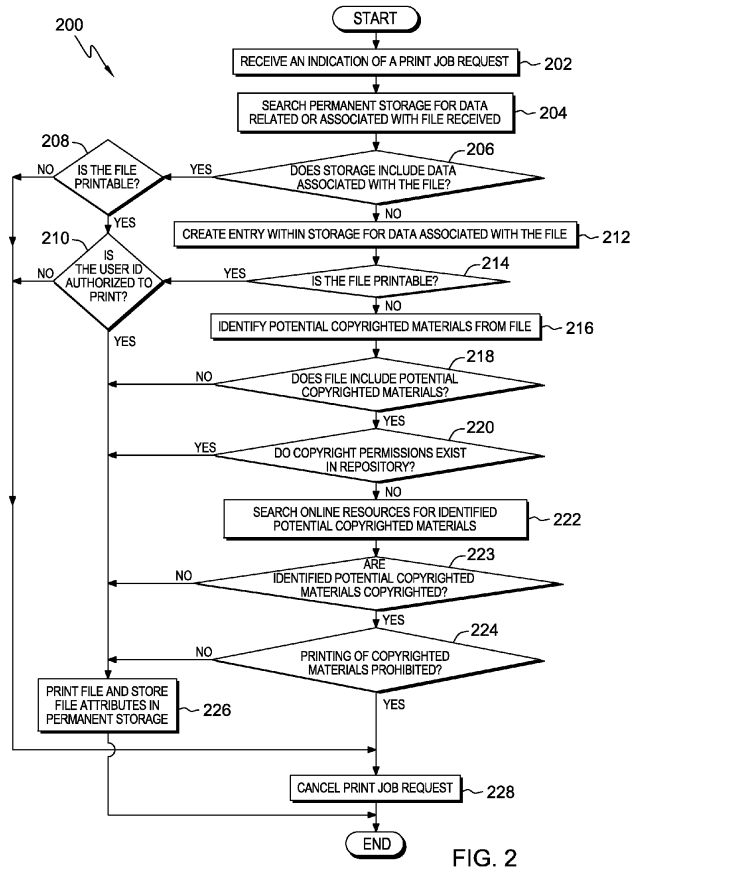
Simply titled “Copyright Infringement Prevention,” the patent’s main goal is to ‘restrict’ the functionality of printers, so they only process jobs when the person who’s printing them has permission to do so.

It works as follows. When a printer receives a print job, it parses the content for potential copyrighted material. If there is a match, it won’t copy or print anything unless the person in question has authorization.

“The computer, in response to identifying any text, images, or formatting indicative of potential copyrighted material, identifies potential copyrighted material within the file.”

“The computer determines whether the file may be printed based, at least in part, on the identified potential copyrighted material,” the patent description adds.

The patent describes various variations on this approach, and IBM notes that ISBN numbers, United States Copyright Office records, and other public resources could be used to define the copyright status of a work.

Image from IBM’s patent

ibmpatent

IBM sees a wide variety of applications for their printer patent. For example, it may also include a feature that provides users with “options to acquire permissions” to print or copy something.

In addition, the printer can also scan through large amounts of texts, much like the plagiarism checkers many schools use nowadays.

The patent doesn’t go into detail about the potential market for these type of printers, but we doubt that the general public will be very interested in a printer or scanner that limits what they can do.

That said, it may be more suitable for a business environment, where preventing infringements and limiting rights or users often has a higher priority.

Source: TF, for the latest info on copyright, file-sharing, torrent sites and ANONYMOUS VPN services.

MPAA ‘Invests’ Millions in Academic Piracy Research

Over the course of several years Hollywood’s MPAA has gifted millions of dollars to piracy related academic research. Tax records reveal that most funds have been directed to Carnegie Mellon University, which produced several high-profile studies. According to the most recent filing the university received $1 million in 2014 alone.

Source: TF, for the latest info on copyright, file-sharing, torrent sites and ANONYMOUS VPN services.

mpaaAll over the world, hundreds of researchers are looking into the effects of piracy and copyright legislation.
These studies are interesting from an academic point of view, but they are also crucially important for stakeholders who lobby lawmakers for change.

Hollywood’s MPAA is one of the groups with a vested interest. The organization often uses research to argue their case, and actively criticizes studies that are not in line with their agenda.

In addition, the MPAA is also actively funding research in this area. Most notably, the group sent multiple gifts to Carnegie Mellon’s “Initiative for Digital Entertainment Analytics” (IDEA), which researches various piracy related topics.

As mentioned previously, MPAA contributed $100,000 to the program in 2012, which was bumped to $912,000 a year later. And it doesn’t stop there.

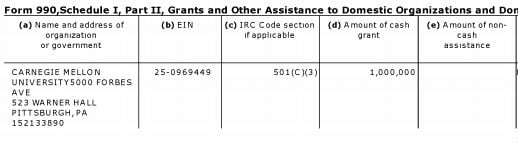
The organization’s most recent tax filing which appeared online this week shows that they sent another gift in 2014, worth a cool $1,000,000. This is the largest donation the MPAA made during the year, and a significant chunk of their $72 million yearly revenue.

MPAA’s gift

carnegrantgift

The continued support suggests that the movie industry group is happy with the results IDEA has achieved so far. The research program resulted in the publication of several high quality peer-reviewed papers in recent years, which largely fall in line with the industry’s agenda.

For example, an IDEA paper recently showed that pirate site blockades boost the use of legal services such as Netflix, and a previous paper found that search engines can help to diminish online piracy.

However, the researchers stress that the gift is unrestricted, which means that in no way does it influence the results of their work.

IDEA co-director Rahul Telang informs TorrentFreak that the gift is used to hire researchers and pay for research materials. It is not tied to a particular project.

“The funding allows us to hire research scientists, post-docs, PhD students and masters students for our projects. Many projects are data intensive that require either purchase of expensive data or collection of data which is time consuming,” Telang says.

Telang couldn’t say how much the entire budget for IDEA is, or what gifts it received from the MPAA after 2014.

“Exact funding amount is a bit tricky since the university takes a pot of money as overhead before we can get to use the money. Plus other funding goes up and down,” he says.

In addition to funding IDEA, the MPAA also supports other academic researchers on a smaller scale. Two years ago the group started a grants program inviting academics to pitch their research proposals.

Researchers were offered a $20,000 grant for projects that address various piracy related topics, including the impact of copyright law and the effectiveness of notice and takedown regimes.

The above clearly shows that Hollywood sees academic research as a valuable tool, and indeed, it has cited various studies in its recent lobbying efforts.

Of course it has to be said that MPAA is not the only industry group that finances research. Various companies from the other side of the table, such as Google, do exactly the same.

Source: TF, for the latest info on copyright, file-sharing, torrent sites and ANONYMOUS VPN services.

Sony Pictures Targets Torrent Sites With Preemptive Takedowns

Copyright holders commonly ask torrent sites to remove links to pirated content, such as the latest blockbuster movies. However, Sony Pictures Networks goes a step further. This week the Indian company sent a stark warning to torrent sites, urging them to keep an eye out for pirated versions of an unreleased film, or else.

Source: TF, for the latest info on copyright, file-sharing, torrent sites and ANONYMOUS VPN services.

SONY_PICTURES_NETWORKS_LOGOWhile it’s not widely publicized, many larger torrent sites regularly remove links to infringing files. This allows copyright holders to somewhat limit the availability of their works on the Internet.

Generally speaking, movie studios and other rightsholders hire anti-piracy companies to track down infringing content. These outfits then send takedown notices to the sites in question.

In India, the local Sony Pictures’ representatives are taking a different approach. This week they informed several torrent site operators about their upcoming release, Azhar, which premieres in theaters today.

However, instead of linking to torrents or specific URLs, the notice is a general warning urging site owners to keep the film off their sites. Citing the Indian Copyright Act, the company warns that distributing the film would break the law.

“By way of the present caution notice issued to you, we caution you and your website, not to indulge in any broadcasting, rebroadcasting, making available for viewing and / or communicating to the public, the film and any content associated thereof, without obtaining permission / authorization from our client,” the notice reads.

Sony Pictures Networks‘ anti-piracy partner MarkScan adds that they will keep a close eye on the developments, and warns that civil or criminal lawsuits may follow if the warning is ignored.

“We will be monitoring your activities for any act of infringement of the statutory and contractual rights of our Client and shall be compelled to initiate legal proceedings (civil and/or criminal) should you engage in violation of our Client’s rights despite the present notice,” they write.

While the language may sound intimidating, the torrent site operators we spoke with have no plans to take preemptive action. Besides broad keyword filters, there are few options to prevent users from uploading content that’s not available yet.

At the time of writing we haven’t seen any pirated copies of Azhar on torrent sites, but the soundtrack is widely distributed. Despite the threats, it’s likely that the movie will follow soon after the first releases leak online.

The Preemptive notice

sonypicindia

Source: TF, for the latest info on copyright, file-sharing, torrent sites and ANONYMOUS VPN services.

MPAA Signs Anti-Piracy Deal With Large Domain Registry

The MPAA has signed its first anti-piracy partnership with a domain name registry outside the United States. The Hollywood group will act as a “trusted notifier,” helping Radix, Asia’s largest new gTLD applicant, to prevent pirate sites from using their domain names.

Source: TF, for the latest info on copyright, file-sharing, torrent sites and ANONYMOUS VPN services.

mpaaFollowing the failed SOPA and PIPA bills, entertainment industry groups have switched their efforts away from legislation and towards voluntary cooperation with various stakeholders.

This has resulted in several agreements with Internet providers, advertising agencies and payment processors, designed to help prevent piracy.

Continuing this trend, the MPAA is now actively working on private deals with domain name registries and registrars. After teaming up with U.S-based Donuts a few months ago, the movie industry group is now going global.

Today, the MPAA and Asian registry Radix announced their new anti-piracy partnership. Radix bills itself as Asia’s largest new gTLD applicant and controls several domain extensions including .online, .tech, .space, .website, .press, .host, .site.

Under their agreement the MPAA will act as a “trusted notifier,” tasked with reporting sites that are clearly copyright-infringing. After several checks, these domain names may then be suspended by the registry.

“We welcome MPAA’s cooperation in helping us prevent intellectual property and copyright violations in our name space,” comments Sandeep Ramchandani, Business Head of Radix.

“We’re hopeful that our joint actions will not only protect creators from having their works stolen, but also protect Internet users from exposure to malware that is commonly found on sites run by unlicensed operators,” he adds.

The details of the partnership have not been released but they are likely similar to the Donuts agreement, which we analyzed in detail in our previous coverage.

Radix’s gTLDs

radixtld

The new deal suggests that the MPAA is actively reaching out to registries to help them fight online piracy.

The Hollywood group previously lobbied domain name system oversight body ICANN to take action against pirate sites, without any result. Thus far, reaching out to registries directly has proven to be more fruitful.

According to Steven Fabrizio, the MPAA’s Senior Executive Vice President, voluntary partnerships should help to battle online piracy, and he hopes they will expand to other industries and domain name services.

“While this agreement is geared to film and television piracy, similar agreements could address other illegal activity online. Hopefully, it can become a model to be used with other players in the domain name ecosystem and Internet intermediaries,” Fabrizio says.

While the deal doesn’t put any major pirate sites at risk right away, it does limit the number of domain name options they have. It also means that sites such as yts.host, thepiratebay.tech and torrentmirror.online could soon disappear.

Source: TF, for the latest info on copyright, file-sharing, torrent sites and ANONYMOUS VPN services.