
MPAA’s Domain Name ‘Policing’ Results in First Suspensions

Several “pirate site” domain names have been suspended following complaints from the MPAA. The websites in question all use domain names that are managed by the Donuts registry, which assigned the Hollywood group as its “trusted notifier.” MPAA and the domain registry are happy with results so far and hope that other key players will join their efforts.

Source: TF, for the latest info on copyright, file-sharing, torrent sites and ANONYMOUS VPN services.

mpaaIn recent years various entertainment industry groups have switched their efforts away from legislation, towards voluntary cooperation with various stakeholders.

This has resulted in several agreements with Internet providers, advertising agencies and payment processors, which are all designed to help prevent piracy.

A few months ago this strategy was expanded to cover key players in the domain name industry. In February, the MPAA and the Donuts registry signed a landmark agreement under which the movie industry group acts as “trusted notifier” of “pirate” domains.

Traditionally, it has been very hard for rightsholders to get domain names suspended without a court order, but through voluntary agreements this process is simplified.

A few months have passed since the initial announcement and according to the domain registry the first results are positive.

The MPAA referred the first three domain names to Donuts in March. After a careful inspection, the registry agreed that the associated sites were indeed linked to illegal downloading or streaming.

“We concluded that the first two were identical to well-known pirated content websites, which were subjects of prior court orders and were illegally streaming and providing downloads of movies, including those still in theaters. The third was dedicated to illegally downloading and live streaming television series,” Donuts notes.

In response, Donuts alerted the responsible domain name registrars about the infringing conduct, paired with a request to inform the persons who registered the domains.

This eventually resulted in two domain name suspensions on the registrar level. In the third case the site’s hosting provider took the site offline.

Neither Donuts nor the MPAA have published the targeted domain names. However, additional research reveals that the Donuts domain Primewire.guru was suspended recently, which fits the profile.

Primewire.guru, now suspended

primewireguru

A few weeks after the first reports, MPAA submitted another set of three “allegedly infringing” domain names. In two of these cases Donuts agreed that the sites were violating their abuse policies, and after the registrants failed to reply, the domains were suspended.

The third domain name, which remains unnamed, is dedicated to streaming TV series. However, after discussions with the registrar and the owner of the domain, no direct action was taken. The domain owner apparently argued that the site complies with takedown requests, so Donuts says that further investigation is needed to make a final decision.

While the MPAA’s efforts have resulted in some suspensions, there are still several “pirate” sites online with Donuts managed domains. This includes domains with the prominent .movie TLD, so there’s still plenty of policing to do.

From the registry point of view Donuts is satisfied with the progress so far. They are happy to contribute in the “continuing battle against pervasive illegal online piracy” but stress that they aren’t suspending domains names on a whim.

“Donuts has been extremely careful in balancing the rights of its end-user customers along with those of copyright holders. We continue to believe this is a useful and efficient manner for addressing blatant online piracy, and we encourage others in the domain name community to follow suit with similar programs,” the registry concludes.

The MPAA’s Chief of Global Content Protection, Dean Marks, agrees and hopes that more domain name registries will come onboard in the near future.

In addition to the deal with Donuts, the MPAA also signed a similar agreement with Radix, Asia’s largest new gTLD applicant. Whether more registries will follow in the future has yet to be seen.

Source: TF, for the latest info on copyright, file-sharing, torrent sites and ANONYMOUS VPN services.

We’re Not Liable for Pirating Subscribers, Windstream Tells Court

U.S. Internet provider Windstream is asking a New York federal court to shield the company from broad piracy accusations. The ISP filed a complaint against BMG and Rightscorp after it was accused of direct and contributory copyright infringement. The lawsuit follows on the heels of a similar complaint by fellow Internet provider RCN, which also seeks legal clarity.

Source: TF, for the latest info on copyright, file-sharing, torrent sites and ANONYMOUS VPN services.

pirate-runningCan an Internet provider be held liable for subscribers who share pirated files? Yes, a Virginia federal jury ruled late last year.

This verdict caused shockwaves in the ISP industry when several companies suddenly realized that they could become the next target.

With 1.1 million subscribers in the United States, Windstream is one of the ‘candidates.’ The company is well aware of this risk but instead of waiting around the ISP is taking the initiative.

This week Windstream filed a complaint for declaratory judgment at a New York District Court, directed against music rights group BMG and its anti-piracy partner Rightscorp.

For several years BMG has accused Windstream and its subscribers of various copyright infringements. The notices they send are issued by the monitoring outfit Rightscorp and often come with a settlement demand for the account holders.

Windstream, however, says that it’s not in any way obligated to forward these notices to the subscribers in question. Instead, the ISP points out that it’s a mere conduit for Internet services.

“Similar to other ISPs, Windstream only provides Internet connectivity, making it a mere conduit for the transmission of Internet services,” Windstream writes in its complaint.

“As a pipeline to the Internet, Windstream does not monitor or otherwise control the manner in which its subscribers utilize their Windstream Internet connection and does not initiate, control, select or modify the material or content transmitted by Windstream subscribers over Windstream’s network.”

According to the ISP, the notices sent by Rightscorp also lack sufficient information to prove that actual copyright infringements have taken place by their customers.

“Defendants have no direct evidence that any Windstream subscriber is engaged in direct copyright infringement and Windstream, as a mere conduit for the transmission of Internet services, cannot be held liable for direct copyright infringement,” the complaint reads.

nodirwind

Windstream previously made its position clear to both BMG and Rightscorp and tried to come to a resolution, but that didn’t stop more notices being sent to the ISP.

Instead, the companies maintain that Windstream is liable for contributory and vicarious copyright infringement, and accuse it of failing to disconnect repeat infringers.

“Defendants claim that Windstream’s knowledge and allowance of unchecked infringement on its network makes Windstream liable for secondary copyright infringement and actual or statutory damages as high as $150,000 per infringed work.”

These allegations go way too far, Windstream believes. As a result, the company is seeking a judgment declaring that it’s not liable for the infringing actions of its subscribers under the DMCA’s safe harbor provisions, among other things.

“Defendants have no direct evidence that any Windstream subscriber engaged in direct copyright infringement and Windstream, as a mere conduit for the transmission of Internet services, cannot be held liable for direct copyright infringement,” they write.

In addition, the ISP says that it doesn’t authorize, direct or encourage its subscribers to pirate anything. Nor does it profit from the alleged copyright infringements that may take place on their network.

With this lawsuit Windstream hopes to obtain legal clarity on several key issues. Aside from the broader liability question, the ISP also asks the court to declare that it’s not required to comply with or respond to Rightscorp’s notices at all, under the DMCA.

Windstream’s lawsuit is similar to the one filed by RCN earlier this month, although the latter doesn’t include Rightscorp as a defendant. These are likely to be followed closely by the larger ISPs, as the outcomes will have a major impact on the industry.

The full complaint is available here (pdf).

Source: TF, for the latest info on copyright, file-sharing, torrent sites and ANONYMOUS VPN services.

Steal This Show S01E12: ‘Pirates – The Indie Producer’s Best Friend?’

Today we bring you the next episode of the Steal This Show podcast, discussing the latest file-sharing and copyright news. In this episode we discuss recent news stories with
well-respected indie producer Brian Newman, who explains that piracy isn’t all bad.

Source: TF, for the latest info on copyright, file-sharing, torrent sites and ANONYMOUS VPN services.

stslogoIn this episode Brian Newman, CEO of SubGenre, discusses entertainment artists against the DMCA, British Lords against copyright trolls, and Dutch film producers suing ISPs.

Brian brings fresh perspective on the question of whether piracy’s really hurting indie film producers – and argues that piracy may not be a failure of morality, but of business.

He further explains how for him, P2P and sharing represents a real chance for filmmakers to develop audiences as the depth of choice available on services like Netflix is shrinking, Brian argues that piracy can be an important means of discovery for these companies.

Steal This Show aims to release bi-weekly episodes featuring insiders discussing copyright and file-sharing news. It complements our regular reporting by adding more room for opinion, commentary and analysis.

The guests for our news discussions will vary and we’ll aim to introduce voices from different backgrounds and persuasions. In addition to news, STS will also produce features interviewing some of the great innovators and minds.

Host: Jamie King

Guest: Brian Newman

Produced by Jamie King
Edited & Mixed by Riley Byrne
Original Music by David Triana
Web Production by Siraje Amarniss

Source: TF, for the latest info on copyright, file-sharing, torrent sites and ANONYMOUS VPN services.

Europe’s ‘Net Neutrality’ Rules Fail to Ban BitTorrent Throttling

After years of negotiating Europe has agreed on a set of Net Neutrality rules. While the legislation is a step forward for some countries, experts and activists warn that it may leave the door open for BitTorrent and VPN throttling. With the “EU Slowdown” campaign that launches today, they encourage the public to have their voice heard to improve the current rules.

Source: TF, for the latest info on copyright, file-sharing, torrent sites and ANONYMOUS VPN services.

nneuFor several years politicians have debated on how Europe should approach net neutrality.

Late last year the results of these negotiations were included in the Telecoms Single Market (TSM) regulation.

While the rules offer improvements for some individual members states, various activist groups and experts warn that they don’t offer real network neutrality.

The current language would allow ISPs to throttle BitTorrent traffic permanently if that would optimize overall “transmission quality.” This is not a far-fetched argument, since torrent traffic can be quite demanding on a network.

To address this issue a coalition of activist groups have launched a campaign, hoping to change the current plans. They urge Europeans to have their voice heard in a public consultation that was launched by Europe’s regulatory body BEREC.

“We need to deliver thousands of comments to regulators, explaining to them why they should pass strong net neutrality guidelines that ban ISPs from doing class-based throttling, or zero-rating,” Holmes Wilson of Fight for the Future (FFTF) says.

FFTF is one of the driving forces behind the Save Net Neutrality campaign. According to Wilson, BitTorrent users should be particularly concerned as the current rules do next to nothing to prevent throttling.

“Europe’s new net-neutrality rules should ban throttling BitTorrent, but they don’t. They leave ISPs a loophole,” Wilson tells TorrentFreak.

“ISPs can say they’re doing it for ‘traffic management’ purposes—even when their networks aren’t clogged, because the rules say they can throttle to ‘prevent impending network congestion’,” he adds.

In addition to file-sharing traffic, the proposed rules also allow Internet providers to interfere with encrypted traffic including VPN connections. Since encrypted traffic can’t be classified through deep packet inspection, ISPs may choose to de-prioritize it altogether.

In theory, ISPs may choose to throttle any type of traffic they want, as long as they frame it as a network congestion risk.

“So if your ISP is lazy, or wants to cut corners and save money, they can throttle BitTorrent, or VPNs, or Bitcoin, or Tor, or any class of traffic they can identify,” Wilson says.

The “EU Slowdown” campaign that was launched today encourages the public to have their say on the matter, hoping to improve the current rules. Thus far 7,000 sites are participating already, with many displaying a “Slow Loading” icon.

Wilson hopes that more sites will join in. Torrent sites in particular may want to urge their users to participate.

“We think the torrent community has a lot at stake here, so we hope that torrent sites and the makers of torrent clients can join in, starting today, or through the July 18th deadline for comments,” Wilson says.

Source: TF, for the latest info on copyright, file-sharing, torrent sites and ANONYMOUS VPN services.

Judge Dismisses Movie Piracy Case, IP-Address Doesn’t Prove Anything

In what’s believed to be a first of its kind ruling, a federal court in Oregon has dismissed a direct infringement complaint against an alleged movie pirate from the outset. According to the judge, linking an IP-address to a pirated download is not enough to prove direct copyright infringement.

Source: TF, for the latest info on copyright, file-sharing, torrent sites and ANONYMOUS VPN services.

trollsignFor more than half a decade so-called “copyright trolling” cases have been keeping the U.S. judicial system busy.

While new cases are still filed every week, there are signs that some judges are growing tired of the practice, and are increasingly skeptical about the claims made by copyright holders.

In the Oregon District Court, Magistrate Judge Stacie Beckerman recently recommended dismissal of a complaint filed by the makers of the Adam Sandler movie The Cobbler.

According to the Judge both claims of direct and indirect infringement were not sufficient for the case to continue. What’s unique in this case, is that the direct infringement claims were dismissed sua sponte, which hasn’t happened before.

To prove direct infringement copyright holders merely have to make it “plausible” that a defendant, Thomas Gonzales in this case, is indeed the copyright infringer.

This is traditionally done by pointing out that the IP-address is directly linked to the defendant’s Internet connection, for example. However, according to Judge Beckerman this is not enough.

“The only facts Plaintiff pleads in support of its allegation that Gonzales is the infringer, is that he is the subscriber of the IP address used to download or distribute the movie, and that he was sent notices of infringing activity to which he did not respond. That is not enough,” she writes in her recommendation.

“Plaintiff has not alleged any specific facts tying Gonzales to the infringing conduct. While it is possible that the subscriber is also the person who downloaded the movie, it is also possible that a family member, a resident of the household, or an unknown person engaged in the infringing conduct.”

That an outsider could be the pirate is not unlikely. The defendant operates an adult foster care home where several people had access to the Internet. The filmmakers were aware of this and during a hearing their counsel admitted that any guest could have downloaded the film.

To gather more information, the filmmakers were allowed to depose Gonzales, but this didn’t result in any additional evidence. Nevertheless, they amended the complaint to name Gonzales as the defendant, which is not correct according to Judge Beckerman.

“Based on the facts alleged in the First Amended Complaint, Gonzales is but one of many possible infringers, and Plaintiff’s allegation that Gonzales is the infringer is just a guess.”

“’Plausible’ does not mean certain, but it does mean ‘likely,’ and Plaintiff has not pled sufficient facts to support its allegation that Gonzales is the likely infringer here. Accordingly, the district judge should dismiss Plaintiff’s claim for copyright infringement.”

The filmmakers also tried to hold Gonzales accountable for the infringements of others through his connection, but the Judge concluded that a claim of indirect copyright infringement doesn’t hold up here either.

In March, Beckerman recommended dismissing the claims for both direct and indirect copyright infringement, a conclusion District Court Judge Anna Brown adopted earlier this month.

“This Court agrees with the Magistrate Judge that Plaintiff has failed to allege sufficient facts to state a plausible claim “tending to exclude the possibility that an alternative explanation is true”,” she concludes.

While not all judges across the country may come to the same conclusion, the ruling offers hope for defendants who are in a similar position. Suing alleged BitTorrent pirates is still an option but increasingly judges demand additional proof.

Source: TF, for the latest info on copyright, file-sharing, torrent sites and ANONYMOUS VPN services.

Game of Thrones Piracy Peaks After Season Finale

The season finale of Game of Thrones is the highlight of the year for many TV fans. At the same time, it also generates a lot of traffic on various torrent trackers. Like previous years, Game of Thrones piracy peaked after the season ending, but not enough to set a new all-time record.

Source: TF, for the latest info on copyright, file-sharing, torrent sites and ANONYMOUS VPN services.

got6Traditionally, the Game of Thrones season finale is among the most viewed episodes of the season, also on pirate sites.

With the Internet abuzz over the latest plot twists and turns, many people turned to torrent sites to grab a pirated copy of the show.

The first episodes appeared online shortly after the official broadcast ended and at the time of writing more than 350,000 people are actively sharing a copy. This is the highest number we’ve seen this year.

Data gathered by TorrentFreak estimates that after just eight hours, well over a million people have already downloaded the final episode of this season via BitTorrent. Millions more are expected to follow during the days to come.

The most popular release is currently an HD version of little over a gigabyte. This is different from previous years, when SD copies were consistently the most downloaded of all.

While the demand is significant, there is no all time “swarm record” to report. Also, the overall download numbers appear to be roughly on par with previous years, perhaps a bit lower.

Although it’s too early to jump to conclusions, there are a few explanations why Game of Thrones piracy might no longer be growing, via torrents at least.

For one, the number of legal alternatives have been growing steadily in recent years. Also, the same is true for “unauthorized” streaming sites where people can view pirated copies of Game of Thrones episodes instantly.

Another factor may be that HBO significantly cranked up its enforcement efforts this year. As a result, it is quite hard, or impossible, to find recent Game of Thrones episodes on some popular torrent sites.

The “disappearing” torrents also lead to scattered swarms, making it harder to break the previous record. Time will tell how this apparent trend develops during the years to come.

That said, it is worth keeping in mind that interest in the show still dwarfs the competition. This means that there is little doubt that it will be crowned the most downloaded TV show for the fifth year in a row.

Source: TF, for the latest info on copyright, file-sharing, torrent sites and ANONYMOUS VPN services.

Top 10 Most Pirated Movies of The Week – 06/27/16

The top 10 most downloaded movies on BitTorrent are in again. ‘Batman v Superman: Dawn of Justice’ tops the chart this week, followed by ‘Finding Dory’ completes the top three.

Source: TF, for the latest info on copyright, file-sharing, torrent sites and ANONYMOUS VPN services.

batsupsThis week we have three newcomers in our chart.

Batman v Superman: Dawn of Justice is the most downloaded movie.

The data for our weekly download chart is estimated by TorrentFreak, and is for informational and educational reference only. All the movies in the list are Web-DL/Webrip/HDRip/BDrip/DVDrip unless stated otherwise.

RSS feed for the weekly movie download chart.

Ranking (last week) Movie IMDb Rating / Trailer
torrentfreak.com
1 (…) Batman v Superman: Dawn of Justice 7.0 / trailer
2 (1) Warcraft (TS/TC) 7.7 / trailer
3 (…) Finding Dory (HDTS) 8.1 / trailer
4 (2) The Huntsman: Winter’s War 6.2 / trailer
5 (4) Whiskey Tango Foxtrot 6.8 / trailer
6 (…) Hardcore Henry 6.9 / trailer
7 (3) X-Men: Apocalypse (HDCam/TC) 7.7 / trailer
8 (5) Eye In The Sky 7.6 / trailer
9 (…) Allegiant 5.9 / trailer
10 (6) Zootopia 8.3 / trailer

Source: TF, for the latest info on copyright, file-sharing, torrent sites and ANONYMOUS VPN services.

Help! My VPN Provider Is Compromised By a Gag Order!

VPN services have become an important tool to counter the growing threat of Internet surveillance. Encrypting one’s traffic through a VPN connection helps to keep online communications private. But, what if your VPN service is compromised by a gag order? This is a question many Proxy.sh customers are asking themselves.

Source: TF, for the latest info on copyright, file-sharing, torrent sites and ANONYMOUS VPN services.

proxyshMillions of Internet users around the world use a VPN to protect their privacy online. One of the key benefits is that it hides one’s true IP-address from third-party monitoring outfits, countering a lot of unwanted snooping.

However, law enforcement is not always happy with these services and in extreme cases can compel VPN providers to start logging internal connections to catch a perpetrator.

This is what appears to have happened to Seychelles-based VPN service Proxy.sh. Earlier this month the company excluded one of its nodes from its warrant canary.

“We would like to inform our users that we do not wish any longer to mention France 8 (85.236.153.236) in our warrant canary until further notice,” the company announced on its website, and via email to its customers.

Proxy.sh’s warning

proxycana

The warrant canary states that no warrants, searches or seizures of any kind have been received, but this is no longer true for the French node. The fact that this has been announced indirectly suggests that the company is not allowed to communicate about it publicly.

TorrentFreak reached out to Proxy.sh hoping to get some additional information. While no further details were provided, the VPN provider strongly advises its users not to connect to the ‘compromised’ node.

“We recommend our users to no longer connect to it. We are striving to do whatever it takes to include that node into our warrant canary again,” Proxy.sh says.

“The warrant canary has been particularly designed to make sure we could still move without being legally able to answer questions in a more detailed manner. We are happy to see it put to use after all and that our users are made aware of it,” they add.

The announcement will come as a shock to most Proxy.sh users and many will be wondering what they should do next. A good question, but unfortunately not one with an easy answer.

Leave or stay?

Some users may be inclined to leave. Why stay with a VPN provider that’s partly compromised if there are many other alternatives out there? This is a logical and understandable response.

On the other hand, one can also value Proxy.sh’s transparency in the matter. The company takes its warrant canary seriously where other VPN providers, with or without a warrant canary, may have stayed quiet.

Ironically, the fact that Proxy.sh received a gag order increases the trustworthiness of the company itself, although that comes at a price.

We suspect that there are only a few VPN providers that would suspend their operations “Lavabit style” on receipt of a narrowly targeted gag order that doesn’t compromise its service as a whole. Considering the fact that only one node is in question, the request does appear to be rather targeted in this case.

It’s also worth keeping in mind that many large Internet companies including Google and Facebook receive gag orders on a regular basis. Most users have no clue that this is happening, and others simply don’t care.

Trust?

VPN users who would prefer their VPN provider to shut down instead of complying with a gag order should leave, that much is clear. But how do you know that the next choice will be as transparent as Proxy.sh?

As is often the case it all boils down to trust. Do you trust your VPN provider to handle your private communications carefully, and to what degree does a gag order on one of the nodes change this?

How one answers this question is a matter of personal preference.

Most of our questions to Proxy.sh remained unanswered, presumably due to the court order, but the company was able to provide some additional details on their compliance with orders from various jurisdictions.

While the company is incorporated in the Seychelles, it also complies with orders from other jurisdictions it operates from.

“Our company respects the law everywhere it operates, but it still has the option to cooperate fully while ceasing any further operations in any specific jurisdiction,” Proxy.sh says.

“Depending on the level of threat to our users’ privacy and according to our legal advisers, we take the decision to bring updates to our warrant canary either for a specific node or for a whole country.”

So what would you do in this situation?

Source: TF, for the latest info on copyright, file-sharing, torrent sites and ANONYMOUS VPN services.

Rightscorp Pressures ISPs to Hijack Pirates Browsers

Piracy monetization firm Rightscorp is promoting its browser hijacking system to ISPs. In a proposal revealed by Internet provider RCN, Rightscorp suggests a gradual approach where pirating subscribers eventually have to pay a fine to regain Internet access.

Source: TF, for the latest info on copyright, file-sharing, torrent sites and ANONYMOUS VPN services.

hijackRightscorp has made plenty of headlines in recent years, often due its aggressive attempts to obtain settlements from allegedly pirating Internet users.

Thus far these efforts haven’t been particularly successful. Rightscorp is reporting millions in losses and most major Internet providers are not forwarding their settlement demands, even when they are offered a cut of the proceeds.

In order to make their services more ‘appealing’ to ISPs the anti-piracy firm recently added a new strategy. In addition to sending in notices, it now offers ISPs a system where the browsers of subscribers are locked until they pay their ‘fine.’

We uncovered the browser hijacking plan before, but thanks to a letter made public by Internet provider RCN we can now see how Rightscorp promotes it to ISPs.

The letter detailing Rightscorp’s proposal was released by RCN this week, as part of the court case it started earlier this month. In the letter Rightscorp claims that it’s tracking tens of thousands of repeat infringers on RCN’s network, for which it sent over a million notices.

“Unfortunately, the problem on your network is massive and growing,” Rightscorp writes.

“It is our professional estimation that on an annual basis, there are still 95 million instances of songs, movies, TV shows, software applications and eBooks being distributed illegally on the RCN network annually without compensation to the owners,” they add.

The anti-piracy outfit says that in order to solve this issue and prevent further Government regulation, repeat infringements have to be properly warned. This means implementing a system where subscribers face serious consequences.

“In our opinion, the average RCN subscriber simply does not fear that there will be any consequences if they continue to engage in piracy.

“Rightscorp has a proven solution that has reduced repeat copyright infringers on ISPs that work with us. We see 374% less repeat infringement on ISPs that work with us versus ISPs that do not work with us,” the letter adds.

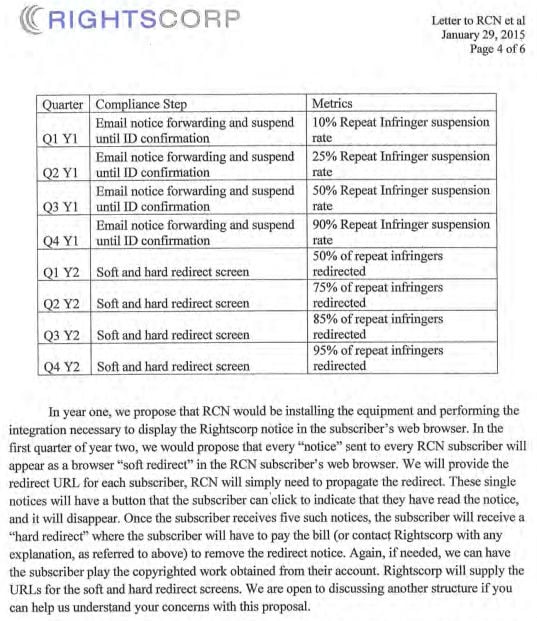
Instead of merely forwarding settlement demands, Rightscorp proposes a system where the ISP hijacks subscribers’ browsers. Initially, this would only affect 10% of infringers but the number would gradually increase to 90%.

The letter also contains details about the setup of the hijacking system, which works via a combination of soft and hard redirects.

Rightscorp’s proposal

rightscrcnletter

The soft redirect will suspend Internet access until the subscribers acknowledge that they’ve read the notice. After five notices this switches to a hard redirect, which requires subscribers to pay up in order to browse the web again.

“These single notices will have a button that the subscriber can click to indicate that they have read the notice, and it will disappear,” Rightscorp explains.

“Once the subscriber receives five such notices, the subscriber will receive a ‘hard redirect’ where the subscriber will have to pay the bill to remove the redirect notice,” they add.

The letter is framed as a cooperation that can benefit both parties, but also applies some mild pressure here and there. For example, it closes by mentioning the devastating effect piracy can have on copyright holders and reminds the ISP of the major impact it can have.

“Without the browser hijacking, copyright holders have no option to stop piracy,” the company claims.

“Just one RCN subscriber with a 5Mbps upload speed running BitTorrent can give away 1.5 million MBps or 12,000 movies a year for free. We are tracking thousands of RCN subscribers doing exactly that every day.”

“Do you really want to stand by and do almost nothing while every American content creator is forced to have their work distributed worldwide for free on your network?” the letter asks.

We doubt that RCN is cheering on its pirating subscribers. However, the company also doesn’t appreciate being pressured into commercial partnerships with companies that have a dubious status.

Instead, it declined the offer and filed a lawsuit against music group BMG, one of Rightscorp’s major clients, describing the company’s piracy monitoring tools as flawed. Whether any other ISPs will take the bait will become apparent in the future.

Rightscorp’s full letter can be downloaded here (pdf).

Source: TF, for the latest info on copyright, file-sharing, torrent sites and ANONYMOUS VPN services.

Piracy Phishing Scam Targets U.S. ISPs and Subscribers

An elaborate “piracy” phishing operation is targeting U.S. Internet providers and subscribers. Scammers are using the name of anti-piracy tracking company IP-Echelon and rightsholders such as Lionsgate, to send fake DMCA notices and settlement demands to ISPs. U.S. law enforcement has been notified and is currently investigating the matter.

Source: TF, for the latest info on copyright, file-sharing, torrent sites and ANONYMOUS VPN services.

scamFor more than a decade copyright holders have been monitoring unauthorized downloads. Traditionally this resulted in harmless takedown notices, but increasingly, these warnings are bundled with automated “fines.”

Rightscorp and CEG TEK are the best known anti-piracy outfits employing this tactic, and this week another party appeared to have joined.

TorrentFreak was alerted to a takedown notice Lionsgate purportedly sent to a Cox subscriber, for allegedly downloading a pirated copy of the movie Allegiant. Under threat of a lawsuit, the subscriber was asked to pay a $150 settlement fee.

This request is unique as neither Lionsgate nor its tracking company IP-Echelon are known to engage in this practice.

When we contacted IP-Echelon about Lionsgate’s supposed settlement offer, we heard to our surprise that these emails are part of a large phishing scam, which has at least one large ISPs fooled.

“The notices are fake and not sent by us. It’s a phishing scam,” IP-Echelon informed TorrentFreak.

For a phishing scam the fake DMCA notice does its job well. At first sight the email appears to be legit, and for Cox Communications it was real enough to forward it to their customers.

Fake takedown notice

IP-echelon-fake

If an ISP is fooled, the rest of the scam is even more convincing, since Cox then treats the email as a regular DMCA takedown notice. This means that they forward it to their customers from an official Cox address.

In reality, however, the ip-echelon.report domain isn’t owned by IP-Echelon and the settlement money goes directly to the phishers.

IP-Echelon and its clients are not happy with having their names exploited in this type of scam. They are aware of the issue and inform us that U.S. law enforcement is currently looking into the matter.

Meanwhile, they suggest that ISPs carefully check the PGP signature before forwarding any notices to their customers.

“The case is being investigated by US law enforcement. IPE notices are signed with PGP for ISPs to check authenticity,” IP-Echelon said.

One Cox subscriber who received a notice inquired about the matter in the ISP’s support forums. She says she didn’t download the movie in question, and wonders if it could be a scam.

“I know your email, if real, said not to contact you but I am not sure what to do. I don’t want to give into a scam or if real pay for something I didn’t do,” the subscriber writes.

In response, a Cox representative confirmed that the email is real and explained that it was forwarded by the network security team. Apparently, the phishing scam was good enough to have the security experts fooled.

TorrentFreak alerted Cox to the fake notices but at the time of writing we have yet to receive a response. Whether any other ISPs have fallen for the same scam is unknown at this point.

It’s ironic that Cox is getting caught up in this. The ISP previous refused to forward these type of notices, even legit ones, to its customers. However, this policy was reversed after they lost their court case against BMG late last year.

In any case, Internet subscribers who receive a settlement demand from IP-Echelon, whether it’s for Lionsgate or another copyright holder, should alert their ISPs to this phishing scam.

Source: TF, for the latest info on copyright, file-sharing, torrent sites and ANONYMOUS VPN services.