World going to hell? Here are the Solar System’s five most livable places

Ars provides a guide to the best spots for DIY off-world colonists.

This artist’s impression shows how Mars may have looked about four billion years ago, when it would have been more conducive to life. (credit: ESO)

In the year 2016 one might be forgiven for thinking the world is going to hell. Across much of Europe and the United States a distressed and angry working class has begun wielding nationalism as a blunt weapon against the disconnected ruling class. Islamic radicals have stepped up attacks against the West as well as moderate practitioners of their own faith. Then there is humanity's untrammeled use of fossil fuels, worsening water shortages, and other environmental degradations of the planet—not to mention the proliferating threat of nuclear, biological, and chemical weapons. Finally, we also haven't yet gotten around to tracking every asteroid that might wipe out humankind.

In short, Earth might need a backup plan.

Elon Musk certainly thinks so, having staked much of his fortune on SpaceX and its relentlessly pursued goal of colonizing Mars. But Mars is not the only place humans could go. There are other worlds in the Solar System where humans could walk without space suits, find ample energy, or even swim in subsurface oceans. None of these places are remotely as habitable as Earth, even at our planet's cold poles. But they also don't have Earth's political baggage, either. So here's our guide to the five-best options for DIY colonists:

Read 10 remaining paragraphs | Comments
China’s powerful new rocket makes a successful debut launch

New fuels, new rockets, new spaceport—China continues to make strides in space.

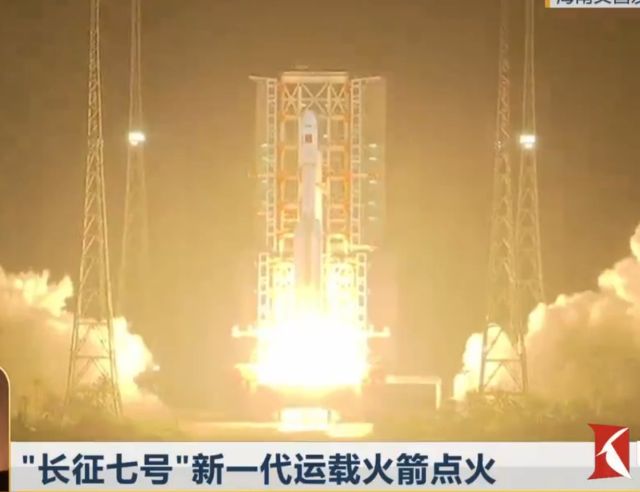
The Long March 7 rocket lifted off at 8:01am ET on Saturday morning. (credit: Chinese TV screenshot)

China's developing space program took another major step forward on Saturday with the launch of its Long March 7 rocket, a new class of booster capable of lifting up to 13.5 metric tons to low-Earth orbit (LEO). The primary payload of the flight was a dummy version of its next-generation crew capsule and some cubesats.

The launch highlighted several key advances for the rapidly modernizing Chinese rocket program. It marked the first launch from the Wenchang Satellite Launch Center, located on Hainan Island, the country's southernmost point. This allows better access to geostationary orbit for Chinese satellites. The Long March 7 also operates with kerosene and liquid oxygen fuels, rather than more environmentally dangerous hypergolic fuels used to power earlier launchers that were based on 1970s technology.

The new 53-meter rocket is the medium-class version of a new launch family that will also include the heavy lift Long March 5 vehicle (with similar capabilities to the Delta IV Heavy rocket), and Long March 6 rocket that will launch small satellites into space. Developed by the China Academy of Launch Vehicle Technology, the new fleet of vehicles will allow China to build and service a new space station, which may debut as early as 2022. The rocket launched Saturday is expected to deliver cargo resupply vehicles to Chinese space station.

Read 1 remaining paragraphs | Comments

The most powerful variant of the world’s most reliable rocket just launched

Because it is reliant on Russian engines the Atlas V may only fly for a few more years.

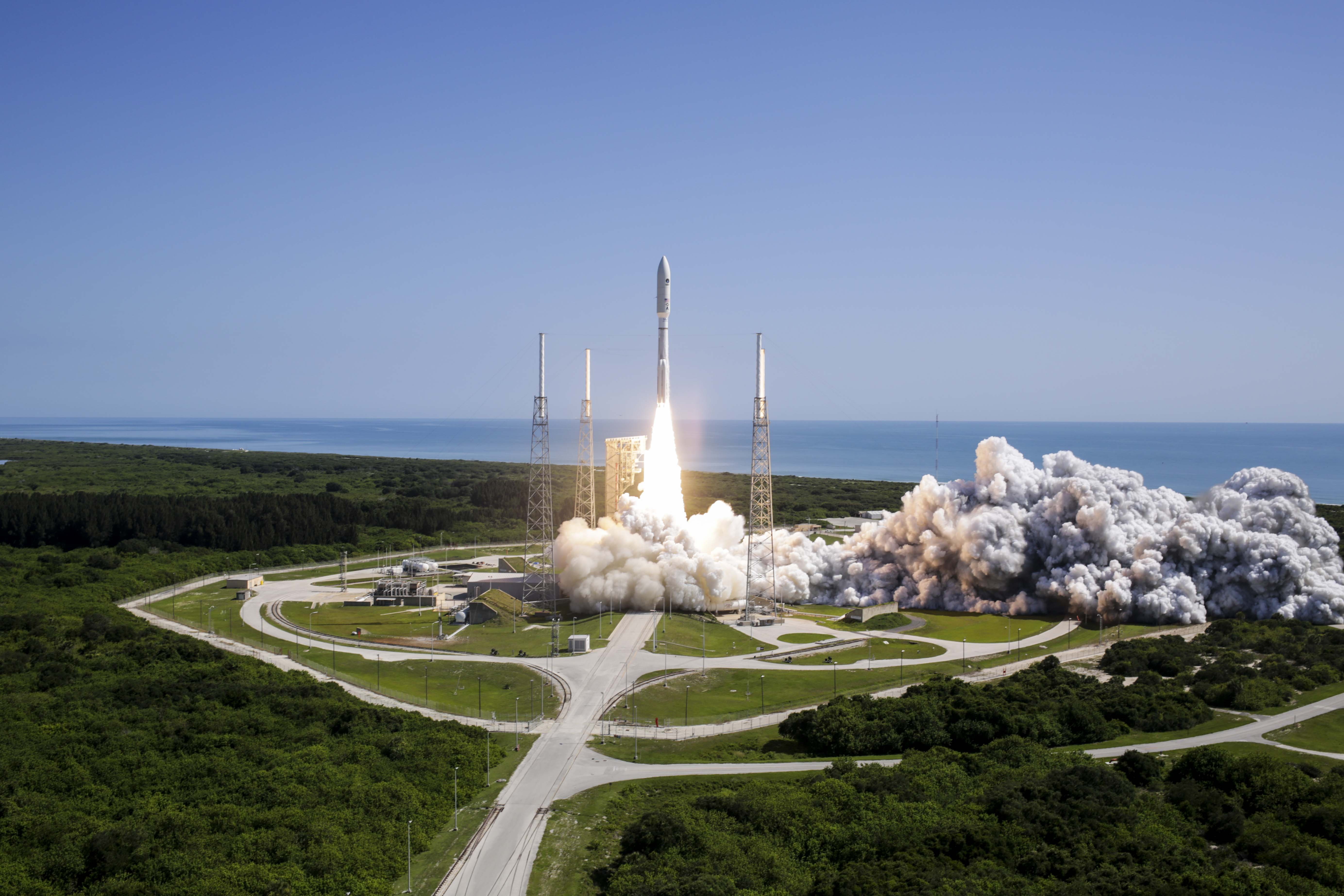
The Atlas V rocket is not the world's most powerful rocket, but it can credibly claim to be the most reliable. Before Friday morning, it had flown 62 times into space, completing its primary mission each time. That 100 percent mission success rate is unparalleled in the history of orbital rockets over so many flights. Accordingly, it's a source of pride for its manufacturer, United Launch Alliance.

The 63rd flight on Friday was also a success, delivering the MUOS-5 satellite into a geostationary transfer orbit 31,000km above Earth for the US Navy. This is the final satellite in the five-satellite constellation, which provides war fighters with significantly improved communications.

The launch was also notable because it flew the 551 variant of the rocket. This combines the core stage along with five solid rocket boosters, which burn for 88.3 seconds at the beginning of the flight to give the rocket an initial kick off the launch pad. This most powerful variant of the Atlas V rocket can deliver up to 19 tons of payload to low-Earth orbit and 8.9 tons to geostationary transfer orbit. The 551 configuration first flew back in 2006, when it launched the New Horizons mission to Pluto.

Read 2 remaining paragraphs | Comments

We’re about to watch a star almost dive into the Milky Way’s black hole

The new GRAVITY instrument will allow scientists to closely the study the star, S2.

This artist’s impression shows stars orbiting the supermassive black hole at the center of the Milky Way. It will make its closest approach in 2018, coming to within just 17 light hours. (credit: ESO)

After spending the better part of a decade closely observing the movement of the star S2, which has a mass about 15 times that of the Sun, a team of astrophysicists concluded in 2002 that it orbited the black hole at the center of the galaxy. This is because the orbital dynamics of S2 were extreme, with an orbital period of about 15.5 years and a maximum velocity of 2.5 percent the speed of light. These observations provided the final proof astronomers needed to confirm that the compact radio source Sagitarrius A* was, in fact, that black hole.

Since then astronomers have been keenly interested in the star S2 because its movement can tell them much about the supermassive black hole at the galaxy's center. They can also test some ideas about general relativity when the star makes its closest approach to the black hole, within about 17 light hours, in 2018. And now, they have a powerful instrument to do just that.

The European Southern Observatory says its GRAVITY instrument has made its first observations, and they were successful. The instrument employs four 8.2-meter telescopes that are part of the "Very Large Telescope" facility in Chile. By using the telescope's interferometer capabilities, astronomers will be able to obtain ultra-precise positions of the orbiting star.

Read 2 remaining paragraphs | Comments

Boeing: “Legitimate chance” of Starliner launch in February 2018

Company to begin training astronauts and flight controllers for new spaceship.

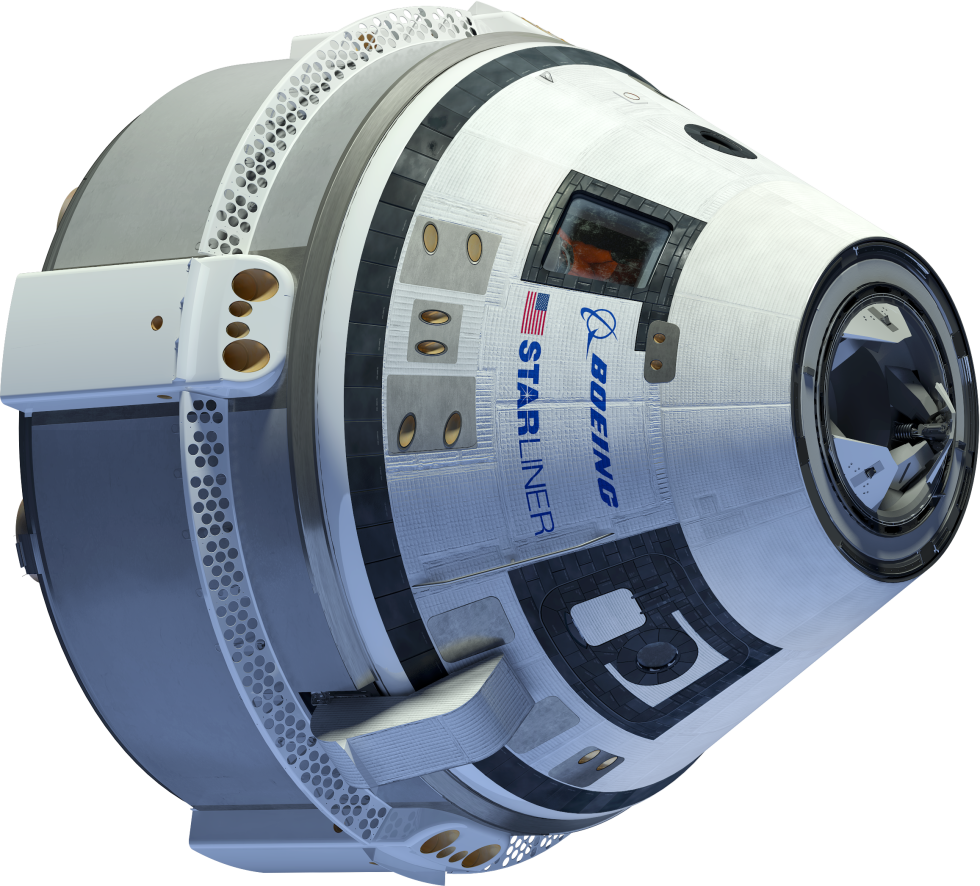
Boeing's Starliner spacecraft is nearing the finish line. (credit: Boeing)

The last human to command a space shuttle stood outside Boeing’s main office building in southeast Houston Wednesday morning, speaking effusively about the company’s Starliner spacecraft, when it began to rain. But as sometimes happens in this humid Gulf coast city, sunshine persisted even at it rained. Perhaps we should step under one of the building’s awnings, Chris Ferguson suggested—to escape the rain and the Sun.

The weather offered an apt metaphor for Boeing’s recent fortunes in aerospace. The company has a big piece of every single one of NASA’s human spaceflight programs. It’s also the prime contractor of the Space Launch System’s core stage as well as for International Space Station operations, and Boeing is one two participants in the commercial crew program to deliver astronauts to the space station.

But clouds loom, too. SpaceX and Blue Origin have begun to demonstrate the viability of reusable rockets, leading to questions about the affordability of large, expendable rockets like the SLS. NASA will also likely drop funding for the station in 2024, or 2028 at the latest, and as the space agency moves on to cislunar space it is not clear Boeing will be the prime contractor on NASA’s next orbital outpost. Finally, Boeing’s Starliner is in a tight race with SpaceX’s Dragon spacecraft to be the first to reach the launch pad for commercial crew in roughly two years.

Read 12 remaining paragraphs | Comments

The US weather model is now the fourth best in the world

When the US Air Force abandons your forecasts for another country, that’s pretty bad.

Forecast models are measured by their anomaly correlation scores, and the GFS model (black line) now ranks fourth among global models. (credit: Cliff Mass)

The forecasting supremacy of the European Center for Medium-Range Weather Forecasts and its global weather prediction model is well documented. This most glaringly reached the American public when only the European forecast model correctly predicted Hurricane Sandy would turn toward the northeastern United States in 2012, rather than remaining out to sea. For several years, the United States and its global forecasting system (GFS) have been struggling to catch up.

But as the United States' forecasting enterprise has more or less stayed the same, other nations are now equaling and passing the GFS model. Perhaps the most well accepted method of measuring a model's accuracy is by scoring its "anomaly correlation," a measure of its ability to accurately predict observations (a score of 1 is perfect). For the northern hemisphere during the last two months, as measured at the 500mb level of the atmosphere (about 5.5km above the Earth's surface), the European model scores by far the highest, at .905. It is followed by the United Kingdom's model (.870), Canadian model, (.868) and finally the GFS (.857).

On Tuesday, Cliff Mass, a University of Washington atmospheric scientist who closely tracks the forecast model "wars," wrote about the GFS model's poor performance relative to other nations. He concluded: "It is not that U.S. global (numerical weather prediction) is getting less skillful, but that other nations are innovating and pushing ahead faster. This situation could be greatly improved within a year, but to do so will require leadership, innovation, and a willingness to partner with others in new ways."

Read 1 remaining paragraphs | Comments

I think it’s time to bet on the guys with 21st century rockets

A year ago Bezos and Musk’s reusable rockets could be dismissed. No more.

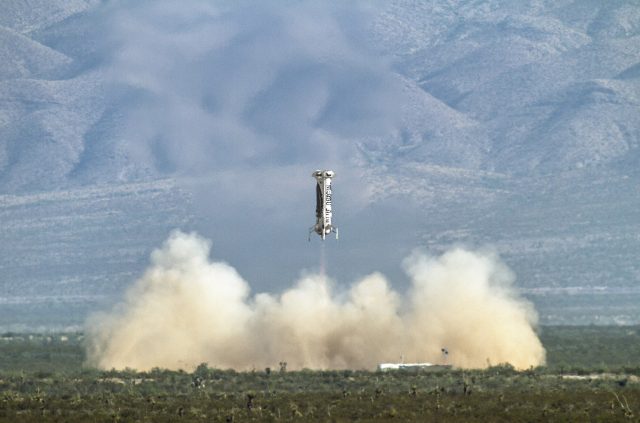
Blue Origin's propulsion module lands in West Texas on Sunday morning. (credit: Blue Origin)

In a first, the secretive Blue Origin rocket company invited the world to watch its Sunday launch, live. Blue Origin's New Shepard vehicle accelerated to 2,142mph, ascended into space, and returned to Earth 10 minutes later. Not that all that much of the world watched. It was Father’s Day, after all, and Blue Origin doesn’t have quite the cachet of SpaceX to draw in the masses. Moreover it’s easy enough to dismiss the achievements of Blue Origin—it’s just a small rocket, after all, and this only an unmanned suborbital flight.

Nevertheless, Sunday’s launch affirmed a singular, increasingly inescapable fact about the future of spaceflight: reusable rockets represent the future of the aerospace industry. SpaceX has proven that it can safely return large orbital rockets to Earth, both on land and at sea. With Sunday’s flight, Blue Origin has now definitively taken the next step, turning a rocket around and flying it again. Four times.

This fact won’t be easy to accept for Big Aerospace, which has built its business model around expendable launch vehicles and large government contracts. Moreover, this article is not intended to denigrate NASA, which continues to do some amazing, absolutely groundbreaking things. But our space agency does not appear to be the outfit that is going to radically rewrite the rules of launch, colonize space, and spread human settlements onto the Moon, perhaps asteroids, and eventually Mars.

Read 12 remaining paragraphs | Comments

Russia’s trampoline guy is now mocking US rocket engine makers

“They have no equipment to orbit their payloads on,” deputy prime minister taunts.

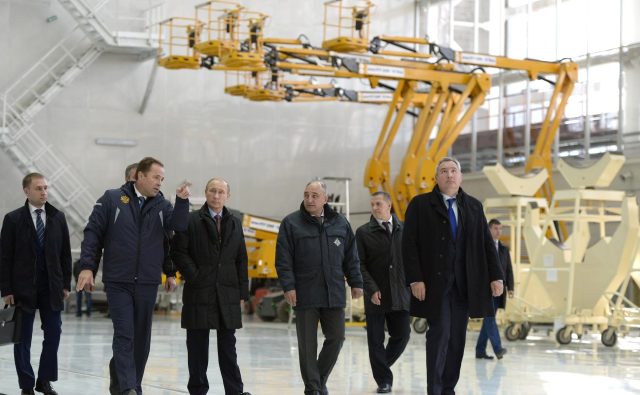
Vladimir Putin, center, and Dmitry Rogozin, far right, tour Russia's new Vostochny Cosmodrome in October, 2015. (credit: Kremlin)

Back in 2014, as tensions between the United States and Russia rose to a crescendo, that country's chief space minister mocked NASA and the US government for its reliance on Russia to get US astronauts to the International Space Station. If the US didn't like Russia's policies and was going to persist in economic sanctions, deputy prime minister Dmitry Rogozin tweeted, perhaps they would like to use a trampoline to get to space?

Publicly, neither NASA nor the US government responded. They continued working with Russia which, despite some of the more heated rhetoric, has remained a steady partner with the International Space Station. In response, NASA and Congress also stepped up funding for commercial crew efforts in the United States, which should allow Boeing and SpaceX to begin carrying astronauts into space from US soil by late 2017 or 2018.

But beyond astronaut transport, the US government is reliant upon Russia in another way in space—until last year the primary means by which national security payloads were launched into space was via the Atlas V rocket. This reliable launch vehicle is powered by RD-180 engines that United Launch Alliance purchases from Russia, and after that country's actions in Ukraine, Congress called upon the American company to end its reliance upon the Russian engine by 2022. This charge has been led by US Senator John McCain (R-Ariz.), chairman of the Armed Services Committee.

Read 3 remaining paragraphs | Comments

Do we really need humans to explore Mars?

Legendary flight director Chris Kraft says NASA should focus on the moon, not Mars.

NASA makes the case that humans offer decided advantages over robots. (credit: NASA/KSC)

The dazzling sunlight that flooded the lake-front restaurant where I sat down with Chris Kraft in 2014 was nothing compared to the brightness in his eyes. He'd just turned 90 and was frustrated that NASA hadn't flown any humans beyond low-Earth orbit since he was the agency's first flight director during Apollo. As much as anyone else, Kraft had built NASA and put men on the moon. You would think he'd want to see humans on Mars soon. Instead, he spent the next 90 minutes eating pasta and explaining that Mars, for now, is best left to robots.

NASA’s justification for sending humans to Mars has something to do with jump-starting the search for life while furthering research and exploration on the red planet. However, even under the space agency’s most wildly optimistic plans, humans will not reach the surface of Mars until the late 2030s. During his lifetime, Kraft has watched the increasing sophistication of robots and artificial intelligence. He imagines that this progress will continue apace or even accelerate. With these trends, the robots and rovers of the 2030s will certainly have some impressive capabilities. If so, why should NASA spend 20 to 40 times as much to send humans to Mars when robots could be almost as able, at a fraction of the cost?

The human rationale

It’s a question perhaps best answered by one of the space agency’s foremost modern explorers, John Grunsfeld. Not only was Grunsfeld a five-time flier on the space shuttle and chief repairman of the Hubble Space Telescope, he also served as the agency’s chief scientist. I had a chance to put the question to Grunsfeld before he left NASA this spring.

Read 10 remaining paragraphs | Comments
Jeff Bezos finds the perfect Father’s Day gift: A New Shepard launch

Company opens up to let the world watch its experimental launch.

"Hey guys, do you think we can land with just two of those?" (credit: Blue Origin)

On Sunday morning, Blue Origin plans to continue pushing the capabilities of its New Shepard launch system, as well as the boundaries of the company's own transparency.

The company conducted the first two flights of New Shepard, which consists of a propulsion module and a capsule that can make a suborbital flight, in secret, only announcing the results afterward. During the third flight in April, founder Jeff Bezos announced the launch from west Texas in advance and live-tweeted its progress. Now for the vehicle's fourth flight, Blue Origin plans a webcast, set to begin at 9:45am ET, with liftoff planned for 10:15am ET (3:15pm UK time). The webcast will be embedded in this post when it's available.

The rocket company is also continuing to push the fault tolerances of its propulsion module and spacecraft. This time the primary objective is determining whether the crew vehicle can land with one of its three parachutes intentionally failing. "There are three strings of chutes, and two of the three should still deploy nominally and, along with our retrothrust system, safely land the capsule," Bezos explained in an e-mail. "Works on paper, and this test is designed to validate that."

Read 1 remaining paragraphs | Comments