These are the best photos of Pluto you’ll likely see in your lifetime

New Horizons sends back its first batch of super high-resolution photos.

Behold: the mountainous shoreline of Sputnik Planum. (credit: NASA/JHUAPL/SwRI)

Finally, the highest resolution images are in from the edge of the solar system. Late Friday NASA released pictures of Pluto's varied terrain with a resolution of 77 to 85 meters per pixel, and these eye-popping images bring us even more detail about a complex world with cratered, mountainous terrain.

The photos of Sputnik Planum show a range of mountains crammed together, before abruptly running into the relatively flat left side of Pluto's heart. "The new details revealed here, particularly the crumpled ridges in the rubbly material surrounding several of the mountains, reinforce our earlier impression that the mountains are huge ice blocks that have been jostled and tumbled and somehow transported to their present locations," said New Horizons science team member John Spencer of the Southwest Research Institute.

The higher resolution photos will allow scientists to better understand Pluto's puzzling geology, which has surprised with an active surface that indicates the presence of interior heating. For example, in the photo below, features such as layering and the interior of crater walls can be seen. With additional analysis, this should provide a snapshot of Pluto's geological history and provide some answers about the dwarf planet's curious evolution.

Read 2 remaining paragraphs | Comments

That one time I played in the Star Wars card game world championship

In honor of The Force Awakens, we dust off a classic customizable card game.

Buy the Dagobah expansion set, it is your destiny. (credit: Aurich vs Vader)

Welcome to Ars Cardboard, our new weekend look at tabletop games! Check out our complete board gaming coverage right here—and let us know what you think.

For those of a certain age, the original Star Wars movies premiered at formative moments in our lives—and thus stayed with us forever. I had only recently turned four when Star Wars came out in 1977, but I saw Empire and Jedi in the theater, and these movies fueled my inner geek for years to come.

We geeks needed lots of fuel, too, for it was a long slog between the Jedi credits rolling off the screen in 1983 and standing in line for The Phantom Menace premiere in 1999. We subsisted on Star Wars collectibles from action figures to Lego Millennium Falcons to LaserDiscs. Later, in 1995, some of us also played a ridiculously complicated but addictive customizable card game based on the Star Wars universe.

Read 22 remaining paragraphs | Comments

Meet “Cosmic Girl,” the plane that would launch rockets into space

Virgin Galactic seeks to enter the small satellite launcher market.

Clad in designer jeans, black leather jacket, and white shirt open at the collar, a characteristically ebullient Sir Richard Branson bounded onto the stage inside an airy hangar at the San Antonio airport on Thursday. After scanning the audience for a moment, he turned his back to the crowd and stared up at the large 747-400 aircraft behind him. “My God,” he said. “It’s fantastic.”

For the first time, Virgin Galactic has revealed the aircraft it intends to use to boost small satellites weighting up to 450kg into orbit, perhaps before the end of 2017. Branson, the charismatic founder of the company, said he hoped that by bringing down the cost of satellite launches he could enable global satellite Internet and bring connectivity to the more than 3 billion people without access to the Web.

Ars was on hand during the reveal, which showcased the aircraft now destined to carry the “LauncherOne” rocket to an altitude of 35,000 feet before releasing it at a 25-degree upward angle. The rocket's Newton 3 engine will then blast its payload into any number of possible orbits around the Earth. Virgin Galactic assessed a variety of aircraft before settling on a 14-year-old 747 from its own fleet nicknamed “Cosmic Girl.” That airplane continued to fly normal routes until October 23, most frequently carrying passengers from London’s Heathrow to JFK in New York City to San Francisco.

Read 9 remaining paragraphs | Comments

Incredibly strong El Niño still developing, bringing surge of winter warmth

Many large US cities recorded record-warm temperatures this fall.

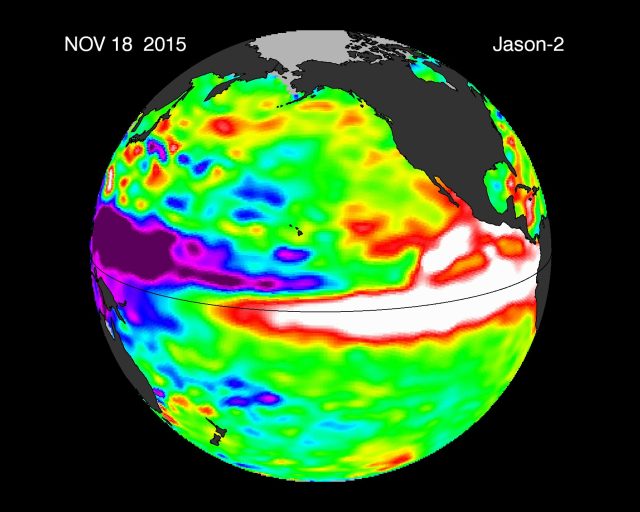
El Niño reached a record weekly high in mid-November and hasn't let up since. (credit: NOAA)

After setting a record for a single-week period in mid-November, El Niño has continued to produce record warm temperatures in the Pacific Ocean. This climate pattern, characterized by an abnormal warming of the equatorial Pacific Ocean, has already contributed to a large number of weather effects around the planet, including increased hurricane activity in the Pacific Ocean and heat across much of the United States.

Of the metrics used to gauge the strength of El Niño, the most straightforward is to look at temperatures between 90 degrees west and 160 degrees east longitude, and 5 degrees north and 5 degrees south of the equator, known as the Niño 3.4 region. Back on November 16, the National Oceanic and Atmospheric Administration reported that this area of the Pacific had a weekly average temperature that was 3.0 degrees Celsius above normal, a record high, topping the 2.8 degrees Celsius anomaly recorded during the week of November 26, 1997, the last really strong El Niño.

During the last two weeks, the temperature in this key region of the Pacific has stayed at or slightly above 3.0 degrees Celsius, NOAA says. The agency's Climate Prediction Center predicts that El Niño will likely peak during the Northern Hemisphere winter 2015-16 and will transition to neutral conditions during the late spring or early summer 2016. Forecast models predict a peak later this month.

Read 4 remaining paragraphs | Comments

During its next flight, SpaceX wants to try returning booster to land

After two seaborne attempts, company hopes to stick a land-based return.

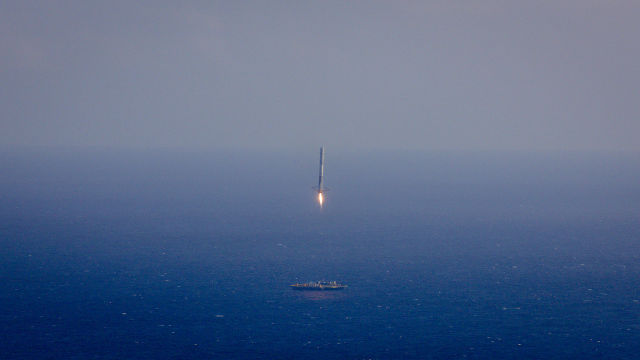
SpaceX didn't quite stick the landing of its Falcon 9 rocket in April, 2015. Now it wants to try doing so on land. (credit: SpaceX)

SpaceX’s ambitions are nothing if not oversized. Not content with just trying to come back from the June failure of its Falcon 9 rocket, SpaceX will also try to return that booster to land for the first time later this month. The rocket company twice tried to land its Falcon 9 booster, without success, on a seaborne platform.

The company has not confirmed its intent, but NASA officials said that SpaceX will try to return the booster of its next rocket launch at a Cape Canaveral location it has designated Landing Complex 1. “Their plan is to try to land (the next booster) out here on the Cape-side,” Carol Scott of NASA’s Commercial Crew Program told Florida Today. The landing attempt is contingent upon SpaceX obtaining regulatory clearance from the US Air Force, which manages Cape Canaveral.

SpaceX officials have described the company’s two water landing attempts on an autonomous drone ship as “practice” for land-based return efforts. The company hopes to eventually make its Falcon 9 boosters reusable, a step that could slash its launch costs by more than half as most of the expense in any launch is in the hardware rather than fuel.

Read 2 remaining paragraphs | Comments

As NASA discards reusable engines, Blue Origin and SpaceX push new frontiers

Jeff Bezos and Elon Musk are chasing the dream of low-cost, recycled rockets.

Four reusable RS-25 engines will power NASA's SLS rocket as it ascends into space, and then they'll be discarded. (credit: NASA)

On the Monday before Thanksgiving NASA made what it deemed a momentous announcement: the space agency had awarded $1.16 billion to Aerojet Rocketdyne for rocket engines that would power its “Journey to Mars.” By contrast, a few hours earlier, the private space company Blue Origin secretly launched a rocket into space and safely landed it. The contrast between the deal struck in corridors of Washington D.C. and what had happened in the desert of West Texas could not have been more stark.

The engines that will power NASA’s new rocket, the Space Launch System, were first developed in 1970. These RS-25 engines that gave the space shuttle its thrust were engineering marvels; with some refurbishment NASA could use them over and over again. But now NASA is funding a contract to restart production of those old engines because they would no longer be reused. Like the rest of the massive SLS rocket, its engines will be used once and then burn up in the atmosphere.

In contrast to the billions of dollars NASA spends on legacy hardware, Blue Origin has received about $25 million from the agency during its 15-year existence. That’s less than the cost of a single RS-25 engine. With the launch of its New Shepard vehicle, Blue Origin has gone not only for reusable engines but a reusable booster and a reusable spacecraft. Why? Because this approach is much, much cheaper than throwing flight-quality hardware away after every launch.

Read 12 remaining paragraphs | Comments

Scientist says huge clumps of dark matter may lie just beyond the Moon

The physicist predicts densities of up to 1 billion times greater than normal.

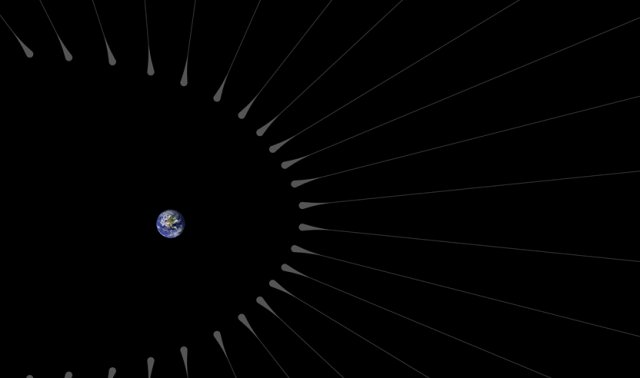
This illustration shows Earth surrounded by filaments of dark matter called "hairs." (credit: NASA/JPL-Caltech)

There are few fields like theoretical astrophysics, where public perception so radically departs from reality. Society generally considers its practitioners—scientists like Stephen Hawking and Kip Thorne—to be among the most brilliant people in the world. They are the great sages to whom we turn with the universe’s deepest questions. Yet in reality, astrophysicists are mired in ignorance.

When a theoretical astrophysicist looks up at the nighttime sky, he or she will see the stars shining overhead. But what concerns the physicist is not what he or she sees but rather what is unseen. Based upon different kinds of observations, such as how galaxies rotate and how they are flying apart from one another, scientists know that 95 percent of the of the universe is made of up stuff we cannot see. Of the universe's mass, physicists say 27 percent is dark matter, and 68 percent is dark energy. And researchers have no idea what this stuff is or where to find it.

Yet a scientist at NASA’s Jet Propulsion Laboratory has now provided a clue about where dark matter—and lots of it—might be found. In a new study published in the Astrophysical Journal, Gary Prézeau has proposed that Earth and other planets and stars in the Milky Way galaxy are surrounded by theoretical filaments of dark matter called "hairs.” By finding the roots of these hairs, he reports, physicists could uncover a trove of dark matter.

Read 9 remaining paragraphs | Comments