When Elon Musk goes to Mars, he won’t be troubled by planetary protection

During a talk this week, Musk said he doubts life exists there anyway.

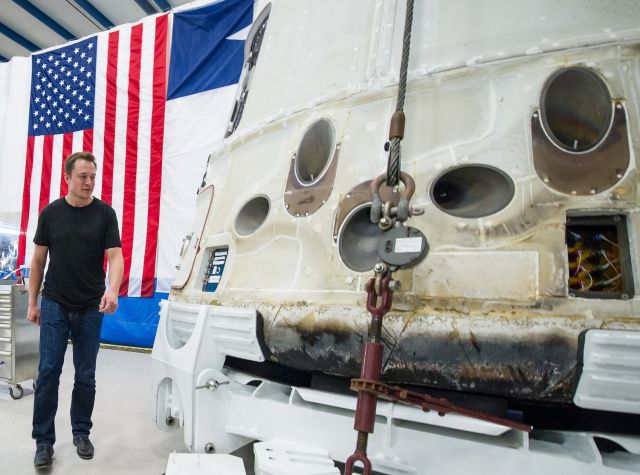
Elon Musk views the historic Dragon capsule that returned to Earth on May 31, 2012, after delivering cargo to the International Space Station. (credit: NASA/Bill Ingalls)

A lot of scientists and engineers who study Mars worry about planetary protection, the concern that biospheres on other worlds might be contaminated by microbes from Earth. It’s a bit like Star Trek’s prime directive, and NASA and other space agencies take pains to clean their robotic spacecraft of Earth-based life before launching them to other planets.

The discovery of periodic, briny water on the surface of Mars earlier this year reignited concerns about planetary protection, including whether the Curiosity rover was free enough of Earth-based microbes to investigate these features, known as recurring slope lineae (RSL). The problem becomes even worse when humans are thrown into the mix.

Therefore, some in the scientific community believe astronauts should remain off Mars until rovers and other probes have thoroughly studied the question of life on Mars. After the confirmation of present-day water on Mars, for example, The Planetary Society’s Emily Lakdawalla, wrote, “If we keep our filthy meatbag bodies in space and tele-operate sterile robots on the surface, we'll avoid irreversible contamination of Mars—and obfuscation of the answer to the question of whether we're alone in the solar system—for a little while longer. Maybe just long enough for robots to taste Martian water or discover Martian life.”

Read 6 remaining paragraphs | Comments

Congress: NASA must not only go to Europa, it must land

Agency’s new budget includes $175 million and a requirement to include a lander.

Plumes of water vapor on Europa? We may find out in about a decade. (credit: NASA/ESA/K. Retherford/SWRI)

In November Ars revealed exclusive details about a daring mission to land on Jupiter’s moon Europa, and now it has become the law of the land. The Congressional budget deal to fund NASA for the fiscal year 2016 includes $1.63 billion for planetary science, of which $175 million is designated for the “Jupiter Europa clipper mission.” It has a target launch date of 2022.

But the new budget legislation does not stop there. It further stipulates, “This mission shall include an orbiter with a lander that will include competitively selected instruments and that funds shall be used to finalize the mission design concept.” In other words, it's against the law to fly the mission to Europa without a lander.

The overall budget for NASA provides $19.2 billion for NASA in fiscal year 2016, about $700 million more than President Obama requested. “This number, this year, is the largest vote of confidence that Congress has ever given NASA,” Texas Congressman John Culberson, who chairs the House Appropriations subcommittee with jurisdiction over the space agency, told Ars. “There’s enough money to do everything on their plate.”

Read 8 remaining paragraphs | Comments

Final NASA budget bill fully funds commercial crew and Earth science

Congress increases funding for critical programs after a protracted fight.

NASA's commercial crew program, and its first four astronauts, were big winners in the agency's final budget. (credit: NASA)

For the first time since 2011, Congress has fully funded NASA's commercial crew program, keeping open the possibility that the space agency will be able to end its reliance upon Russia for transportation to the International Space Station by the end of 2017.

The final fiscal year 2016 budget bill provides $1.24 billion to the agency for its commercial crew program, the exact amount requested by President Obama in his budget proposal. NASA administrator Charles Bolden has said without the full request, efforts by SpaceX and Boeing to develop their spacecraft will be further delayed. Earlier iterations of both the House and Senate budget bills had provided hundreds of millions of dollars less for commercial crew.

In another concession to the White House, the final budget bill also provides $1.92 billion for Earth Science research, just $20 million less than the President's original budget request. Although below the level Obama sought, this cut is slight compared to initial budget proposals from the House and Senate which had slashed as much as $500 million from the President's request.

Read 2 remaining paragraphs | Comments
Amid overwhelming interest, 124 teams qualify for Hyperloop competition

Teams will present concepts for “pods” that can be run on an actual test track.

Who can design the best pod to run inside a test track? (credit: SpaceX)

SpaceX has selected 124 teams of mostly college student engineers to participate in a Hyperloop Pod competition at the end of January. The teams will present their concepts for pods, which will then compete on a test track next summer in front of judges from SpaceX, Tesla, and universities.

The hyperloop, as outlined by Elon Musk two years ago, would involve a pod or capsule moving at nearly the speed of sound inside a tube elevated above the ground. This kind of track system could provide rapid transportation between cities 1,500 km or less apart, Musk said, after which supersonic aircraft would probably be faster or cheaper. Passengers might travel from Los Angeles to San Francisco in just 30 minutes according to Musk. The idea was hailed as visionary by some, but others have criticized it for being far from practical.

Although Musk has said he is focused on launching rockets with SpaceX and building electric cars with Tesla, he has nonetheless sought to nurture the project along by developing a functional prototype. To that end, he invited young engineers to propose ideas for a pod. The teams, from 27 US states and 20 countries, will have their concepts judged on January 29 and 30 at Texas A&M University in College Station.

Read 7 remaining paragraphs | Comments

Orbitar, really? Some new exoplanet names are downright weird

The International Astronomical Union blessed the names after a public vote.

Infographic of winning names for nearly four dozen stars and exoplants. (credit: IAU)

Everyone who lived through the demotion of Pluto as a planet knows that the International Astronomical Union (IAU) is the final arbiter when it comes to designating all things astronomical, including official names for celestial bodies. And now the IAU has turned its international eyes on exoplanets for the first time, with public input, to name 14 stars and 31 exoplanets orbiting them.

Members of the public from the United States ended up suggesting the winning name for one star (42 Draconis) and two planets (42 Draconis b, Fomalhaut b). The names chosen were Fafnir for the star, and Orbitar and Dagon for the planets. Fafnir is named for a Norse mythological dwarf who turned into a dragon. Orbitar is a "contrived word paying homage to the space launch and orbital operations of NASA." Dagon was a Semitic diety, half-man, half-fish.

Color us unimpressed with those names.

Read 3 remaining paragraphs | Comments

Why we’re going back to the Moon—with or without NASA

The discovery of lunar water has changed everything for human exploration.

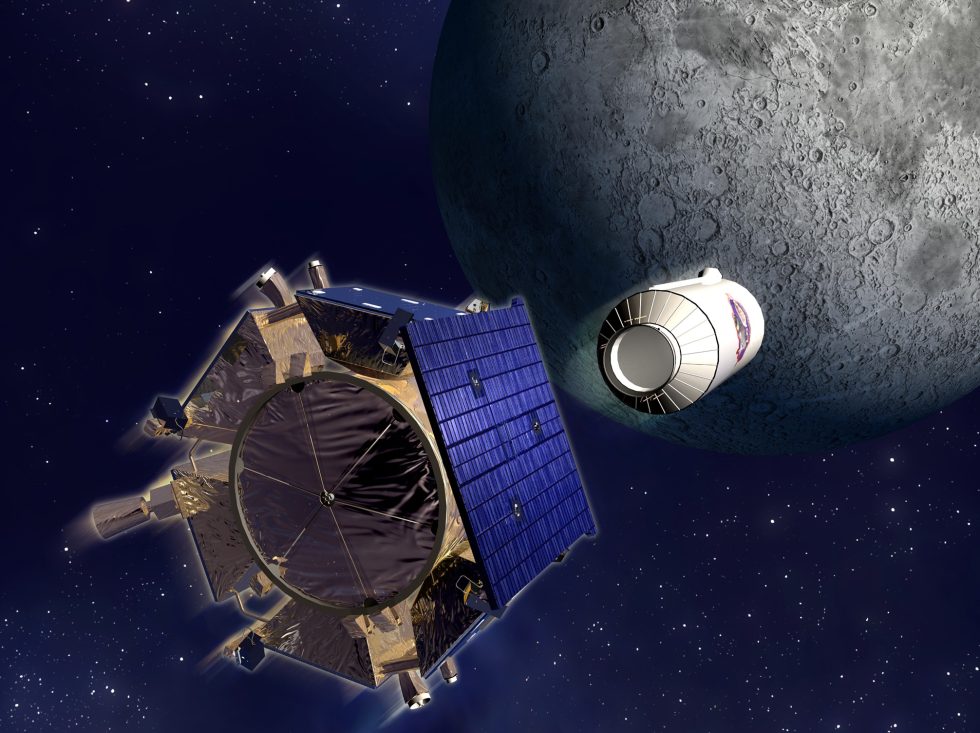
An artist's impression of the Centaur upper stage detaching from the LCROSS spacecraft. (credit: NASA)

It was time for the spent rocket to die. So the 2,000kg Centaur upper stage, about the size of a yellow school bus, detached from its spacecraft and began falling toward the Moon six years ago. Soon lunar gravity took hold, tugging the Centaur ever faster toward the Moon’s inky black South Pole. An hour after separation, the rocket slammed into terra incognita at 9,000kph (or roughly 5,600mph).

Named for a mythical creature with the upper body of a human and lower body of a horse, the empty Centaur burrowed several meters into a crater that had not seen the Sun’s light for billions of years. The impact kicked a plume of Moon dust as high as 20 km into space. The detached spacecraft followed just minutes later, sampling the plume. “We knew within hours that we had measured something really interesting,” recalled Anthony Colaprete, the mission’s principal investigator.

Interesting indeed. After more than a decade of speculation and intriguing findings, the Centaur had blasted up grains of pure ice. It provided dazzling confirmation that a world once thought entirely barren and desiccated harbors the most valuable commodity for human exploration—water. Yet even as Colaprete and other scientists announced their findings in the fall of 2009, NASA’s lunar program was dying.

Read 50 remaining paragraphs | Comments

North Carolina citizenry defeat pernicious Big Solar plan to suck up the Sun

Town council votes to deny zoning permit that would allow solar farm development.

We looked for solar panel farms in Woodland, N.C., but didn't find any. (credit: Google Maps)

The citizens of Woodland, N.C. have spoken loud and clear: They don't want none of them highfalutin solar panels in their good town. They scare off the kids. "All the young people are going to move out," warned Bobby Mann, a local resident concerned about the future of his burg. Worse, Mann said, the solar panels would suck up all the energy from the Sun.

Another resident—a retired science teacher, no less—expressed concern that a proposed solar farm would block photosynthesis, and prevent nearby plants from growing. Jane Mann then went on to add that there seemed to have been a lot of cancer deaths in the area, and that no one could tell her solar panels didn't cause cancer. “I want information," Mann said. "Enough is enough."

These comments were reported not in The Onion, but rather by the Roanoke-Chowan News-Herald. They came during a Woodland Town Council meeting in which Strata Solar Company sought to rezone an area northeast of the town, off of US Highway 258, to build a solar farm. The council not only rejected the proposal, it went a step further, voting for a complete moratorium on solar farms.

Read 1 remaining paragraphs | Comments

Astronomers question claim of super planet found at solar system’s edge

New papers say “Super Earth” may orbit the Sun at six times the distance of Pluto.

The ALMA Telescope’s antennas are seen under a starry night sky. (credit: Christoph Malin)

Scientists and amateur astronomers have long been fascinated by the possibility of a "Planet X" at the edge of the solar system that may explain some apparent anomalies in the orbits of planets such as Neptune and Uranus. However, in recent years, astronomers have largely ruled out the possibility of a large, unseen planet far beyond the orbit of Pluto.

Research groups from Sweden and Mexico have now submitted pre-prints of two research papers to arXiv (here and here) that claim to have discovered a massive object at the edge of the solar system. Using observations from the Atacama Large Millimeter/submillimeter Array in Chile during 2014 and 2015, the astronomers spied "a new blackbody point source" that appears to be moving in conjunction with the Alpha Centauri star system, about 4.3 light years from Earth.

The authors do not believe the new object is part of the Alpha Centuari system, however, because if it were that far away, such a star would have been bright enough to be seen before. Rather, they offer several explanations for the object, which one of the research teams named "Gna." Perhaps most notably, they suggest a "Super Earth" at a distance of about 300 astronomical units (AU) from the Sun, or about six times further than Pluto is at its aphelion. Another explanation is a "super-cool" brown dwarf (too big to be a planet, too small to be a star) at about 20,000 AU from the Sun.

Read 5 remaining paragraphs | Comments

Game on: Second competitor in Google Lunar XPRIZE gets a ride to space

Moon Express secures a launch contract with Rocket Lab

An artist's illustration of the Moon Express MX-1 lunar lander on the surface of the moon. (credit: Moon Express)

Time is running out for the 16 teams entered into the Google Lunar XPRIZE, which requires entrants to land a small spacecraft on the surface of The Moon by the end of 2017. But now, eight years after the prize was announced, the competitors are beginning to show tangible signs of progress.

In October an Israeli team, SpaceIL, became the first of the 16 competitors to announce a launch contract to carry its lander to the Moon. The team signed up for a SpaceX Falcon 9 rocket launch in the second half of 2017. On Tuesday a second team attained that goal, as the US-based Moon Express, led by Bob Richards, announced a deal for a Rocket Lab Electron rocket in 2017.

"We believe that the spirit of competition brings about breakthroughs that once seemed unimaginable or impossible, and so it thrills us to now have two Google Lunar XPRIZE teams with verified launch contracts attempting missions to the moon in 2017," said Chanda Gonzales, senior director of the Google Lunar XPRIZE, in a statement. "The new space race is truly on!"

Read 2 remaining paragraphs | Comments

NASA official warns private sector: We’re moving on from low-Earth orbit

Top human spaceflight official says companies should take advantage of space station.

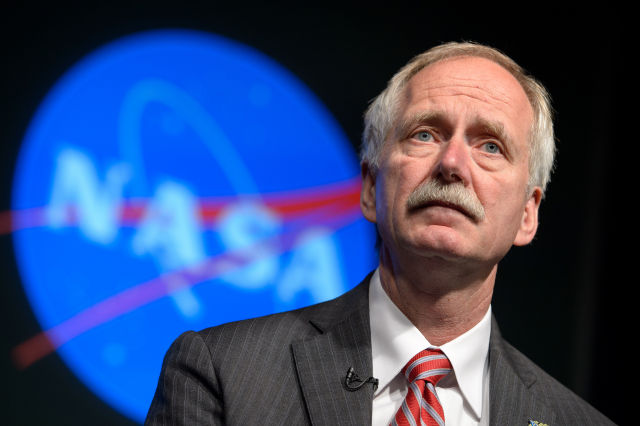
Bill Gerstenmaier, NASA's associate administrator for human exploration and operations, at the agency's headquarters in 2013.

NASA has flown the International Space Station for the last 15 years, and during that time it has offered private industry a pretty sweet deal. The space agency pays transportation costs to and from the station for experiments and provides astronaut time to tend to that research. And when NASA needed new spacecraft to get its astronauts on board the station, it paid private companies to develop their own vehicles for that purpose. NASA, in some sense, has become the Chamber of Commerce for outer space.

But all good things must come to an end, so the free ride in low Earth orbit for private industry may stop as soon as a decade from now. “We’re going to get out of ISS as quickly as we can,” said William Gerstenmaier, NASA’s chief of human spaceflight, last week. “Whether it gets filled in by the private sector or not, NASA’s vision is we’re trying to move out.”

Gerstenmaier made those comments during a meeting of NASA’s advisory council in early December at Johnson Space Center, which Ars attended. The comments are striking because, while the remarks reflect NASA’s desire to see US commercial industries thrive in the space around Earth, it is not the agency’s top priority to ensure that happens. Gerstenmaier said NASA is committed to moving humans deeper into space to the vicinity of the Moon, an area known as cislunar space.

Read 10 remaining paragraphs | Comments