SpaceX Falcon delivers NASA/NOAA satellite but has rough landing

A landing at sea may have been disrupted by rough waves.

On Sunday, SpaceX's Falcon booster successfully lifted the Jason-3 satellite into orbit from Vandenberg Air Force Base in California. Following that, the first stage attempted to achieve a landing on the Just Read the Instructions barge, which was floating off the California coast. The barge was experiencing 12-to-15-foot waves at the time of liftoff and just as the rocket descended towards the barge, communications went out possibly due to those rough seas.

Early indications are that it descended on target but experienced a rough landing; we'll have more details as they become available. Meanwhile, the Falcon's payload is on target for an insertion into polar orbit.

The water landing attempt follows the company's historic return to a landing site on the coast of Florida in December, when SpaceX became the first company to deliver a payload to orbit and then successfully fly the booster back to Earth.

Read 5 remaining paragraphs | Comments
China to attempt a space first: Landing on the far side of the Moon

The 2018 mission is the latest in an ambitious lunar exploration program.

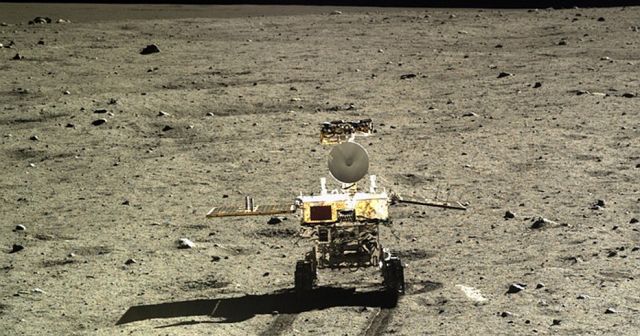
The Chang'e-3 probe carried the Yutu rover to the lunar surface in 2013. (credit: CNSA)

China plans to become the first nation to land a probe on the far side of the Moon, according to Xinhua News Agency, the country's official press organization.

Launching possibly as early as 2018, the mission represents the next step in China's plans to explore the Moon with robotic probes and, within the next decade, to return a couple of kilograms of lunar material to Earth. The proposed Chang'e-4 probe follows the successful soft landing of the Chang'e-3 probe on the near side of the Moon in December 2013.

Although the new probe was built as the engineering backup to the Chang'e-3 lander, Chinese officials said the structure could handle a larger payload. China plans to use the probe to study "geological conditions" on the far side of the moon. The Chang'e probes are named after the Chinese goddess of the Moon.

Read 2 remaining paragraphs | Comments

NASA signals commitment to private space with $14 billion investment

Commercial cargo contracts will keep the Space Station provisioned through 2024.

The Dream Chaser would allow NASA to reclaim some of its space shuttle heritage. (credit: Sierra Nevada Corporation)

Today, NASA awarded a new round of contracts to supply the International Space Station with food, water, and scientific research from late 2019 through 2024.

The space agency both expanded the number of companies providing services from two to three, and more than doubled the potential value of awards to as much as $14 billion over about five years. “This is the next chapter,” said Ellen Ochoa, director of Johnson Space Center, which manages the Space Station program.

Both Orbital ATK, with its Cygnus vehicle, and SpaceX, with its Dragon, won new contracts. Sierra Nevada Corporation joined them with its Dream Chaser. Unlike the other two capsules, the Dream Chaser is a winged vehicle that resembles the space shuttle and lands on a runway. Each of the companies is guaranteed to fly at least six supply missions to the station.

Read 14 remaining paragraphs | Comments
A rare January hurricane forms, could become month’s strongest on record

Hurricane Alex likely intensified due to very cold upper atmosphere temperatures.

Hurricane Alex as observed by NASA's MODIS satellite at 10:30am ET Thursday. (credit: NASA)

Hurricane Alex formed south of the Azores on Thursday morning far from the United States, becoming the third January hurricane on record in the Atlantic Ocean and the first in 78 years. By early afternoon it had strengthened to a system with sustained winds of 85mph.

"Remarkably, Alex has undergone the transformation into a hurricane," wrote Richard Pasch, a senior forecaster at the National Hurricane Center, in his discussion of the system. "A distinct eye is present, embedded within a fairly symmetric mass of deep convection. Water vapor imagery shows that the upper-level trough is now west of the cyclone, with divergent flow over the center, indicative of a tropical transition."

Notably, sea surface temperatures near where the storm formed, 31.5°N and 28.4°W, are not anomalously warm. They are, in fact, near normal for January in the northern Atlantic Ocean. However temperatures in the upper troposphere, about 10 to 15km above the surface of the Earth, are about -60 degrees Celsius, substantially colder than normal. This stark temperature gradient has increased the upward pull on warmth and moisture at the surface, helping the hurricane to intensify.

Read 2 remaining paragraphs | Comments

Fiery space debris that hit Earth in November likely from Moon rocket

A mission searching for water on the Moon found it instead in the Indian Ocean.

Did a piece of the Lunar Prospector fly around in space for 17 years before crashing back into Earth? (credit: NASA)

In November, an approximately 1-meter piece of space junk burnt up in the Earth's atmosphere and fell into the Indian Ocean, making a fiery spectacle of itself. At the time space scientists weren't sure about the origin of the object, named WT1190F. Since then, there has been a flurry of activity to try and trace the trajectory of the debris back to its origin.

Now according to a report in Nature, scientists have a leading candidate. The space debris appears likely to have come from the translunar injector of Lunar Prospector, a spacecraft launched by NASA in 1998. This part of the rocket would have boosted the spacecraft out of Earth orbit and toward the Moon.

By comparing observations from telescopes since 2009, scientists found the object had a stretched out path that brought it beyond the Moon's orbit, which was consistent with a Moon rocket. They believe the object only could have survived in the Earth-Moon system for a decade or slightly longer. Additionally, spectra from the debris showed the presence of titanium oxide and hydrogen, which were consistent with the injector's titanium case.

Read 2 remaining paragraphs | Comments

Payload concerns, high costs, and competition cloud future of NASA rocket

Has NASA told employees it is having difficulties finding things to launch on SLS?

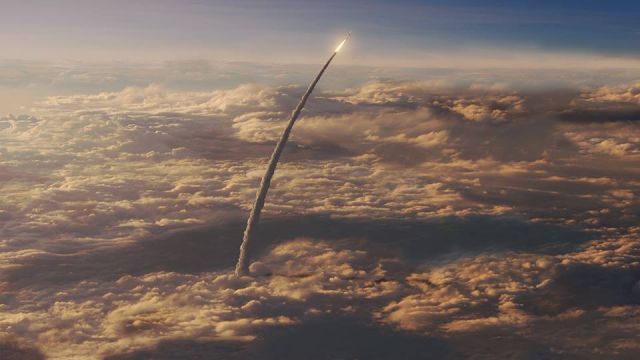
An artist's concept of the Space Launch System rocket ascending through the clouds. (credit: NASA)

Almost from the inception of NASA’s large and costly rocket program, the Space Launch System, aerospace engineers have questioned the viability of a rocket that will fly infrequently, perhaps as little as once every two to four years. The most influential body to review the rocket, the National Research Council, concluded in 2014 that such low flight rates “will not be sustainable over the course of an exploration pathway that spans decades.”

NASA has steadfastly maintained that it will be able to fly the SLS rocket on an annual basis. However, on Tuesday, the website NASA Spaceflight.com reported on an “all hands” meeting at Kennedy Space Center in Florida where Robert Lightfoot, the agency’s top civil servant, addressed employees. According to the report, NASA officials explained during the meeting that the SLS lacks “booked missions at this time due to tight funding.”

Essentially this appeared to be an acknowledgement by NASA that it lacks funding to build payloads for its flagship rocket, largely because it is spending so much time and money building that rocket. This has been a main contention of SLS critics, who have said it gobbles up so much of the agency’s budget that NASA cannot afford to use it. For this reason the SLS has been derided as a “rocket to nowhere.”

Read 13 remaining paragraphs | Comments

Inside the vault: A rare glimpse of NASA’s otherworldly treasures

Did Ars geek out over Moon rocks, bits of the Sun, and Martian meteorites? Oh yes—Ars did.

Ron Bastien holds an aerogel tile that flew into the tail of a comet, captured dust particles, and survived to tell the tale. (credit: Lee Hutchinson)

HOUSTON, Tex.—Building 31 on the campus of Johnson Space Center lacks the Tower of London’s majesty and history. No Queen’s Guard stand outside. But this drab, 1960s-era building is nonetheless where NASA keeps the crown jewels of its exploration program. Inside various clean rooms, curators watch over meteorites from Mars and the asteroid belt, cosmic dust, samples of the solar wind, comet particles, and, of course, hundreds of kilograms of Moon rocks.

In late December, Ars spent a day visiting these collections, including the rarely accessed Genesis Lab. While our request for a Moon rock keepsake was sadly rebuffed, we nonetheless got a VIP tour of every astromaterial NASA has collected from other bodies in the Solar System and beyond. With Senior Space Editor Eric Berger providing the words and Senior Technology Editor Lee Hutchinson capturing the photos, we can now offer an unprecedented look at how NASA protects its rarest and most valuable off-world samples.

Antarctic meteorites

To start, we wanted to see the famous Mars rock.

Read 41 remaining paragraphs | Comments

After sticking a land-based return, SpaceX will try the ocean again

Will the third time prove a charm for a tricky seaborne rocket return?

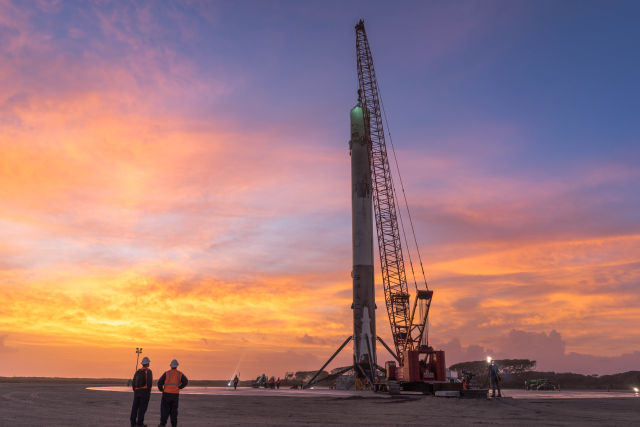
The Falcon 9 first stage after successfully landing in Florida. (credit: SpaceX)

Less than a month after successfully flying the first stage of its Falcon 9 rocket booster back to a landing site along the Florida coast, SpaceX plans to try a seaborne return. The attempt will come as early as Sunday, when SpaceX plans to launch the Jason-3 satellite into space for the National Oceanic and Atmospheric Administration.

SpaceX has tried twice to land its spent rocket on a barge, in January and April of 2015, but failed in part due to the inherent instability of a sea-based platform. For this launch the company cannot attempt a ground-based landing because the rocket will blast off from Vandenberg Air Force Base in California, where it doesn't yet have an established landing site. SpaceX's Landing Zone 1 is located in Florida, near Cape Canaveral Air Force Station.

Still, the company would like to perfect sea-based landings. After a rocket launch, the first stage flies several hundred miles downrange, and must expend propellant to fly back to land. For launches that require a maximum amount of energy, such as sending larger payloads to geostationary orbit, there will not be enough fuel to fly back to land. Company founder, Elon Musk has also said the central core of SpaceX's Falcon Heavy rocket, which remains under development, would probably need to be returned at sea.

Read 1 remaining paragraphs | Comments

What happens when a black hole eats all the nearby gas? Its quasar dims

A rapidly fading quasar confirms scientific theories about their nature.

An artist’s conception of the “changing-look quasar” as it appeared in early 2015. The glowing blue region shows the last of the gas being swallowed by a central black hole. The spectrum is from 2003. (credit: Dana Berry / SkyWorks Digital, Inc.; SDSS collaboration)

Here's a mystery Encyclopedia Brown probably couldn't solve: the case of the missing quasar. But astronomers appear to be up for the task. They're excited about a distant quasar that appears to have dimmed dramatically during the last decade, because it validates their understanding of these phenomena.

For a long time scientists were mystified by quasars, fairly compact objects in the sky that are extremely bright, in some cases ten or even 100 times brighter than the Milky Way Galaxy. Some scientists even speculated that these quasi-stellar objects were the other "side" of a black hole out of which all the material sucked in eventually emerged. By the 1980s, however, astronomers began to understand that quasars actually surrounded the very large, supermassive black holes at the center of galaxies. All of the electromagnetic energy quasars generate, they believed, comes from material falling into the black hole.

About 13 years ago, scientists first measured the spectrum of a quasar known as SDSS J1011+5442. To estimate the amount of gas falling into its central black hole, they looked at its hydrogen-alpha emission line. When they looked at the same quasar again in 2015, they found that emission of this gas had fallen by a factor of 55. As a result of this unprecedented decline in hydrogen-alpha emissions, it has become known as the "changing-look quasar."

Read 2 remaining paragraphs | Comments

Sorry NASA, Europe says it’s going to the Moon instead of Mars

The European Space Agency has become increasingly bold with its lunar preferences.

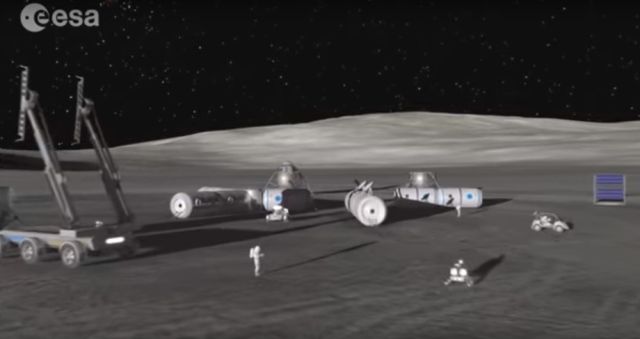
A screen capture from the new ESA video shows a concept of a human lunar settlement. (credit: ESA)

NASA has made it clear for the last half decade that it considers Mars the next destination for its astronauts. Nevertheless, since President Obama took the Moon off the table during a 2010 space policy speech, potential partners for NASA's "Journey to Mars" have fallen by the wayside.

Earlier this decade, both China and Russia, the two nations now capable of launching humans into space, signaled their intentions to first explore the Moon. Now they have been joined by arguably NASA's most important partner in the coming years, the European Space Agency (ESA). In a new video titled "The Moon Awakens," the agency says it will take lessons learned from the International Space Station and team with other interested partners to return humans to Earth’s natural satellite by the end of the next decade.

"This new exploration will be achieved not in competition, as in the past, but through peaceful, international cooperation," the narrator says. "Eventually we will see a sustained infrastructure for research and exploration where humans will live and work for prolonged periods. Here we will put into practice the lessons of the International Space Station, to establish a facility akin to those we see in Antarctica today. In the future the moon can become a place where the nations of the world work together."

Read 6 remaining paragraphs | Comments