Astronomers have detected a Super-Earth atmosphere for the first time

Diamond-like world isn’t going to be on anyone’s bucket list, though.

This artist’s impression shows the super-Earth 55 Cancri e in front of its parent star. (credit: ESA/Hubble, M. Kornmesser)

No, 55 Cancri e isn't an exoplanet anyone will want to visit anytime soon. Because it orbits so close to its star, the world has a surface temperature of around 2,000 degrees Celsius. But that hasn't prevented the planet, recently named "Janssen" by the International Astronomical Union, from having an atmosphere. And it's an interesting atmosphere indeed.

Discovered back in 2004, Janssen was one of the first "super Earths" found by astronomers. These planets, larger than Earth but considerably smaller than the gas giants of the Solar System, are thought to be the most common type of planets in the galaxy. Now, using a technique to tease atmospheric data out of Hubble Space Telescope observations, scientists have been able to deduce the atmosphere of this particular super Earth.

According to results published in the Astrophysical Journal, European astronomers have found hydrogen and helium in the atmosphere around Janssen, which may have a diamond-like core due to its very high density. This atmosphere is likely a remnant of the nebula from which the planet and its star formed about 8 billion years ago. The planet has kept this atmosphere somehow, despite the proximity of its star.

Read 2 remaining paragraphs | Comments

See the galaxy! Book today! These travel deals won’t last!

Ars Tourisma lets you pick from a wide variety of exotic travel destinations.

Come and sail the methane seas of Titan! (credit: NASA)

What are you waiting for? There's a whole galaxy out there for you to explore. With our custom DreamMaker spacecraft, the Solar System and planets beyond lie at your fingertips—for less money than you think!

Why experience a solar eclipse from the South Pacific when you can watch a Mercury transit from Venusian clouds? Why see the auroras from Alaska when you could see mightier ones on Jupiter? Why go to Vegas for nightlife when you could experience the perpetual darkness of a rogue planet?

We at Ars Tourisma are here to make your next vacation truly out of this world. So please browse our brochure below to select your vacation of choice. Payments accepted in US Dollars, Lunar Lira, or Charon Credits. (We're sorry, but we can no longer accept Betelgeuse Bitcoins).

Read 1 remaining paragraphs | Comments

NASA’s asteroid mission isn’t dead—yet

Agency delays initial launch date to 2023, program may never fly at all.

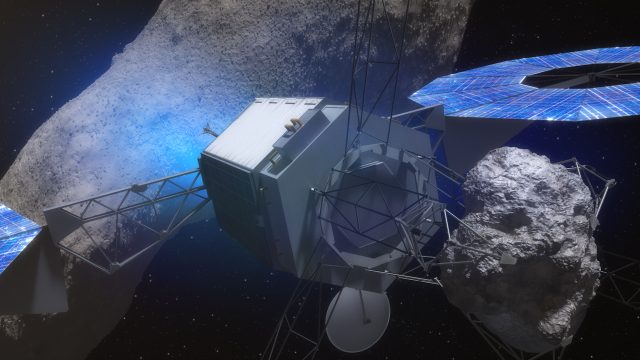
NASA's asteroid mission calls for a robotic spacecraft to grab a boulder from an asteroid and return it to cislunar space.

It seemed like a good idea at the time. Back in 2010 President Obama wanted to distance himself from the space exploration programs of George W. Bush and his predecessors. Humans had been to the Moon, and while they would one day go to Mars, the president reasoned, they needed a more realistic near-term destination. He chose an asteroid.

“By 2025 we expect new spacecraft designed for long journeys to allow us to begin the first-ever crewed missions beyond the Moon into deep space,” Obama said at Florida’s Kennedy Space Center, during the one space policy speech he has given as president. “So we’ll start by sending astronauts to an asteroid for the first time in history.”

An asteroid offered a couple of key benefits. It was new—no human had visited one before. And with a shallow gravity well, it didn’t require expensive landers and ascent vehicles to get onto and off its surface. But there were also problems. Even after searching for a couple of years, scientists couldn’t find a suitable asteroid that came close enough to Earth for astronauts to reach it in a timely manner, and the Orion vehicle NASA was building could only support a crew for 21 days in deep space.

Read 13 remaining paragraphs | Comments

Liveblog: Scientists to announce major gravitational wave finding

Ars is on the scene at the source of gravitational wave science in Louisiana.

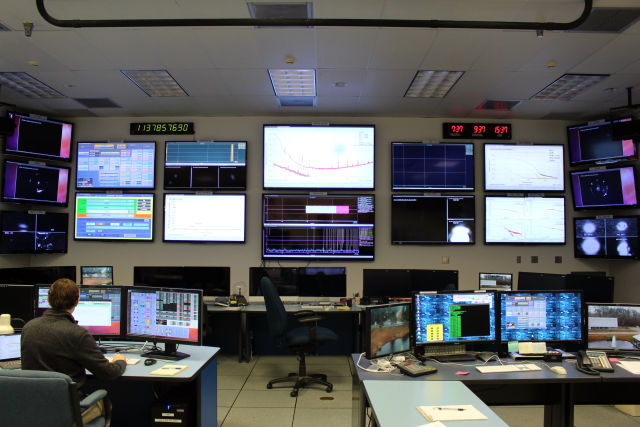
Inside the main control room at the gravitational wave detector facility in Livingston, Louisiana. (credit: Eric Berger)

View Liveblog
2016-02-11T09:15:00-06:00

On Thursday morning (10:30 EST, 15:30 GMT) scientists will make what they are calling a major gravitational wave announcement.

The scientists are being pretty coy about it, and after a century of looking for gravitational waves, you can understand their caution about not wanting the cat to slip out of the bag.

However, credible rumors have been swirling about the discovery of gravitational waves emanating from a binary black hole, and physicists associated with the National Science Foundation-funded project are expected to discuss this new research during their presentation.

Read 1 remaining paragraphs | Comments

NASA budget proposal widens divide between White House and Congress

Budget battles likely over Earth science, and the Space Launch System

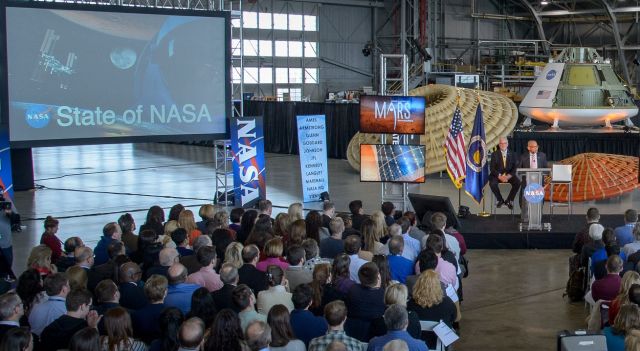
NASA Administrator Charles Bolden delivers his "State of NASA" speech at Langley Research Center on Tuesday. (credit: NASA)

Each year President Obama submits a budget for NASA to Congress, and each year the House of Representatives and Senate essentially toss out those numbers and come up with their own figures. Now that the President has submitted a $19 billion NASA budget for fiscal year 2017, we can expect the same scenario to play out again this year.

The macro battle with Congress will likely remain over the direction of the space agency. NASA sees itself as being on a journey to Mars. On Tuesday Charlie Bolden, the agency’s administrator and a four-time astronaut, reiterated that point. “We are closer today than ever before in human history to sending humans to the red planet,” Bolden said during a State of NASA speech. “Our plan is clear, affordable, sustainable and attainable.”

However Congress has become increasingly skeptical about the viability of NASA’s plan to go to Mars. During a hearing earlier this month, Republicans openly questioned whether NASA was, in fact, on a path to Mars. The chairman of the House Science Committee, Rep. Lamar Smith (R-Tex.), called it an "imbalanced proposal [that] continues to tie our astronauts’ feet to the ground and makes a Mars mission all but impossible,” in a statement to Ars.

Read 12 remaining paragraphs | Comments

SpaceX sets launch date for later this month, sea landing likely

The company has tried three sea-based returns before. Will the fourth one stick?

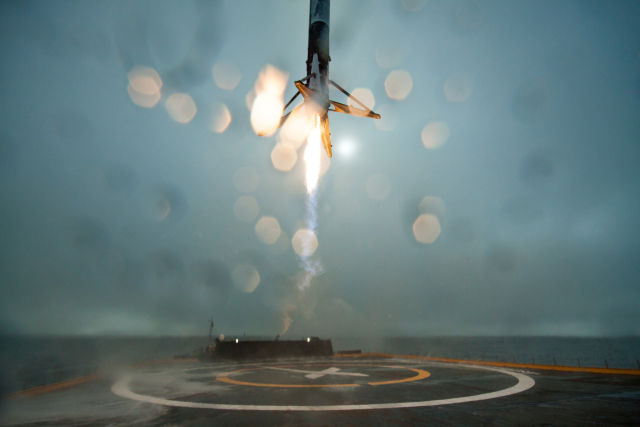
SpaceX came close to sticking the landing of a January 17 launch of a NOAA satellite, but it just missed. (credit: SpaceX)

SpaceX will make its next launch attempt on February 24th when it attempts to put a SES-9 satellite into orbit 35,000km above the equator. The Luxembourg based-owner of the satellite announced the launch date on a Falcon 9 rocket Monday. It did not provide a launch window.

Because the rocket will expend nearly all of its fuel to reach this higher orbit, it will not have enough left to return to a landing site on the Florida coast as a similar launch did in December. Therefore SpaceX is expected to attempt a fourth sea-based landing on an autonomous drone ship.

The company's previous tries have failed, but the last attempt in January came close. One of the rocket's four landing legs failed to lock out, even as the Falcon 9 booster made a feathery touchdown on the drone ship in high seas. "We stuck the landing, and then we unstuck it," said Gwynne Shotwell, president and chief operating officer of SpaceX at a Federal Aviation Administration conference last week.

Read 1 remaining paragraphs | Comments

Indian man could be first recorded human fatality due to a meteorite

Indian officials say bus driver was killed by a meteorite, pending confirmation.

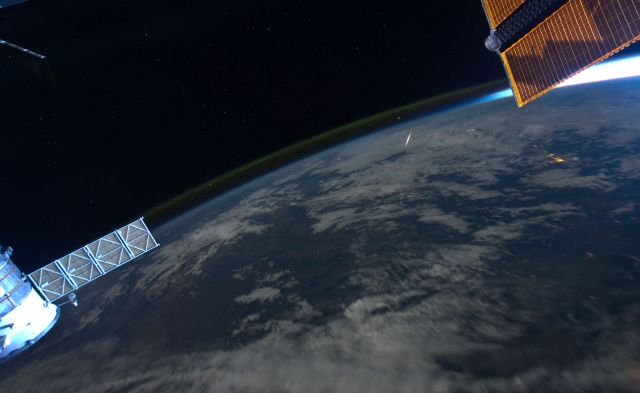
A Perseid meteor is seen entering Earth's atmosphere from the International Space Station. (credit: NASA)

Indian officials say a meteorite struck the campus of a private engineering college on Saturday, killing one person. If scientists confirm the explosion was due to a meteorite, it would be the first recorded human fatality due to a falling space rock.

According to local reports, a bus driver was killed on Saturday when a meteorite landed in the area where he was walking, damaging the window panes of nearby buses and buildings. Three other people were injured.

On Sunday, various Indian publications, including The Hindu, reported that the chief minister of Tamil Nadu, Jayalalithaa, issued a statement confirming the death: "A mishap occurred yesterday when a meteorite fell in the campus of a private engineering college in Vellore district's K Pantharappalli village." Tamil Nadu is located in southern India, and has a population of more than 70 million people.

Read 2 remaining paragraphs | Comments
With its mirror complete, giant space telescope on track for 2018 launch

After nearly two decades of planning, James Webb nears completion.

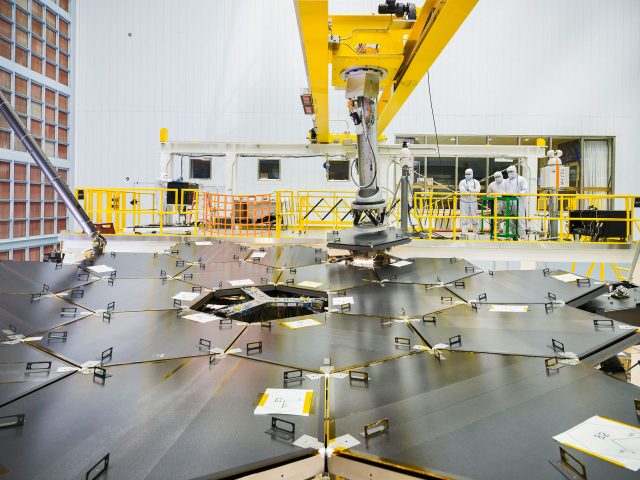
This week the James Webb Space Telescope team used a robotic am to install the last of the telescope's 18 mirrors onto the telescope structure. (credit: NASA)

After years of delays and cost overruns, the James Webb Space Telescope is finally coming together. This week the 18th and final primary mirror segment of the telescope was installed onto the support structure at Goddard Space Flight Center. From here, additional optics must be installed, and the telescope requires testing to ensure it can withstand the forces of a rocket launch anticipated in late 2018.

Each of the hexagon-shaped mirrors weighs 40 kg and spans 1.3 meters. After launch, the telescope will be flown to the second Lagrange point of the Earth-Sun system, about 1.5 million kilometers from Earth. From there, it will begin observations. When deployed in space, the telescope will have a 6.5-meter diameter.

"Completing the assembly of the primary mirror is a very significant milestone and the culmination of over a decade of design, manufacturing, testing, and now assembly of the primary mirror system," said Lee Feinberg, optical telescope element manager at Goddard. "There is a huge team across the country who contributed to this achievement."

Read 2 remaining paragraphs | Comments
From exile to eminence: How the alien hunters conquered astronomy

Jill Tarter tells Ars how technology and discovery have primed the search for life.

Tarter speaks after a screening of Contact, in 2014, at the Qualcomm Institute. (credit: Qualcomm Institute)

When Jill Tarter first began to look for aliens, she drew looks askance from her friends and colleagues. The perception was “What’s a nice girl like you doing in a subject like this?” she recalled in an interview with Ars. Tarter, now 72, would go on to rise above that perception, becoming a leading figure at the SETI Institute. And the astronomer played by Jodie Foster in the movie Contact, which was largely based on Tarter, would further bolster her reputation.

She and her fellow searchers haven’t found E.T. yet, but they have become respected members of the scientific community. These days, when NASA plots future explorations of Mars or ice-covered moons in the outer solar system, they’re driven by the search for microbial life. And with the discovery of billions of planets in the Milky Way, no one snickers any more at the idea of sniffing atmospheres around other worlds for biosignatures.

The search for aliens has become respectable because it no longer is a philosophical or religious matter to ask if we are alone. During Tarter’s lifetime, scientists and engineers have developed the tools and technology to finally probe this question in a meaningful way.

Read 12 remaining paragraphs | Comments
Space experts warn Congress that NASA’s “Journey to Mars” is illusory

Testimony says NASA lacks the financial resources and technology to do the mission.

House Republican Brian Babin chaired a hearing in which experts said NASA's plans for Mars lacked real substance. (credit: NASA)

For the last half-decade, NASA has resolutely declared that it has embarked on a Journey to Mars. Virtually every agency achievement has, in one way or another, been characterized as furthering this ambition. Even last summer when the New Horizons spacecraft flew by Pluto, NASA Administrator Charles Bolden said it represented “one more step” on the Journey to Mars.

But as the end of President Obama’s second term in office nears, Congress has begun to assess NASA’s Mars ambitions. On Wednesday during a House space subcommittee hearing, legislators signaled that they were not entirely pleased with those plans. Comments from lawmakers, and the three witnesses called to the hearing, indicate NASA’s Journey to Mars may receive some pushback in the next year or two.

Some of the most critical testimony came from John Sommerer, a space scientist who spent more than a year as chairman of a National Research Council technical panel reviewing NASA’s human spaceflight activities. That panel’s work, summarized in a 2014 report titled Pathways to Exploration, considered possible pathways to Mars.

Read 13 remaining paragraphs | Comments