Former NASA chief on US space policy: “No vision, no plan, no budget”

NASA’s Mars goal may be reset by a new administration and Congress in 2017

Michael Griffin addresses the National Advisory Committee for Aeronautics 100th Anniversary Celebration in 2015. (credit: NASA)

During a congressional hearing Thursday, former NASA Administrator Mike Griffin had harsh words for the space agency—and the space policy crafted by President Obama's administration. Under the Obama administration's guidance, NASA has established Mars as a goal for human spaceflight and said that astronauts will visit the red planet by the 2030s. However, a growing number of critics say the agency’s approach is neither affordable or sustainable.

On Thursday, Griffin, administrator of NASA from 2005 to 2009, joined those critics. The United States has not had a serious discussion about space policy, he testified, and as a result, the space agency is making little discernible progress. NASA simply cannot justify its claims of being on a credible path toward Mars, he added.

“To quote my friend and colleague Jim Albaugh, the now-retired CEO of Boeing Commercial Aircraft, the current administration’s view of our nation’s future in space offers ‘no dream, no vision, no plan, no budget, and no remorse,’” Griffin said during a hearing of the House Science Committee. “We must remedy this matter with all deliberate speed.”

Read 9 remaining paragraphs | Comments

SpaceX’s booster will likely crash, but it’s trying a landing anyway [Updated]

Weather scrubbed Wednesday’s attempt, SpaceX will try again Thursday.

The SES-9 on the pad. Weather conditions are 60 percent "go" for a launch on Wednesday. (credit: SpaceX)

Update: Due to weather concerns SpaceX scrubbed Wednesday's launch attempt. The company will try again Thursday, when the launch window again opens at 6:46pm ET.

Original story: Weather permitting, SpaceX will launch a commercial communications satellite, SES-9, to a geostationary transfer orbit on Wednesday at 6:46pm ET. The rocket company will try yet again to fly its booster back to an automated ship in the Atlantic Ocean off the coast of Florida.

However, because this is a high orbit (about 35,000km above the equator) and will require a heavy vehicle with more fuel and more speed, returning safely back to Earth is far from a sure thing. Still, the company says it will make another attempt at a historic first, landing an orbital rocket on a sea-based platform.

Read 3 remaining paragraphs | Comments

Living the dream: Astronaut retires to fly others to the edge of space

Ron Garan becomes chief pilot of World View’s balloon rides to the upper atmosphere.

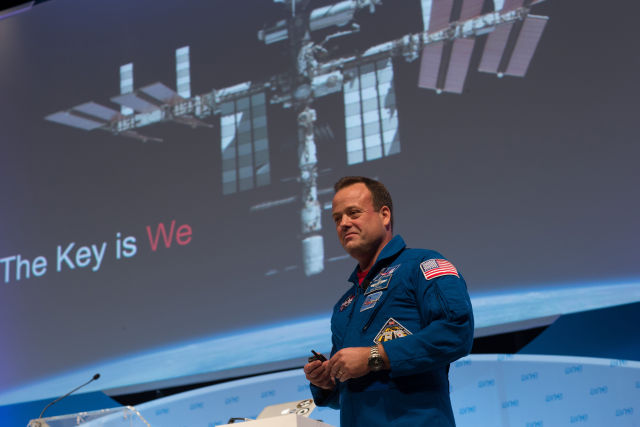
Ron Garan at the One Young World summit. (credit: Fragile Oasis)

One of the most frustrating things about being an astronaut, fliers often say, is being unable to share the incredible experience of seeing our world from above with the rest of us. Astronauts go to space and then come back talking about things like seeing no borders, spaceship Earth, and the need to protect our planet both because of its beauty and fragility.

Perhaps no astronaut has taken this to heart more than Ron Garan, who left NASA in 2014 to work full time on sharing this unique perspective of the planet. Garan believes deeply in the “transformative power” of the big picture and how it compels people to address the challenges facing humanity back on Earth.

But Garan’s websites, book, and documentary film can do only so much to help people see this bigger picture. Each medium has its limitations. Really, there’s no substitute for being there and seeing it with one's own eyes. So on Tuesday, Garan announced he’s joining World View, a company that will use balloons to loft passengers above 100,000 feet, as the company’s chief pilot.

Read 4 remaining paragraphs | Comments
How gravitational wave detectors survived the Contract With America

Could a basic research project get funded now? Probably not, science advisor says.

Newt Gingrich, Al Gore, and Bill Clinton sing the National Anthem at the 1997 Presidential Inaugural Swearing-in Ceremony. Under their watch the gravitational wave detectors got built. (credit: US National Archives)

It seemed an inauspicious time to seek funding for a large physics experiment. During the midterm elections in 1994, with Newt Gingrich and his Contract with America at the vanguard, Republicans stormed to power in Congress after successfully painting President Bill Clinton as a “tax-and-spend” liberal. Gingrich and his new majority promised to balance the country’s budget.

Meanwhile, at the offices of the National Science Foundation, the foundation’s director wanted to press ahead with the construction of gravitational wave detectors that would cost hundreds of millions of dollars. There was no guarantee that these instruments would find gravitational waves. In fact, many scientists predicted they wouldn't work. And even if they were successful, the discovery of gravitational waves would not advance the interests of the United States in any material way.

The foundation’s director at the time was particle physicist Neal Lane, who would go on to become President Clinton’s science advisor. When I asked him about the Gingrich revolution and the Laser Interferometer Gravitational-Wave Observatory (LIGO) detectors, he chuckled. “When Gingrich came to town with the Republicans, that could have definitely been a major hiccup,” Lane said.

Read 17 remaining paragraphs | Comments

China pressing ahead with orbiter and lander mission to Mars

Country’s ambitious space program still targeting a 2020 launch window.

China's space agency displayed a mock-up of the proposed rover at the 2014 Zhuhai Air Show. (credit: defence.pk/cirr)

China appears to be moving forward with its Mars ambitions, as a key space official has confirmed that work is continuing toward launching an orbiter and lander by 2020 or 2022.

“We are aiming to use the launch window of 2020," Dr. Wu Ji, director-general of the National Space Science Center in Beijing, told the website gbtimes. “If we miss that window, it will be 2022. So it is quite urgent.”

There has been discussion about the mission for several years, but the new report provides some additional detail about science payloads for both the orbiter and lander, including a ground penetrating radar. China also appears to be interested in further investigating the possible presence of methane and its implications for extant life on Mars.

Read 3 remaining paragraphs | Comments

Virgin Galactic moves on from crash, debuts flashy new spaceship

The VSS Unity will open up space to anyone willing to pay $250,000.

Behold: VSS Unity, the spacecraft Virgin Galactic says will open up space to the rest of us. (credit: Virgin Galactic)

It’s been 16 months since SpaceShipTwo crashed into the Mojave Desert and killed the vehicle’s co-pilot Michael Alsbury. On Friday, Virgin Galactic sought to move on from that accident and put the company firmly back on a path toward delivering tourists to the edge of space by unveiling a new version of its spacecraft named VSS Unity.

“I’m really proud of the entire team,” said George Whitesides, chief executive of Virgin Galactic, in an interview with Ars. “It’s a bunch of folks who came to this company to open space up, and they’re not going to be deterred by the accident. They’ve been working really hard for a year and a half to finish this vehicle.”

The new spacecraft is in many ways the same as the original SpaceShipTwo, dubbed Enterprise, Whitesides said. It has the same basic airframe and propulsion systems. The biggest change is to the feather locking system, used to aid in the descent of the spacecraft. During the fatal flight on Oct. 31, 2014, Alsbury prematurely deployed the system while still making a powered ascent. Unity now includes a mechanical pin to prevent the feather lever from moving when the vehicle is flying in an unsafe flight regime.

Read 7 remaining paragraphs | Comments

NASA just smashed its record for astronaut applications—18,000+

Despite uncertainty about destinations, NASA will now trim field down to 8-14 candidates.

For many Americans, the lure of space is irresistible. (credit: NASA)

Back in 1978, excitement about the future of NASA, with the space shuttle soon to debut, was palpable. So when the space agency called for astronaut applications, a record 8,000 people responded. That number has stood as a record for applications until today, when the space agency announced that a whopping 18,300 people applied to join its 2017 astronaut class.

The agency's administrator, Charles Bolden, said the total number of applications reflects public approbation for NASA's Journey to Mars. “It’s not at all surprising to me that so many Americans from diverse backgrounds want to personally contribute to blazing the trail on our Journey to Mars,” the four-time astronaut said. “A few exceptionally talented men and women will become the astronauts chosen in this group who will once again launch to space from US soil on American-made spacecraft.”

NASA’s astronaut applications have surged even as its flight opportunities have fallen by about 90 percent. Back in the early 2000s during the peak of the space shuttle program, NASA had more than 150 active astronauts. That’s because the shuttle, with six to seven launches a year, afforded 40 to 50 annual flights into space. The number of active astronauts is now about one-third of that peak due to the shuttle's retirement in 2011.

Read 5 remaining paragraphs | Comments

Far distant Charon may have once had a large subsurface ocean

Grand Canyon-sized features on Pluto’s moon may be explained by freezing water.

Charon's Serenity Chasma is highlighted, along with color-coded highlights to illustrate its extreme topography. (credit: NASA/JHUAPL/SwRI)

Pluto's moon Charon looks dark, foreboding, and dry in pictures taken by the New Horizons spacecraft last summer. A brownish feature near its pole appeared so ominous that scientists actually named it "Mordor." But after further analysis of Charon's fractured surface, scientists now think they've discovered evidence of an ancient, subsurface ocean.

Today, the gray outer layer of Charon is composed primarily of water ice. More than 4 billion years ago, however, even though Charon and Pluto were far from the Sun, decaying radioactive elements and other sources of internal heat would have kept them relatively warm. In fact, there probably would have been enough heat to melt water near Charon's core.

As Charon cooled over billions of years, this chthonic ocean would also have cooled, and then finally frozen, causing its volume to expand. Scientists looking at data collected by New Horizons believe this may explain a set of features they see on the surface of Charon today: a series of ridges, scarps, and valleys that sometimes plunge more than six kilometers deep.

Read 1 remaining paragraphs | Comments

A tale of two telescopes: Contrasting approaches in Hawaii and China

As scientists, let’s consider human rights as we work to expand human knowledge.

A rendering of the Five-hundred-meter Aperture Spherical Telescope, or FAST, which is now nearly complete. (credit: Chinese Academy of Sciences)

Sometimes, when we build huge telescopes to see deep into the Universe, we end up learning more about ourselves back here on Earth. That appears to be the case during the last week as two bits of telescope news came out of Hawaii and China.

First came news from the Thirty Meter Telescope project, a collaboration of international institutions led by the California Institute of Technology. The team would begin considering alternate sites for the large optical instrument it originally planned to build on Mauna Kea. The announcement followed months of delays due to protests by native Hawaiians. The protesters believe the 55-meter-tall facility would desecrate sacred ground.

Then came reports out of China that, as the country finishes building the world's largest radio telescope, it plans to move 2,029 families—a total of 9,110 people—who live near the telescope in the south-central Chinese province of Guizhou. According to Chinese officials, relocating the nearby residents will create “a sound electromagnetic wave environment” for the telescope. (Perhaps they might have considered this before choosing the site?) Residents will receive about $1,800 for housing compensation.

Read 7 remaining paragraphs | Comments

Inside the wild—and wildly successful—early years of Mission Control

A new book tells of early flight directors, from biergartens to horses on campus.

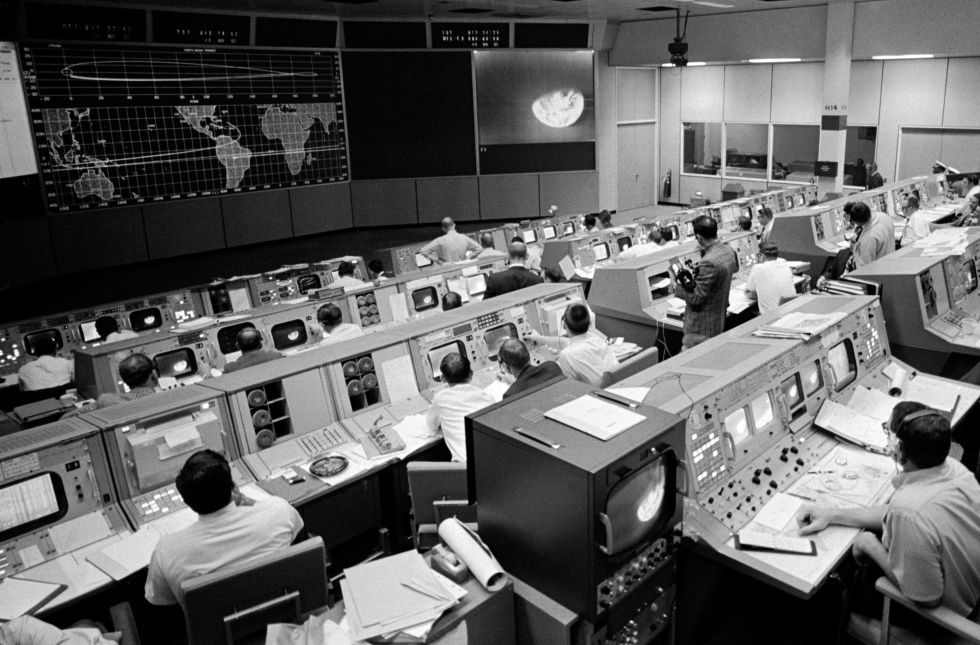
Mission Control, on the third day of Apollo 8. Seen on the TV monitor is a picture of Earth telecast from the spacecraft 176,000 miles away. (credit: NASA)

Aside from a few famous names like Chris Kraft and Gene Kranz, the people who worked in NASA’s Mission Control during the space program’s glory days remain largely anonymous. But that doesn’t make their personal stories any less compelling than those of the astronauts inside the spacecraft they so closely watched over.

These flight controllers worked inside the “Cathedral,” the third floor of Building 30 in the center of the Johnson Space Center’s sprawling campus. They were always watching, running the missions and ready to make split-second decisions. Now a new book, Go, Flight!, brings these flight controllers to life by providing an illuminating look at NASA in the days during the Gemini and Apollo programs, when the agency was more freewheeling and less buttoned down.

Above all, the dedication of these “steely eyed missile men” to their tasks stands out. Inside the doors of Mission Control it was all business. Was there really never any BSing? “Never,” the book’s coauthor and long-time Flight Director Milt Heflin told Ars. But outside Mission Control? They worked hard. They partied hard. And here are some of their stories.

Read 20 remaining paragraphs | Comments