Mad Mike postpones Texas canyon jump after “brutal” rocket tests

The would-be King of the Daredevils wants to ensure the “bad boy” doesn’t misfire.

Climb into the X2-SkyLimo for the ride of your life.

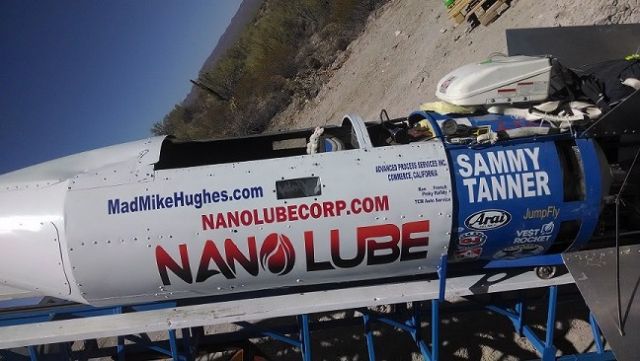
Initially, "Mad" Mike Hughes had planned to jump across the Palo Duro Canyon in the Texas Panhandle this coming Saturday afternoon, April 2nd. However, when Ars spoke with Mad Mike on Monday, he indicated that he was having some last-minute issues with his steam-powered rocket and was racing to get everything ready for Saturday's big leap.

Unfortunately, he's not going to be ready. Mad Mike's final tests on Monday and Tuesday, before he was due to leave his Apple Valley, California-based home, did not go well. “Absolutely brutal. Just brutal," he told the Amarillo Globe-News. "This isn’t a scam. I’m beyond frustrated. Things just compounded."

Mad Mike aspires to become "King of the Daredevils," and Saturday's jump over the yawning Palo Duro Canyon was an important step in the master plan. His X2-SkyLimo rocket is capable of producing 4,000 pounds of thrust at launch, and he intended to rise about 3,500 feet into the air and reach 350mph before descending back to Earth under a parachute. "It’s a bad boy," he said of the rocket in an interview with Ars. "You’re unleashing the devil with this thing. That’s the only way to describe it."

Read 1 remaining paragraphs | Comments

Major Tim to ground control: Moon a logical stepping stone to Mars

As a non-NASA astronaut, Peake can express a preference for going back to the Moon.

Tim Peake prepares for his Dec. 15th launch to the International Space Station. (credit: NASA)

Almost from the moment they are accepted as candidates, NASA's astronauts receive extensive media training. Don't speak out of school in public. Promote the program. Stay on message. And invariably, when talking with reporters, NASA astronauts will talk about all the wonderful things the space agency is doing. It's no surprise: many of them are from the military, so they're good at following orders. But more important than this, they want to fly. And flights don't go to off-message astronauts.

That is not to say NASA's astronauts don't have a variety of opinions about what the space agency is actually doing. And when you talk to many of them, they are deeply skeptical about NASA's Journey to Mars. They prefer a return to the Moon first, where the space agency can test out deep-space habitation systems before sending humans far deeper into the solar system.

Just as importantly, a lot of veteran astronauts do not have confidence in successive presidential administrations, Congress, and NASA's own leadership to work together to craft a cohesive, visionary exploration plan. In other words, there's a greater likelihood of sticking to a 10-year plan to put astronauts on the Moon rather than a 20-plus year plan to put humans on Mars.

Read 7 remaining paragraphs | Comments

NASA launch system software upgrade now 77% over budget

As with its big rocket, NASA chose an expensive, kluge-it-together software plan.

It takes sophisticated software to measure a rocket's health during a launch countdown. (credit: NASA)

During a launch countdown, rockets must be continually checked to ensure that control pumps, motors, fuel levels, and myriad other systems and subsystems are operating normally. It takes sophisticated software to oversee this, and it is this software that will often autonomously make the call to terminate a launch right up until T-minus zero.

As it builds the Space Launch System rocket, NASA is updating this Spaceport Command and Control System software for the Kennedy Space Center. However, a new report by the space agency's inspector general, Paul Martin, finds this decade-long software development effort has fallen behind schedule and is on track to exceed its initial budget of $117.3 million by 77 percent, with cost estimates now increased to $207.4 million. Moreover, the inspector general criticized NASA for not adopting cheaper, commercially available launch software already used by Orbital ATK and SpaceX to launch their rockets.

To develop its new launch software, NASA has essentially kluged together a bunch of different software packages, Martin noted in his report. "The root of these issues largely results from NASA’s implementation of its June 2006 decision to integrate multiple products or, in some cases, parts of products rather than developing software in-house or buying an off-the-shelf product," the report states. "Writing computer code to 'glue' together disparate products has turned out to be more complex and expensive than anticipated. As of January 2016, Agency personnel had developed 2.5 million lines of 'glue-ware,' with almost two more years of development activity planned."

Read 2 remaining paragraphs | Comments

“Mad” Mike built a rocket so he can jump the Grand Canyon of Texas

One homemade rocket. 350mph. 4,000 pounds of thrust. And a ton of guts.

Screen capture from a video in which "Mad" Mike Hughes tests his steam engine. (credit: Mike Hughes)

He styles himself "Mad" Mike Hughes. But Mad Mike Hughes is not content with just one nickname, so he aspires to a second one—"King of the Daredevils." Given what Mad Mike plans to do this coming Saturday, it is hard to begrudge him either moniker. Mad Mike has built a rocket, the X-2 "SkyLimo," and on April 2 he plans to set this rocket up on one side of the Palo Duro Canyon, light that sucker up, fly 3,500 feet into the air, and reach a maximum speed of 350mph.

Palo Duro Canyon cuts across the Texas Panhandle. At 70 miles long and with a depth of nearly 900 feet, it is no mere ditch. The artist Georgia O'Keeffe lived nearby almost a century ago in the towns of Amarillo and Canyon, and she loved to visit the great red crack in the flat plains by car or wagon. O’Keeffe referred to the sight as a “slit in nothingness.”

(credit: Mike Hughes)

Rather than become nothingness himself, Mad Mike hopes to survive this adventure in his homemade rocket. "I’m not a crazy guy," he told Ars. "I have a high IQ. I know the dangers. But this is a whole new world. I’m in uncharted territory with this thing."

Read 9 remaining paragraphs | Comments

Lost Japanese X-ray satellite was to probe “exotic” areas of the universe

Japanese space agency has lost contact with Hitomi and debris is reported.

An artist's impression of the Hitomi satellite in orbit. Note: That scary, all devouring X-ray source isn't actually that close to Earth. (credit: JAXA)

The Japanese space agency, JAXA, lost communication with its new Hitomi X-ray astronomy satellite on Saturday, spending Sunday trying unsuccessfully to reestablish control over the spacecraft. The prognosis appears to be fairly grim after the US Strategic Command’s Joint Space Operations Center revealed Sunday that it is tracking five pieces of debris associated with the satellite.

It is not clear whether Hitomi struck a piece of space debris in its orbit about 580km above Earth or what else might have precipitated the loss of communication. Either way, scientists lamented the apparent failure of an instrument that would have allowed them to probe much deeper into the relatively unstudied field of X-ray astronomy.

High-energy but very-short-wavelength X-rays are absorbed by the Earth's atmosphere. To observe them, scientists must therefore send instruments into the upper atmosphere or into space itself. Unlike other kinds of observational  astronomy, then, X-ray astronomy is a fairly new field.

Read 2 remaining paragraphs | Comments

Here’s why the next SpaceX launch isn’t just about the booster landing

Bigelow’s inflatable module may one day revolutionize in-space habitation.

The expandable habitat from Bigelow Aerospace is lifted into Dragon's trunk for a ride to the space station. (credit: SpaceX)

It's a big idea. It's a bold idea. And at first blush, it seems a bit of a daft idea. A company called Bigelow Aerospace wants to build space stations for the government and hotels for private customers that will inflate like balloons once they reach outer space. Bigelow’s inflatables have the potential to revolutionize spaceflight by providing lighter, and much larger, places to live in space. But the big question remains: Does anyone really want to live in a space balloon?

NASA intends to find out and has signed a $17.8 million contract with Bigelow to do so. As early as April 8 a deflated module will launch inside the trunk of a SpaceX Dragon spacecraft. The space agency has agreed to attach a test module to the International Space Station, inflate it, and over the course of two years determine if such a contraption can work in space. Crew won’t live in it—inflatables remain too experimental to risk life and limb. But if the module holds up, NASA will invest more money into the technology.

The space agency has said it wants to use the space station as a platform for technologies that will enable, and perhaps lower the cost, of deep space exploration. With the Bigelow module NASA appears to be doing exactly that. “It’s a big step for us, because inflatables can be a big multiplier for us as we move further out into space,” explained Mark Geyer, deputy director of Johnson Space Center, during a recent meeting of NASA’s advisory council.

Read 11 remaining paragraphs | Comments

Elect Hillary Clinton and we’ll all find out what’s hiding in Area 51

Bill Clinton didn’t see anything in those files, but his wife will look again.

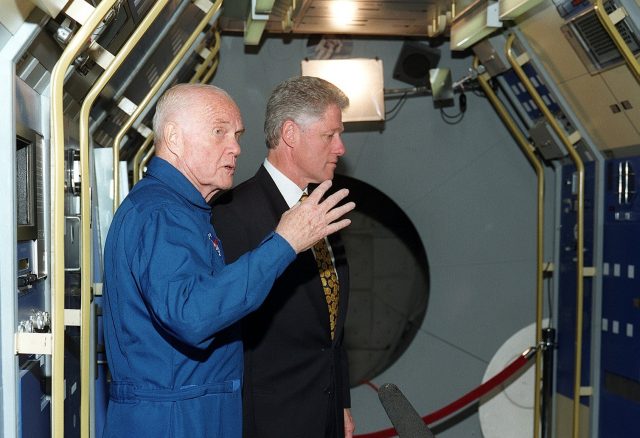
John Glenn explains to then President Clinton where NASA keeps the aliens in 1998. (credit: NASA)

Some polls have suggested that as many as 50 percent of Americans believe UFOs of extraterrestrial origin have visited Earth, and the percentage appears to be higher among Democratic voters. So perhaps Hillary Clinton was playing to her voters Thursday night when she appeared on Jimmy Kimmel's late night talk show on ABC.

In comments first reported by the Daily Caller, Kimmel mentioned the first thing he would do as president would be to rifle through the Area 51 files with the aim of finding out what the government knows about aliens. He also mentioned he'd asked Bill Clinton about that, and the 42nd president said he had looked and didn't find anything.

"Well, I'm going to do it again," Hillary Clinton said. "I would like us to go into those files and hopefully make as much of that public as possible. If there's nothing there then let's let people know there's nothing there." What if there is something there? "If there is something there, unless it's a threat to national security, I think we ought to share it with the public."

Read 1 remaining paragraphs | Comments
Saturn’s inner moons may have formed only recently, from a giant ring

If a new hypothesis is correct, prospects for life on Enceladus have dimmed.

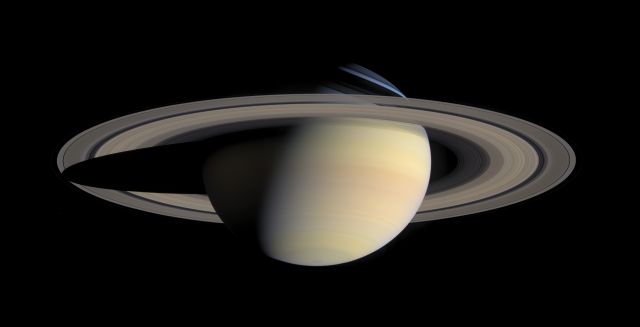
Saturn's moons push and pull on its fluid, making it bulge around the middle. (credit: NASA)

It's common to think of the Solar System as a fairly static place. Yes, everything is moving around all the time, but the same basic system of planets and most of their moons seems to have more or less existed as-is since the relatively early days of the Solar System. Earth’s Moon, for example, is thought to have formed less than 100 million years after the Solar System coalesced, coming into existence when Earth collided with a Mars-sized body. And so it has gone for the last 4.5 billion years.

In contrast, a series of observations suggests some of Saturn’s moons may be mere 100 million years old. That is the theory put forth in a new paper published Thursday in the Astrophysical Journal, authored by scientists from the SETI Institute and the Southwest Research Institute. The researchers believe, based upon observations made by the Cassini spacecraft, that the interior moons could only have existed in their relatively pristine orbits for a short time. “I think we are at a point where we can confidently say that the inner moons are not as old as the planet,” Matija Ćuk, lead author of the new research paper, said in an interview.

Saturn has a complicated system of at least 62 moons in addition to its famous rings, making it the busiest planetary system in the Solar System. Titan, the largest and best-known of Saturn’s moons, is covered in exotic hydrocarbon seas. But equally interesting to scientists is one of its inner moons, the much smaller Enceladus. Cassini found the moon to have geysers at its southern pole, blasting water from its interior into outer space. Since then, scientists have wondered whether life may exist in the warm, interior oceans of Enceladus. Ćuk and his colleagues, Luke Dones and David Nesvorný, have an answer that astrobiologists may not like.

Read 13 remaining paragraphs | Comments
London to NYC in just 3.4 hours? A roundtrip will set you back $5,000

Virgin Galactic to go where the Concorde failed, into commercial supersonic flight.

An artist's conception of the Boom aircraft at London's Heathrow Airport. (credit: Boom)

After more than a decade of dormancy commercial supersonic flight may soon return to the skies. The Soviet Tupolev supersonic aircraft flew just a few dozen flights back in 1977, and the Concorde, flown by British Airways and Air France, retired in 2003 after a fatal accident three years earlier that compounded economic problems.

But now Richard Branson and his Virgin empire are ready to try it again. According to The Guardian, Branson has signed a deal with an American firm to bring commercial supersonic travel to the airways, beginning with trans-Atlantic flights between London and New York City.

The agreement brings Branson's Virgin Galactic into a partnership with Colorado-based Boom, founded by Amazon executive Blake Scholl. Virgin Galactic, according to a company spokeswoman, will provide engineering, design, operations, and manufacturing services, along with flight tests at Virgin's base in Mojave, Calif. It will then have an option to buy the first 10 airframes from Boom.

Read 8 remaining paragraphs | Comments

Scientists teasing out primordial secrets on Ceres, once an ocean world

World is now dead, but salt spots hint at a dramatic freezing long ago.

An "approximately" true color image of Ceres taken by the Dawn spacecraft as it approached the dwarf planet in May, 2015. (credit: NASA)

THE WOODLANDS, Texas—Ceres is a cold, dead world today. But it wasn't always so, and as researchers delve deeper into images and data collected by the Dawn spacecraft, they continue to find intriguing hints about a world that likely had a large, subsurface ocean during the early days of the solar system. They also have found a number of features on the surface of Ceres they cannot yet explain, deepening the mystery of the dwarf planet’s evolution.

The largest object in the asteroid belt, measuring some 950km across, Ceres is roughly the size of Texas. So perhaps it's fitting that scientists gave their most detailed briefing yet about the planet in a darkened conference room in The Woodlands, just north of Houston, at the Lunar and Planetary Science Conference on Tuesday. Here the mysterious bright spots of Occator crater and other parts of the small world shone brightly.

These parts also intrigued. As the Dawn spacecraft approached Ceres in 2015, it revealed a large bright spot in Occator crater, but as the spacecraft has flown down to within 400km of the world’s surface and produced a global map at a resolution of 35 meters per pixel, scientists have found many bright spots in the crater likely due to salt deposits. Still, the brightest one at the center remains most interesting.

Read 12 remaining paragraphs | Comments