On Thursday NASA added air to an inflatable module, and it didn’t inflate

NASA and Bigelow engineers will assess what went wrong and may try again Friday.

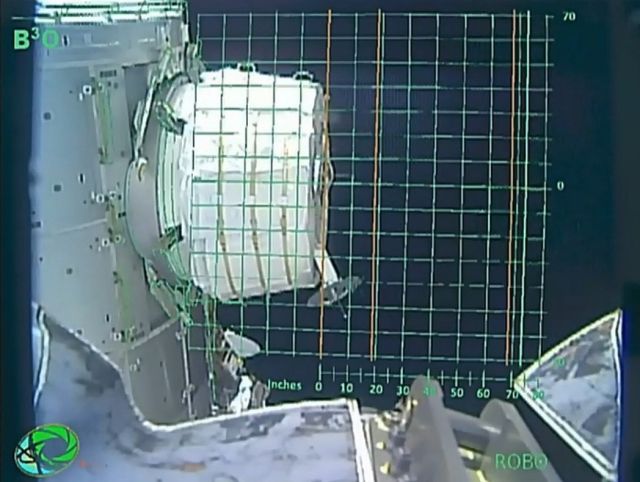
When air was added to the Bigelow module on Thursday morning, it didn't inflate properly. (credit: NASA TV)

After working for several hours unsuccessfully Thursday morning to inflate an expandable module attached to the International Space Station, NASA astronaut Jeff Williams and a team of engineers in Houston decided to delay operations for a day. Williams summed up the efforts by saying, "That's the space business."

The initial steps of the process to expand Bigelow Aeropace's habitat from a length of 5.7 feet to 13 feet went well. But when Williams opened a valve to add air into the module, pressure inside it began to increase at a greater rate than expected, and the habitat expanded only very slowly. When Williams stopped and then repeated the valve-opening process four more times, the same anomalous pressure rises occurred. After engineers on the ground conferred, they decided to delay the expansion efforts until Friday morning at the earliest.

Teams from NASA, which has paid Bigelow $17.8 million to test the concept, and Bigelow are expected to meet today to study data from the expansion attempts, determine what went wrong, and then make a decision on whether to proceed Friday.

Read 2 remaining paragraphs | Comments
Europe’s staggeringly large telescope project takes a step forward

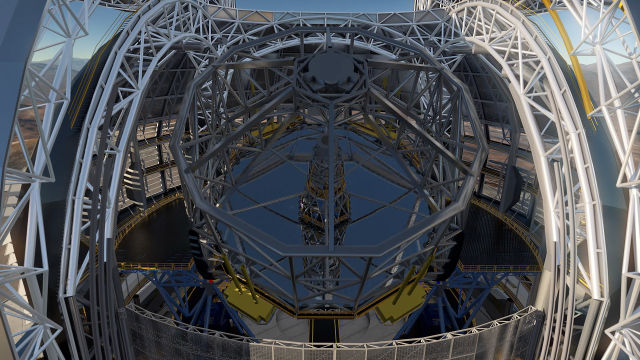
The European Extremely Large Telescope will need an 80-meter-tall dome to house it.

The European Extremely Large Telescope is, indeed, extremely large at 39 meters across. (credit: ESO)

An astronomy organization consisting of 15 European countries, as well as Chile and Brazil, has signed a €400 million ($450 million) contract to move forward with the construction of a large dome and structure to support a massive optical telescope that will have a 39-meter wide main mirror.

The European Southern Observatory said the contract keeps it on track to begin observing the night sky with its European Extremely Large Telescope (EELT) as early as 2024. The telescope will operate from a 3,000-meter mountaintop site in northern Chile. The agency said that this is the most expensive contract ever awarded by ESO and the largest contract ever in ground-based astronomy. However, it represents only a fraction of the telescope's overall multi-billion dollar cost.

The largest optical telescopes in the world today are only about 10 meters in diameter. The European instrument is part of a new generation of much larger telescopes being built to extend the ability of astronomers to peer back further into the history of the universe, when the first stars and galaxies formed. The newly possible observations may also elucidate the nature of dark matter and dark energy and could potentially sniff out the signatures of life in the atmospheres of exoplanets. As such, there is a tremendous race to reach first light and begin using these large instruments. Nobel Prizes await.

Read 2 remaining paragraphs | Comments
Four wild technologies lawmakers want NASA to pursue

House budget provides funding for Mars helicopters, super fast propulsion, and more.

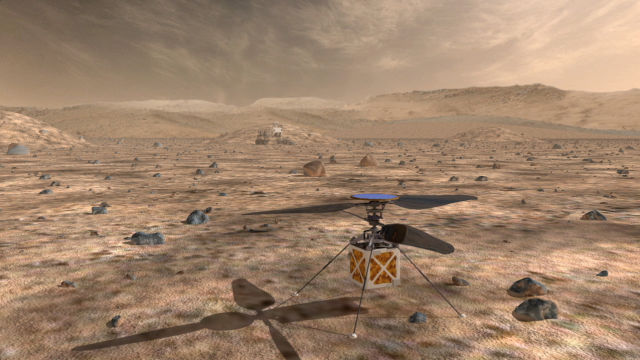
A proposed helicopter could triple the distances that Mars rovers can drive in a Martian day. (credit: NASA)

Imagine a tissue-box sized device, with blades a few feet long, whirring to life after charging for a full Sol on Mars. It then flies ahead of a rover to search for hazards and targets of interest. Deeper in the solar system, on Europa, a large spacecraft lands near a fissure and drops small probes into the ocean far below. Beyond the Moon, a telescope with a specially fitted shade images an Earth-like exoplanet for the first time, possibly finding chemical markers of life. Finally, in a few decades, powered by hitherto undreamed-of propulsion, a spacecraft takes off for Alpha Centauri at a significant fraction of the speed of light.

It all sounds like science fiction, but a new budget for NASA proposed by the US House of Representatives includes seed money for all of these initiatives, some of which are receiving funding for the first time. The budget must still be reconciled with that of the Senate, but the House and Senate committees have worked well in the past to finalize NASA’s funding. Most of these concepts should therefore survive.

Ars caught up with the author of this budget Monday evening, John Culberson, a Texas Republican who represents one of the most conservative districts in the conservative state of Texas. He’s a proud member of the Tea Party and would like nothing more than to tear up Obamacare. But Culberson is also a science geek through and through, and while he’d like to cut the federal budget, he’d just as soon plough those savings into NASA to fuel new innovations.

Read 14 remaining paragraphs | Comments
The US House tells NASA to start planning lunar missions

In latest funding bill lawmakers call for a “common sense” spaceflight strategy.

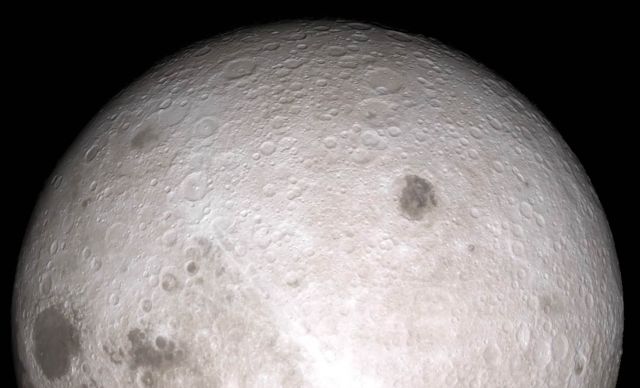
The best-ever image of the far side of the Moon. (credit: NASA)

On Tuesday, budget writers in the US House will make changes to a bill that funds federal commerce, justice, and science agencies—which includes NASA—for the coming fiscal year. But a draft of the full bill released Monday contains a blockbuster for the space agency: the House calls for a pivot away from NASA’s direct-to-Mars vision toward a pathway that includes lunar landings first.

Since a space policy speech in 2010 by President Obama, the space agency has been following a loosely defined plan to first send astronauts to visit a fragment of an asteroid near the Moon and then conduct other operations in the vicinity of the Moon before striking off for Mars some time in the 2030s. However a number of independent reports, such as the National Research Council’s Pathways to Exploration, have questioned the viability and sustainability of a direct-to-Mars plan. That panel called for NASA and the White House to reconsider the Moon as an interim destination.

In the new House budget, which provides funding for fiscal year 2017, the committee recognizes there are some useful components of the asteroid mission. These include propulsion research and asteroid deflection, but committee members found that “neither a robotic nor a crewed mission to an asteroid appreciably contribute to the overarching mission to Mars.” The costs of such a mission are also unknown, the committee wrote.

Read 11 remaining paragraphs | Comments
India’s shuttle-like reusable spaceplane makes its first test flight

Innovative launcher will also eventually feature scramjet technology.

The RLV-TD winged body spacecraft takes off Monday morning. (credit: ISRO)

For the last several years, India has been making steady progress with its space program, including the successful insertion of a spacecraft into Mars orbit in 2014, something previously only the United States, Soviet Union, and the European Space Agency had accomplished. Now the second-most populous country in the world has taken its first significant step toward developing a reusable launch vehicle.

On Monday,  the country's space program launched a winged body aerospace vehicle on its maiden test flight from the Satish Dhawan Space Center on the east coast of India. The Indian Space Research Organization, or ISRO, declared the test flight a success.

At 7am local time, the HS9 solid rocket booster fired for 91.1 seconds, lifting the RLV-TD winged body spacecraft to above 50km. After separating from the booster, the spacecraft crested to an altitude of 65km, nearly two-thirds of the way to outer space, before beginning its descent. During reentry the vehicle reached speeds of Mach 5 as it glided down to a pre-defined location in Bay of Bengal, about 450km from the launch site. Indian officials said the vehicle's first test flight successfully demonstrated technologies such as autonomous navigation, guidance and control, as well as a reusable thermal protection system.

Read 1 remaining paragraphs | Comments

NASA misses a chance to promote the best-ever ad for the space station

Movie highlights the human side of spaceflight inside the station.

The movie A Beautiful Planet lives up to its name. Earth is a planet, it is beautiful, and arguably it has never looked this good before. To capture imagery for this IMAX movie, NASA delivered 4K cameras to the space station in 2014, marking the first time 4K resolution cameras have been used to make a commercial film in orbit. Nevertheless, if you’re remotely interested in space, you’ve probably seen images and videos like these before.

That’s because astronauts have been taking amazing photos of planet Earth, with increasingly sophisticated cameras, during the 15 years the International Space Station has given them a semi-permanent platform to do so. Two years ago, NASA even activated several commercial HD video cameras on the exterior of the station to provide around-the-clock views of the planet in high definition. Earth—our pale blue dot, the cradle of humanity, an oasis of life in a cold, dark universe—has become an easy story to tell.

What has proven far more difficult for NASA and journalists to capture is the immensity and scope of the International Space Station. Even though it flies only a few hundred miles above Earth, the station still advances human spaceflight. Yet the station remains an abstract concept when compared to something as concrete as a rocket launch or a space shuttle. Is the station a tin can? Is it cramped? Just what is it like to live aboard?

Read 6 remaining paragraphs | Comments

House tells NASA to stop messing around, start planning two Europa missions

Provide a realistic funding profile next time, Congress tells the White House.

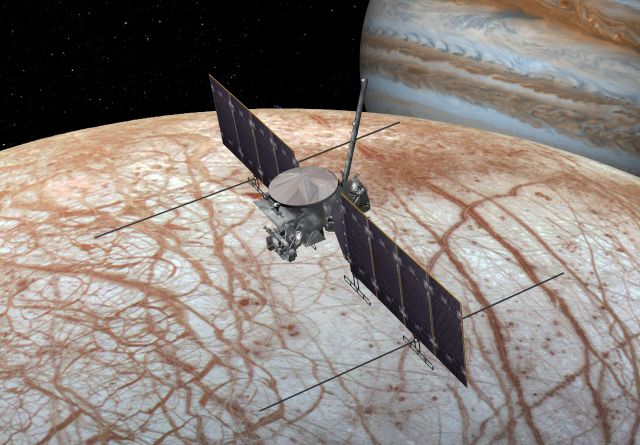
Concept art for NASA's flyby mission to Europa. (credit: NASA)

Planetary scientists have identified Jupiter's icy moon of Europa as one of their top targets for exploration, believing that its warm interior oceans may well harbor life. A new study published just this week, authored by scientists at NASA's Jet Propulsion Laboratory, found that conditions in the oceans on Europa may indeed be Earth-like and capable of harboring life.

Despite the wishes of the planetary science community to further investigate Europa, NASA has been wary of mounting such a mission because of the high cost—well above $1 billion. Additionally, planetary science hasn't been a priority in President Obama's NASA budgets, and the space agency has preferred to focus most of its robotic solar system exploration on Mars. The red planet is easier to reach, and NASA says it wants to explore Mars further to enable future human missions.

Congress has been more interested in planetary science, however. And in particular, the chairman of the House Appropriations subcommittee with jurisdiction over NASA's budget, John Culberson (R-Texas), has fancied Europa. Even when NASA wasn't asking for Europa funds, the congressman was funneling money to the scientists at the California-based Jet Propulsion Laboratory. Between the 2013 and 2016 fiscal years, NASA requested just $45 million in Europa funding, but Congress appropriated $395 million. For fiscal year 2017, NASA requested $49.6 million in Europa funding, but a House appropriations bill released this week by Culberson's committee proposes $260 million for mission planning and development.

Read 5 remaining paragraphs | Comments

Buzz Aldrin says NASA is going about Mars exploration the wrong way

The second man on the Moon joins another Apollo legend in calling for change.

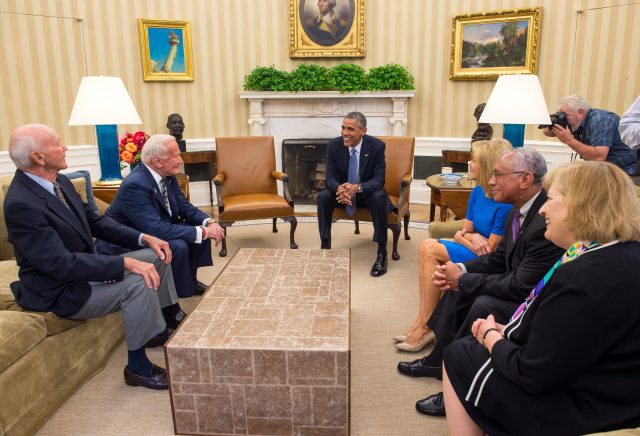
Buzz Aldrin, left of President Obama, visited the Oval Office in 2014. (credit: NASA)

Of all the Apollo astronauts that walked on the Moon, none has made more of his fame than Buzz Aldrin, who followed Neil Armstrong onto the lunar surface in 1969. But long before he danced with the stars and inspired Buzz Lightyear, and even before he served as the Apollo 11 lunar module pilot, Aldrin was known as an expert in orbital rendezvous.

In recent years, Aldrin has used his astronautics expertise and fame to push a cycler concept that he believes would be the best way to visit and eventually inhabit Mars. In his public lectures, however, Aldrin has largely avoided criticizing the present approach being taken by NASA with the development of the Space Launch System (SLS) rocket and Orion spacecraft and its two-decade "Journey to Mars."

That changed at this week's Humans to Mars conference. In his remarks, Aldrin said NASA should change the approach it has had in place since the 1960s, that of designing and managing development of its own rockets. He took direct aim at the SLS vehicle, which he reminded listeners was based on 1970s technology and the space shuttle rather than more modern concepts. "It competes with the private sector," Aldrin said. "I thought most of us were in the process of learning that the government shouldn't do that."

Read 9 remaining paragraphs | Comments

Here’s why many in aerospace remain skeptical of the Journey to Mars

Asked about the “plan” for Mars, a senior NASA official can’t give a direct answer.

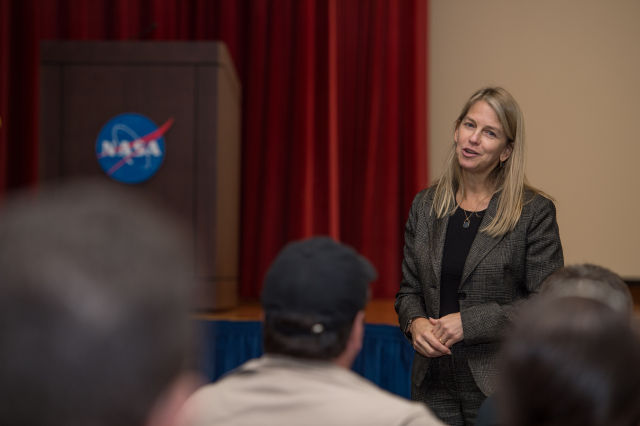
NASA Deputy Administrator Dava Newman speaks to NASA Social attendees at Kennedy Space Center in December. (credit: NASA)

On Tuesday, hundreds of Mars enthusiasts are gathering in Washington, DC to celebrate the red planet at the annual Humans to Mars conference. Buzz Aldrin will discuss his “cycler” plan for going to Mars. Andy Weir, author of The Martian, will be on hand to sign books and talk about his vision for Mars exploration. And representing NASA by giving the plenary speech, NASA Deputy Administrator Dava Newman will update the gathering about the Journey to Mars.

Since the conference is more or less a conclave of Mars devotees, there will probably be few hard questions asked about the feasibility of NASA's plans. But those hard questions are coming, and it’s not clear that NASA has the answers. Although space has not been an issue in the presidential election, whether a Republican or Democrat is elected this fall, a transition team will review the panoply of government spending, including NASA’s human exploration programs. Among those questions that will be asked are these: What is the plan for NASA to get to Mars? And can the space agency make it there within a reasonable budget?

In late April, Newman was asked these very questions at a meeting of the Federal Aviation Administration’s Commercial Space Transportation Advisory Committee. The FAA regulates commercial space launches, and Newman had given the standard speech about NASA’s activities. During a Q&A period, Newman took a question from Jeff Greason, a rocket scientist who founded XCOR and is now a consultant with Agile Aero, about the viability of the Mars plan.

Read 11 remaining paragraphs | Comments

SpaceX puts its third booster in a barn—and the result is dazzling

The company now must test these landed boosters to see when they can fly again.

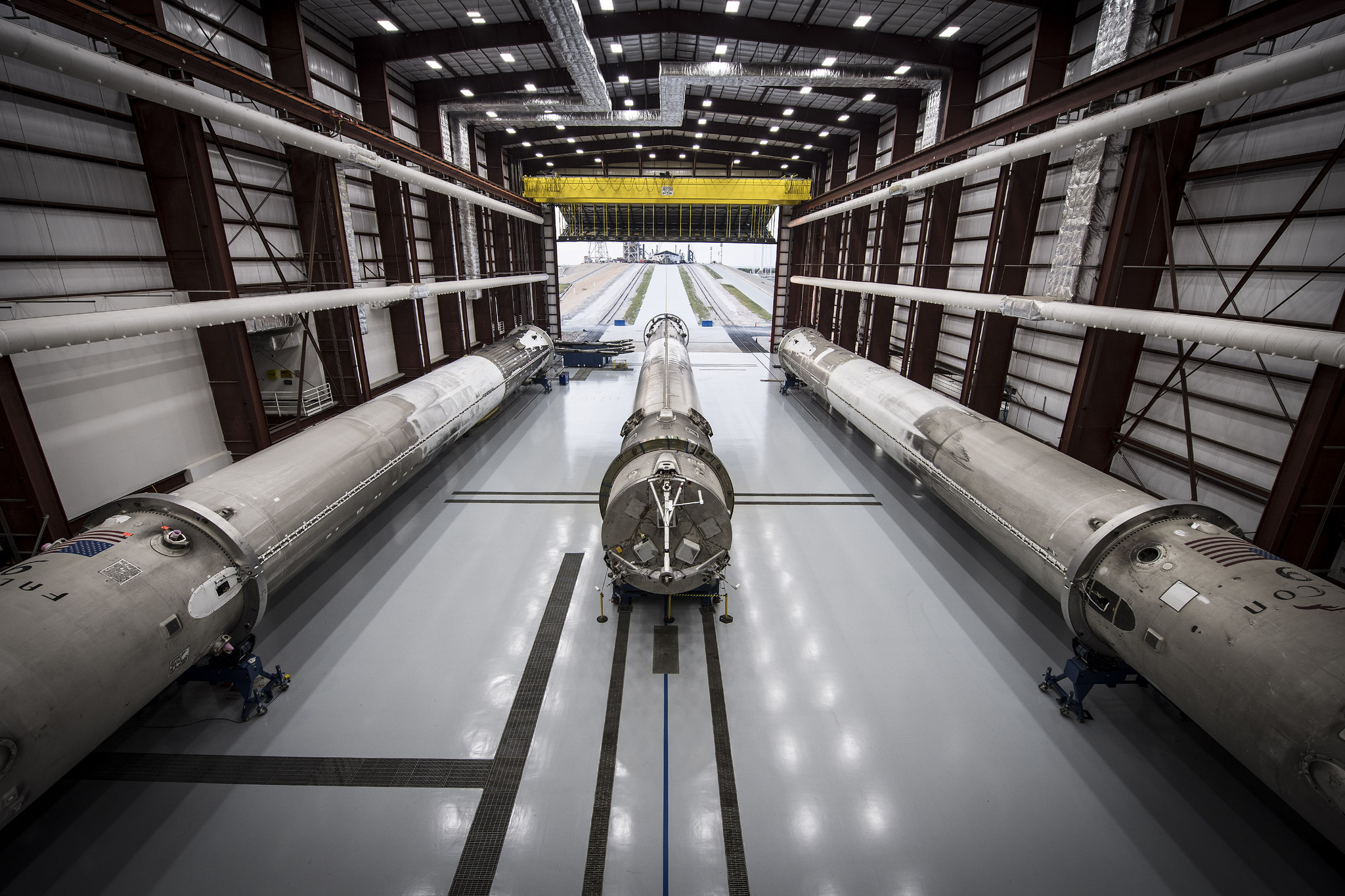
SpaceX has now successfully landed three rockets from space—one by land and two by sea. That has given the company quite a collection of boosters in its Hangar 39A at Cape Canaveral in Florida.

This weekend, the rocket company released some photos of the three boosters together after the Falcon 9, which delivered a Japanese communications satellite transfer orbit some 35,786km above the Earth earlier this month, was towed back to the Florida coast and brought into the hangar. This success led Musk to muse on Twitter: "May need to increase size of rocket storage hangar."

These three landings have marked an important step toward a key goal of SpaceX and other new space companies—reusability. This would completely remake the economics of spaceflight because launch costs are driven by hardware, not propellants. The cost to fuel a Falcon 9 rocket with liquid oxygen and kerosene propellant is about $200,000, Musk said. The company’s commercial launch price is $61 million.

Read 2 remaining paragraphs | Comments