Anti-piracy firm Rightscorp’s Q1 financials read like an obituary

Firm that bills online pirates $20 a pilfered song needs $1 million to stay afloat.

(credit: Nicolas Raymond)

Rightscorp heralded itself as a content savior when it was founded in 2011 with a novel business model—enforcing copyrights by capturing online pirates and demanding about a $20 fee per pilfered work.

But a few things happened along the way to a year-over-year 78-percent plummet in first-quarter revenues and a loss of $784,180. Among other things, pirates are seemingly masking their IP addresses more and more, and ISPs aren't forwarding Rightscorp's money-demand letters to pirates, the company announced Monday. Still, the California-based anti-piracy company has never made a profit. Last year, it lost $3.5 million and, judging by its first-quarter earnings report released Monday, it's on course to go defunct.

For the moment, the company is teetering on the brink of financial collapse. It raised $500,000 on February 22, the company reported, but it needs another $1 million to stay afloat. It has enough cash on hand to continue "into the second quarter of 2016," according to the company's latest financial report.

Read 7 remaining paragraphs | Comments

Indefinite prison for suspect who won’t decrypt hard drives, feds say

“This is not a fishing expedition on the part of the government,” feds say.

(credit: Christiaan Colen)

Federal prosecutors urged a federal appeals court late Monday to keep a child-porn suspect behind bars—where he already has been for seven months—until he unlocks two hard drives that the government claims contains kid smut.

The suspect, a Philadelphia police sergeant relieved of his duties, has refused to unlock two hard drives and has been in jail ever since a judge ordered him to do so seven months ago—and after finding him in contempt of court. The defendant can remain locked up until a judge lifts the contempt order.

The government said Monday he should remain jailed indefinitely until he complies. The authorities also said that it's not a violation of the man's Fifth Amendment right against compelled self incrimination because it's a "foregone conclusion" that illegal porn is on the drives, and that he is only being asked to unlock the drives, not divulge their passcodes.

Read 10 remaining paragraphs | Comments

The Intercept releasing docs leaked by NSA whistleblower Snowden

“Primary objective” of document dump is to allow public to scour them for stories.

(credit: squirrel83)

Several years ago, nobody would have believed you if you said that a secret US court was ordering the nation's telecoms to forward the metadata for all telephone calls coming to and from the United States to the National Security Agency. It would have sounded like fiction from some deranged person wearing a tinfoil hat. But it was true. Edward Snowden, a former contractor for the NSA, turned over internal government documents in 2013 that illustrated just that reality. Future document releases would underscore that the United States had been spying on its populace and the world at large to a breathtaking extent.

Snowden, now living in Russia, handed over the documents to reporter Glenn Greenwald, who published many of the juiciest disclosures at the Guardian. Greenwald left the Guardian and took the documents with him to The Intercept, which announced Monday that it is beginning a public document dump of the goods provided by Snowden. Today, The Intercept is releasing its first batch of many classified documents—166 articles of the NSA's internal newsletter called SIDtoday. The site explained:

The Intercept’s first SIDtoday release comprises 166 articles, including all articles published between March 31, 2003, when SIDtoday began, and June 30, 2003, plus installments of all article series begun during this period through the end of the year. Major topics include the National Security Agency’s role in interrogations, the Iraq War, the war on terror, new leadership in the Signals Intelligence Directorate, and new, popular uses of the internet and of mobile computing devices.

Greenwald encouraged "journalists, researchers, and interested parties" to sift through these and forthcoming document dumps "to find additional material of interest. Others may well find stories, or clues that lead to stories, that we did not. (To contact us about such finds, see the instructions here.) A primary objective of these batch releases is to make that kind of exploration possible."

Read 3 remaining paragraphs | Comments

Encryption is “essential tradecraft” of terrorists, FBI director says

Comey also says cops may not police well out of fear of being in a viral video.

FBI Director James Comey is upping the ante on the government's war on encryption. During a news conference Wednesday, Comey not only said he expected more litigation over the issue, but he claimed that encryption was an "essential tradecraft" of terror groups like ISIS.

The director's comments come as the nation finds itself in a crossroads over the encryption debate. Two high-ranking senators have proposed legislation that mandates the tech sector build backdoors into their products—harkening back to the days of the clipper chip proposal during the President Bill Clinton administration. All the while, the government is content on jailing people indefinitely who won't unlock their phones for the authorities.

When the director talked about more litigation, he was referencing the FBI-Apple fight in which the agency obtained a court order demanding that Apple write code to assist the authorities in unlocking the encrypted phone of one of the San Bernardino, California shooters. The government eventually dropped the plan because it said it cracked the phone with the help of an outside party.

Comey took issue with other technology, too. He claimed the YouTube society was thwarting police officers in the field and might be the reason for an increase in violent crime in 40 cities. According to the New York Times, which attended Comey's news conference:

James Comey, the director, said that while he could offer no statistical proof, he believed after speaking with a number of police officials that a “viral video effect”—with officers wary of confronting suspects for fear of ending up on a video—“could well be at the heart” of a spike in violent crime in some cities.
“There’s a perception that police are less likely to do the marginal additional policing that suppresses crime—the getting out of your car at 2 in the morning and saying to a group of guys, ‘Hey, what are you doing here?’” he told reporters.

The director said that "lots and lots of police officers" may not be policing as hard out of fear of being the next officer in a viral online video. And that "could well be an important factor" in explaining an uptick in violent crime, he said.

The lesson here, it seems, is that it's OK for the authorities to surveil the populace. But it's not OK when the citizenry surveils the authorities because it chills their activities.

Woman broadcasts herself on Periscope committing suicide

People watching commented: “We’re waiting” and “I think it’s fun.”

(credit: Ian Britton)

French police are investigating the suicide death of a woman who threw herself under a train Tuesday and live-streamed her death on Periscope. The woman was killed at the Égly station, just south of Paris on the C line of the R.E.R. train system.

The 19-year-old woman's name has not been released. "This person allegedly sent an SMS to one of her close relations, several minutes before her death, to announce her intentions," Eric Lallement, a local prosecutor, said in a statement. "Furthermore, she allegedly made statements to Internet users, via the Periscope application, to explain her act."

The woman is said to have named a person she claims had recently raped her before she committed suicide.

Read 4 remaining paragraphs | Comments

Did Facebook suppress conservative views? Senate committee wants answers

Senator: “Facebook must answer these serious allegations.”

A US Senate committee on Tuesday demanded that Facebook Chairman Mark Zuckerberg respond to a Monday report in Gizmodo that the social networking site's workers "routinely suppressed news stories of interest to conservative readers from the social network's influential 'trending' news section."

South Dakota Republican Sen. John Thune, chairman of the Senate Committee on Commerce, Science, and Transportation, labeled the allegations in the anonymously sourced Gizmodo piece "serious."

"Facebook must answer these serious allegations and hold those responsible to account if there has been political bias in the dissemination of trending news,” Thune said in a statement. "Any attempt by a neutral and inclusive social media platform to censor or manipulate political discussion is an abuse of trust and inconsistent with the values of an open Internet."

Read 9 remaining paragraphs | Comments

Craigslist seller sentenced to 12 years for armed robbery of a buyer

Records search of phone number used on Craigslist posting led police to suspect.

(credit: Alan Cleaver)

A suburban San Francisco man was sentenced to 12 years in prison Monday following his conviction of robbing a Craigslist patron at gunpoint.

The 38-year-old defendant, Tuan Ngoc Luong, was nabbed last year during a sting operation when he tried to rob an undercover Alameda County sheriff's deputy, according to court documents (PDF). His sentence was lengthy because, in part, he was found guilty of being a convicted felon in possession of a Glock semi-automatic pistol.

The investigation began last year after a man saw a Craigslist advertisement about a car—a 1996 Acura Integra—and contacted the seller, who turned out to be the defendant. The two met at a local Bay Area subway station. During a late-evening test drive, the victim got out of the car to inspect it and wanted to buy it for $1,100. The defendant, who went by the name Michael, "pointed a black semi-automatic handgun at the victim and demanded money," according to a police affidavit.

Read 3 remaining paragraphs | Comments

Judge resigns as nude photos of defendants found on his computer

He had claimed pics were “to corroborate participation in community service.”

(credit: Fox16.com)

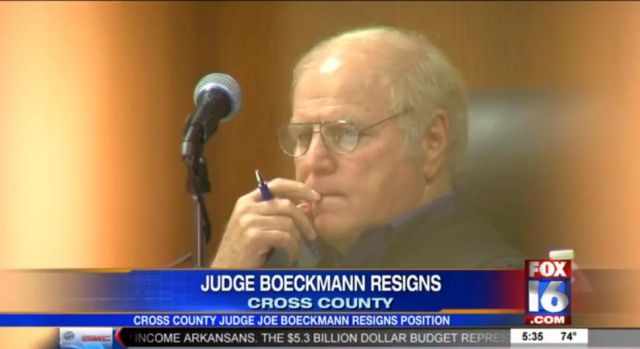
An Arkansas local judge resigned Monday following an ethics commission inquiry that concluded he had traded sex for reduced sentences and stored pictures of nude defendants on his home computer. The commission alleged he also housed child porn on that computer.

Cross County District Judge Joseph Boeckmann's resignation comes months after the state Judicial Discipline & Disability Commission concluded that the judge gave male defendants a hand-written note in court with his phone number on it instructing them that they could perform a "community service" at his house as part of a "substitutionary" sentence.

In a letter to the judge last week, the commission said it was in the process of recovering some 4,500 photos from the judge's computer.

Read 4 remaining paragraphs | Comments

Driver fingerprinting flap prompts Uber, Lyft to exit Austin tech hub

Dispute likely to play out in other areas.

(credit: SPUR)

Uber and Lyft said Monday they are suspending their ride-hailing services in Austin—the home of the South by Southwest festival—in the wake of a driver-fingerprinting fracas.

The companies had said they would bail on the tech hub if voters rejected Proposition 1 to repeal regulations in a dispute that is likely to play itself out in other areas. It's a legal fight that is a victory for taxi cab companies, which have been hit hard by ride-hailing companies.

Nearly 56 percent of voters rejected Proposition 1 on Saturday. The companies spent a combined $8 million in a failed bid to get it passed. The measure would have repealed earlier regulations for transportation network company drivers to pass a driver-history background check and a fingerprint background check. The fingerprints eventually make their way to the FBI. The companies said the regulations were making it too difficult to follow their business models.

Read 4 remaining paragraphs | Comments

Twitter tells US intel agencies to do their own data mining

Move comes as Silicon Valley publicly battles the US intelligence agencies.

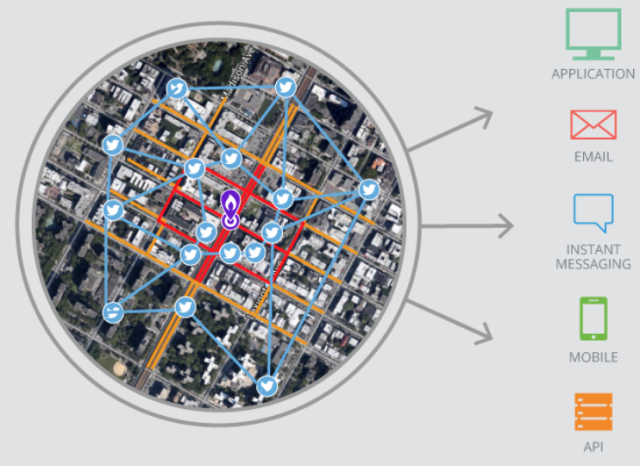
An illustration of Dataminr's data-mining of Twitter (credit: Dataminr)

In another sign that tensions between Silicon Valley and the US government are strong, Twitter is now barring US intel agencies from a service that analyzes the micro-blogging service's entire feed.

San Francisco-based Twitter has informed business partner Dataminr to cut off access to the CIA, NSA, and other government surveillance outfits. Twitter was concerned about the "optics" of appearing too cozy with the US intel community, The Wall Street Journal first reported Monday.

In a statement to Ars, Twitter downplayed the development. "Dataminr uses public Tweets to sell breaking news alerts to media organizations such as Dow Jones and government agencies such as the World Health Organization, for non-surveillance purposes," Twitter said. "We have never authorized Dataminr or any third party to sell data to a government or intelligence agency for surveillance purposes. This is a longstanding Twitter policy, not a new development."

Read 6 remaining paragraphs | Comments