
Apple’s Touch ID blocks feds—armed with warrant—from unlocking iPhone

Supreme Court has not ruled about compelled unlocking of fingerprint-locked devices.

Accused Dallas pimp Martavious Banks Keys was ordered by a federal judge to unlock his iPhone with his fingerprint. (credit: Facebook via The Dallas Morning News)

A Dallas, Texas man accused of prostituting underage girls was secretly ordered by a federal judge to unlock his iPhone using his fingerprint, according to federal court documents that are now unsealed.

It's rare that we see a case demanding that a phone be unlocked in that manner, but we should expect more as the mainstream public begins embracing fingerprint technology. Ever since 2013, when Apple popularized this form of unlocking technology, legal experts have predicted that these types of government demands would slowly become more common. Experts also warned these demands are probably not a breach of the Fifth Amendment right against compelled self-incrimination.

As an aside, some courts don't necessarily think that compelling a suspect to reveal their computer passcode is a constitutional violation. A Philadelphia man accused of possessing child pornography has been behind bars on a contempt charge for more than seven months for refusing to divulge his password. The man's attorney claims it's a constitutional violation to compel his client to assist the authorities with their prosecution. A federal appeals court has tentatively agreed to hear the case in September as the suspect (who has not been charged with a crime) remains in prison.

Read 11 remaining paragraphs | Comments

Batten down the hatches—Navy accused of pirating 585k copies of VR software

Bitmanagement Software says Navy “did not license” its virtual reality product.

(credit: Nicolas Raymond)

A German maker of 3D virtual reality software is accusing the US Navy of engaging in wanton piracy, and we're not talking about piracy on the high seas. This is about digital piracy of software, according to a federal lawsuit brought by Bitmanagement Software. The company is seeking copyright infringement damages of more than $596,000 from the Navy for allegedly stealing more than 558,000 copies of its BS Contact Geo software.

The amount of damages, if the Navy loses, could go up substantially. That price tag included in the lawsuit is the market value of the unpaid licenses. Bitmanagement also noted that in addition to licensing fees it is seeking pre- and post-judgement interest, punitive damages, legal costs, attorney fees, and statutory damages that could amount to $150,000 per infringement.

According to the lawsuit (PDF) filed in the US Court of Federal Claims:

Read 5 remaining paragraphs | Comments
Hacker who published LA Times login credentials ordered to prison

Matthew Keys must begin serving two-year sentence for putting login info online.

(credit: Cyrus Farivar)

A journalist convicted of hacking was ordered Thursday to begin serving his two-year prison sentence. Matthew Keys was scheduled to begin serving his term last month, but a federal appeals court stayed his custody to determine whether he should remain free from the federal prison camp in Atwater, California pending an appeal of his federal conviction under the Computer Fraud and Abuse Act (CFAA).

After reviewing the conviction for a month, the 9th US Circuit Court of Appeals announced that there is nothing novel about his conviction and that he is likely to lose on appeal. Therefore, the court ruled (PDF), he should begin serving his time even while his appeal is pending. The court wrote:

Appellant has not shown that the appeal raises a "substantial question" of law or fact that is "fairly debatable," and that "if that substantial question is determined favorably to defendant on appeal, that decision is likely to result in reversal or an order for a new trial of all counts on which imprisonment has been imposed," or a sentence that does not include a term of imprisonment, or a reduced sentence to a term of imprisonment less than the total of the time already served plus the expected duration of the appeal process.

Keys maintains that he did not expose login information that led to the 40-minute alteration of a Los Angeles Times headline in 2010 when he worked for a local California television station, KTXL Fox 40 in Sacramento, which was owned by the newspaper's parent company, Tronc. Authorities said he published Tronc login credentials in a hacker forum and told forum readers to go "fuck some shit up." On appeal, Keys maintained that there was no damage done because the defaced article was restored from a backup, and therefore the CFAA was misapplied.

Read 3 remaining paragraphs | Comments

Teen’s Snapchat school bathroom prank is criminal behavior, court rules

Fellow student who was filmed while in school toilet stall committed suicide.

A California appeals court is upholding the juvenile-court conviction of a 16-year-old high school boy who uploaded a 10-second video to Snapchat of a fellow high school student who appeared to be masturbating in a bathroom stall.

"I think this dude is jacking off," read the video's caption.

The teen's misdemeanor invasion of privacy charges stem from what he said was him merely playing a joke on another student "to get a laugh." The boy on the receiving end was joking around, too, not really masturbating but pretending to, according to a juvenile witness. But in the end, that didn't matter. The boy who was filmed by the mobile phone committed suicide two weeks later, leaving a note behind: "I can't handle school anymore and I have no friends."

Read 13 remaining paragraphs | Comments

Wearable maker Fitbit must face lawsuit over sleep-tracking claims

Fitbit’s defense “is focused on attacking the plaintiffs’ evidence as bad science.”

(credit: Fitbit)

A proposed class-action lawsuit accusing Fitbit of misrepresenting the ability of its wearable fitness products to track sleep can move forward, a federal judge has ruled.

The San Francisco federal lawsuit claims that Fitbit materially misrepresented on its packaging the ability of the Flex product to track users' hours slept, times woken up, and sleep quality. The suit alleges false advertising, unfair trade practices, fraud, and a host of other claims.

US District Judge James Donato did not rule on the merits of the case but instead refused to toss the lawsuit as Fitbit had wanted. Now Fitbit, which claimed the allegations were based on "bad science," according to the judge, must mount another defense to the allegations. The case could still be dismissed at a later stage, and it might also go to a trial or settle.

Read 4 remaining paragraphs | Comments

Maine electronic food-stamp cards printed with sex-line chat number

“Ladies, to talk with interesting and exciting guys free, press 1 now. Press 1 now.”

LJ Langelier has some Facebook fun with his Maine food-stamp card that erroneously links to a sex chat line.

"Welcome to America's hottest talk line. Ladies, to talk with interesting and exciting guys free, press 1 now. Press 1 now."

That's the greeting callers get when they dial the number on the back of their Maine electronic food-stamp card. Either the Maine Department of Health and Human Services has branched out into the phone-sex market or it's a misprint. Turns out the agency hasn't opened a sex line, and instead the phone number to reach the agency is off by one digit on the Electronic Benefit Transfer (EBT) cards.

Agency spokesman John Martins told local media that the department is aware of the mistake, and it's being corrected.

Read 4 remaining paragraphs | Comments

Sorry, there’s no more porn with your Starbucks latte

Coffee chain’s move follows McDonald’s, Chick-fil-A, Panera Bread, and Subway.

(credit: Bradley Fulton)

Starbucks said Friday it would soon add porn-blocking filters to its public, in-store Wi-Fi. The move follows McDonald's, which disclosed this week that it had blocked the hamburger-eating public from accessing Wi-Fi-enabled porn at its restaurants.

"Once we determine that our customers can access our free Wi-Fi in a way that also doesn't involuntarily block unintended content, we will implement this in our stores," Starbucks said in a statement. "In the meantime, we reserve the right to stop any behavior that interferes with our customer experience, including what is accessed on our free Wi-Fi."

The group Enough is Enough and the National Center on Sexual Exploitation have been putting pressure on companies that provide free Wi-Fi to the public to block porn sites.

Read 4 remaining paragraphs | Comments

Sex offender arrested, accused of playing Pokémon Go with kids

Probation agent saw offender playing game with kids outside agency’s office.

(credit: Eduardo Woo)

We've read about all kinds of weird things happening to people playing Pokémon Go on their mobile phones—including players being the victims of muggings, participants being accused of trespassing or getting lost, and even app-related divorce.

The story of an Indiana man, however, takes the cake. The case of 42-year-old Randy Zuick comes in as our top vote for Dumbest Criminal of the Month, and it also gets our top vote for the Strangest Pokémon Go Story we've heard following the mobile app's debut last week.

Zuick is a registered child sex offender. In April he pleaded guilty to a felony charge of fondling a child under 14 and was placed on sex-offender probation for four years. The terms include him not interacting with children, local media reported.

Read 2 remaining paragraphs | Comments

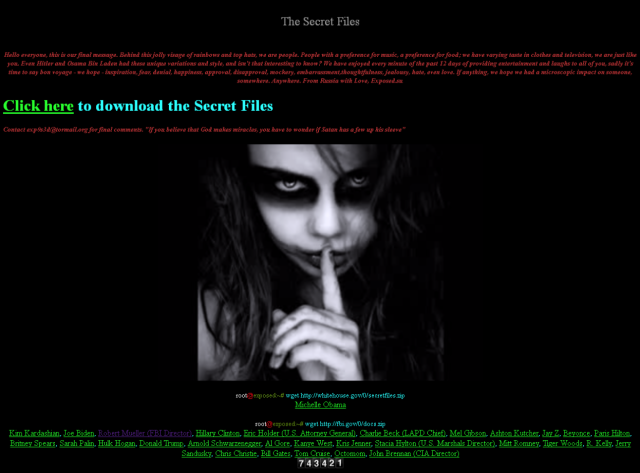
Serial hacker, doxxer, and swatter sentenced to two years in prison

He and others “embarked on this digital crime spree to entertain themselves.”

The site Exposed.su published the birthday, address, phone number and Social Security number of dozens of celebrities and public officials, including the heads of the FBI and CIA. (credit: krebonsecurity.com)

A 22-year-old hacker has been handed a two-year prison sentence for his role in doxing and swatting politicians, celebrities, prosecutors, the first lady, and security journalist Brian Krebs.

While cooperating with the FBI after his 2012 arrest on unrelated charges, Mir Islam doxed and swatted as many as 50 people, authorities said. Those who were doxed had their information appear on a website Islam ran called "Exposed." Victims included First Lady Michelle Obama and Vice President Joe Biden. Those who were swatted include Stephen P. Heymann, the Massachusetts federal prosecutor who handled the Aaron Swartz prosecution; security journalist Brian Krebs; Wayne LaPierre, the CEO of the National Rifle Association; and Mike Rogers, a former GOP representative from Michigan and a key supporter of the Stop Online Piracy Act.

Islam also orchestrated a phony threat of an active shooter at the University of Arizona.

Read 7 remaining paragraphs | Comments

Pokémon Go is so yesterday as cell phone gambling hits the Vegas strip

Gamblers compete against other MGM resort gamers in bingo, slots, and video poker.

Jester Poker is one game you can play virtually at MGM Resorts in Vegas. (credit: easyPLAY)

MGM Resorts on Wednesday unveiled what it's billing as the nation's first "real-money" mobile tournament gambling platform. The new platform enables gamblers 21 and older, who are connected to the Wi-Fi network of an MGM-owned hotel in Las Vegas, to throw down their kids' college funds for the chance to strike gold—all from their mobile phone, tablet, or laptop.

The easyPLAY Mobile Tournaments platform allows resort guests "at nine iconic Las Vegas resorts to compete with other players in a variety of tournament games using their own mobile devices whether they are at the pool, sipping cocktails at the bar, or simply relaxing in their rooms," the company said.

Bettors compete against fellow resort guests in bingo, slots, and video poker. Other methods of throwing away your hard cash are in the works, the company said. There are plenty of Vegas-based, MGM-owned resorts where bettors can play, too. They include ARIA Resort & Casino, Bellagio, MGM Grand, Mandalay Bay, The Mirage, Monte Carlo, Luxor, New York-New York, and Excalibur. What could go wrong? It has all been approved by the Nevada Gaming Control Board.

Read 5 remaining paragraphs | Comments