Manslaughter charges dropped in BP spill case—nobody from BP will go to prison

Explosion killed 11 workers, spewed 134 million gallons of oil, and fouled the coastline.

(credit: US Coast Guard)

In April 2010, the Deepwater Horizon exploded and began spewing oil into the US Gulf Coast. In all, this released some 134 million gallons of crude over a span of almost three months. Eleven workers were killed in the nation's worst offshore oil spill.

Today, federal prosecutors moved—and a judge agreed—to drop manslaughter charges against two supervisors aboard the Deepwater Horizon when it exploded. This development, in which prosecutors said they believed they no longer could meet the legal threshold for a conviction, means that nobody will go to prison for the disaster that soiled coastlines from Texas to Florida, killed nearly a dozen people, and was an environmental disaster that perhaps brings with it never-before-seen longterm consequences.

The government announced the legal move Wednesday in a New Orleans courtroom. Rig supervisor Donald Vidrine instead pleaded guilty to violating the Clean Water Act, a misdemeanor that likely will result in 10 months of probation and 100 hours of community service. Robert Kaluza, the other supervisor who also was being charged with 11 manslaughter counts, is going to fight a single misdemeanor charge that he also violated the Clean Water Act.

Read 5 remaining paragraphs | Comments

Sharing of television news clips hangs in the fair-use balance

Lower court says sharing, downloading, and time-searching clips isn’t fair use.

(credit: Wikipedia)

Fox News is winning more than just the news network ratings wars. It's also winning the battle against copyright's fair use doctrine.

In August, a federal judge sided (PDF) with the news station's copyright-infringement lawsuit against a television and radio clipping service known as TVEyes, which charges as much as $500 a month for its service. A New York federal judge ruled that wanton sharing, time searching, and downloading of Fox News' news segments is not fair use. Then in November, US District Judge Alvin Hellerstein ruled TVEyes could not allow its clients—like the White House, American Red Cross, members of Congress, and others—to download Fox News clips. The judge also ordered TVEyes to block users from searching Fox News clips and from allowing them to share them on social media.

TVEyes shall implement a blocking feature that will prevent links to FNC or FBN clips stored on any servers owned or leased by TVEyes from playing when they are accessed from links posted to the major social sharing services on the internet. TVEyes will also block plays linked from domain names associated with the blocked sites (such as "url shorteners") to ensure that its list of blocked domains remains comprehensive. Examples of such social media sites include: twitter.com; t.co (Twitter's URL shortener); facebook.com; fb.me (Facebook's URL shortener); linkedin.com; pinterest.com; plus.google.com; tumblr.com; vine.co; snapchat.com; hubs.ly (Hubspot, a social media posting system); bit.ly (Bitly, a social media posting system); buff.ly (Buffer, a social media posting system); and reddit.com."

Fox News is seeking unspecified damages in the case, too, at a trial. But on Monday, TVEyes and Fox News temporarily set aside their differences and agreed to allow the appellate courts to review Hellerstein's decisions. The judge's orders were to take effect on December 14, but the agreement indefinitely delays implementation pending the outcome of the case before the New York-based 2nd US Circuit Court of Appeals. That's the same appeals court that ruled in October that it's legal to scan books even if you don't own the copyright.

Read 4 remaining paragraphs | Comments

Patent troll claims HTTPS websites infringe crypto patent, sues everybody

Netflix and others are fighting back while Scotttrade and others are settling.

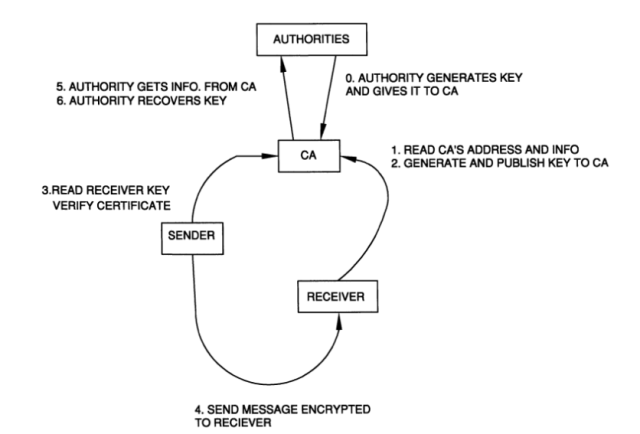
An image from the patent called "Auto-escrowable and auto-certifiable cryptosystems." (credit: Auto-escrowable and auto-certifiable cryptosystems patent)

A Texas company is suing some of the biggest names in tech and retail, claiming their HTTPS websites infringe an encryption patent titled "Auto-Escrowable and Auto-Certifiable Cryptosystems." CryptoPeak Solutions has filed about six dozen cases in all, and they began hitting the patent-troll friendly venue of the Eastern District of Texas in July.

The patent's abstract describes the invention, granted in 2001:

A method is provided for an escrow cryptosystem that is overhead-free, does not require a cryptographic tamper-proof hardware implementation (i.e., can be done in software), is publicly verifiable, and cannot be used subliminally to enable a shadow public key system. A shadow public key system is an unescrowed public key system that is publicly displayed in a covert fashion. The keys generated by the method are auto-recoverable and auto-certifiable (abbrev. ARC). The ARC Cryptosystem is based on a key generation mechanism that outputs a public/private key pair and a certificate of proof that the key was generated according to the algorithm. Each generated public/private key pair can be verified efficiently to be escrowed properly by anyone. The verification procedure does not use the private key. Hence, the general public has an efficient way of making sure that any given individual's private key is escrowed properly, and the trusted authorities will be able to access the private key if needed. Since the verification can be performed by anyone, there is no need for a special trusted entity, known in the art as a “trusted third party”. The cryptosystem is overhead free since there is no additional protocol interaction between the user who generates his or her own key, and the certification authority or the escrow authorities, in comparison to what is required to submit the public key itself in regular certified public key systems. Furthermore, the system is designed so that its internals can be made publicly scrutinizable (e.g., it can be distributed in source code form). This differs from many schemes which require that the escrowing device be tamper-proof hardware.

The latest batch of cases was lodged November 25. The cases name AT&T, Costco, Expedia, GoPro, Groupon, Netflix, Pinterest, Shutterfly, Starwood Hotels, Target, and Yahoo, among others. All the lawsuits include virtually identical language.

Read 4 remaining paragraphs | Comments

The National Security Letter spy tool has been uncloaked, and it’s bad

No warrants needed to get browsing history, online purchase records, and other data.

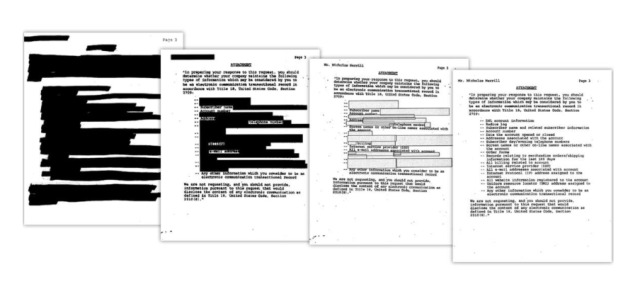
It took 11 years to finally unveil what the FBI demands in a National Security Letter. How it evolved over the years is shown above. (credit: ACLU)

The National Security Letter (NSL) is a potent surveillance tool that allows the government to acquire a wide swath of private information—all without a warrant. Federal investigators issue tens of thousands of them each year to banks, ISPs, car dealers, insurance companies, doctors, and you name it. The letters don't need a judge's signature and come with a gag to the recipient, forbidding the disclosure of the NSL to the public or the target.

Nicholas Merrill (credit: Wikipedia)

For the first time, as part of a First Amendment lawsuit, a federal judge ordered the release of what the FBI was seeking from a small ISP as part of an NSL. Among other things, the FBI was demanding a target's complete Web browsing history, IP addresses of everyone a person has corresponded with, and records of all online purchases, according to a court document unveiled Monday. All that's required is an agent's signature denoting that the information is relevant to an investigation.

"The FBI has interpreted its NSL authority to encompass the websites we read, the Web searches we conduct, the people we contact, and the places we go. This kind of data reveals the most intimate details of our lives, including our political activities, religious affiliations, private relationships, and even our private thoughts and beliefs," said Nicholas Merrill, who was president of Calyx Internet Access in New York when he received the NSL targeting one of his customers in 2004.

Read 7 remaining paragraphs | Comments