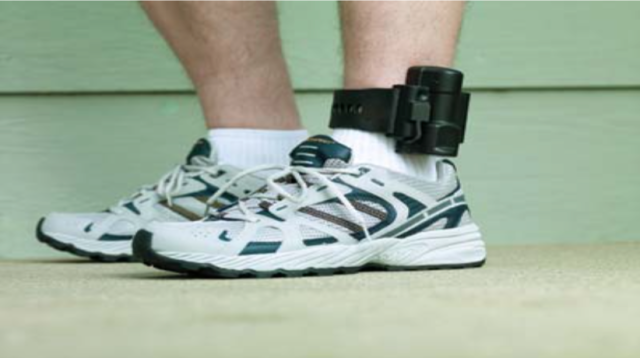
Felon’s lifetime GPS monitoring upheld by US federal appeals court

Burden on privacy “must in any event be balanced against the gain to society.”


A federal appeals court is upholding lifetime GPS monitoring of a convicted felon, in this instance a Wisconsin pedophile who served time for sexually assaulting a boy and a girl. The court upheld the constitutionality of a Wisconsin law that, beginning in 2008, requires convicted pedophiles to wear GPS ankle devices for the rest of their lives.

A federal judge had sided with the offender, Michael Belleau, now 72. Wisconsin appealed to the 7th US Circuit Court of Appeals, which ruled (PDF) in the state's favor Friday and derided the lower court's ruling as "absurd." Among other things, Belleau said the GPS device violated his privacy because he had served his time and was not on post-prison supervision. The three-judge appeals court did not agree, saying:

When the ankleted person is wearing trousers the anklet is visible only if he sits down and his trousers hike up several inches and as a result no longer cover it. The plaintiff complains that when this happens in the presence of other people and they spot the anklet, his privacy is invaded, in violation of the Fourth Amendment, because the viewers assume that he is a criminal and decide to shun him. Of course the Fourth Amendment does not mention privacy or create any right of privacy. It requires that searches be reasonable but does not require a warrant or other formality designed to balance investigative need against a desire for privacy; the only reference to warrants is a prohibition of general warrants.

The court's reasoning, however, could apply to other criminals who have a propensity to reoffend. The court said that the burden on privacy "must in any event be balanced against the gain to society from requiring that the anklet monitor be worn. It is because of the need for such balancing that persons convicted of crimes, especially very serious crimes such as sexual offenses against minors, and especially very serious crimes that have high rates of recidivism such as sex crimes, have a diminished reasonable constitutionally protected expectation of privacy."

Read 7 remaining paragraphs | Comments

Feds don’t need crypto backdoors to spy—your TV and toothbrush will do

Internet of Things opens government access to real-time, recorded communications.

Who needs crypto backdoors when Barbie can spy on you? (credit: Mike Licht)


The so-called "going dark" problem—which various government officials claim will be the death knell to the US because Silicon Valley won't bake crypto backdoors into its wares—is greatly overblown. That's because crime fighters are not in the dark, at least technologically, and are now presented with a vast array of spy tools at their disposal. Specifically, modern espionage is piggybacking on the Internet of Things (IoT) tools, from televisions to toasters, that enable wanton spying.

"The audio and video sensors on IoT devices will open up numerous avenues for government actors to demand access to real-time and recorded communications," according to a Berkman Center for Internet & Society report published Monday.

The report added:

Read 6 remaining paragraphs | Comments

Facebook prohibiting private firearms sales from unlicensed dealers

The company will remove posts reported by its users that violate the policy.

(credit: Franco Bouly)

The social-networking site Facebook, and its Instagram photo-sharing service, are prohibiting person-to-person firearms transactions and related firearms advertising on the popular platforms.

The Friday move comes almost a month after President Barack Obama announced an executive initiative requiring those selling guns—whether at a flea market or online—to register as a firearms dealer and to perform background checks on gun purchasers. The White House has urged Silicon Valley to bake encryption backdoors into its wares, and has also urged social media companies to make it difficult for unlicensed gun dealers to sell firearms on their networks. Silicon Valley, however, has publicly balked at calls for encryption backdoors. Facebook's changeover is part of its updated terms of service that also prohibit its 1.6 billion monthly visitors from selling marijuana, pharmaceuticals and illegal drugs.

The company will remove posts reported by its users that violate the policy, which had already prohibited firearms sellers from promoting "no background checks required." Licensed dealers, which by law must perform background checks, may still advertise as long as transactions occur outside Facebook properties. Minors have already been shielded from seeing pages advertising guns. Repeat violators of Facebook's policy, designed to clamp down on unregulated gun sales, could be banned from the social network.

Read 4 remaining paragraphs | Comments

US Commerce Department wants courts to be kinder, gentler to file sharers

Works of “minimal commercial value” should get a “lower award.”

(credit: Mike Seyfang)

A US Department of Commerce task force recommended Thursday that Congress alter the Copyright Act in a bid that likely would reduce financial damages for file sharing copyright scofflaws.

The recommendations from the agency's Internet Policy Task Force don't call for doing away with the maximum $150,000 in damages available to rights holders per infringement. But if Congress adopts the task force's recommendations, it's doubtful there would be large awards, as one of the recommendations would require juries to consider a file sharer's ability to pay and, among other things, the actual value of the works that were infringed.

"We believe that litigants and courts would be well-served by requiring consideration of a uniform set of factors designed to result in an appropriate award based upon the facts of each case," said the report from the task force, which included members from the US Patent and Trademark Office, The National Telecommunications and Information Administration, and other Commerce Department entities.

Read 7 remaining paragraphs | Comments

Body cam captures man’s final words—begging the cops to get off of him

“Sir, we’re not killing you,” one of a handful of officers is overheard saying.

(credit: Kevin Lim)

"They're killing me right now... I can't breathe."

Those are among the final words of an Oakland man shouting to his sister as Oakland Police Department officers pinned him to the ground—a knee on his back—moments before he died. Hernan Jaramillo screamed those words over and again, according to grainy body cam footage from the 2013 incident that sparked a civil rights lawsuit (PDF) the city is now settling (PDF) for $450,000.

"Sir, we're not killing you," one of the handful of officers on the scene is overheard saying calmly. Minutes later, the 51-year-old man is dead. The footage has been sealed under a protective order, but the Contra Costa Times managed to get ahold of it and published it Tuesday.

Read 8 remaining paragraphs | Comments

Ethics charges filed against DOJ lawyer who exposed Bush-era surveillance

Thomas Tamm exposed “the program” which provided the fodder for a Pulitzer Prize.

(credit: sdobie)

A former Justice Department lawyer is facing legal ethics charges for exposing the President George W. Bush-era surveillance tactics—a leak that earned The New York Times a Pulitzer and opened the debate about warrantless surveillance that continues today.

The lawyer, Thomas Tamm, now a Maryland state public defender, is accused of breaching Washington ethics rules for going to The New York Times instead of his superiors about his concerns about what was described as "the program."

Tamm was a member of the Justice Department's Office of Intelligence Policy and Review and, among other things, was charged with requesting electronic surveillance warrants from the secret Foreign Intelligence Surveillance Court.

Read 6 remaining paragraphs | Comments

Man arrested, jailed for filming cop settles lawsuit and gets $72,500

Video was destroyed while iPhone was in police custody.

George Thompson settles a federal civil rights lawsuit for $72,500 after being arrested for filming the police. (credit: YouTube)

A Massachusetts man charged with wiretapping in 2014 for filming a local police officer with his iPhone is settling a federal civil rights lawsuit for $72,500.

According to court documents, a Fall River man named George Thompson saw a police officer outside his house cursing into his mobile phone while working traffic detail. The lawsuit said that Thompson began filming the officer, Thomas Barboza, with his mobile phone. The officer eventually pushed Thompson, 53, to the ground and handcuffed him, according to the lawsuit (PDF). Thompson spent a night in jail.

The arresting officer received a one-day suspension for conduct unbecoming of an officer—that is speaking profanities in public. The Fall River police erased the footage from the phone by typing in wrong passwords at least 10 times, which prompted the iPhone to restore to factory settings. That erasure was among the reasons the authorities dropped the wiretapping charges against Thompson, as the alleged evidence had been destroyed.

Read 7 remaining paragraphs | Comments

Cute to “a little sinister”—the beauty of US spy satellite rocket launch logos

For example: 2004 mission logo depicts a sword-wielding, big-breasted redhead with wings.


When the National Reconnaissance Office (NRO) launched an Atlas V ferrying a GEMSat classified payload in December 2013, the mission's logo set off a public firestorm of sorts.

The mission logo, or patch, from the launch from Vandenberg Air Force Base in California is of a giant, orange-ish-colored octopus sitting atop Earth. "Nothing Is Beyond Our Reach," read the logo for the NROL-39 mission. The office of the Director of National Intelligence published a picture of the logo-patch on Twitter hours before launch, tweeting that the "Atlas 5 will blast off just past 11PM, PST carrying an classified NRO payload (also cubesats)."

The launch came as the Guardian was publishing one leak after the other from NSA whistleblower Edward Snowden. The leaks detailed that the US National Security Agency was, among other things, exercising digital domination across the world's fiber optic lines. So a spy agency's cartoon depicting total world domination was an untimely public relations failure given the focus Snowden was bringing to the US surveillance state.

Read 8 remaining paragraphs | Comments

Court refuses to block Obama’s climate-change initiative

The rule requires a 32 percent reduction in power plant emissions by 2030.

The sulfer-coal-burning John E. Amos Power Plant in West Virginia. (credit: Cathy)

A federal appeals court is refusing to block the President Barack Obama administration's climate change initiative. Two dozen states and other energy companies sued (PDF) the Environmental Protection Agency in October, on the day the carbon-emissions cutting plan became law.

The US Court of Appeals for the District of Columbia Circuit said the plan, which impacts hundreds of power plants across the nation and is one of the president's centerpiece accomplishments, can proceed even as the legal challenge is pending. "Petitioners have not satisfied the stringent requirements for a stay pending court review," the court ruled in a brief order Thursday. (PDF)

The rule requires a 32 percent reduction in power plant emissions by 2030, with the baseline set at 2005 emission levels. Coal-burning power plants, which generate about a third of the nation's power, are the hardest hit. West Virginia and Kentucky, two of the states that rely heavily on coal for power and jobs, initiated the legal challenge to the Clean Power Plan. Utilities are the nation's largest source of carbon emissions.

Read 4 remaining paragraphs | Comments

Shkreli invokes 5th Amendment, won’t assist Senate drug-pricing probe

Embattled Shkreli already facing allegations of running a Ponzi-like fraud scheme.

The founder and former CEO of Turing Pharmaceuticals, Martin Shkreli, invoked his Fifth Amendment right against compelled self-incrimination on Wednesday, and he won't comply with a subpoena for documents issued from a Senate panel investigating pharma drug pricing tactics.

The 32-year-old Shkreli was also subpoenaed to appear before a different panel, the US House Committee on Oversight and Government Reform, to testify about the price of a life-saving drug he increased by more than 5,000 percent.

Shkreli became the poster child for greed last year after he raised the price of Daraprim—used to treat parasitic infections—from $13.50 a pill to $750. A single pill once sold for $1. Now facing criminal charges that he allegedly defrauded investors, Shkreli has said he should have boosted prices for the drug even more.

Read 5 remaining paragraphs | Comments