FBI is asking courts to legalize crypto backdoors because Congress won’t

The most lawmakers have done is float bill to create a “commission” to study issue.

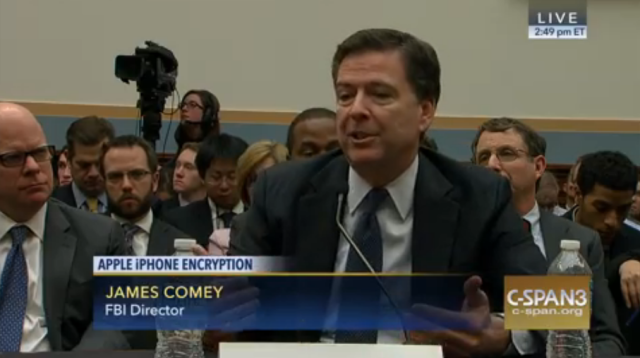
FBI Director James Comey in the hot seat Tuesday before the House Judiciary Committee. (credit: C-SPAN3)

James Comey, the FBI director, told a House panel on Tuesday that the so-called “Going Dark” problem is “grave, growing, and extremely complex.” (PDF)

His prepared testimony to the House Judiciary Committee is not surprising. There’s been a chorus of government actors singing that same song for years. But what we didn't hear was the bureau director ask Congress for legislation authorizing encryption backdoors. That’s because there’s no congressional support—which underscores why the President Obama administration is now invoking a 1789 obscure law in federal courthouses asking judges to do what Congress has declined to do.

"If I didn't do that, I oughta be fired," Comey told the panel during his live testimony. The panel's hearing, "Encryption Tightrope: Balancing Americans' Security and Privacy," was largely dedicated to the FBI's legal battle with Apple. He said if the bureau had the capability to bypass iPhone passcode locks in the dozens of pending cases where they've gone to court, "We wouldn't be litigating if we could."

Read 25 remaining paragraphs | Comments

Facebook posts mocking judge earn brothers two years in jail

Don’t tell judge to “suck it” and “up ur ass” right after getting suspended sentence.

Daniel Sleddon and brother Samuel. (credit: Lancashire Police)

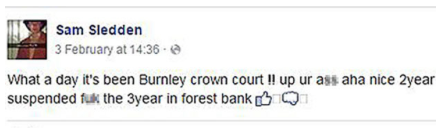
Two British brothers convicted of selling marijuana are being sent to prison for two years after they mocked the judge on Facebook immediately after their court appearance. The judge had handed them two-year suspend sentences. The brothers, from Accrington, showed remorse when they appeared for sentencing earlier this month, but they sang a different tune on Facebook.

About an hour after a Burnley Crown Court judge issued the suspended sentences, one of the brothers, Daniel Sledden, 27, took to Facebook telling judge Beverley Lunt to suck his you-know-what. Younger brother Samuel, 22, wrote Lunt on Facebook "up ur ass aha nice 2year suspended," according to Sky News.

The elder brother apologized on Facebook, to no avail. "I want to say how sorry I am for what I wrote about Judge Lunt and my sentence," he wrote.

Read 1 remaining paragraphs | Comments

More GOP presidential hopefuls now side with the FBI in iPhone crypto fight

Rubio: Apple doesn’t want to “hurt their brand.” Carson: terrorism is “bad for America.”

What do they have in common? They want to be president and (seem to) think Apple should comply with the FBI. (credit: Getty Images)

The now five candidates vying for the GOP presidential nomination discussed everything from immigration, health care, and the Middle East during their latest debate, sponsored by CNN/Telemundo and held in Houston on Thursday evening. But what caught our attention was the candidates' discourse about the Apple-FBI encryption legal fight.

CNN moderators Wolf Blitzer and Dana Bash actually initiated the topic. Blitzer first mentioned how Apple responded to the FBI's court order earlier in the day with a formal motion to vacate. Bash then addressed the topic to Florida Senator Marco Rubio, referencing his defense of Apple last week during a GOP candidate town hall in South Carolina.

BASH: Senator Rubio, you say it's complicated, and that, quote, "Apple isn't necessarily wrong to refuse the court order." Why shouldn't investigators have everything at their disposal?

RUBIO: No, in fact what I have said is the only thing—the FBI made this very clear 48 hours ago—the only thing they are asking of Apple is that Apple allow them to use their own systems in the FBI to try to guess the password of the San Bernardino killer. Apple initially came out saying, "We're being ordered to create a back door to an encryption device." That is not accurate.

The only thing they're being asked to do, and the FBI made this very clear about 48 hours ago, is allow us to disable the self-destruct mode that's in the Apple phone so that we can try to guess using our own systems what the password of this killer was.

And I think they should comply with that. If that's all they're asking for, they are not asking for Apple to create a back door to encryption.

BASH: So just to be clear, you did say on CNN a couple of weeks ago this is a complicated issue; Apple is not necessarily wrong here.

RUBIO: Because at the time, Apple was portraying that the court order was to create a back door to an encryption device.

BASH: But just to be clear—just to be clear, if you are president, would you instruct your Justice Department to force Apple to comply or not?

RUBIO: To comply with an order that says that they have to allow the FBI the opportunity to try to guess the password?

BASH: Correct.

RUBIO: Absolutely. That Apple phone didn't even belong to the killer. It belonged to the killer's employee (sic) who have agreed to allow him to try to do this. That is all they're asking them to do is to disable the self-destruct mode or the auto-erase mode on one phone in the entire world. But Apple doesn't want to do it because they think it hurts their brand.

Bash and Blitzer soon directed the question of national security or personal privacy to a trio of other candidates in attendance—Texas Senator Ted Cruz, Ohio Governor John Kasich, and Neurosurgeon Dr. Ben Carson. Cruz pointed out Rubio's potential hypocrisy, said Apple doesn't need to place back doors in every phone, but concluded with "Apple doesn't have a right to defy a valid court order in a terrorism investigation." Carson simply took an anti-terror approach ("I think allowing terrorists to get away with things is bad for America"), while Kasich criticized President Obama for not bringing the two sides together for a meeting outside the court system.

Read 5 remaining paragraphs | Comments
Texas cop indicted for searching car of activist filming the police

“Are you going to identify yourself?” meets “What crime have I committed?”

A Galveston Police Department sergeant in Texas has been indicted on misdemeanor accusations of unlawfully searching the vehicle of a video activist, according to a report in the Galveston County Daily News. The videographer was originally arrested in connection to filming police officers and their car license plates while standing outside the station.

Sgt. Archie Chapman, whose lawyer says he is innocent, faces up to 180 days in jail and a maximum $2,000 fine on allegations of criminal trespass. Phillip Turner, the 25-year-old activist in question, was arrested last November. He was handcuffed and later jailed for 16 hours on allegations of failing to identify himself to police officers. Eventually the charges were dropped.

Turner is a correspondent for photographyisnotacrime, a website largely dedicated to issues surrounding abuse and the right to film cops. A friend with him during the incident captured everything on film and uploaded it to YouTube.

Read 10 remaining paragraphs | Comments

Forget the 1st Amendment, Apple to plead the 5th in iPhone crypto flap

It’s a novel constitutional legal argument versus an unprecedented government demand.

(credit: Kim Davies)

There's been ongoing dialogue about Apple's upcoming legal strategy in its battle with the government about whether it should be required to comport with a court order mandating that the Cupertino gadget maker assist the authorities in accessing a locked, encrypted iPhone used by one of the San Bernardino shooters. One legal angle that has largely been overlooked is the Fifth Amendment.

Here at Ars, we already produced a lengthy feature focusing on the All Writs Act of 1789, a law invoked by judges to order somebody to do something despite there being no law requiring them to do so. That ancient law is at the heart of the government's argument demanding that Apple write custom software to assist the authorities in unlocking the encrypted iPhone used by killer Syed Rizwan Farook, who participated in a shooting spree in December that killed 14 people. Our Ars story overlooked a Fifth Amendment defense and largely discussed a nuanced three-pronged approach to how Apple will defend its stance of not wanting to provide assistance to the government's request. If Apple is ultimately ordered to comply, Apple chief Tim Cook said it would set a "dangerous precedent."

Then on Tuesday, Bloomberg wrote that Apple will also argue in its legal papers to be filed by Friday that computer code and its cryptographic autograph are protected speech under the First Amendment and that the government cannot compel speech by Apple. Bloomberg reported:

Read 7 remaining paragraphs | Comments

Trump urges supporters to boycott Apple in wake of encryption brouhaha

Boycott should last until Apple complies with court order, GOP candidate says.

Talking about bringing jobs back from China... then boycotting Apple?

GOP presidential contender Donald Trump is urging his followers to boycott Apple until it complies with the US government in its ongoing encryption battle. Apple is currently facing a court order requiring the company to assist authorities in unlocking an iPhone used by one of the two killers involved in a San Bernardino mass shooting that killed 14 and injured two dozen others in December 2015.

"First of all, Apple ought to give [authorities] the security to that phone," Trump told the crowd at a South Carolina rally on Friday. "What I think you ought to do is boycott Apple until they give that security number. I just thought of that—boycott Apple.”

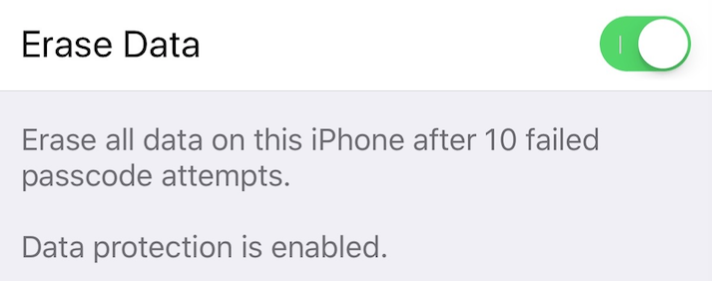
Trump was initially discussing how he believes the US needs to bring back jobs from China before he stumbled into his Apple position. The comments come as the debate about encryption reached a fever pitch this week. On Friday, the Justice Department demanded that a federal judge make Apple comply with a Tuesday court order requiring Apple to create a custom firmware in the seized iPhone 5C used by Syed Rizwan Farook. That firmware would remove a possible automatic wipe feature on the phone if a passcode is incorrectly entered 10 times.

Read 6 remaining paragraphs | Comments

Senate intel chief backs off on bill criminalizing refusal to aid decryption

It’s been a whirlwind week surrounding the encryption debate.

That didn't take long. The chairman of the Senate Intelligence Committee, Richard Burr (R-N.C.), is backing off on trial-balloon legislation he floated Thursday that would criminalize Apple's or any other firm's refusal to assist the government's encryption efforts.

The change of heart comes on the heels of a whirlwind week surrounding the encryption debate—a week in which a federal judge ordered Apple to aid the authorities in unlocking an iPhone used by one of the San Bernardino shooters. Soon after came Apple chief Tim Cook's angry response to the order alongside much public debate, and Burr's proposal followed on Thursday.

A Burr spokeswoman said on Friday, however, that the lawmaker is "studying" whether to "tighten rules about encryption."

Read 4 remaining paragraphs | Comments

Reading tea leaves: Scalia’s death gives new life to Obama’s climate plan

Just last week, Obama’s carbon-cutting plan appeared DOA before Supreme Court.

The sulfer-coal-burning John E. Amos Power Plant in West Virginia. (credit: Cathy)

Four days before Justice Antonin Scalia died on Saturday, the 79-year-old justice and the court's four other conservatives blocked one of President Barack Obama's centerpiece packages—his climate change initiative requiring a 32-percent reduction in power plant emissions by 2030.

More than two dozen states and energy companies are suing to thwart the plan, claiming that Obama's carbon regulations announced in October are an abuse of power and will "unlawfully impose massive and irreparable harms upon the sovereign states, as well as irreversible changes in the energy markets." The Supreme Court's decision to block the plan from taking force ahead of June 2 oral arguments before a federal appeals court was viewed as an ultimate death blow of sorts to the plan. The 5-4 conservative majority sided with the states and essentially said that the regulations are shelved until the Supreme Court lifts its stay.

Coal-burning plants generate about a third of the nation's power and are the hardest hit by Obama's regulations. West Virginia and Kentucky, two of the states that rely heavily on coal for power and jobs, initiated the legal challenge to the Clean Power Plan. Utilities are the nation's largest source of carbon emissions.

Read 2 remaining paragraphs | Comments

Through the Ars lens: Looking at Justice Scalia’s opinions, dissents

Scalia weighed in on Aereo, GPS tracking, thermal imaging, drug dogs, gun rights, and DNA.

(credit: Shawn)

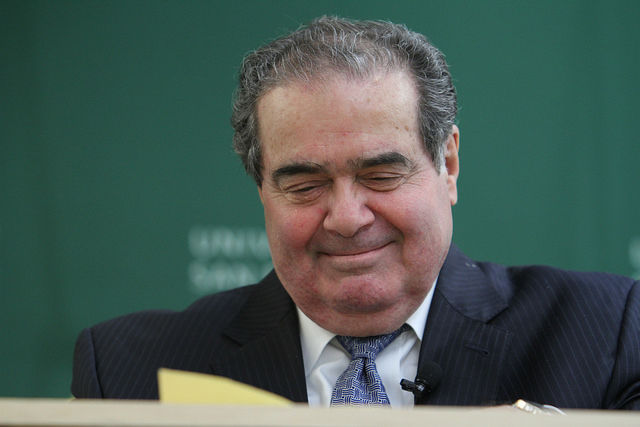
Supreme Court Justice Antonin Scalia, who died Saturday, will go down in history as the backbone of the court's modern conservative wing. The Reagan-appointee's long tenure touched upon so many facets of life that intersection with the Ars worldview was inevitable.

When viewed through this lens, the 79-year-old justice's writings concerned cases involving Aereo, video gaming, GPS tracking, thermal imaging, drug dogs, Second Amendment rights, Obamacare, and DNA among a host of other topics. So as the remembrances and reflections continue to trickle out, here's a reminder of how Justice Scalia's opinions and dissents impacted the technologies and policies we keep an eye on at the Orbital HQ.

American Broadcasting v. Aereo: The Supreme Court ruled 6-3 in a 2014 decision that resulted in the shuttering of the over-the-air broadcast TV company Aereo. New York-based Aereo needed the broadcasters' permission to sell monthly subscriptions, the court ruled. The court sided with broadcasters who said that Aereo offering customers tiny antennas to transmit the signal was akin to a cable company. In dissent, Scalia wrote, "The Court manages to reach the opposite conclusion only by disregarding widely accepted rules for service-provider liability and adopting in their place an improvised standard ("looks-like-cable-TV") that will sow confusion for years to come."

Read 12 remaining paragraphs | Comments

Kids, forget console gaming—play the FBI’s browser-based game instead

“Slippery Slope to Violent Extremism” is an awful game unworthy of even pirating.

(credit: FBI)

After months of delay, the Federal Bureau of Investigation has unveiled an online educational site for children. The bureau's "Don't Be A Puppet: Pull Back the Curtain on Violent Extremism" program is designed to sway kids from falling prey to violent extremists.

It's a great concept, as we often hear of one prosecution after another of somebody in the US being apprehended after wanting to join ISIS and succumbing to the terror group's online recruitment tactics.

The site, which surprisingly lauds the First Amendment, teaches kids about propaganda, symbols, and "groupthink." It talks about "what is violent extremism" and, among other things, how violent extremists make contact.

Read 6 remaining paragraphs | Comments