Linux kernel lawsuit SCO v IBM is alive, 13 years and counting

Suit claims IBM allegedly placed commercial UNIX code in the Linux kernel’s codebase.

(credit: michael)

The SCO Group's attempt to extract billions from IBM for code allegedly written into the Linux kernel's codebase is still meandering through the legal system—13 years after the now-bankrupt company filed the IP infringement suit against Big Blue.

A Utah federal judge dismissed (PDF) the latest iteration of the case this month, and SCO on Wednesday said (PDF) it would take the lawsuit to the 10th US Circuit Court of Appeals. The suit has had many twists and turns, but we'll summarize it briefly.

At its core, SCO Group, then named Caldera Systems, filed suit (PDF) against IBM in March 2003 for allegedly contributing sections of commercial UNIX code from UNIX System V—which the SCO Group claimed it owned—to the Linux kernel's codebase. SCO Group claimed that the alleged presence of its proprietary code in the open source kernel devalued its proprietary code and that by making the source code available, IBM had violated its license agreement with SCO Group. Along the way, SCO filed for bankruptcy, and the group claimed that anyone who used Linux owed them money. All the while, Novell successfully claimed ownership of the allegedly infringing code and agreed to indemnify Linux users.

Read 1 remaining paragraphs | Comments

Feds used 1789 law to force Apple, Google to unlock phones 63 times

“These cases predominantly arise out of investigations into drug crimes.”

(credit: :D)

We've been reporting over and again about how the FBI is citing a 1789 law, the All Writs Act, to compel Apple to assist the authorities in unlocking the iPhone used by extremist Syed Farook, who along with his wife killed 14 people in San Bernardino County in December.

In a sense, the law allows for judges to issue orders for people or companies to do something despite Congress not passing laws to cover specific instances. The All Writs Act is the law that led a federal magistrate ordering Apple to write code and unlock Farook's phone, an order that was no longer necessary because the authorities said Monday they cracked the phone without Apple's assistance. The government also said it wouldn't hesitate to use the "court system" to require other tech companies to weaken their security, too.

According to the American Civil Liberties Union, the US government has cited the All Writs Act in 63 cases since 2008 to compel Apple or Google to assist in accessing data stored on an iPhone or Android device. Most of the orders involved Apple. "To the extent we know about the underlying facts, these cases predominantly arise out of investigations into drug crimes," said Eliza Sweren-Becker, an ACLU attorney.

Read 3 remaining paragraphs | Comments

US says it would use “court system” again to defeat encryption

Feds say they can force entire tech sector, not just Apple, to disable security.

(credit: Perspecsys Photos)

US government officials from the FBI director down have said repeatedly that the FBI-Apple legal brouhaha was just about a single phone—the seized iPhone used by Syed Farook, one of the San Bernardino shooters. And just last week, James Comey, the FBI director, said his fight with Apple wasn't about setting precedent; rather, it was about battling terrorism.

But it seems that the storyline has changed.

The Justice Department now says it will not hesitate to invoke the precedent it won in its iPhone unlocking case. The authorities had obtained a court order weeks ago ordering Apple to write code to help the authorities unlock Farook's phone, all in hopes that data on it could stop another terror attack or shed light on the one that killed 14 people in San Bernardino in December. On Monday, however, the authorities said they didn't need Apple's help, asking the judge presiding over the case to withdraw the order because they had cracked the phone and obtained the desired information, all with the help of an "outside" party.

Read 7 remaining paragraphs | Comments

Apple likely can’t force FBI to disclose how it got data from seized iPhone

“It is an important test for the government’s disclosure policy.”

(credit: Bwana McCall)

The US government isn't saying whether it will divulge to Apple the method it used to access the locked iPhone seized by one of the San Bernardino shooters. The iPhone has been at the center of a bitter dispute between Apple and the Federal Bureau of Investigation. But that legal battle—in which a judge last month had ordered Apple to write code to assist the authorities in unlocking the phone—came to a seemingly abrupt halt late Monday when the government said it "successfully accessed the data" on the phone without Apple's assistance.

A federal law enforcement official requesting anonymity told reporters in a conference call Monday that the US government would not discuss whether it would reveal the method.

"We cannot comment on the possibility of future disclosures to Apple," the law enforcement official said in response to a question from Ars. Just a week ago, Apple told reporters in a conference call that it would insist in court of knowing everything about the vulnerability. Ars reported last week that the Israeli firm Cellebrite was potentially working for the US government to unlock the phone, and many have speculated that the method was a NAND mirroring attack.

Read 8 remaining paragraphs | Comments

Texas cops joke on Facebook about Ebola-tainted meth and net one arrest

Police say they arrested a woman after she requested they test her meth for Ebola.

A Central Texas police department issued a "breaking news alert" on Facebook, cautioning residents that meth and heroin in the Granite Shoals area "could be contaminated with the life-threatening disease Ebola." Last week's fake Facebook alert urged the public "NOT" to ingest those illicit drugs "until it has been properly checked for possible Ebola contamination" by the police department.

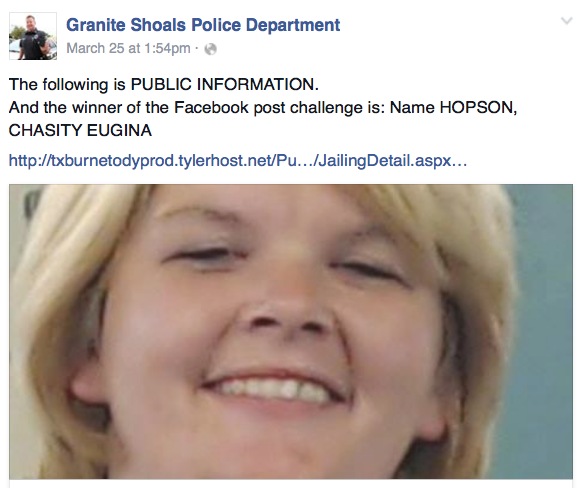
The ploy netted one arrest, the Granite Shoals Police Department (GSPD) reported on Facebook. A woman allegedly brought in her meth so the police department could analyze it for Ebola:

This morning, we had our first concerned citizen notify the Granite Shoals Police Department (GSPD) that they believed their methamphetamine may be tainted. Our officers gladly took the item for further testing. Results and booking photos are pending. Please continue to report any possibly tainted methamphetamine or other narcotics to the Granite Shoals Police Department. Public health and safety continue to remain our #1 priority. ‪#‎notkidding‬

For the uninitiated, there are no Ebola-contaminated drugs. The alert was a hoax played on the citizens of Granite Shoals, a town of about 5,000 northwest of Austin. But the arrest of 29-year-old Chastity Eugina Hopson is not a joke. She was accused of possessing under a gram of a controlled substance. The police department described Hopson's arrest as "the winner of the Facebook post challenge."

Read 2 remaining paragraphs | Comments

Utah now has an online registry for white-collar criminals

Weeks-old site is designed to protect the public but shames suit-and-tie convicts.


Every US state has a registry for sex offenders. Utah is taking that concept to a new level. The state has unveiled a first of its kind database for white-collar criminals that lawmakers say is intended to increase public safety.

"This registry has been a goal of mine for years and will further equip citizens to protect themselves from financial fraud by making information much more accessible in this digital age," Utah Attorney general Sean D. Reyes said. "A simple search cold curtail a fraudulent investment and save an entire nest egg."

The database, complete with mug shots, previewed weeks ago and includes around 100 listings. When you first visit the site, a "Registry Disclaimer" pops up with a message that the state "does not guarantee the website's accuracy or completeness." The disclaimer also says "members of the public are not allowed to use the information to harass or threaten offenders or members of their families."

Read 2 remaining paragraphs | Comments

Video clears Texas man of assaulting cop—did police commit perjury?

“Without the video I would be in prison. There is no doubt about that.”

The Texas man, Lawrence Faulkenberry, shown being leg whipped and thrown down, was accused of assaulting a police officer. When prosecutors saw the video, they declined to press charges.


"I knew the camera system was capturing everything the entire time. It knew everything that happened. I told him, 'You just messed up. You have no idea how bad.' He told me to 'shut up.'"

That's the conversation 47-year-old Larry Faulkenberry had with an officer of the Caldwell County Sheriff's Department after being leg-whipped to the ground and roughed up by three deputies in January 2015. He was tossed in jail for 10 days and held on $807,000 bail, and was staring down years in prison for three felonies: assaulting a cop, resisting arrest, and other charges.

That's the story Faulkenberry told Ars in a recent telephone interview. The incident took place in a rural county of 40,000 just east of Austin, at the five-acre property where Faulkenberry runs a motorcycle parts shop.

Read 22 remaining paragraphs | Comments

Video rental past due for 14 years leads to arrest of NC man

Rental store is defunct. Format is obsolete. Movie is bad.

A Concord, North Carolina man has been arrested on suspicion of failing to return a video rented 14 years ago. James Meyers is accused of failing to return a rented tape to a video store that no longer exists, according to local media and his own account on YouTube.

Meyers said he was pulled over Wednesday, allegedly for having a taillight out. A Concord police officer ran a background check, and that's when an outstanding warrant surfaced. The arrest warrant was for Meyers being well over a decade late in returning Freddy Got Fingered, a comedy starring comedian Tom Green.

"He goes, 'Sir, I don’t know how to tell you this, but there’s a warrant for your arrest from 2002. Apparently, you rented a movie Freddy Got Fingered and you never returned it... And we’re here to take you to jail,'" Meyers said of the incident with a Concord police officer.

Read 3 remaining paragraphs | Comments

FBI director says fight with Apple about terrorism, not setting precedent

“You are simply wrong to assert that the FBI and the Justice Department lied….”

FBI Director James Comey testifies to the House Judiciary Committee on March 1. (credit: C-Span3)

James Comey, the Federal Bureau of Investigation director, is defending the agency's legal battle with Apple, saying it is about fighting terrorism and not about setting legal precedent.

The director's comments, published Wednesday afternoon in the letters section of the Wall Street Journal, comes amid a slew of attacks against the agency for its handling of what is arguably the biggest legal showdown in modern tech history. The verbal assaults on the FBI are coming from the blogosphere, the rank-and-file public, and even the WSJ itself. The arguments essentially boil down to assertions that the FBI lied when stating that it could not open the iPhone used by San Bernardino terrorist Syed Farook and that it needed Apple's assistance in a court of law to set a legal precedent. The scheme asserts that because Congress won't adopt crypto-backdoor legislation or laws requiring companies like Apple to write code that undermines their own security, the FBI concocted a legal strategy to get the courts to do what lawmakers have refused to do.

Comey emphatically denied this idea and repeated that the FBI did not have the ability to access Farook's phone. Instead, he believes that the FBI decided to tentatively retreat once it was presented with a possible viable solution—which happened to come on Monday, just one day before the court hearing.

Read 6 remaining paragraphs | Comments

Israeli mobile forensics firm helping FBI unlock seized iPhone, report says

News comes after FBI withdrew demands for Apple to help unlock seized iPhone.

Screenshot from Cellebrite home page. (credit: Cellebrite)

The mobile forensics firm Cellebrite of Israel is reportedly assisting the Federal Bureau of Investigation in unlocking a seized iPhone that has become the center of a legal dispute between the bureau and Apple, the Israeli paper Yedioth Ahronoth reported Wednesday.

The revelation comes two days after the US government tentatively withdrew its demands that Apple write code and assist the authorities to unlock a seized iPhone used by one of the San Bernardino County shooters. The FBI told a federal judge Monday that an "outside party demonstrated to the FBI a possible method for unlocking (Syed) Farook's iPhone." A federal magistrate then tentatively stayed her order demanding that Apple assist the authorities in unlocking the phone.

That same day, according to public records, the FBI committed to a $15,278 "action obligation" with Cellebrite. An "action obligation" is the lowest amount the government has agreed to pay. No other details of the contract were available, and the Justice Department declined comment. Cellebrite, however, has reportedly assisted US authorities in accessing an iPhone.

Read 3 remaining paragraphs | Comments