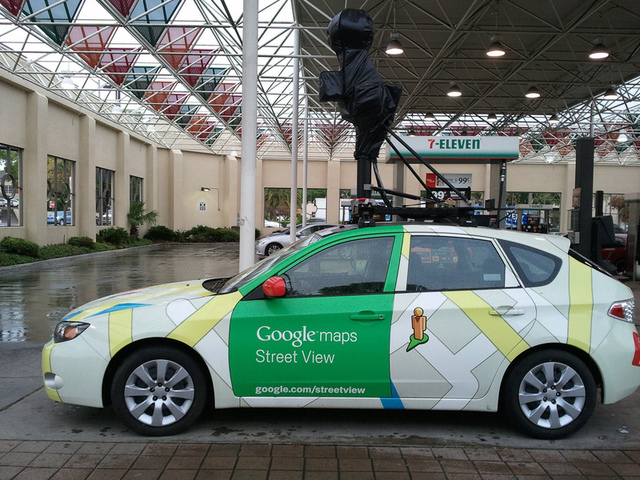
Feds: Upset by Google, man threw Molotov cocktails at Street View car near HQ

Raul Diaz was arrested June 30 outside Google headquarters and charged with arson.

An Oakland, California, man now faces federal arson charges after he was accused of separate instances of throwing Molotov cocktails at Google Street View cars and other vehicles parked near Google headquarters.

No one was injured in the attacks, but one of the cars involved was destroyed. According to the criminal complaint against Raul Diaz, this was a self-driving car, but a Google spokesperson told Ars the damaged vehicle was not self-driving. (We're awaiting further clarification).

According to an affidavit written by Michael Nuttall, a special agent with the Bureau of Alcohol, Tobacco and Firearms, the attacks began in May. The Mountain View Police Department first responded to a reported incident of arson at a Google building on May 19, 2016. There, two broken Blue Moon beer bottles were found, one with the wick still intact. A Street View vehicle appears to have been targeted, but it was undamaged.

Read 8 remaining paragraphs | Comments

US safety agency: Over 500,000 hoverboards to be recalled

They still look silly and still don’t hover.

(credit: urbanwheel.co)

More than half a million so-called “hoverboards” are being recalled, according to a Wednesday announcement by the Consumer Product Safety Commission. The government agency noted that there have been 99 reported incidents of batteries that have exploded or caught fire roughly within the last year.

Since March 2016, most self-balancing scooter sales have been halted in the United States anyway after Segway brought a patent suit. Prior to that, the devices were banned by several airlines in December 2015 over the same battery safety concerns.

As Ars reported earlier, the main reason hoverboards have self-destructed is because of their batteries. All of the major hoverboard brands use rechargeable lithium-ion batteries for power, and those can be dangerous for two reasons: cheapness and mistreatment. Li-ion batteries are used in everyday devices such as smartphones and tablets, but typically the companies making those devices can afford to use higher-quality, more expensive batteries.

Read 1 remaining paragraphs | Comments

This X-shaped sensor will alert you to incoming drones, so you can freak out

Starting at $10,000, Drone Tracker will help you find where those sneaky UAVs are.

(video link)

OAKLAND, Calif.—As I stand along the shores of Lake Merritt on a breezy summer day, I try to imagine I’m someone with either enough fame or money to worry about over-zealous paparazzi and over-curious neighbors. And because it’s 2016, when anyone can buy an inexpensive drone and fly it over my wall, I need some sort of countermeasure, like Dedrone’s DroneTracker.

I peer into a video feed and see an approaching object, marked as a green dot. It’s unclear based on the distance whether it’s a bird, a plane, Superman, or, indeed, a drone. As this drone approaches my DroneTracker, the green dot morphs into a red dot and then a red square.

Read 15 remaining paragraphs | Comments

County sheriff quietly expands drone fleet to 6, flown dozens of times

In June alone, sheriff’s deputies in Alameda Co., California flew 3 drone missions.

Earlier this week in San Leandro, California, law enforcement officers closed in on a house that they believed was being used as an illegal casino. But before deputies from the Alameda County Sheriff’s Office could secure the residence, one of the suspects bolted and started hopping fences. Luckily for the cops, the ACSO had a secret weapon: a drone. After the bust, they even bragged about it on Twitter.

"In this situation the suspect fled, and the UAV was able to observe the suspect flee and to alert the first responders to where he was so they could contain him and apprehend him as safely as possible," Capt. Tom Madigan, who was present for the bust, told Ars.

And what would have happened if the drone hadn’t been overhead?

Read 24 remaining paragraphs | Comments

Live in NYC or London? This chatbot will help you appeal parking tickets

160,000 tickets challenged, appellants have won over 60 percent of the time.

Joshua Browder, a 19-year-old British student at Stanford University, has created a chatbot (DoNotPay.co.uk) that successfully challenged parking tickets in London and New York City.

The chat interface asks a few basic questions and then auto-generates a legal appeal for a parking ticket (it can also make a claim for compensation regarding delayed flights). Alternatively, a simple Web form is available for those who don’t want to interact with an AI.

"When I started the website, it was because I got a few parking tickets myself," Joshua Browder told Ars by phone. "Local governments aren’t issuing these tickets when people are doing something wrong—they’re doing it to raise revenue."

Read 7 remaining paragraphs | Comments

To study possibly racist algorithms, professors have to sue the US

The CFAA, the law everyone loves to hate, pops up again.

(credit: UrbanOasis.org)

The American Civil Liberties Union filed a lawsuit Wednesday against the Attorney General of the United States, asking the court to declare a section of a 1980s-era anti-hacking law as "unconstitutionally overbroad."

In the case, known as Sandvig v. Lynch, the ACLU argues on behalf of First Look Media Works and four professors who want to deploy bots and fake profiles to study possible racial discrimination in online advertising for housing and employment. The researchers haven't been able to proceed because they're afraid of being sued or prosecuted under the Computer Fraud and Abuse Act (CFAA).

The ACLU's civil complaint points to examples in the media and in academia suggesting that such biases and unlawful practices may already be ongoing.

Read 4 remaining paragraphs | Comments

Airbnb: We shouldn’t have to help San Francisco enforce new rental law

Startup: Making us monitor listings for registration numbers violates federal law.

Members of HomeSharersSF, speaking at a rally at City Hall in San Francisco before the big vote on the Airbnb Law in October 2014. (credit: Kevin Krejci)

It’s not every day that a major tech company sues its hometown. But that’s exactly what’s just happened: on Monday, Airbnb sued the City and County of San Francisco over a new law set to go into effect next month.

The new law expands upon a previous ordinance, which Airbnb itself helped initially draft. The earlier law went into effect in February 2015—it defined and began to regulate short-term rentals. The additional legislation, set to take effect in late July 2016, now requires that listings on sites like Airbnb clearly publish this new registration number and holds both the host and the "platform" (Airbnb) potentially civilly and criminally liable for non-compliance.

In its civil complaint, Airbnb argues that it should not be found liable under the new ordinance, as it is exempt under federal statute. Specifically, Airbnb says that it is protected under Section 230 of the Communications Decency Act—the famed law that protects "computer service" providers from being found liable for speech made by its users.

Read 8 remaining paragraphs | Comments

To mitigate poverty, Y Combinator set to launch minimum income plan

A few dozen Oakland residents to get $2,000 per month, no strings, for a year.

(credit: Jaegar Moore)

OAKLAND, Calif.—Earlier this month, Y Combinator, the famed Silicon Valley incubator dropped a bombshell: it had selected this city to be the home of its new "Basic Income" pilot project, to start later this year.

The idea is pretty simple. Give some people a small amount of money per month, no strings attached, for a year, and see what happens. With any luck, people will use it to lift themselves out of poverty.

In this case, as Matt Krisiloff of Y Combinator Research (YCR) told Ars, that means spending about $1.5 million over the course of a year to study the distribution of "$1,500 or $2,000" per month to "30 to 50" people. There will also be a similar-sized control group that gets nothing. The project is set to start before the end of 2016.

Read 13 remaining paragraphs | Comments

FBI’s use of Tor exploit is like peering through “broken blinds”

Judge: Making a computer reveal its IP address does not constitute a search.

(credit: Billie)

Law enforcement does not need a warrant to hack someone’s computer, according to a just-unsealed court order written by a federal judge in Virginia.

This case, United States v. Matish, is one of at least 135 cases currently being prosecuted nationwide stemming from the FBI’s investigation of the Tor-hidden child pornography site called "Playpen."

US District Judge Henry Coke Morgan, Jr. further explained in the order on Thursday that warrantless government-sanctioned hacking "resembles" law enforcement looking through broken blinds. In this case, however, a warrant was sought and obtained. Judge Morgan found that even if the warrant did not exist—or was found to be invalid—the search would have been valid.

Read 6 remaining paragraphs | Comments

Ad firm: It doesn’t matter that migrant app doesn’t work, it’s the idea that counts

“I Sea” claimed its users could help migrants via “real-time” satellite imagery.

(credit: Rosyna Keller)

Grey Group has continued to defend its widely-criticized smartphone app, "I Sea," after it was pulled from the Apple App Store earlier this week when two security researchers exposed it as a fraud.

The app purported to be a crowdsourced way for people to help migrants crossing the Mediterranean Sea by spotting satellite images in "real-time." It won third place prize at a major global advertising industry competition held in Cannes, France.

On Thursday, a Grey Group spokesman, Owen Dougherty, insisted to Ars that "the app is real…the attack on us by [an] unnamed ‘tech blogger’ is the fraud in all of this. [It's] not worthy of comment let alone coverage."

Read 15 remaining paragraphs | Comments