Court: Feds must get warrant to search e-mail, even if cops find child porn

AOL flagged message with suspected child porn image, further search found 3 more.

(credit: Sara Björk)

A federal appeals court in Denver has ruled that e-mailed images obtained by the National Center for Missing and Exploited Children constituted a warrantless search, and therefore must be suppressed as part of a child pornography case.

The 10th Circuit Court of Appeals ruled last Friday in favor of a Kansas man who sent an e-mail in April 2013 with four attachments that included suspected child porn via his AOL account. AOL immediately flagged the message via its hash value matching algorithm, believing one of the attached images was suspect, and sent them all on to NCMEC. (Providers have a "duty to report" to the NCMEC if their users access, transmit, or store child pornography.) The agency then opened his message and confirmed that Walter Ackerman had indeed attempted to transmit not just one, but four illegal images.

The following month, a Homeland Security Investigations special agent got the tip through the NCMEC system, and he sought and received a warrant to search Ackerman's home in Lebanon, Kansas. Under questioning, Ackerman admitted to distributing child pornography via e-mail. Months later, Ackerman was formally indicted on two counts of child pornography. His lawyers filed a motion to suppress in February 2014, arguing that his e-mail was searched illegally. Ackerman eventually accepted a plea deal in September 2014. Although he was sentenced to 170 months in prison, he was kept out of custody pending an appeal on the Fourth Amendment question.

Read 5 remaining paragraphs | Comments

Corrupt Silk Road agent’s lawyer: This appeal is frivolous, I want out

After plea deal, ex-Secret Service agent Shaun Bridges makes spurious legal claims.

Shaun Bridges was captured by CCTV security cameras, leaving a Secret Service field office with a large bag. The government said the bag may have contained hard drives with keys needed to access his Bitstamp wallet. (credit: US Attorney's Office San Francisco)

The lawyer representing Shaun Bridges, the corrupt Secret Service agent who was part of the Silk Road investigation, has said that his recent appeal is largely worthless and has asked to be removed from the case.

Davina Pujari, who is Bridges’ third lawyer since his appeals process began in December 2015, wrote in a filing last Friday to the 9th Circuit Court of Appeals:

After having carefully examined this record and after having researched the relevant statutes and case law, counsel has concluded that this appeal presents only legally frivolous issues. Therefore, counsel requests the Court's permission to withdraw as attorney of record and to allow Appellant to file any further briefs he deems necessary.

Last year, Bridges was sentenced to 71 months in prison after pleading guilty to stealing money from Silk Road dealers while investigating the site. He is now in federal prison in Terre Haute, Indiana, and is set to be released in January 2021.

Read 4 remaining paragraphs | Comments

Ars asks: How can I bring my ancient car stereo into the modern era?

My 2003 Toyota Prius still has a tape deck! What new head unit do I want?

The 2003 Toyota Prius in question. (credit: Cyrus Farivar)

While I spend most of my time on my bike, my wife and I share a 2003 Toyota Prius. Technologically speaking, this is almost like saying I still own a Treo 650. Sure, it's a modern smartphone, but barely.

When we bought the used Prius in 2012, the previous owner made hay about how he had an aftermarket multi-disc CD changer installed in the trunk. I told him I would never use it, and more than four years later, I've proven myself right. Usually our radio is tuned to KQED (yes, we’re Bay Area public radio nerds), or for longer drives, podcasts.

For those unfamiliar with the Prius, its screen for displaying real-time energy efficiency pales in comparison to more modern cars. In fact, to hook up my iPhone, I have to use a cassette adapter to connect to the stereo and the cigarette lighter for power. (Cars Technica Editor Jonathan Gitlin reminds me that the last car to have a factory cassette deck was in model year 2010!)

Read 7 remaining paragraphs | Comments

If you’re an alleged drug dealer, don’t use “asshole209” as a password

David Ryan Burchard is accused of selling $1.4M in marijuana and cocaine online.

(credit: Marc Falardeau)

Nearly 18 months ago, federal authorities began investigating a man from Merced, California, who they believed was selling millions of dollars in bitcoins to an “unlicensed digital currency exchanger.”

That man, David Ryan Burchard, was arrested in March 2016 and pleaded not guilty at his first court appearance. After being recently released on bail, he now faces nearly 20 counts of drug-related and money laundering charges.

According to the affidavit by special agent Matthew Larsen of Homeland Securities Investigations (HSI), the FBI estimates that Burchard was the 18th largest vendor on Silk Road. That made Burchard the third-largest US-based vendor on the notorious and now-shuttered online drug market.

Read 29 remaining paragraphs | Comments

Mayor arrested, accused of secretly recording strip poker game with teens

Defense lawyer says his client, Stockton Mayor Anthony Silva, “denies the charges.”

This is the booking photo of Stockton Mayor Anthony Silva. (credit: Amador County Sheriff)

The mayor of Stockton, California was arrested Thursday and charged with felony eavesdropping, among other misdemeanor charges, related to a strip poker game that he allegedly played with teenage counselors at a camp for economically disadvantaged kids last year, according to prosecutors in neighboring Amador County.

Mayor Anthony Ray Silva was taken into custody Thursday morning at the annual mayor’s Youth Camp in Silver Lake, just outside of Stockton, an inland port city approximately 80 miles east of San Francisco.

N. Allen Sawyer, Silva's attorney, told Ars that his client remains mayor, has posted bail, and has returned Thursday afternoon to the camp to help final clean up. The City of Stockton said in a statement that law enforcement are on site at the camp, presumably to keep the peace.

Read 14 remaining paragraphs | Comments

Getty Images sued again over alleged misuse of over 47,000 photos

Lawyer: “Getty has been carelessly and recklessly acquiring content.”

Getty Images has been accused of selling unauthorized licenses to this, and thousands of other photos. (credit: Richard Liebowitz)

Getty Images has been hit with a second copyright-related lawsuit less than a week after famed photographer Carol Highsmith sued the company.

On Monday, Zuma Press, an independent press agency, sued Getty for alleged copyright violations and unauthorized licensing of more than 47,000 images.

In its nine-page civil complaint, Zuma attorney Richard Liebowitz alleged that as Getty has been rapidly expanding its collection of images, it has run roughshod over copyright.

Read 4 remaining paragraphs | Comments

Family of Star Trek actor Anton Yelchin sues Fiat Chrysler for wrongful death

Just a month before accident, FCA recalled 2015 Jeep due to strange shifter design.

(credit: Gary Dordick)

The family of the late Star Trek actor Anton Yelchin filed a wrongful death lawsuit Tuesday against Fiat Chrysler (FCA), alleging that because of a "defective design and/or manufacture" on his 2015 Jeep, the 27-year-old was killed.

According to the lawsuit, Yelchin’s 2015 Jeep Grand Cherokee had a defective monostable gear selector. Last month, Yelchin parked his Jeep at the top of his steep driveway at his home in Studio City, California, believing he had put it properly into park. However, the car seems to have rolled down the driveway quickly, pinning him to the gate, trapping him there, and eventually killing him.

The civil complaint, filed in Los Angeles County Superior Court, says that not only was Yelchin’s 2015 Jeep affected, but as family lawyer Gary Dordick noted:

Read 5 remaining paragraphs | Comments

Clerk printed lottery tickets she didn’t pay for but didn’t break hacking law

Oregon Supreme Court: Woman stole, but she was “authorized” to use lottery machine.

(credit: Google Street View)

The Oregon Supreme Court has ruled that while a convenience store clerk was guilty of stealing lottery tickets through the store’s computer system, she did not violate the state’s anti-hacking law while doing so.

In the case, known as State v. Nascimento, Oregon’s highest court ruled late last month that a hacking conviction against the defendant should be overturned, and the court sent the case back down to the lower court for reconsideration. The Electronic Frontier Foundation, which appeared on Caryn Nascimento’s behalf during the case as an amicus curae (friend of the court), announced the narrow victory on Tuesday.

According to the Supreme Court’s decision, the case dates back to 2007, when Nascimento began working at Tiger Mart, a small convenience store in Madras, Oregon, about 120 miles southeast of Portland. In late 2008 and early 2009, a company vice president began investigating what appeared to be cash shortages at that store, sometimes about $1,000 per day. After reviewing video recordings that correlated with Nascimento’s work schedule, this executive began to suspect that she was buying lottery tickets but not paying for them.

Read 7 remaining paragraphs | Comments

Nigerian authorities arrest alleged mastermind of $60M worth of online scams

Interpol: “Mike” used network of 40 people across Africa, Asia to execute schemes.

(credit: B Rosen)

Authorities finally arrested an alleged Nigerian online scammer accused of orchestrating schemes totaling more than $60 million, according to Interpol. The 40-year-old man, whom authorities have said is known as “Mike,” is also believed to have convinced one person to pay out $15.4 million. The man was arrested in Port Harcourt, in southern Nigeria

Mike and another unnamed Nigerian now face charges including hacking, conspiracy, and obtaining money under false pretenses.

According to the international law enforcement organization, Mike used “a network of at least 40 individuals across Nigeria, Malaysia, and South Africa which both provided malware and carried out the frauds. The alleged mastermind also had money laundering contacts in China, Europe, and the US who provided bank account details for the illicit cash flow.”

Read 4 remaining paragraphs | Comments
Seymour Papert, theorist behind One Laptop Per Child, dies at 88

South African computer scientist had an outsized influence on tech-driven learning.

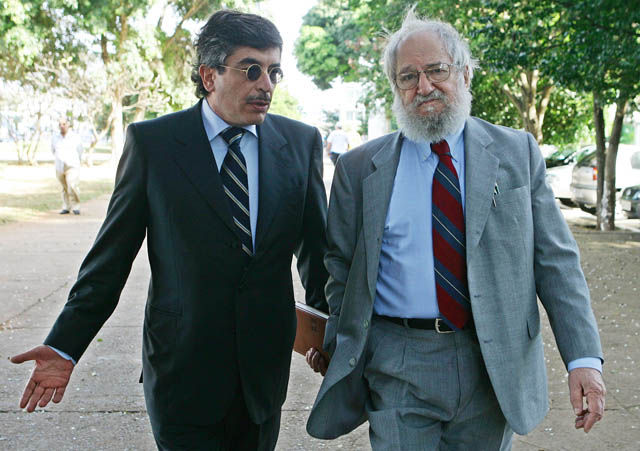
Seymour Papert (right) seen here in 2005. (credit: Rodrigo Mesquita)

Seymour Papert, one of the creators of the Logo programming language and a significant influence behind One Laptop Per Child and Lego Mindstorms, died Sunday at home in Maine. He was 88.

On Monday, the Logo Foundation announced Papert’s passing in a tweet, but it did not cite a cause of death. Papert had sustained a serious brain injury after being hit by a motorcycle in Vietnam in 2006.

Papert was born February 29, 1928 in Pretoria, South Africa, where he completed his doctorate in mathematics in 1952 at the University of the Witwatersrand. He then emigrated to the United Kingdom, where he completed another doctorate at Cambridge University. After bouncing around European universities in the early 1960s as a researcher, he finally landed at the Massachusetts Institute of Technology in 1963.

Read 3 remaining paragraphs | Comments