I put an $18 silicone smartphone mount on my bike, and it was sweet

Sure, the Finn rotated a bit around my handlebar, but I could mount it in seconds.

Of course I read Ars while stopped at traffic lights. Don't you? (credit: Cyrus Farivar)

OAKLAND, Calif.—Even though I work at home, I’m on my bike nearly every day—whether it’s picking up groceries at Trader Joe’s, or meeting friends, or picking up my kid from school—most places nearby are within a quick bike ride of my front door.

Most of the time when I’m in the saddle, I know where I’m going. My iPhone remains firmly in my pocket. But, like anyone, there have been times where I head out, not 100 percent sure of my route, and I have to pull over and examine Google Maps to figure out precisely which street I’m supposed to turn left on. It's certainly frustrating at times.

So I was intrigued when I received an e-mail from Austrian company Bike Citizens about a universal smartphone mount for bikes called Finn.

Read 16 remaining paragraphs | Comments

Judge knocks Uber over latest attempt to bar drivers from class-actions

Hours-long hearing marks latest chapter in class-action suit, O’Connor v. Uber.

(credit: Uber)

SAN FRANCISCO—On Thursday, a federal judge admonished Uber over its questionable newly issued labor agreement. He also ruled that the new agreement does not affect members of the certified class of California drivers who are currently suing Uber over whether they should be considered employees.

Uber’s lawyer, Theodore Boutrous, said the company believed it was within its right to suddenly send out the new document last Friday, which drivers had to agree to in order to continue driving for the company.

"Whatever your intent, I'm going to tell you my intent, I had no intent to say go ahead and issue notices," US District Court Judge Edward Chen said during the hearing in O'Connor v. Uber, which was over two hours long.

Read 10 remaining paragraphs | Comments

Chicago doubles down on $300 million lawsuit against red light camera firm

New amended complaint also targets Redflex’s Australian corporate parent.

(credit: Renee McGurk)

Redflex Holdings Limited (RHL), the embattled Australian red light camera company, has now been brought into an ongoing massive corruption-related lawsuit involving the city of Chicago.

Earlier this year, the city of Chicago had previously sued Redflex Traffic Systems Inc. (RTSI), RHL’s Arizona-based subsidiary, for $300 million. RTSI recently had the case transferred out of Illinois state court and into federal court.

Earlier this week, the city of Chicago filed an amended complaint outlining expanded allegations against both firms. The new allegations include the previous accusations of violations of the city’s False Claims Ordinance “as well as claims for breach of contract, civil conspiracy, unjust enrichment, and payment of kickbacks in connection with City contracts.”

Read 11 remaining paragraphs | Comments
Busted by online package tracking, drug dealer gets more than 8 years in prison

Even after getting arrested, Harold Bates still received drugs from China.

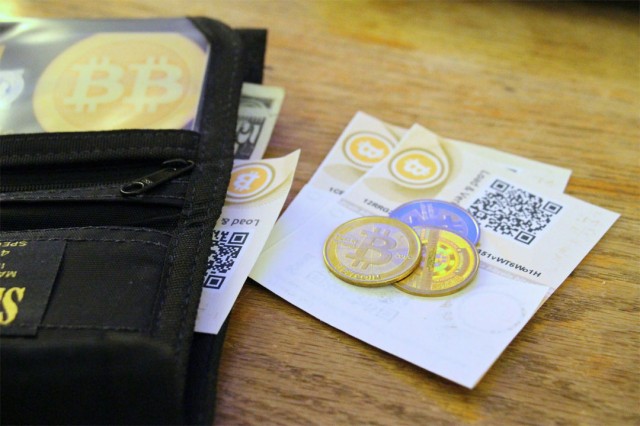
(credit: Adam Jones, Ph.D.)

A Massachusetts man who bought methylone (also known as "molly") online from China was sentenced Monday to eight years and four months in prison.

Harold Bates pleaded guilty in September 2015 to importing methylone and one count of possession by an inmate in prison of a prohibited object. Curiously, the man was busted by the digital trail he left on the USPS tracking website, according to the United States Postal Inspection Service.

The judge’s memorandum and order from April 2015 explains that in October 2013, postal investigators found 500 grams of a substance that turned out to be methylone in a package to be delivered in Hollywood, Florida. That statement may suggest investigators found the suspicious package first and then manually checked IP logs to see if anyone had been searching for tracking information. Once they located Bates’ IP address, they could then check to see if it had been used to search for other packages.

Read 2 remaining paragraphs | Comments
All LA schools shut down over message sent from 8chan’s e-mail host, cock.li

“We live in an age where anonymous messages can be sent with extreme ease.”

(credit: Ken Conley)

The "credible" threat that caused the Los Angeles Unified School District (LAUSD) to close all schools on Tuesday was sent from cock.li, the "meme" e-mail host that also provides e-mail services for 8chan, the 4chan splinter site.

School officials in New York and Los Angeles reportedly both received threats from madbomber@cock.li but only LAUSD took it seriously. All 640,000 LAUSD students were unable to attend classes on Tuesday.

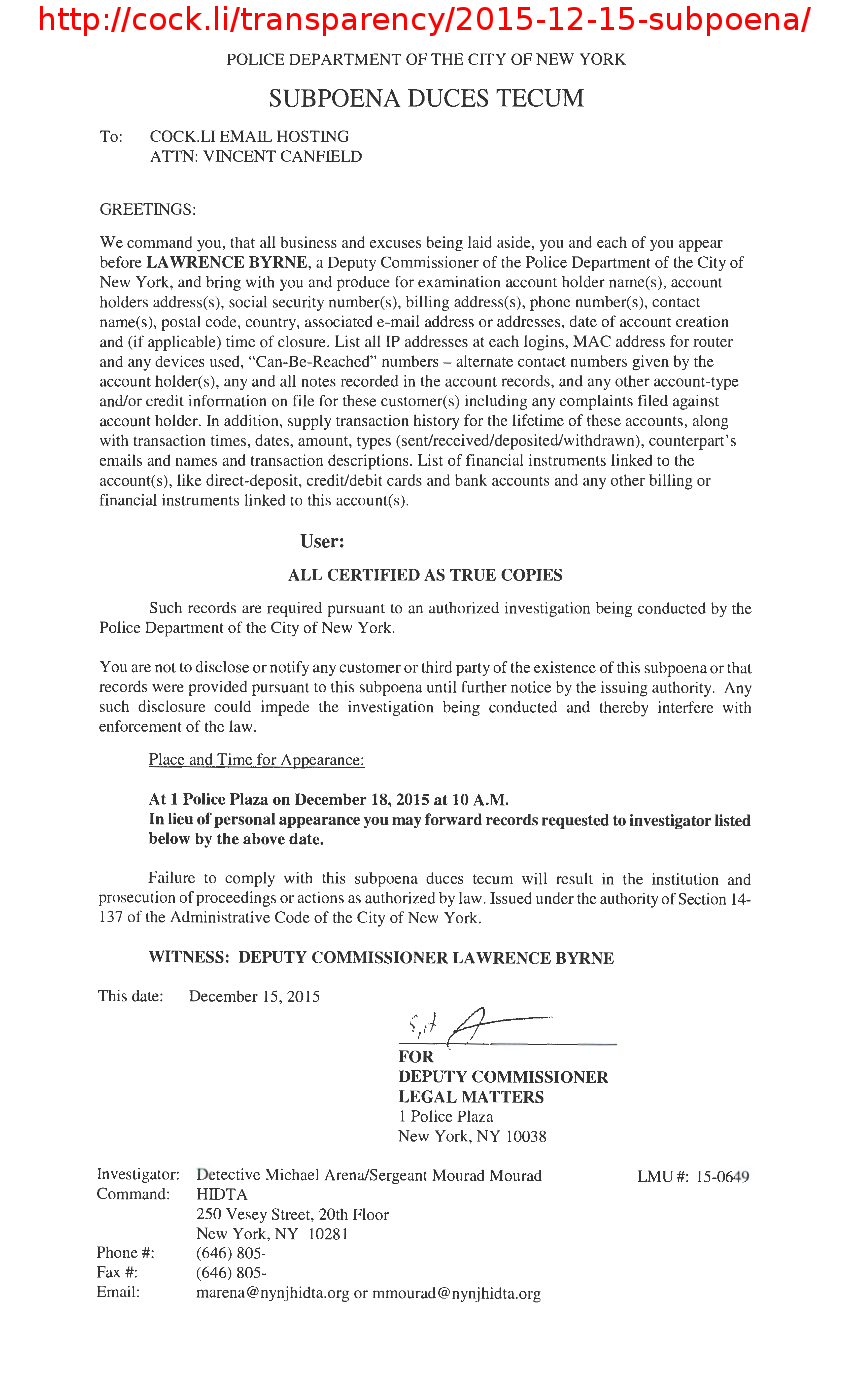
Vincent Canfield, the founder of cock.li, posted a copy of the subpoena he received from a New York detective on his own website and included audio recordings of polite but brief conversations with two officials from the New York Police Department (NYPD) Intelligence Bureau.

Read 14 remaining paragraphs | Comments

Tech firms could owe up to 4% of global revenue if they violate new EU data law

After years of negotiation, European Union approves new data protection law.

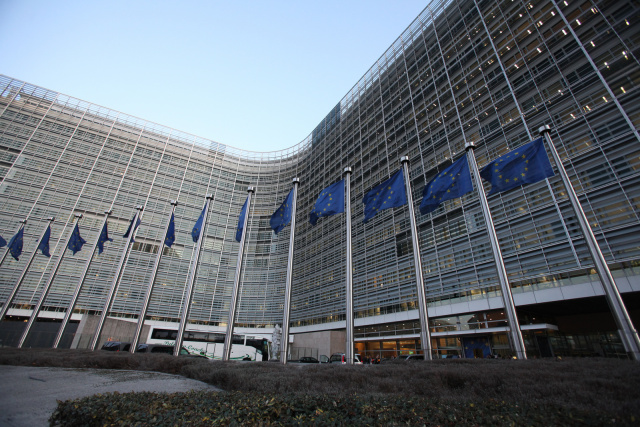
(credit: Parti socialiste)

European Union negotiators have finally agreed on the text of a significant new data protection and privacy law after years of debate.

On Tuesday, the European Commission, the European Parliament and the European Council came to a consensus on the language of the text, which has not yet been released in its entirety. (The most recent previous draft Ars was able to locate was dated November 27, 2015.)

Notably, the agreement sets the maximum corporate fine for violating user privacy to four percent of a company’s worldwide revenue—significantly more than the marginal sums that companies like Facebook and Google have paid in the past. For a company like Facebook, the new agreement would mean a potential maximum fine in the neighborhood of $500 million. For Google’s parent company, Alphabet, it would be about $2.5 billion.

Read 5 remaining paragraphs | Comments

Uber doesn’t want drivers to sue again, so it pushes them to arbitration

Attorney leading lawsuit against Uber files emergency motion to halt new agreement.

(credit: Uber)

On Friday, Uber pushed a new 21-page agreement on to all of its 400,000-plus drivers nationwide, forbidding them from filing a lawsuit in the event of a future labor dispute. Drivers were required to agree to the terms on their phones and could not accept any more fares until they did so.

As a result, the lawyer representing California-based Uber drivers in an ongoing class action lawsuit has asked a federal judge in San Francisco to immediately put a stop to the new agreement.

Under Uber's new agreement, drivers are now supposed to only file for arbitration rather than sue or join a class action lawsuit. Unlike the public judicial system, arbitration is wholly private and almost always favors companies over people. Worse still, it makes class action cases nearly impossible, creating a situation where individuals en masse can rarely hold companies accountable for wrongdoing.

Read 8 remaining paragraphs | Comments

American, United, Delta, British Airways all ban “hoverboards”

Delta: sometimes there are mislabeled batteries that can “spontaneously overheat.”

(credit: Ben Larcey)

On Friday, three major US airlines’ ban against so-called "hoverboards" goes into effect.

American, United, and Delta banned the devices on Thursday out of concern that their lithium ion batteries could be a fire hazard on a flight. According to the Los Angeles Times, British Airways will also reject the self-balancing devices.

In a statement, Delta said that it had "reviewed hoverboard product specifications and found that manufacturers do not consistently provide detail about the size or power of their lithium-ion batteries. This investigation revealed devices often contain battery varieties above the government mandated 160 watt hour limit permitted aboard aircraft."

Read 2 remaining paragraphs | Comments

Defunct social network asks court to reverse Facebook’s $3M award in spam case

Facebook sued Power Ventures back in 2008, won “permanent injunction” in 2013.

(credit: Power Ventures)

SAN FRANCISCO—A panel of three federal appellate judges appeared generally skeptical on Wednesday as forgotten social networking startup Power Ventures claimed that the company and its former CEO are not liable for violating an anti-spam and an anti-hacking law. A lower court previously ruled in favor of Facebook, which brought the original case, and issued an award of $3 million to the social network giant.

Back in 2008 when the original suit was filed, Power.com attempted to be a one-stop-shop for all social networks—its users could post to Facebook and other sites all in one place.

But as part of its "Power 100" campaign, Power Ventures offered its customers the chance to win $100 if they invited 100 friends to join. In so doing, Power Ventures sent messages through Facebook that came from @facebookmail.com and appeared to come from "The Facebook Team," giving the impression that they had come from Facebook itself. Facebook attempted to block this activity through an IP block, which Power Ventures circumvented. When Power Ventures ignored Facebook’s requests to cease-and-desist, Facebook then filed a lawsuit in 2008.

Read 20 remaining paragraphs | Comments

Thai police: Suspected Silk Road consigliere to be sent to US soon

Suspect accused of being Variety Jones on Silk Road to fight extradition to US.

(credit: Zach Copley)

On Thursday, Thai authorities told reporters that they plan on extraditing Roger Thomas Clark, the Canadian man accused of being a top adviser to Silk Road founder Ross Ulbricht.

"We caught and detained him and he is being held by immigration police in Bangkok," said Songpol Wattanachai, a deputy spokesman for national police, according to Reuters. "We are in the process of sending him back to the United States as America asked for him. We can send him back in about a month."

Clark, who was arrested last week in Thailand, has been criminally charged in the United States with one count of narcotics conspiracy and one count of money laundering conspiracy.

Read 3 remaining paragraphs | Comments