“What are you doing in my f?!@#g house?”—a behind-the-lens look at body cameras

As more cities want more footage, Taser (and rivals) is all too happy to oblige.

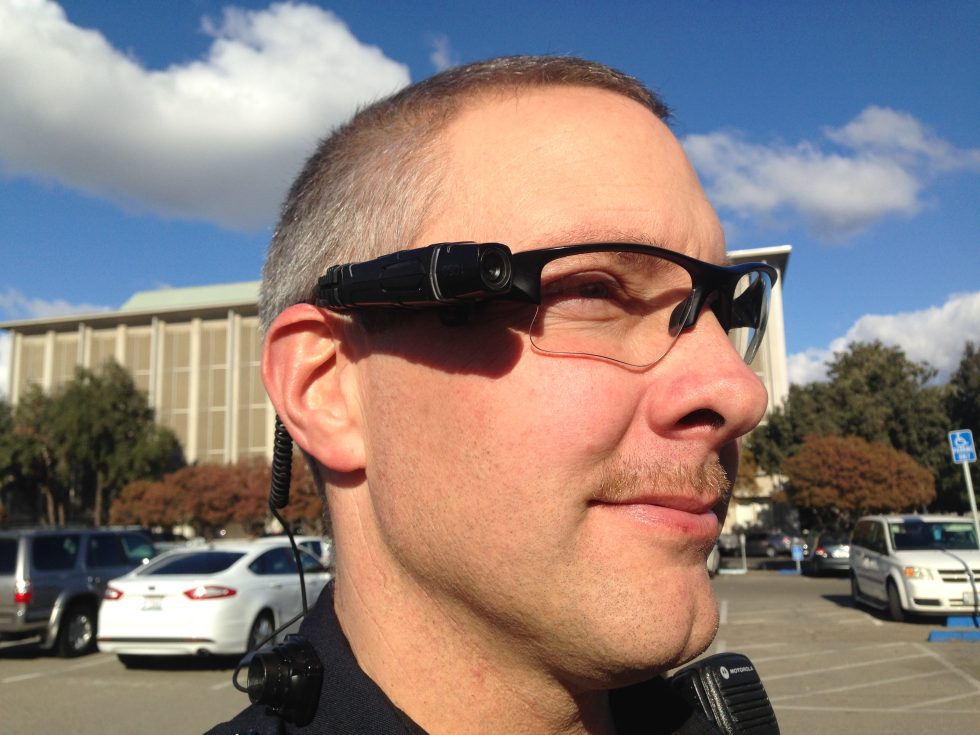
Martin Van Overbeek of the Fresno Police Department models a Taser Axon Flex body-worn camera. (credit: Cyrus Farivar)

SAN LEANDRO, Calif.—All I knew was that somebody called in a local disturbance—a local barbecue had apparently gotten a little too loud. I tapped twice to activate my body-worn camera, which hung from the middle of my chest. I listened for the beep to indicate that it was recording and started walking.

A moment later, I was face-to-face with a man who seemingly would not shut up.

"Hello, how are you sir?" I said, trying to be authoritative, friendly, and cop-like.

Read 98 remaining paragraphs | Comments
An afternoon at the battleship in the desert—Ars visits Taser’s HQ

“We want to blow your socks off when you come here.”

Video by Jennifer Hahn (video link)

SCOTTSDALE, Ariz.—We arrived at an imposing building that stood apart from its boring office park neighbors. While other structures looked to be housing pencil-pushers, this exterior had a three-story image of a police officer looming over all visitors. Even the entrance to the building was something else entirely—it featured a spaceship-like metallic circle with a projected logo on the floor. The receptionist buzzed us via an iPad. It was clear this wasn't the normal nine-to-five.

Read 23 remaining paragraphs | Comments

In 2016, terror suspects and 7-Eleven thieves may bring surveillance to Supreme Court

This year, US v. Graham is just one of several privacy cases we have our eye on.

(credit: Chris Wieland)

It has now been 2.5 years since the first Snowden revelations were published. And in 2015, government surveillance marched on in both large (the National Security Agency) and small (the debut of open source license plate reader software) ways.

Within the past year, Congress voted to end Section 215 of the Patriot Act—but then substituted it with a similar law (USA Freedom Act) that leaves the phone metadata surveillance apparatus largely in place even if the government no longer collects the data directly. Even former NSA Director Michael Hayden admitted in June 2015 that this legal change was pretty minor.

We also saw some notable 2015 reforms as to how federal law enforcement uses stingrays, the invasive cell-phone surveillance devices in use by everyone from local cops all the way up to the FBI, the Department of Homeland Security (DHS), and the Internal Revenue Service (IRS). The Department of Justice (the parent agency of the FBI) and DHS both announced new policies that require the agencies to get a warrant prior to deploying the snooping device.

Read 31 remaining paragraphs | Comments

In 2015, promising surveillance cases ran into legal brick walls

Attorneys everywhere are calling things moot after the phone metadata program ended.

(credit: Gage Skidmore)

Today, the first Snowden disclosures in 2013 feel like a distant memory. The public perception of surveillance has changed dramatically since and, likewise, the battle to shape the legality and logistics of such snooping is continually evolving.

To us, 2015 appeared to be the year where major change would happen whether pro- or anti-surveillance. Experts felt a shift was equally imminent. "I think it's impossible to tell which case will be the one that does it, but I believe that, ultimately, the Supreme Court will have to step in and decide the constitutionality of some of the NSA's practices," Mark Rumold, an attorney with the Electronic Frontier Foundation, told Ars last year.

The presumed movement would all start with a lawsuit filed by veteran conservative activist Larry Klayman. Filed the day after the initial Snowden disclosures, his lawsuit would essentially put a stop to unchecked NSA surveillance. In January 2015, he remained the only plaintiff whose case had won when fighting for privacy against the newly understood government monitoring. (Of course, it was a victory in name only—the judicial order in Klayman was stayed pending the government’s appeal at the time).

Read 34 remaining paragraphs | Comments
Kim Dotcom to be finally extradited to the US, New Zealand judge rules

Megaupload founder promises new appeal in case that’s dragged on for nearly 4 years.

This week, Kim Dotcom tweeted this photo, with the tagline: "When life gives you lemons, make lemonade!" (credit: Kim Dotcom)

On Tuesday afternoon (Wednesday, Auckland time) a New Zealand judge ordered that founder Kim Dotcom and his co-defendants should be extradited to the United States to face criminal charges over alleged massive copyright infringement on his now-shuttered site, Megaupload.

The judgement, which almost certainly will be appealed, sets the stage for the winding down of Dotcom’s tenacious years-long legal fight against the American judicial system.

As Ira Rothken, Dotcom's California-based lawyer, tweeted:

Read 14 remaining paragraphs | Comments

Judge, siding with Google, refuses to shut down Waze in wake of alleged theft

“This rule applies even when the ‘facts’ are inaccurate.”

Google, the owner of the traffic app Waze, has managed to beat back a copyright lawsuit filed by lesser-known rival PhantomAlert.

Back in September 2015 PhantomAlert sued Google over allegations of copyright infringement. Google purchased Waze in June 2013 for over $1 billion. PhantomAlert alleged that after a failed data-sharing deal between itself and Waze collapsed in 2010, Waze apparently stole PhantomAlert’s "points of interest" database.

In a judicial order filed earlier this month, the San Francisco-based federal judge found that PhantomAlert could not allege a copyright claim on simple facts of where different places actually are.

Read 4 remaining paragraphs | Comments

San Francisco politician’s iPhone snatched away, but he negotiates for it back

“Whether I ever get the $200 back, it’s worth it to get her off the streets.”

Turns out, if your phone gets stolen, you might be able to negotiate with your mugger. At least that’s a strategy that worked for San Francisco Supervisor Scott Wiener last Friday night as dusk was falling around 5:30 pm.

The local politician told Ars that he was walking down 16th St. from his home in the Castro towards a nearby BART station. He was waiting for a red light at 16th and Valencia when he stopped to take his iPhone out of his pocket to check his calendar for a brief moment. All of a sudden, a woman, flanked by two men appeared.

"She grabbed the phone out of my hand," he said.

Read 10 remaining paragraphs | Comments

Cock.li e-mail server seized by German authorities, admin announces

Vincent Canfield: “I will say that I have the utmost respect for law enforcement.”

(credit: Vincent Canfield)

In a new video statement posted on Monday, the administrator of novelty e-mail provider cock.li announced that one of the hard drives used to host the service in a Bavarian data center had been seized.

"That means that SSL keys and private keys and full mail content of all 64,500 of my users, as well as hashed passwords, registration time, and the last seven days of logs were all confiscated and now are in the hands of German authorities," Vincent Canfield said.

Cock.li was reportedly used last week to send a bogus bomb threat e-mail from "madbomber@cock.li" to several school districts nationwide, which led to the closure of all schools in the Los Angeles Unified School District. The New York City Department of Education however, dismissed the e-mail as an obvious hoax.

Read 7 remaining paragraphs | Comments

CEO Tim Cook denies tax dodging: “Apple pays every tax dollar we owe.”

Why doesn’t Apple bring overseas profits home? Because it would cost 40 percent.

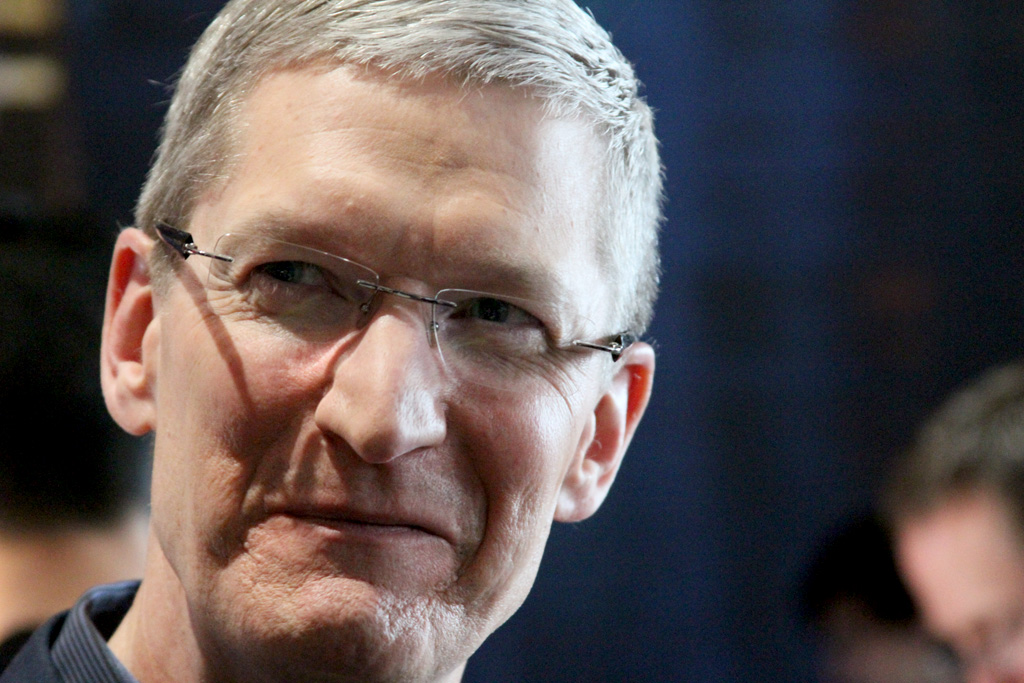
Enlarge / Apple CEO Tim Cook. (credit: Chris Foresman)

In an interview last weekend with 60 Minutes, Apple CEO Tim Cook defended his company’s use of the legal overseas tax maneuvering that effectively keeps tens of billions of dollars in would-be American tax revenue out of the country.

In a short back and forth with host Charlie Rose, Cook gave a very legalistic—though accurate—answer as to why Apple does not repatriate its mounds of cash. Cook said that Apple pays more taxes in the United States than anyone else.

After all, it is the most profitable company in America and the second-most in the entire world.

Read 4 remaining paragraphs | Comments

As Venezuelan economy collapses further, gov’t targets US-based currency news site

Pres. Nicolas Maduro said he’d ask US to extradite “bandits” behind DolarToday.com.

(credit: ruurmo)

The US-based website that publishes a daily unofficial exchange rate between American dollars and Venezuelan bolivares has recently filed a vigorous defense in a strange international lawsuit. The site, DolarToday, was sued in October 2015 by the Central Bank of Venezuela (CBV) in federal court in Delaware, where the site is based.

In its bizarre and bombastic civil complaint, the US-based lawyer for the CBV argued that the three Venezuelan-American men who run the site are engaged in "cyber-terrorism" designed to create "the false impression that the Central Bank and the Republic are incapable of managing Venezuela’s economy."

The CBV formally accuses DolarToday of violating a major anti-racketeering and criminal conspiracy statute (RICO Act), false advertising, unjust enrichment, and strangely, breaching a Venezuelan civil statute that refers to "causing harm." (Obviously, an American federal court has no ability to adjudicate claims made under Venezuelan law.)

Read 8 remaining paragraphs | Comments