Guilty: Corrupt ex-city official who pushed red-light camera deal convicted

John Bills took bribes to push lucrative contract for Redflex—he bought a boat, car.

A Redflex camera as seen in Modesto, California. (credit: Cyrus Farivar)

On Tuesday, a federal jury in Chicago found a former city transportation official guilty on all 20 counts of mail and wire fraud, bribery, extortion, conspiracy, and tax evasion charges.

John Bills, who was the managing deputy commissioner at the Department of Transportation, helped steer a lucrative city contract to Redflex, the embattled Australian red-light camera vendor. He faces decades in prison but won't be sentenced until May 2016.

After Bills urged his colleagues to approve the deal, the city hired Redflex to provide automated enforcement cameras, known formally as its Digital Automated Red Light Enforcement Program (DARLEP), from October 2003 until February 2013. That contract abruptly ended after Bills was shown to have accepted a hotel room that Redflex paid for—but city officials believe that the corruption ran far deeper. In October 2013, Chicago selected Xerox ACS to replace Redflex as its new red-light camera operator. Since then, Redflex has suffered financially, dubbing North America a "low/no-growth market.”

Read 8 remaining paragraphs | Comments

Three reasons why Bitcoin isn’t dead yet

Op-ed: Despite the loss of a key dev (and his pessimistic words), Bitcoin plows ahead.

(credit: Trader Tim)

About a week ago, colleagues were sending me copies of a Medium post ricocheting all over the Internet: a crucial Bitcoin developer, Mike Hearn, was calling it quits. The announcement unsurprisingly spawned media speculation and opinion pieces with headlines like, "RIP Bitcoin, it’s time to move on." Bitcoin’s trading price in US dollars fell by about 10 percent in about 24 hours.

But take it from an admitted Bitcoin skeptic—the cryptocurrency isn’t anywhere close to being dead. At least, it's not dying anytime soon.

Hearn is certainly much more knowledgeable about Bitcoin than I am, and he outlines a compelling case for why Bitcoin is in crisis. I hadn’t known, for example, that the blockchain is controlled by a majority of miners based in China where outbound international traffic has high latency. I didn’t realize there’s a huge drag on completing Bitcoin-based transactions. And after reading Hearn’s previous piece arguing in favor of the Bitcoin XT fork, I didn’t realize so many people hated the idea. Users wanted the term banned entirely from a prominent Bitcoin forum.

Read 9 remaining paragraphs | Comments

Appeals court: Evidence stands against man who used Tor-enabled child porn site

Legal experts: Technical misunderstanding points to large problem in hacking cases.

(credit: Steven Guzzardi)

A federal appeals court has upheld the evidence that lead to the conviction of a Florida man who was sentenced last year to 10 years in prison for accessing a Tor-enabled child porn site, PedoBook.

Lawyers representing Joshua Welch argued on appeal that because prosecutors did not adequately provide him notification of a warrant that enabled investigators to deploy a "network investigative technique," (NIT) that the subsequent evidence should be tossed. Last week, the 8th Circuit Court of Appeals upheld the United States District Court of Nebraska's previous ruling in US v. Welch, finding that Welch could not show that he was "prejudiced by the violation or that the investigators recklessly disregarded proper procedure."

The NIT, as Ars has reported previously, is a type of malware designed to unmask Tor users by using a Flash-based exploit. When deployed, it reveals a Tor users' true IP, which through a subpoena can be used to identify a particular person. (This particular Tor vulnerability that allowed the NIT to operate was fixed in 2013.)

Read 10 remaining paragraphs | Comments

San Francisco’s largest taxi firm files for bankruptcy protection, owes over $20M

Yellow Cab Co-Op appeals to the judge, hoping to allow drivers to continue to be paid.

(credit: Andrea Vallejos)

As expected, court records now show that San Francisco’s largest traditional taxi company has filed for Chapter 11 bankruptcy protection.

According to a Friday filing, Yellow Cab Co-Op owes over $20 million in disputed claims under civil litigation, related arbitration and mediation, and other debts. The company's troubles come as the taxi industry as a whole has simultaneously been squeezed by startup newcomers such as Uber, Lyft, and the recently defunct Sidecar. Those companies are regulated under California’s "transportation networking company" (TNC) law, which is separate from traditional taxi law.

Yellow Cab Co-Op’s largest creditor is a woman who was awarded an $8 million judgement in 2015 after she sustained very serious injuries in a 2011 taxi crash. In that San Francisco case, known as Fua v. Yellow Cab, the company argued the driver was not an employee and therefore the company was not liable. Curiously, this is similar to arguments that Uber, Lyft, and like firms have made. Uber in particular is being sued over whether its drivers should be treated as employees or contractors.

Read 5 remaining paragraphs | Comments

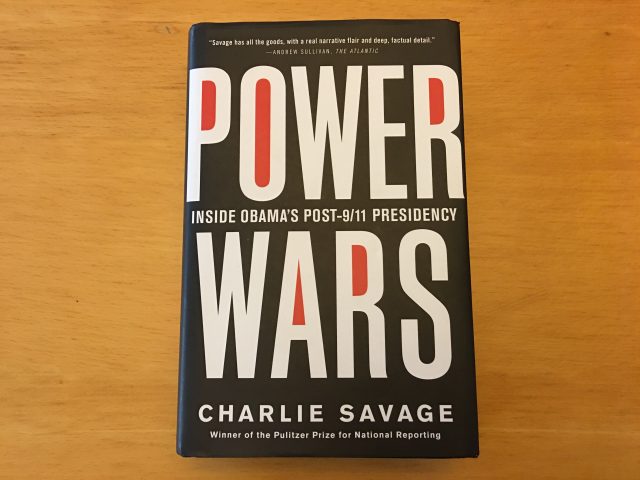
Power Wars: How Obama justified, expanded Bush-era surveillance

Review: veteran national security reporter has inside scoop on Obama White House.

(credit: Cyrus Farivar)

Over the winter holidays, I took some well-needed time offline, away from e-mail and social media. I hung out with friends and family, and spent hours with my nose in a massive book, Power Wars: Inside Obama’s Post-9/11 Presidency. Charlie Savage’s latest book is the most essential explanation of modern-day American national security policy.

After reading it, I came away with one (fairly obvious) conclusion: keeping the republic safe is hard, and crazy complicated. Anyone who has followed current events on drone strikes, surveillance, and encryption, and other essential issues at the forefront of modern America—and wants the entire inside baseball play-by-play to go with it—will love this book. (The book is quite expansive and covers many other issues that this review will not address.)

The premise of the book is simple and intriguing. It opens with two epigraphs, both from Barack Obama.

Read 36 remaining paragraphs | Comments

After FBI briefly ran Tor-hidden child-porn site, investigations went global

“It’s amazing the shit law enforcement leave online, accessible by some Google-fu.”

(credit: Andrew)

In 2015, the FBI seized a Tor-hidden child-porn website known as Playpen and allowed it to run for 13 days so that the FBI could deploy malware in order to identify and prosecute the website’s users. That malware, known in FBI-speak as a "network investigative technique," was authorized by a federal court in Virginia in February 2015.

In a new revelation, Vice Motherboard has now determined that this operation had much wider berth. The FBI’s Playpen operation was effectively transformed into a global one, reaching Turkey, Colombia, and Greece, among others.

Motherboard’s Joseph Cox wrote on Twitter on Friday that he was able to find a document describing this infiltration as something called "Operation Pacifier" by using creative "Google-fu."

Read 11 remaining paragraphs | Comments

Tor Project raises over $200,000 in attempt to “diversify” its funding

Activist group took in about $2.5M in 2014, mostly from US government sources.

(credit: Tor Project)

As a result of its recent crowdfunding campaign, the Tor Project announced Thursday that it had raised over $200,000 from more than 5,000 individuals over nearly two months.

The organization also released its 2014 Form 990, the financial document that all nonprofits must file with the IRS.

As of 2014, the organization took in about $2.5 million annually, roughly 75 percent of that coming from grants from US government institutions such as Radio Free Asia and the State Department.

Read 1 remaining paragraphs | Comments

Yet another bill seeks to weaken encryption-by-default on smartphones

Asm. Jim Cooper: “Human trafficking trumps privacy, no if ands or buts about it.”

(credit: Julien Sabardu)

A second state lawmaker has now introduced a bill that would prohibit the sale of smartphones with unbreakable encryption. Except this time, despite very similar language to a pending New York bill, the stated rationale is to fight human trafficking, rather than terrorism.

Specifically, California Assemblymember Jim Cooper’s (D-Elk Grove) new bill, which was introduced Wednesday, would "require a smartphone that is manufactured on or after January 1, 2017, and sold in California, to be capable of being and decrypted and unlocked by its manufacturer or its operating system provider."

If the bill passes both the Assembly and State Senate, and is signed into law by Gov. Jerry Brown (D), it would affect modern iOS and Android devices, which enable full-disk encryption that neither Apple nor Google can access. AB 1681’s language is nearly identical to another bill re-introduced in New York State earlier this month, but Cooper denied that it was based on any model legislation, saying simply that it was researched by his staff. He also noted that the sale of his own iPhone would be made illegal in California under this bill.

Read 18 remaining paragraphs | Comments

New privacy bills to hinder data collection could affect 100M Americans

Among other proposals, a new Nebraska bill would ban stingrays outright.

(credit: ACLU)

On Wednesday, the American Civil Liberties Union unveiled a new campaign to introduce a slew of pro-privacy bills in 16 states across America and the District of Columbia.

In what it has dubbed "#TakeCTRL," the ACLU has partnered with various lawmakers in states ranging from Hawaii to New Hampshire to propose new laws that, among other restrictions, would require a warrant for the use of cell-site simulators, impose "rapid deletion" of data collected by an automatic license plate reader, and limit educational institutions’ ability to access data about what students do on school-loaned computers.

"A bipartisan consensus on privacy rights is emerging, and now the states are taking collective action where Congress has been largely asleep at the switch," Anthony Romero, the head of the ACLU, said in a statement. "This movement is about seizing control over our lives. Everyone should be empowered to decide who has access to their personal information."

Read 3 remaining paragraphs | Comments

Kickstarter publishes inside story of how Europe’s most-funded project collapsed

Startup Torquing Group raised $3.4M for a handheld drone that didn’t deliver.

Ars held this Zano prototype at Torquing Group's office in April 2015. (credit: Cyrus Farivar)

Kickstarter has posted its post-mortem on how Europe’s most-crowdfunded project suddenly collapsed, marking the first time the company has hired a reporter to examine a failed project.

In a 13,000-word article first sent to backers of the Zano handheld drone and then re-posted on Medium, journalist Mark Harris concluded that Wales-based Torquing Group over-promised and under-delivered due to incompetence rather than malice.

"I don’t think any amount of time or money with those people would have resulted in a success," Harris told Ars. "I got the impression they were in over their head. They were out of their depth."

Read 18 remaining paragraphs | Comments