Ted Cruz not great at buying domain names, loses CruzFiorina.com

Republican consultant beat him to the punch, re-directed it to charity donation page.

Senator Ted Cruz. (credit: Gage Skidmore)

Sen. Ted Cruz (R-Texas) clearly needs to fire whoever buys domain names for him.

The Republican presidential contender, having already lost the obvious TedCruz.com—settling for TedCruz.org—missed out Wednesday on the predictable URL to incorporate his new running mate, Carly Fiorina. The former CEO of Hewlett-Packard herself ran as a GOP presidential candidate but dropped out earlier this year after failing to gain much traction with Republican voters.

According to Politico, GOP consultant Matt Mackowiak “made the snap decision” to buy CruzFiorina.com as news of Cruz’ vice presidential pick broke. For his part, Cruz settled on CruzCarly.com. Mackowiak re-directed his domain to a donation page for the Leukemia & Lymphoma Society.

Read 3 remaining paragraphs | Comments

Judge rules in favor of child porn suspect: Search warrant was improper

FBI used a Tor vulnerability to find child porn on suspect’s computer.

(credit: Brick Police)

A second federal judge has now invalidated a search warrant that authorized a search of a suspect’s computer via a Tor exploit, meaning the child pornography authorities say they found on that man’s computer cannot be used as evidence. For now, the case remains live, but absent a successful government appeal, it will be quite difficult for the case against Scott Frederick Arterbury to go forward.

A week ago, a federal judge in Massachusetts made a similar ruling and similarly tossed the relevant evidence. The Massachusetts magistrate judge and now the Oklahoma magistrate judge came largely to the same conclusion: that only more senior judges, known as district judges, have the authority to issue out-of-district warrants. Because the warrant was invalid ab initio, or from the beginning, any evidence that resulted from that search must be suppressed.

Experts say that with two similar results by two different judges across judicial districts, some if not most of the other 135 "Operation Pacifier" child pornography cases that are being prosecuted may be in jeopardy. (Here, in United States v. Arterbury, an Oklahoma district judge could overrule the magistrate's ruling, and even that ruling could be appealed further.)

Read 14 remaining paragraphs | Comments
Judge rules in favor of “likely guilty” murder suspect found via stingray

Baltimore judge: “I can’t play the ‘what if’ game with the Constitution.”

(credit: Artondra Hall)

A Baltimore judge has tossed crucial evidence obtained via a stingray in a murder case—the trial was set to begin this week.

According to the Baltimore Sun, local police used the device, also known as a cell-site simulator, to locate the murder suspect in an apartment near his victim’s. In 2014, investigators used the stingray to locate the suspect, Robert Copes, who allowed them into his apartment. There, amid cleaning supplies including bleach and the phone they were looking for, police found the blood of Ina Jenkins, 34, in Copes' apartment. Jenkins' body was found “dumped across the street.”

The Baltimore police had a court-approved pen register, a legal authorization, to use the stingray. However that is not the same as a search warrant that requires probable cause.

Read 6 remaining paragraphs | Comments
DOJ, FCC chairman ok Charter/Time Warner Cable deal, with a few caveats

Charter and Comcast set to control 70% of high-speed Internet connections.

Cole Marshall's house—and a welcome message from Charter. (credit: Cole Marshall)

The Department of Justice and the Federal Communications Commission chairman have formally signed off on the blockbuster deal that allows Charter Communications to purchase Time Warner Cable for $78 billion and Bright House Networks for $10.4 billion.

However, both agencies expressed conditions that the telcos must abide by for the deal to go through. The remaining full FCC must now vote on the proposed deal.

As Ars reported earlier, Charter is now set to become the nation's second largest Internet service provider after Comcast, with the two companies controlling the majority of high-speed Internet subscriptions. Comcast struck a deal to buy Time Warner Cable in February 2014, but it failed to convince the FCC and DOJ to approve that merger. Among other things, the agencies were concerned that a bigger Comcast would try to harm online video providers that need access to Comcast's broadband network.

Read 9 remaining paragraphs | Comments

James Clapper: Snowden sped up sophistication of crypto, “it’s not a good thing”

“What they had forecasted for seven years ahead, three years ago, was accelerated.”

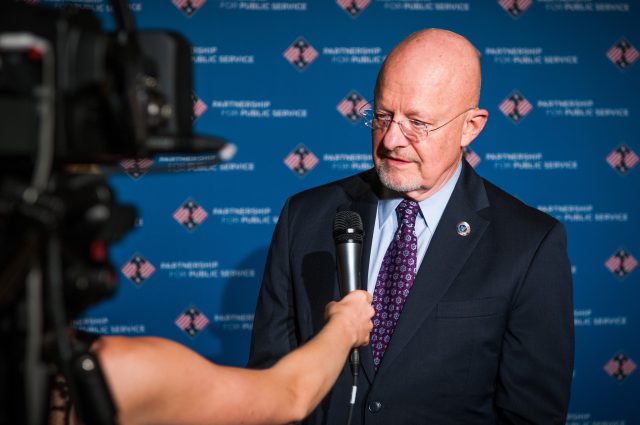
Director of National Intelligence James Clapper, seen here in 2013. (credit: Partnership for Public Service)

Director of National Intelligence James Clapper said Monday that the Snowden revelations have sped up the sophistication of encryption by "about seven years," according to the Christian Science Monitor.

"From our standpoint, it’s not a good thing," Clapper reportedly said at CSM's breakfast event. When asked how he came up with that figure, he cited the National Security Agency.

“The projected growth maturation and installation of commercially available encryption—what they had forecasted for seven years ahead, three years ago—was accelerated to now because of the revelation of the leaks," Clapper continued.

Read 5 remaining paragraphs | Comments

Court tosses Kansas case that tried to challenge science education guidelines

Group claimed new science education violated separation of church and state.

(credit: NJCU.edu)

A federal appeals court has affirmed a lower court’s decision to dismiss a case brought in Kansas by a religiously-minded group of parents and students. The plaintiffs were concerned about their home state’s adoption of the Next Generation Science Standards (NGSS).

As Ars reported back in 2013 when the case was first filed, the NGSS standards are a nationwide attempt to improve science education in the US. They have been backed by organizations such as the National Research Council, National Science Teachers Association, and the American Association for the Advancement of Science.

This case, COPE v. Kansas Board of Education, is a notable victory for science—and a blow to the creationist crowd and its progeny.

Read 4 remaining paragraphs | Comments

Feds: someone gave us the passcode in NY drug case, so we don’t need Apple

In February, judge warned of “virtually limitless expansion” of gov’t authority.

(credit: Beryl_snw)

In a short letter filed Friday evening, federal prosecutors wrote to a Brooklyn judge to say that they no longer needed Apple’s help in accessing the data on a seized iPhone 5S running iOS 7 associated with a drug case.

In the letter, United States Attorney Robert Capers wrote:

The government respectfully submits this letter to update the Court and the parties. Yesterday evening, an individual provided the passcode to the iPhone at issue in this case. Late last night, the government used that passcode by hand and gained access to the iPhone. Accordingly, the government no longer needs Apple’s assistance to unlock the iPhone, and withdraws its application.

This case pre-dates the debacle that played out earlier this year in San Bernardino, but relied on many of the same legal arguments. Here, in October 2015, the government asked the court to grant it an order that would have forced Apple to assist the unlocking of a phone belonging to Jun Feng, a man who eventually pleaded guilty to drug charges. Unlike the case in California however, Apple does have the ability to extract data on pre-iOS 8 devices with minimal difficulty. Feng has claimed that he forgot the passcode to this particular iPhone. According to the Wall Street Journal, it was Feng himself who recently supplied the passcode to investigators.

Read 6 remaining paragraphs | Comments

Uber settles class-action labor lawsuits in Massachusetts, California

Drivers still considered contractors, but under settlement, they could get $8,000 or more.

Late Thursday, the lawyer representing a class-action of Uber drivers e-mailed members of the press to say that two pivotal labor cases have been settled.

"We are very pleased to announce that Uber has agreed to a historic settlement of the claims we have brought in California and Massachusetts for misclassifying its drivers as independent contractors," Shannon Liss-Riordan, the attorney representing the drivers, e-mailed Ars in a statement.

"Under this agreement, Uber has agreed to pay up to $100 million to resolve these claims and will implement a number of significant policy changes."

Read 9 remaining paragraphs | Comments

FBI paid at least $1.3M for zero-day to get into San Bernardino iPhone

FBI Director James Comey: “But it was, in my view, worth it.”

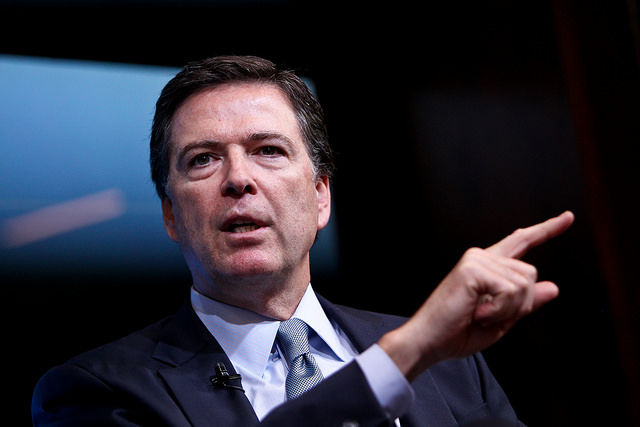
James Comey is the director of the FBI. (credit: Brookings Institute)

FBI Director James Comey suggested to a conference in London that his agency paid more than $1.3 million to gray-hat hackers who were able to unlock the iPhone 5C that was used by Syed Farook Rizwan, the dead terrorist who masterminded the attack in San Bernardino, California, in December 2015.

According to Reuters, Comey was asked Thursday how much the FBI paid for the technique that eventually allowed investigators to access the locked phone.

"A lot. More than I will make in the remainder of this job, which is seven years and four months for sure," Comey said. "But it was, in my view, worth it."

Read 5 remaining paragraphs | Comments

Comcast now lets some customers watch TV sans classic set-top box

After FCC vote, Roku and Samsung Smart TV viewers can buy purely online TV service.

(credit: Mike Mozart)

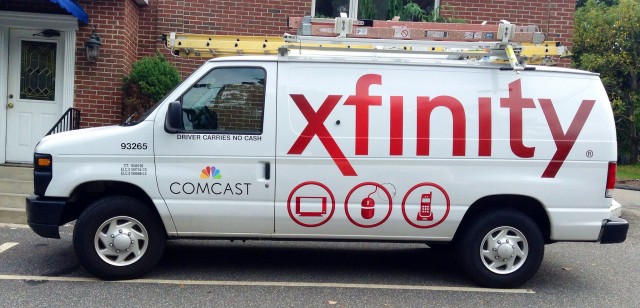
As expected, Comcast will officially offer a paid television service over the Internet. For now, the new service will only allow Roku and Samsung Smart TV owners to purchase access to the cable giant’s broadcast offerings. The program likely will be expanded over time.

As Ars reported two months ago, the Federal Communications Commission approved a Notice of Proposed Rulemaking (NPRM) that would force pay-TV companies to provide content and programming information to makers of third-party hardware and applications. This would create a software-based replacement for CableCard, allowing other companies to build set-top boxes or mobile applications that display a pay-TV subscriber's channels without a physical CableCard. (That vote has gotten support from the White House as recently as last week.)

Comcast’s new "Xfinity TV Partner Program" appears to be in direct response to that FCC move, although the company stated earlier this year in an FAQ that such a service was coming in 2016.

Read 4 remaining paragraphs | Comments