FDA loosens ban on blood donations from gay men

Indefinite exclusion lifted, but donations accepted only after a year of abstinence.

Enlarge (credit: ec-jpr)

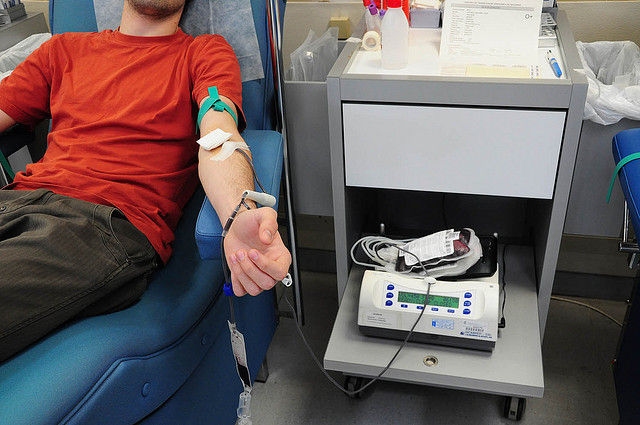
Men who have sex with men are now allowed to donate blood, according to a revised policy posted today by the Food and Drug Administration.

The update reverses a previous policy that banned homosexual men from donating blood indefinitely—a recommendation that dates to 1983, the early days of the HIV/AIDS epidemic. However, to donate blood now, homosexual men must abstain from sexual contact for a year.

“Ultimately, the 12-month deferral window is supported by the best available scientific evidence, at this point in time, relevant to the US population,” Peter Marks, deputy director of the FDA’s Center for Biologics Evaluation and Research said in a press release. “We will continue to actively conduct research in this area and further revise our policies as new data emerge.”

Read 4 remaining paragraphs | Comments

Caffeine-spiked peanut butter offers a bittersweet buzz

The pick-me-up sticks around, but so does an unpleasant aftertaste.

(credit: Beth Mole)

Last month, New York Senator Charles Schumer brought to our attention the existence of caffeinated peanut butter, which immediately seemed like something we should try. Of course, that was probably not an outcome that Schumer was going for, since he brought it up only in hopes of getting the Food and Drug Administration to ban it. Nevertheless, as a peanut butter fan and a coffee enthusiast, I happily volunteered to eat some and report back.

(credit: STEEM)

To recap, the peppy peanut butter is made by a company called STEEM, based in Greenfield, Massachusetts, which sells 8-ounce jars online for $5.99 each plus $7.50 for shipping. Jars can also be acquired in select grocery stores in California, Connecticut, Massachusetts, New Hampshire and New York. But, as far as I can tell, it’s only offered in smooth variety. (Sorry, chunky fans)

The spread is jam-packed with caffeine, the company boasts, with every two-tablespoon serving offering 150 milligrams of caffeine. STEEM says that’s as much caffeine as two cups of coffee. But that entirely depends on how you make your coffee. According to health researchers, a typical 8-ounce cup of brewed coffee contains anywhere from 95 to 200 milligrams of caffeine. So, maybe STEEM employees make weak-ass coffee.

Read 18 remaining paragraphs | Comments

Martin Shkreli steps down as CEO of Turing Pharmaceuticals

Resignation follows arrest on charges of securities fraud and public outcry.

Martin Shkreli, chief executive officer of Turing Pharmaceuticals LLC, exits federal court in New York, US, on Thursday, December 17, 2015. Shkreli was arrested on alleged securities fraud related to Retrophin Inc., a biotech firm he founded in 2011. (credit: Louis Lanzano/Bloomberg via Getty Images)

Martin Shkreli, founder of Turing Pharmaceuticals, has resigned as chief executive of the embattled company, effective immediately. The chairman of Turing’s board of directors, Ron Tilles, has been appointed interim CEO, the company announced.

The news comes a day after Shkreli, 32, was arrested by the FBI on securities fraud charges. A seven-count indictment, unsealed Thursday, laid out how Shkreli allegedly set up a Ponzi-like scheme, swindled his former pharmaceutical company, Retrophin, out of more than $11 million, and repeatedly defrauded and lied to investors of two hedge funds he managed.

Shkreli was arraigned in a Brooklyn court yesterday. He pleaded not guilty and was released on a $5 million bond.

Read 2 remaining paragraphs | Comments

Egg-less condiment can still be called mayo says FDA

In a 180, the agency OKs name of vegan spread on condition of labeling tweaks.

Mayonnaise, the creamy, fatty condiment often slathered on sandwiches and fries, may now have a looser definition—at least in the eyes of the Food and Drug Administration.

Generally, mayonnaise is an emulsion of oil and vinegar or lemon juice, and classic recipes use egg yolk as the emulsifier. But on Thursday the agency backed-off on the requirement for mayonnaise products to contain eggs, allowing a formerly contested vegan condiment to keep ‘mayo’ in its name.

In August, the FDA sent a warning letter to Hampton Creek Foods, a San Francisco-based start-up, over its vegan products “Just Mayo” and the spicy version “Just Mayo Sriracha.” The egg-less condiment, now sold at Whole Foods, Target, Walmart and others, has a cracked egg on the label.

Read 5 remaining paragraphs | Comments

American grins are just as bad as Britain’s—kind of

The UK has national dental coverage and more teeth, but aesthetics data missing.

(credit: Kat1990's channel)

The stereotype of yellow, slimy, crooked British smiles may not have teeth any more.

In a study comparing American and English dental health surveys, researchers found that American grins tended to have slightly fewer teeth, and those in lower socioeconomic positions had significantly worse oral health than their British counterparts. And researchers found no differences in participants' perceptions of overall oral health between the two nations. The data, published in the Christmas issue of The BMJ—an annual, light-hearted edition of the British medical journal—suggests that the English may have something to smile about as they sip their teeth-staining tea.

But, there are some cavities in the study. When asked about dental pain, function, and whether their teeth were embarrassing, the English self-reported more problems. They study also lacked data on aesthetics and comparisons of wisdom teeth extraction practices, which may skew the counts of missing teeth.

Read 5 remaining paragraphs | Comments

Turing’s reviled Shkreli indicted for security fraud over “Ponzi-like” scheme [Updated]

$750/pill CEO accused of illegally using assets from former company to pay debts.

Martin Shkreli, chief executive officer of Turing Pharmaceuticals LLC, exits federal court in New York, US, on Thursday, December 17, 2015. Shkreli was arrested on alleged securities fraud related to Retrophin Inc., a biotech firm he founded in 2011. (credit: Louis Lanzano/Bloomberg via Getty Images)

In a seven-count indictment unsealed Thursday, Martin Shkreli, the embattled CEO and founder of Turing Pharmaceuticals, has been charged by the FBI with securities fraud, securities fraud conspiracy, and wire fraud conspiracy for allegedly orchestrating three interwoven schemes. In what the Department of Justice terms “Ponzi-like” schemes, Shkreli allegedly defrauded investors of two former hedge funds he managed and misappropriated $11 million in assets from the biopharmaceutical company he once headed, Retrophin, all in the course of about five years.

The charges carry a maximum sentence of 20 years, Robert Capers, United States Attorney for the Eastern District of New York, said in a press conference Thursday.

Also included in the indictment are charges against Evan Greebel, who served as outside counsel for Retrophin. Greebel, who allegedly helped Shkreli pull off the schemes, is charged with wire fraud conspiracy.

Read 11 remaining paragraphs | Comments

Turing’s Shkreli on drug price-hike: “It gets people talking… that’s what art is”

Embattled CEO fumes over RZA, talks hip hop and musical aspirations with HipHopDX.

Martin Shkreli being photographed for his role as CIO of MSMB Capital Management. (credit: Getty Images)

Regardless of the negative opinions of Martin Shkreli, no one can deny that he has sparked a much-needed discussion about drug pricing and access—and maybe that was his goal?

The founder and CEO of Turing Pharmaceuticals has been publicly lambasted for jacking up the price of a life-saving drug—often used to treat AIDS patients and babies—by more than 5,000 percent. But he says in an exclusive interview with HipHopDX that it may all be an elaborate performance:

“To me, what I’m doing right now in the media, raising prices, all this shit, believe what you want, but it’s interesting," he said. "It gets people talking. At the end of the day, that’s what art is.”

Read 4 remaining paragraphs | Comments

Psychiatric drug—not antibiotic—messes with gut microbes, spurs obesity

Mice burned fewer calories and had altered bacterial and viral communities.

(credit: Razlan/Flickr)

A drug that helps your mind may turn your gut microbes—and waistline—against you.

In a series of experiments in mice, researchers found that a common drug used to treat psychiatric illnesses, including autism and bipolar disorder, alters the gut microbial community. Those changes caused the mice to burn fewer calories while resting and gain weight, researchers report in EBioMedicine. The finding, which lines up with weight gain seen in patients, suggests that drugs other than antibiotics can easily mess with a person’s microbes, which in turn profoundly influence metabolism, weight, and overall health.

In the study, researchers led by microbiologist John Kirby of the University of Iowa gave mice water laced with the psychiatric drug risperidone. This drug is well-known to cause significant weight-gain, insulin resistance, and metabolic problems in people. Kirby and colleagues had a hunch that the hefty side-effects were linked to changes in the gut microbiome, but they were unsure of the exact mechanism.

Read 7 remaining paragraphs | Comments

Websites may soon know if you’re mad—a little mouse will tell them

Cursor speed and precision link to anger and other negative emotions.

In a move akin to Google’s efforts to help you avoid drunk e-mailing, computer scientists are now trying to keep you happy while using the Web—by gauging when you get ticked off.

From three different experiments, researchers found that Internet users who became frustrated, confused, or upset while online tended to move their cursor sporadically and less precisely, instead of in smooth strokes. Perturbed users also tended to navigate their mouse more slowly, not faster as some might expect. The findings, reported in the information systems journal MIS Quarterly, may allow computer scientists or website developers to identify and intervene in real time when users become agitated with the interface or content of a site.

"Using this technology, websites will no longer be dumb," Jeff Jenkins, lead study author and an information systems professor at Brigham Young University, said in a press release. "Websites can go beyond just presenting information, but they can sense you. They can understand not just what you're providing, but what you're feeling."

Read 5 remaining paragraphs | Comments

Corpse-eating microbes could help solve murder mysteries

Communities on carcasses follow strict feasting schedules that tell time of death.

(credit: Lamro/Wikimedia)

There’s no accounting for taste, but it may be a good thing that some microbes are cadaver connoisseurs—their picky palates for flesh, aged to their exacting preferences, may help forensic detectives call a time of death in unsolved murders, a new study suggests.

Regardless of season, surroundings, and the species of the dead, communities of flesh-eating microbes seem to have a predictable timetable for when they dine on corpses, researchers report in Science. The new data allowed researchers to accurately estimate the time of death of mice and human corpses to within a two-to-four-day window, even after the bodies had decomposed for weeks.

Forensic scientists are eager to have new methods to determine time of death, Jessica Metcalf, lead study author and an ecologist and evolutionary biologist at the University of Colorado, Boulder, told Ars. Currently, there are no precise ways to determine how long ago a person died just given the corpse, she said. Some forensic scientists use the life cycle of blow flies, which seek out and lay eggs on corpses. But there’s a lot of variability between fly species and seasonal effects, she said.

Read 9 remaining paragraphs | Comments