As promised, Aetna is pulling out of Obamacare after DOJ blocked its merger

Insurance giant claims losses alone spurred decision, but there are clear links to merger.

Enlarge (credit: Getty | Bloomberg)

Aetna announced Monday that due to grave financial losses, it will dramatically slash its participation in public insurance marketplaces set up by the Affordable Care Act. In 2017, Aetna will only offer insurance policies in 242 counties scattered across four states—that’s a nearly 70-percent decrease from its 2016 offerings in 778 counties across 15 states.

The deep cuts have largely been seen as a blow to the sustainability of the healthcare law, which has seen other big insurers also pull out, namely UnitedHealth group and Humana. But the explanation that Aetna was forced to scale back due to heavy profit cuts doesn’t square with previous statements by the company.

In April, Mark Bertolini, the chairman and chief executive of Aetna, told investors that the insurance giant anticipated losses and could weather them, even calling participation in the marketplaces during the rocky first years “a good investment.” And in a July 5 letter (PDF) to the Department of Justice, obtained by the Huffington Post by a Freedom of Information Act request, Bertolini explicitly threatened that Aetna would back out of the marketplace if the department tried to block its planned $37 billion merger with Humana.

Read 4 remaining paragraphs | Comments
When we’re happy, we actively sabotage our good moods with grim tasks

With the chance at long-term gains, humans may not take the obvious, hedonistic path.

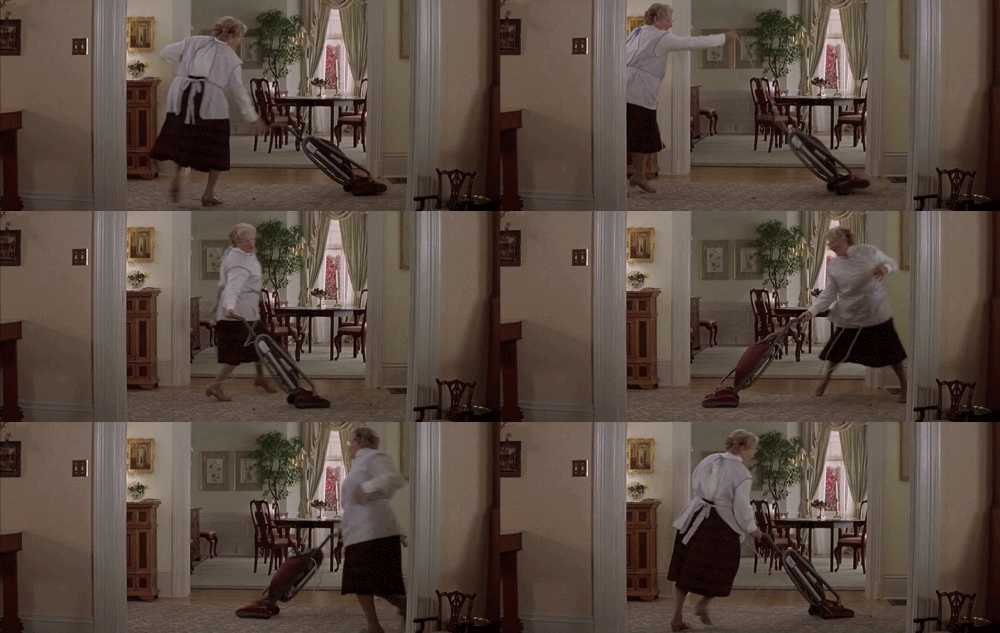
Always keeping your house tidy and spotless may earn you the label of “neat freak”—but “super happy” may be a more accurate tag.

When people voluntarily take on unpleasant tasks such as housework, they tend to be in particularly happy states, according to a new study on hedonism. The finding challenges an old prediction by some researchers that humans can be constant pleasure-seekers. Instead, the new study suggests we might seek out fun, uplifting activities mainly when we’re in bad or down moods. But when we’re on the up, we’re more likely to go for the dull and dreary assignments.

This finding of “flexible hedonism,” reported Monday in The Proceedings of the National Academy of Sciences, may seem counterintuitive because it suggests we sabotage our own high spirits. But it hints at the idea that humans tend to make sensible short-term trade-offs on happiness for long-term gains.

Read 10 remaining paragraphs | Comments

Wrong chemical dumped into Olympic pools made them green, smelly—and unsafe

Worker wrongly used hydrogen peroxide, which neutralized the chlorine.

(credit: Getty | Tom Pennington)

After a week of trying to part with green tides in two outdoor swimming pools, Olympic officials over the weekend wrung out a fresh mea culpa and yet another explanation—neither of which were comforting.

According to officials, a local pool-maintenance worker mistakenly added 160 liters of hydrogen peroxide to the waters on August 5, which partially neutralized the chlorine used for disinfection. With chlorine disarmed, the officials said that “organic compounds”—i.e. algae and other microbes—were able to grow and turn the water a murky green in the subsequent days.

The revelation appears to contradict officials’ previous assurances that despite the emerald hue, which first appeared Tuesday, the waters were safe.

Read 6 remaining paragraphs | Comments

Raising your kid as a vegan could soon be a crime in Italy

Lawmaker seeks lengthy jail terms for parents who impose “dangerous” diet on kids.

(credit: Dave Crosby)

Visiting Italy and passing on the country’s world-class cheeses, meats, and seafood may seem like a ghastly travel crime. But if you live in the country and do the same with your kids, it could soon be a real crime.

Conservative lawmaker Elvira Savino recently proposed a law that would prohibit parents from keeping their kids on a strict vegan diet—that is, one that abstains from meat, fish, dairy products, and sometimes other animal products such as honey and gelatin. The text of the law describes such a diet as “devoid of elements essential for healthy and balanced growth.”

If the law is passed, parents found in violation would face up to a year in prison. But if a child becomes ill or dies on the diet, the parents would face boosted jail time of up to four or six years, respectively. The law applies to parents of kids 16 and under, with the harshest penalties going to parents of kids three and under.

Read 6 remaining paragraphs | Comments

Rio diving pool—still green—now closed and smells like farts

Authorities have blamed everything from people to pH, but no end is in sight.

(credit: Getty | CHRISTOPHE SIMON )

The outdoor Olympic diving pool, which turned a startling shade of green Tuesday, is now closed. It reportedly smells like farts and may be causing eye itchiness among athletes.

Since Tuesday, Olympic organizers have repeatedly assured athletes and fans that the pool is safe. Rio organizing committee spokesman Mario Andrada told reporters on Wednesday that “the pool should go back to its classic blue color during the day.”

That clearly didn’t happen. Instead, reports trickled in that the adjacent pool used for water polo and synchronized swimming also began to turn green.

Read 4 remaining paragraphs | Comments

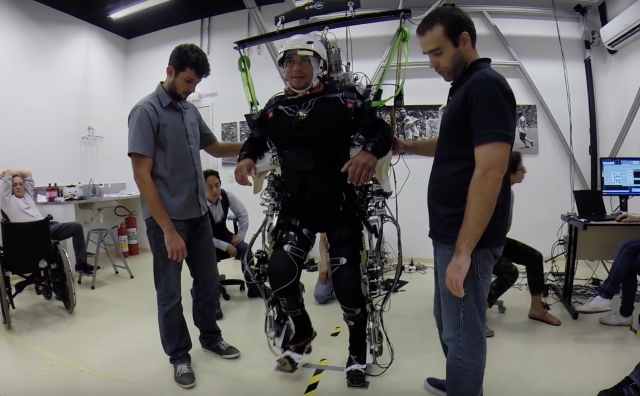
Brain training with exoskeleton and VR spurs recovery for paraplegics

In a year, 50% of patients upgraded from complete to incomplete paralysis rating.

(credit: AASDAP and Lente Viva Filmes, São Paulo, Brazil)

With brain training, paraplegics can once again move and sense their limbs despite having spinal cord injuries that were previously considered irreversible, an international team of researchers reports Thursday in Scientific Reports.

After a year of working with a brain-machine interface, virtual reality, and robotic exoskeletons, eight paraplegic patients began moving and feeling their lower bodies again. Some can now even walk with assistance. Half of them were upgraded from a classification of ‘complete’ paralysis to incomplete. And this group has continued to train and improve, according to the lead study author, Miguel Nicolelis, of Duke University.

“Nobody ever imagined that one day we would be talking about the possibility of using brain-machine interfaces to induce partial neurological recovery in patients who have been diagnosed as having a complete spinal cord injury,” Nicolelis told press during a conference call. “As you can imagine, for us this is a very important milestone."

Read 7 remaining paragraphs | Comments

Brain wiring needed for reading isn’t learned—it’s in place prior to reading

Researchers could predict how kids’ brains would develop before they learned to read.

(credit: ThomasLife)

Our brains are apparently really good at divvying up heavy mental loads. In the decades since scientists started taking snapshots of our noggins in action, they’ve spotted dozens of distinct brain regions in charge of specific tasks, such as reading and speech. Yet despite documenting this delegation, scientists still aren’t sure exactly how slices of our noodle get earmarked for specific functions. Are they preordained based entirely on anatomy, or are they assigned as wiring gets laid down during our development?

A new study, published this week in Nature Neuroscience, adds more support for that latter hypothesis. Specifically, researchers at MIT scanned the brains of kids before and after they learned to read and found that they could pinpoint how the area responsible for that task would develop based on connectivity patterns. In other words, the neural circuitry and hookups laid down prior to reading determined where and how the brain region responsible for reading, the visual word form area, or VWFA, formed.

“Long-range connections that allow this region to talk to other areas of the brain seem to drive function,” Zeynep Saygin, lead study author and researcher at MIT’s McGovern Institute for Brain Research, said in a news release.

Read 8 remaining paragraphs | Comments

Access to healthcare through ACA may actually improve Americans’ health

Though data are preliminary, they suggest health upticks in participating states.

(credit: Dr.Farouk)

Brace yourselves, dear readers: according to a shocking study in the journal JAMA Internal Medicine, health insurance may be good for your health.

Researchers at Harvard surveyed the health of nearly 9,000 low-income people in Texas, Arkansas, and Kentucky from 2013 to 2015. During this time, Arkansas and Kentucky expanded Medicaid healthcare under the Affordable Care Act while Texas did not. In the course of the study, survey respondents in Arkansas and Kentucky not only reported improvements in their access and quality of care, but were five percent more likely to report being in excellent health compared to their counterparts in Texas.

While the findings are perhaps not surprising, they offer some of the first hard data that the ACA is actually improving the health of the 20 million Americans that gained insurance under the elaborate health law. However, the authors caution that it’s just a correlation. The data doesn’t directly prove ACA’s role in any health improvements captured. In the words of the Harvard researchers, the study design “precludes any clear causal interpretation."

Read 7 remaining paragraphs | Comments

Got a picky eater? Toddlers form food preferences based on social cues

Infants seem to make assumptions when they see people like and dislike foods.

(credit: David Goehring)

The food preferences of toddlers are a mind-boggling enigma. On the one hand, kids under two years old are the most likely age group to accidentally poison themselves—by deciding it’s a great idea to guzzle detergent, for instance. Yet, when parents try to coax them into ingesting nutritious, non-lethal options, tots may cook up a fit.

According to a new study, toddlers may actually have some logic to their apparent dietary madness—at least a little logic, that is. By watching toddlers react to people’s food preferences, researchers found that the little ankle-biters seem to make generalizations about good eats and who will like them based on social identities. Toddlers expected people in the same social groups to like the same foods and appeared puzzled if that wasn’t the case. But if one person expressed a dislike for a food first, toddlers seemed to expect that everyone would follow suit regardless of social identities.

The findings, published Monday in the Proceedings of the National Academy of Sciences, suggests that toddlers soak up social information about food choices and may be particularly sensitive to any signal that a food is bad or perhaps dangerous. Though more study into toddlers’ gut feelings on foods are necessary, the authors speculate that campaigns to improve kids’ diets may be better served by including social aspects of eating rather than just nutrition information.

Read 8 remaining paragraphs | Comments

People look guiltier when their actions are viewed in slow motion

Slowing down footage in criminal cases may dramatically sway life-or-death decisions.

(credit: Paweł Zdziarski )

From the pull of a trigger to the swing of a fist, a lot can happen in a fraction of a second. And gauging what's going through the minds of those involved during such dramatic slivers of time can be incredibly difficult, if not impossible. That's why law enforcement agents and prosecutors are increasingly turning to video. Those digital records don't just replay quick, life-altering events—they can be slowed down so that the slightest movements can be dissected. This, the logic goes, clarifies not just what happened, but helps explain what an alleged criminal intended to happen. But, according to a new study, slow motion might actually muddle our view.

Viewers who watch videos in slow motion—as opposed to regular speed—are more likely to feel that the people filmed act with a willful, deliberate, and premeditated intention, researchers report. The elongation of events, it turns out, gives viewers the impression that people in video clips have more time to think over and plan out what they are doing. The findings, published this week in the Proceedings of the National Academy of Sciences, suggest that jurors who view slow motion footage of an alleged crime may assign more responsibility to the accused than they would have otherwise.

“In legal proceedings, these judgments of intent can mean the difference between life and death,” the authors conclude. “Thus, any benefits of video replay should be weighed against its potentially biasing effects.”

Read 7 remaining paragraphs | Comments