Here’s how gut microbes train your immune system to dodge disease

Gut dwellers signal immune cells to stay calm and dial down inflammation.

Where would we be without our gut microbes? Most likely, we’d be in the bathroom, according to a new study.

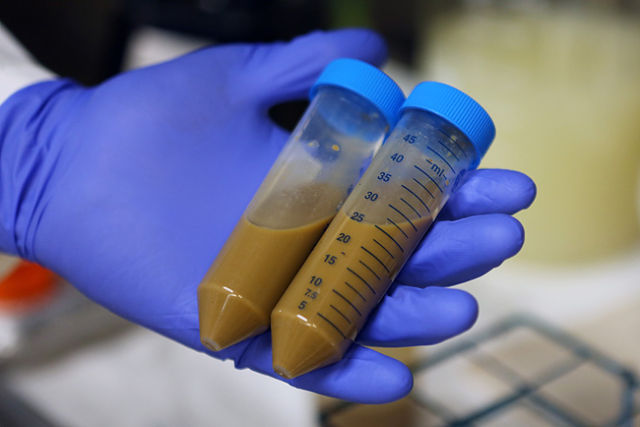
Unraveling the interplay between our immune systems and gut microbes, researchers report that sensing and befriending helpful bacteria in our intestines may be critical for avoiding inflammatory bowel diseases (IBD), such as Crohn's disease and ulcerative colitis. Those invisible allies can hack into the immune system’s chemical communications and shut down excessive inflammation, averting chronic and self-inflicted damage that can cause diarrhea, intestinal bleeding, and pain.

The finding, published in the journal Science, isn’t particularly surprising to scientists, who have long suspected that our microbiomes manipulate our immune responses and steer our health. But until now, the microbial tactics and the immune signals they alter have been a brown box.

Read 6 remaining paragraphs | Comments
FDA flexes regulatory muscles, says vaping, e-cigs now under its control

E-cigarette makers have three years to get their devices cleared by the agency.

(credit: Flickr/ecig click)

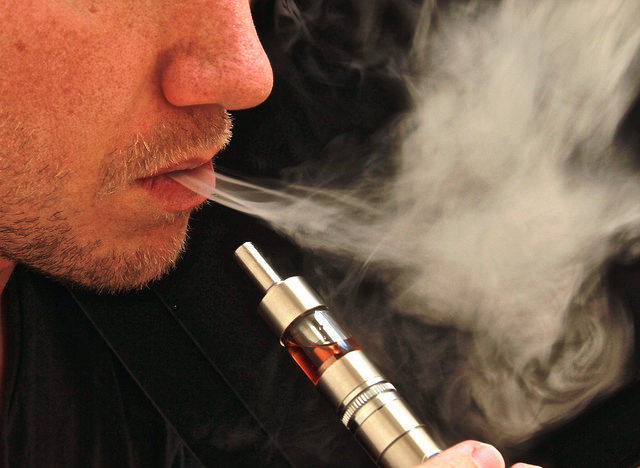
The US Food and Drug Administration announced Thursday that it has extended its authority and will now regulate electronic cigarettes, hookah tobacco, cigars, and other tobacco products under the 2009 Family Smoking Prevention and Tobacco Control Act.

The regulatory move, first proposed in 2014, is largely aimed at protecting kids from tobacco and nicotine products. The result is that e-cigs and the other products will now be subject to the same federal regulations as regular cigarettes. These regulations include some relatively uncontroversial rules such as a ban on selling e-cigs to minors (which some states have already done), requiring a photo ID to buy e-cigs, not selling e-cigs out of vending machines, and a ban on free e-cig samples.

But the regulations also require that e-cigarette manufactures register with the agency and put any new devices through a pre-market regulatory approval process. By “new,” the FDA means any novel devices put on the market after February 15, 2007. Devices released before then will be grandfathered into the regulations. However, in the relatively young e-cig market, the vast majority of current products were introduced after 2007 and will be subject to the approval process.

Read 6 remaining paragraphs | Comments
First autonomous robot to operate on soft tissue outdoes human surgeons

New surgical robot beat out human doctors at stitching up guts of living pigs.

(credit: Axel Krieger])

Step aside, Ben Carson. The once lauded ability to perform delicate operations with gifted hands may soon be replaced with the consistent precision of an autonomous robot. And—bonus—robots don’t get sleepy.

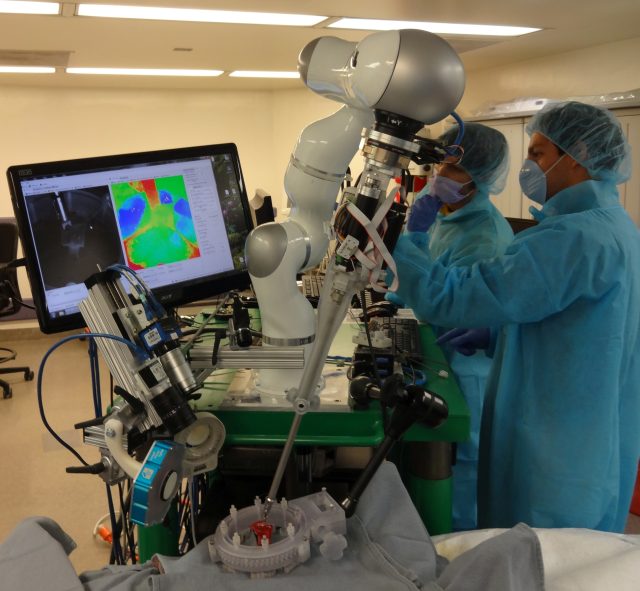
In a world’s first, researchers report using an autonomous robot to perform surgical operations on soft tissue and in living pigs, where the adroit droid stitched up broken bowels. The researchers published the robotic reveal in the journal Science Translational Medicine, and they noted the new machinery surpassed the consistency and precision of expert surgeons, laparoscopy, and robot-assisted (non-autonomous robotic) surgery.

The authors, led by Peter Kim at Children’s National Health System in Washington, DC, emphasized this feat is not intended to be a step toward completely replacing surgeons. Rather, they want the technology to provide new tools that help every operation go smoothly. “By having a tool like this and by making the procedures more intelligent, we can ensure better outcomes for patients,” Kim said.

Read 8 remaining paragraphs | Comments

“A good day for Martin Shkreli,” who may try to pin fraud on former counsel

Feds mulling additional charges as CEO’s former company, Turing, gets sued.

Martin Shkreli, chief executive officer of Turing Pharmaceuticals LLC, exits federal court in New York, US, on Thursday, December 17, 2015. Shkreli was arrested on alleged securities fraud related to Retrophin Inc., a biotech firm he founded in 2011. (credit: Louis Lanzano/Bloomberg via Getty Images)

In a Tuesday court hearing, a federal judge delayed setting a trial date for Martin Shkreli, the disgraced founder and ex-CEO of Turing Pharmaceuticals who was indicted on seven counts of securities fraud charges last December.

Shkreli and his lawyer requested the delay after learning recently that prosecutors are considering filing more charges against the embattled former executive and his ex counsel, Evan Greebel, who was already charged with one count of wire-fraud conspiracy. The new potential charges—along with the initial ones—relate to allegations that the pair ran a Ponzi-like scheme, in which they funneled millions of dollars out of Retrophin, another of Shkreli’s pharmaceutical companies, to cover losses from two hedge funds Shkreli managed.

In the Brooklyn federal court Tuesday, prosecutors told the judge that they would decide if they would file new charges within the month.

Read 5 remaining paragraphs | Comments

Former Biggest Loser contestants fight slow metabolisms, weight gain

TV show contestants that lost the most weight also lost the most calorie-burning power.

(credit: Pete Thomas)

After successfully dropping pounds, dieters often see their weight bounce back. But they may not see the same rebound in their sluggish metabolisms.

Researchers followed 14 contestants from the TV weight-loss competition The Biggest Loser, and they found that the dramatic weight loss significantly slowed the rate at which the contestants’ burned calories while resting. Those metabolic slow-downs, which make it more difficult to keep off pounds, lingered six years after the competition—even after nearly all of the contestants regained much of the weight they lost.

The findings, published Monday in the journal Obesity, suggests that the body may purposefully slow down its metabolism to regain lost pounds and maintain a weight “set point.” If the finding holds true in larger studies of dieters, it may explain why it’s so difficult to keep off weight once its lost.

Read 10 remaining paragraphs | Comments

Drugs, wine, mushy poops explain gut microbe variation—but just a little

Large surveys find we understand >20% of person-to-person microbe differences.

Homogenized fecal matter for transplantation (credit: Wikimedia)

Our guts are teeming with trillions of microbes. They fight, form alliances, gobble our food, spew chemicals, and hack our immune systems. These hidden happenings in our innards hold sway over our health. Yet the key microbial players and their affairs vary considerably from person-to-person. And, overall, these communities remain a mystery to scientists.

This week, three studies published in the journal Science offer new glimpses of what’s going on in the black box that is our guts. While they all provide insights into these complex communities, they also highlight just how much we still have to learn.

Two studies dug into people’s health and, literally, their poop looking why there is so much variation in gut microbiome. Factors the studies hoped might explain that variation include diet, medication, disease, and stool types—from hard lumps to mushy piles according to the Bristol stool scale. The studies looked at samples from 1,135 Dutch and 1,106 Belgian volunteers. Researchers found that such factors account for only 18.7 percent and 7.6 percent, respectively, of variation. What differences account for the rest are complete unknowns.

Read 10 remaining paragraphs | Comments

CEO tests “crazy” genetic therapy on herself, claims it added 20 years of life

Though the treatment had promising results in mice, scientists are skeptical.

Elizabeth Parrish (credit: YouTube)

Elizabeth Parrish, CEO of the biotech company BioViva, claims that her body's cells are 20 years younger after testing her company’s age-reversing gene therapy on herself.

The 45-year old Seattle-area woman, who has no scientific or medical training, underwent the experimental treatment last September in an undisclosed clinic in Colombia. The unorthodox, overseas trial, which was designed to skirt US federal regulations, prompted the resignation of one of the company’s scientific advisors. George Martin of the University of Washington quit after telling MIT Technology Review, "This is a big problem. I am very upset by what is happening. I would urge lots of preclinical studies.”

Though details of the fast-tracked trial are unpublished, Parrish says it involved intravenous infusions of an engineered virus. That infectious germ carried the genetic blueprints for an enzyme called telomerase, which is found in humans. When spread to the body’s cells, the enzyme generally extends the length of DNA caps on the ends of chromosomes, which naturally wear down with cellular aging. In a 2012 mouse study, Spanish researchers found that similar treatment could extend the lifespan of the rodents by as much as 20 percent.

Read 6 remaining paragraphs | Comments

Apple throws open doors to CareKit, shows off the first four apps

Company hopes open source platform transforms everyday gadgets into medical hubs.

(credit: Apple)

Following the huge success of Apple’s ResearchKit—which connected tens of thousands of patients with clinical research in its first year—comes the release today of its medical sibling, the open source platform CareKit.

First unveiled by Apple last month, the platform is set up to be a springboard for apps that will allow users to manage their own health through mobile devices. Specifically, the platform includes four modules designed to allow patients to: monitor their progress through medical treatment plans; aggregate health and activity data via device sensors and manual logs; analyze that data in graphical interfaces; and share all of the information with health professionals and care takers by easily creating PDF files that can be e-mailed.

(credit: Glow)

The goal, according to Apple, is to empower patients to control and personalize their own medical care while providing doctors with more complete pictures of their patients’ health and progress. Inspiration for the new platform came from ResearchKit users who, after logging and tracking health data in apps, felt as though their phones were more in tune with their medical status than their doctors.

Read 4 remaining paragraphs | Comments

As FDA preps e-cigs rules, scientists and Congress rally to support vaping

Fierce debate erupts as sides fight to protect children and smokers from tobacco.

(credit: Kieran McCarthy)

The 2017 Agriculture Appropriations Bill may not seem like a stirring piece of legislation to most, but it raised quite a few eyebrows last week as it passed through a House subcommittee with a key amendment—one that aims to spare the vast majority of electronic cigarettes from impending federal regulations.

The bipartisan effort to protect the burgeoning e-cig market is just the latest in a long-smoldering debate reignited by the Food and Drug Administration’s plans this year to begin regulating the new devices as it does traditional tobacco products. The crux of the controversy is about whether e-cigarettes act more as a gateway into or a ticket out of dangerous tobacco use, the single largest cause of preventable deaths in the US.

Proponents argue that the new FDA regulations will protect children from bad habits. For instance, one of the proposed rules will prevent e-cig makers from using youth-based marketing—like edgy, rebellious ads and candy-flavored e-cigs—that can hook kids into lifelong nicotine addictions and deadly tobacco habits. Such marketing strategies were first used by tobacco companies decades ago and were highly successful until the FDA banned the practice. With e-cig companies already copying the tactics, many politicians and public health experts have chided the FDA for not rolling out regulations faster. The agency first proposed rules back in 2014.

Read 12 remaining paragraphs | Comments

Body’s defenses against common viruses may mess up neurons, spark depression

Mouse data reveal haywire cellular signals, which could help treat mental disorders

(credit: Wikimedia)

Getting sick is definitely a bummer. But besides feeling icky and being stuck in bed, viral infections may cause us to actually be depressed. While scientists have been clued into this connection for a while, there was little data on how everyday viral infections, like the flu, might mess with our moods.

Now, data from a new mouse study shows that common viruses may spur sadness by causing the cells that line the blood-brain barrier to release signals that hush the chatter between neurons in the area of the brain responsible for mood. The findings, published this week in the journal Immunity, may finally explain the link between infections and mental health problems, and it could point researchers towards new strategies for treating depression and other mood disorders.

Researchers have been collecting hints of the connection between mental health and infections for years. Though it was first dismissed as people simply being blue about getting sick, doctors now accept that there is a condition called “sickness behavior.” This condition is marked by cognitive deficits, drowsiness, general malaise, and other depression-like symptoms in those with an infection. Moreover, in a 2013 Danish study, researchers found that people who had been treated for a severe infection were 62 percent more likely to suffer from mood disorders. Perhaps related, those that had an autoimmune disease were 45 percent more likely to have such a mental health issue.

Read 8 remaining paragraphs | Comments