Nick Farmer knows dozens of languages, so he invented one for The Expanse

From the archives: “Pelésh mi ere imbobo rum Oakland.”

Linguist Nick Farmer tells us more about some of his favorite Belter words. (Video edited by Jennifer Hahn) (video link)

OAKLAND, Calif.—It all started when Nick Farmer bought George R. R. Martin a drink, but the plot really thickened when the linguist met Martin's then-assistant Ty Franck. Franck was one half of the writing team behind the novels that fuel SyFy's incredible new series, The Expanse. And the author soon discovered that Farmer was a talented polyglot, a master of over two dozen languages who worked as a linguistic sellsword for financial research companies desperate to translate global business news for analysts. Farmer also happened to be just the kind of expert that Franck and his co-author Daniel Abraham needed to bring their novels to the screen.

The Expanse series takes place two centuries from now in the Belt, a ring of asteroids that orbit the Sun between Mars and Jupiter. People who have migrated to the Belt come from all over Earth speaking dozens of languages, and they're often isolated for years at a time on remote mining stations. To communicate, they evolve a creole called Belter, which becomes the lingua franca for what is essentially the solar system's new proletariat. The problem? In the book, Belter could be referenced. But now that The Expanse was coming to television, people would actually have to speak the damn thing. SyFy suddenly needed a linguist who could build a language out of dozens of parts. Luckily, Franck knew a guy. He soon recommended Farmer, who delivered a lot more than they bargained for.

Read 7 remaining paragraphs | Comments

BAHFest London: Hard science collides with fake theories on Trump and squirrels

The Festival of Bad ad Hoc Hypotheses is hilariously nerdy even if bloody useless.

(credit: Lucy Orr)

Would I like to cover Barfest? Why, of course! Even though it seems like some form of alcoholic devolution, considering I was very recently in Germany at Puke-Fest... Oh, sorry, I see—you mean BAHFest, aka the Festival of Bad ad Hoc Hypotheses. I consider myself a layperson when it comes to hard science so, in the best familial tradition, I bully my little sister—a massive nerd and PhD-holding research assistant at Birkbeck Babylab—to assist me in ascertaining how any data might be mishandled. By design, there’s bound to be some bad science here.

I've attended my fair share of Uncaged Monkeys shows, and love a good Carl Sagan quote, so I feel privileged to be attending the very first international BAHFest. It's billed as “a celebration of well-argued, and thoroughly researched, but completely incorrect scientific theory.” The festival is running over two days at Imperial College London, where my famous-not-famous particle physicist dad, Robert Orr, studied in the 1960s. I can’t help wondering if I was conceived in a lab nearby.

On the first evening, dubbed BAH! London Evolution, six brave speakers (assisted by inexplicably popular Hogwarts' escapee, and AV technician, Lloyd) present their awfully absorbing, and utterly loony theories to a live audience of hollering nerds, and a panel of three judges, some of whom might even have valid science credentials.

Read 38 remaining paragraphs | Comments

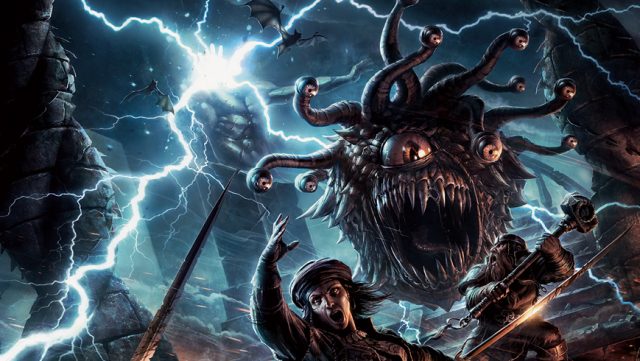
Reviewed: Dungeons & Dragons 5th edition

Streamlining, self-publishing, annual stories—if you left, it’s time to unretire for 5E.

Dungeons & Dragons just celebrated its 42nd birthday—an auspicious number, to be sure—some 16 months after the release of its 5th edition. Since D&D’s latest release in August of 2014, many players and Dungeon Masters have rolled their polyhedrals in approval, and publisher Wizards of the Coast has grown its support for the world’s most popular role-playing game in ways you might not have expected.

No matter your edition or specific RPG of choice, today D&D continues to be the measuring stick by which other pen-and-paper games are judged, be it on sales, popularity, or even complexity. For many gamers over the course of the game's existence, D&D has been the entry point into role-playing which sparks a lifetime of storytelling and adventure.

So, with more than a year behind it, how does the newest edition of D&D hold up for newbies and hardcore fans alike?

Read 30 remaining paragraphs | Comments
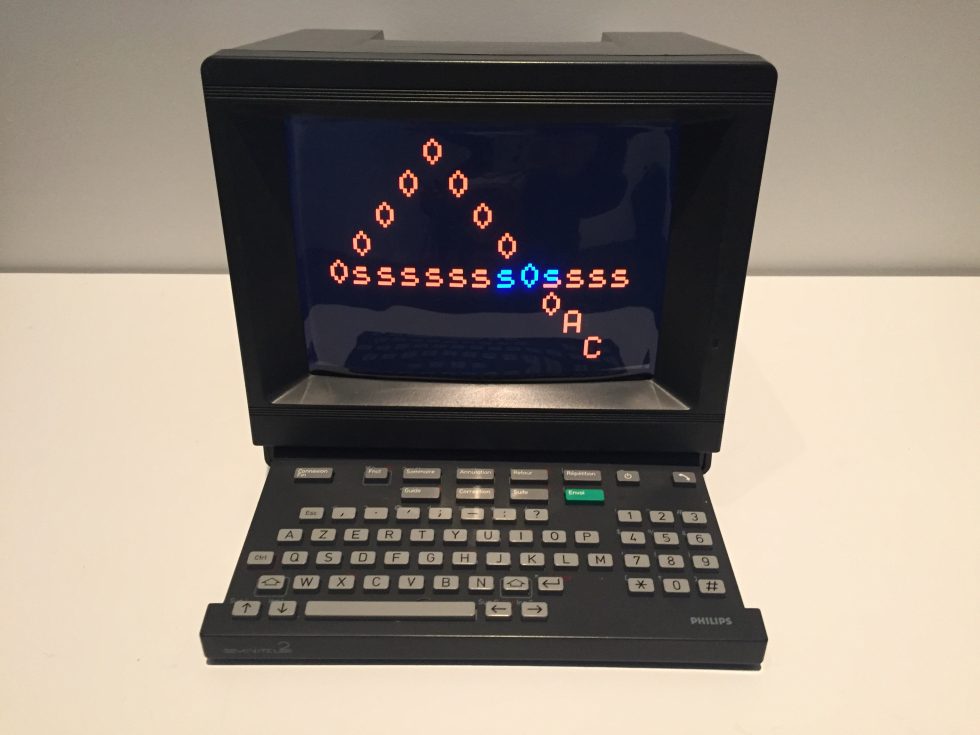
Electronic Superhighway review: Sex, Wi-Fi, and videotape with Douglas Coupland

New London exhibit takes us on a 50-year-long trip through the light (and dark) Internet.

I’m a stalker. Not a virtual stalker, a real life stalker. The good news is that Douglas Coupland—author of Microserfs and Generation X—doesn’t seem to mind.

Snatching my camera, Coupland reassures me in his smooth Canadian brogue that “electrons are free, one of these has to be OK,” before firing off 20 selfies, while I stand here in shock.

Text Butt 2015 by Olaf Breuning (credit: Lucy Orr)

This may be somewhat at odds with the art that he's here to promote at the hot new Whitechapel Gallery exhibition, Electronic Superhighway (2016-1966), which has just opened to the public in London. Coupland's large mixed media pieces are black and white photos with Piet Mondrian-like coloured cubes, or black and white stripes stuck over them. Titled Deep Face, the images (see gallery below) represent a critique of Facebook’s face recognition software.

Read 19 remaining paragraphs | Comments
Dealmaster: Get a Dell Inspiron 3000 desktop with Core i7, 16GB RAM for $599

Plus more deals on laptops, desktops, Logitech accessories, and much more.

Greetings, Arsians! Courtesy of our partners at TechBargains, we have a number of deals on laptops, desktops, and accessories to share today. One of them makes Black Friday prices look steep—you can get a Dell Inspiron 3000 desktop computer with 16GB of RAM and a 2TB hard drive for just $599. That's nearly half of its original list price of $1,032. Now's the time to upgrade if you're in need of a new desktop, because this price definitely won't last long.

Check out the full list of deals below as well.

Featured

Read 4 remaining paragraphs | Comments

Why Safe Harbor 2.0 will lose again

Ars talks with privacy campaigner Max Schrems.

(credit: europe-vs-facebook)

BRUSSELS—Over the weekend, negotiators from the European Union's executive body, and the US Federal Trade Commission worked frantically to thrash out a deal to allow transatlantic data transfers to take place. But the so-called Safe Harbour 2.0 is far from a done deal.

So how did we get here? Two men are essentially responsible: Edward Snowden, and Max Schrems.

The whole world knows only too well about the whistleblowing exploits of Snowden, who infamously exposed the US National Security Agency's PRISM spying operation. What Austrian privacy campaigner Schrems went on to do with that information, once it became public in 2013, is logical but impressive in its scale. Schrems—then a law student in his mid-20s—looked at the companies accused of leaking personal information to the NSA, and decided to file an official complaint about the misuse of his personal data by Facebook.

Read 28 remaining paragraphs | Comments

XCOM 2 review: Best-in-class tactical battles with a new sense of style

Sequel greatly improves on character and setting without ruining the gameplay.

The design on the new alien creatures is impressive.

Corporal Alessandra Cancellara is heading into a mission on the Skyranger when I notice her. Most of my squaddies are present, looking cool, as the music theoretically pumps both them and me up. But Alessandra, suited up in green with needles holding up her ash-colored bun, stands out. She’s practically dancing in her seat, a bundle of nervous energy and quick grins. I’d probably look like that heading into a massively tense battle zone, so it suddenly hits me: XCOM 2 has managed to find an emotional core.

The first of the rebooted XCOMs, 2012’s Enemy Unknown, was a fantastic strategy game. So was its expansion, Enemy Within. Yet if there was an immediate criticism to be made of both games, it was that they were stylistically... well, dull. The near-future X-Files-like alien invasion storyline only allowed for the most generic science fiction, and the game structure never felt fully committed beyond “well, this is how the 1994 X-COM did it.” In that light, XCOM 2 having a distinct sense of style is a tremendously positive sign.

That sense of style manages to weave itself through the entire game, making XCOM 2 a notable improvement over its predecessor at nearly every conceptual level—but the game does miss the opportunity to make structural improvements.

Read 25 remaining paragraphs | Comments

Today, a California ghost town can have fiber to the doorstep—but it’s not easy

Pop. density in Sloat is roughly equal to Montana, but you can get 48.4Mbps/9.8 Mbps.

SLOAT, CALIFORNIA—Plumas County is rural, mountainous, and at the far north of the Sierra Nevada Range. In area, it is larger than the individual states of Rhode Island and Delaware, but the population here is under 20,000. It all makes for a beautiful place to live, but some amenities that are common in more densely populated areas can be hard to come by.

High-speed Internet access that’s reliable across all seasons of the year is one clear example. In 2014, the local cable TV provider (New Day Broadband) went bankrupt, taking with it the only source for cable-based Internet access in the town of Quincy, California. It was also the only tethered high-speed provider accepting new customers. AT&T used to offer DSL in the area, but the company stopped taking on new clients and does not allow existing customers to transfer service. And while both satellite Internet access and multiple WISPs (wireless ISPs) are available, both of these delivery methods face reliability challenges in stormy, snowy weather (a common occurrence for this area in the winter).

With that in mind, you can imagine my surprise when in recent years I learned a local ISP—Plumas Sierra Telecommunications—now offers fiber to the doorstep. This new availability of reliable, high-speed Internet access allowed me to shift from an office job to telecommuting, meaning my wife and I could return to the rural Sierra Nevada after 15 years of living in the metropolis of Southern California.

Read 13 remaining paragraphs | Comments

On American Indian reservations, challenges perpetuate the digital divide

After mild improvements, American Indian reservations still suffer from “digital divide.”

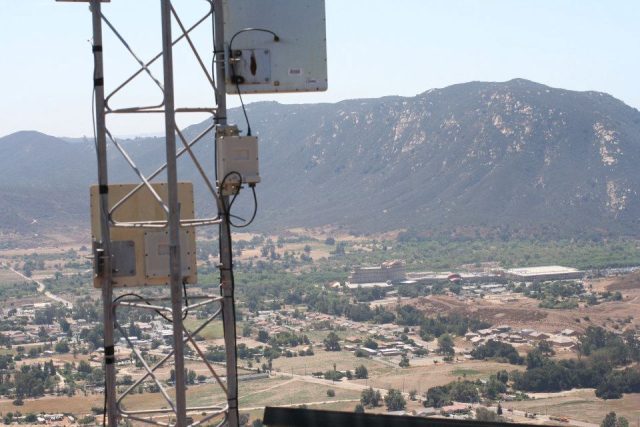
An access ­point tower constructed by Tribal Digital Village overlooks Pala, California. (credit: Tribal Digital Village)

Recently, Sam Tenakhongva, a teacher living on the Hopi reservation in northern Arizona, bought a Chevrolet pickup truck equipped with integrated 4G LTE. As the company’s advertising boasts, the feature was novel for a commercial vehicle and unprecedented for a truck. Intrigued, Tenakhongva decided to take advantage of a free trial.

It didn’t take long for him to eschew the service. The truck only connected when Tenakhongva was in a 4G network and, given the region’s limited broadband access, Tenakhongva knew such an occurrence would be too rare to justify the cost.

Today, this situation rings true for an overwhelming majority of American Indians living on reservations. This year, the Federal Communications Commission reported that 41 percent of Americans living on tribal lands lacked access to broadband (which the FCC currently defines as 25Mbps for downstream speeds and 3Mbps for upstream speeds); that number leaps to 68 percent for those in rural areas of tribal lands.

Read 16 remaining paragraphs | Comments

Bombshell review: An arm, a leg, and entirely too much of your time

An isometric shooter that tries too much and accomplishes very little.

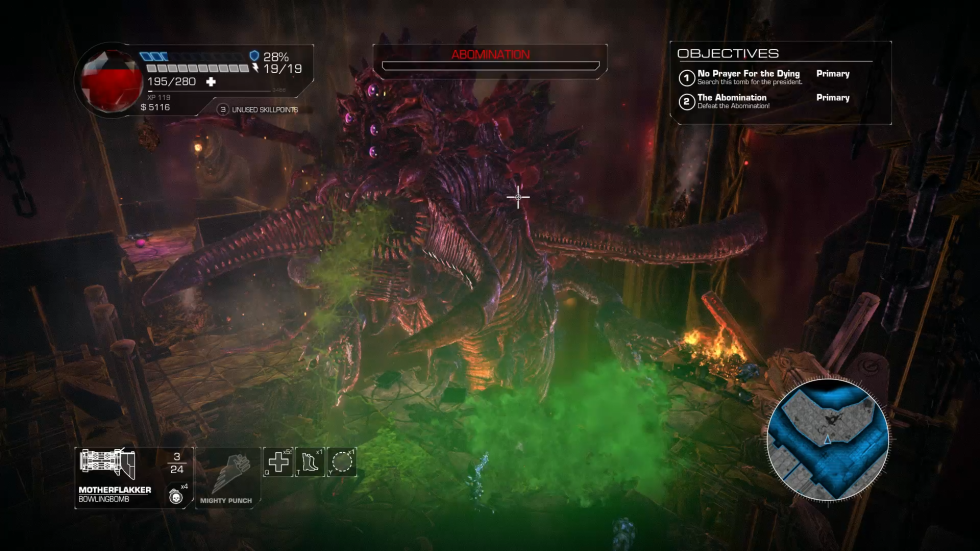
Don't get too excited by the look of this boss. You just shoot it a lot.

In Bombshell, the new isometric shooter from Interceptor Entertainment and 3D Realms, there is a shield. I know this with 100 percent certainty, because for the last third of my playthrough, every step, action, and breath I took was punctuated by a robotic voice intoning "shield activated."

That’s not because I was spamming my character's comically overpowered bubble shield (though I did plenty of that), but it resulted from what I assume was a bug. I say "assume" because I'm not entirely sure that Bombshell hadn't grown sentient and developed just a bit of malice toward me. The game seems sapient enough to at least realize what a repetitive drag it had been up to that point, so maybe it turned its newborn ability to think and feel entirely toward mocking my efforts to find the fastest path to the credits.

Bombshell isn't an aggressively terrible game. It's just aggressively mediocre for long enough that it starts to seem that way.

Read 17 remaining paragraphs | Comments