Dark Souls 3 review: Marching towards masochism

New entry is fresh and satisfying in the most enjoyably painful ways possible.

The world of Dark Souls 3 retains much of the series' bizarre desperation.

About 50 hours into Dark Souls 3, I learned how to let go. Not to let go of my experience points, which in these games are dropped then obliterated after every other death. I learned how to get over that a third of the way through the first game, years ago.

No, what I learned to put behind me in Dark Souls 3 was my undying, almost slavish admiration for the original Dark Souls.

Superficially, Dark Souls 3 couldn't seem more similar to its forebears. But Dark Souls 3 isn't really that much like the previous games in the series, at least not when you dig down into the deep, esoteric mantle found in every Souls game.

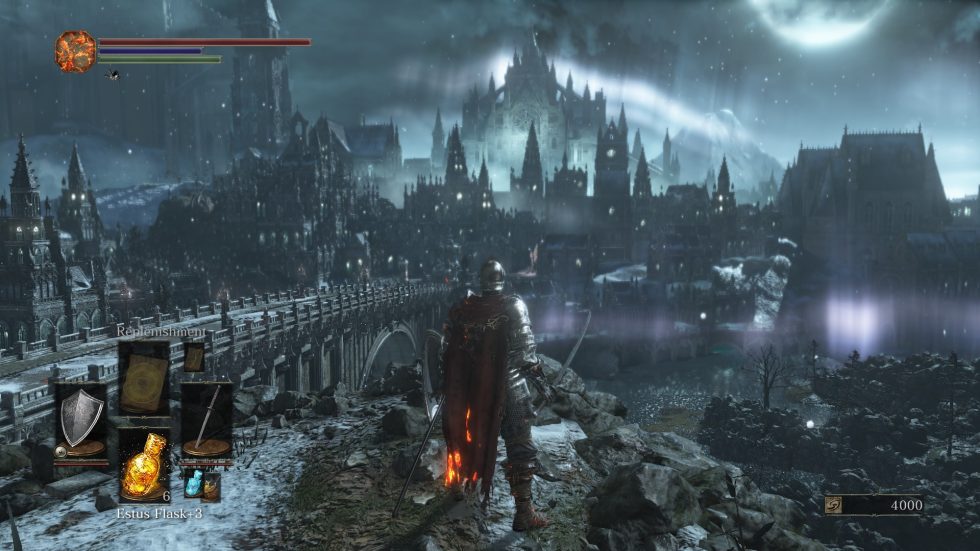
The most distinct, most immediate, difference is in the way Dark Souls 3 looks. I was instantly struck by how fluidly my newly spawned character's cape swayed in the mountain breeze. The opening hours are spent with the familiar humanoid Hollows—undead whose apathy turned to directionless bloodlust—but now, they just look so much better. I was just as impressed when the first boss exploded into snakes made of writhing black oil. Here was Dark Souls living up to its paradoxical promise of delivering unexpected dangers and looking damn good while doing it.

Read 19 remaining paragraphs | Comments

Brussels terror attacks: Why ramping up online surveillance isn’t the answer

Op-ed: Brief moratorium needed on calls for new spying laws after atrocities.

I am in Brussels. And I am scared. Very scared… of the probable security backlash following last month’s terrorist attacks.

I don’t want to live in a city where everyone is viewed with suspicion by the authorities, because it won’t stop there. Because suspicion is infectious. When misappropriated and misdirected, that sort of suspicion can very easily become racism and prejudice—two of the key ingredients that led the awful attacks on the morning of Tuesday, March 22.

Read 28 remaining paragraphs | Comments

Zombies, frostbite, and betrayal: Dead of Winter review

Ars Cardboard looks at the popular kinda-cooperative zombie game.

Welcome to Ars Cardboard, our weekend look at tabletop games! Check out our complete board gaming coverage right here—and let us know what you think.


When the zombie apocalypse inevitably comes, I sure hope I’m not stuck in the small town that’s the setting for Dead of Winter. Because boy, are those people just plain screwed. Traversing the hostile wasteland in the vain hope of scavenging supplies, fending off the never-ending onslaught of the undead—the end of the world is rough enough without a bunch of backstabbing friends making things harder.

Read 20 remaining paragraphs | Comments

Dealmaster: Today only, save $15 off eBay orders of $75 or more

Plus a bunch of other deals on TVs, laptops, games, accessories, and more.

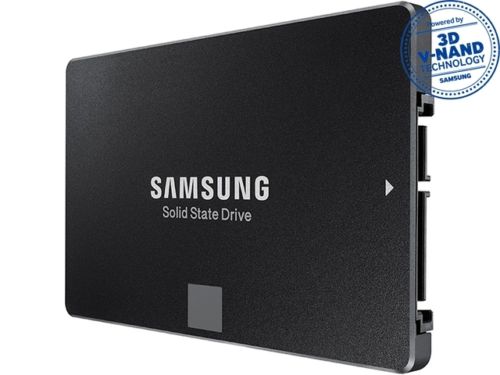
Greetings, Arsians! Courtesy of our partners at TechBargains, we have a bunch of tempting deals for you today—and one of them could save you even more money on other deals. For today only, you can get $15 off almost any eBay order of $75 or more. That means you can save money on a plethora of items, including the already discounted MSI Geforce GTX 980ti 6GB Golden Edition video card, a 1TB Samsung 850EVO solid state drive, an Xbox Elite controller, and more. This deal is only valid until 5:00pm PST—shop now so you have no regrets later!

Check out the rest of our deals on laptops, PCs, accessories, and more below.

Featured

Read 7 remaining paragraphs | Comments

Shadows over Innistrad: Madness, werewolves, and gothic horror descend upon Magic

Cards that transform, flavoursome new mechanics, and a maddeningly mysterious story.

Magic: The Gathering kicks off 2016 with Shadows over Innistrad (SOI), another return trip to a much-loved world from Magic’s history. Moving on from the overt giant-tentacled-monster theme of Zendikar, SOI instead embraces gothic horror, emphasising a sense of mystery and creeping dread. (But don't worry, there are still some rather powerful werewolves.)

Although the expansion isn't released until April 8, Ars has managed to get its hands on some packs—and we’re already excited to get hold of more at the Shadows over Innistrad prerelease events, starting this weekend (April 2 and 3). Read on for our review of the set and how SOI will play out in both Limited and Constructed formats.

What's new in Shadows over Innistrad?

The original Innistrad set is often hailed as the turning point for modern Magic, with praise aimed at its flavour, its varied draft format, and its depth for deckbuilders. SOI has a lot to live up to, and also has a challenge in design space—when you’ve already made a bunch of vampires and werewolves in the first set, what does the second set change to keep things fresh?

Read 25 remaining paragraphs | Comments

UK cops tell suspect to hand over crypto keys in US hacking case

Lauri Love faces extradition to US over hitting Federal Reserve, among others.

(credit: Aurich Lawson)

At a court hearing earlier this month, the UK's National Crime Authority (NCA) demanded that Lauri Love, a British computer scientist who allegedly broke into US government networks and caused "millions of dollars in damage," decrypt his laptop and other devices impounded by the NCA in 2013, leading some experts to warn that a decision in the government's favor could set a worrisome precedent for journalists and whistleblowers.

Arrested in 2013 for the alleged intrusions but subsequently released, Love was re-arrested in 2015 and is currently fighting extradition to the United States. He has so far refused to comply with a Section 49 RIPA notice to decrypt the devices, a refusal that carries potential jail time. However, British authorities have not charged Love with any crime, leading him to counter-sue in civil court for the return of his devices.

In the NCA's submission to the court, which Ars has seen a copy of, the government demanded that Love turn over the passwords and encryption keys to his confiscated devices. The devices in question include a Samsung laptop, a Fujitsu Siemens laptop, a Compaq computer tower, an SD card, and a Western Digital hard drive. The NCA in particular wants Love to decrypt TrueCrypt files on the SD card and external drive.

Read 15 remaining paragraphs | Comments

To SQL or NoSQL? That’s the database question

But as technological lines blur, there’s not always a clear cut answer.

It's a tangled, database web out there. (credit: Getty Images)

Poke around the infrastructure of any startup website or mobile app these days, and you're bound to find something other than a relational database doing much of the heavy lifting. Take, for example, the Boston-based startup Wanderu. This bus and train focused travel deal site launched about three years ago. And fed by a Web-generated glut of unstructured data (bus schedules on PDFs, anyone?), Wanderu is powered by MongoDB, a "NoSQL" database—not by Structured Query Language (SQL) calls against traditional tables and rows.

But why is that? Is the equation really as simple as "Web-focused business = choose NoSQL?" Why do companies like Wanderu choose a NoSQL database? (In this case, it was MongoDB.) Under what circumstances would a SQL database have been a better choice?

Today, the database landscape continues to become increasingly complicated. The usual SQL suspects—SQL Server-Oracle-DB2-Postgres, et al.—aren't handling this new world on their own, and some say they can't. But the division between SQL and NoSQL is increasingly fuzzy, especially as database developers integrate the technologies together and add bits of one to the other.

Read 51 remaining paragraphs | Comments

Dealmaster: Get a Dell XPS 15 with a QHD touchscreen for $1,450

Plus more deals on smart home devices, mobile accessories, and gift cards.

Greetings, Arsians! Courtesy of our partners at TechBargains, we have a bunch of great deals today, including huge savings on one of Dell's premium laptops. Now you can get a Dell XPS 15 laptop with a Core i7 processor, 3200x1800-pixel touchscreen, 512GB SSD, and 16GB of RAM for just $1,450. This loaded laptop is originally priced at $2,400, so it's worth snatching it up now while this deal can save you 40 percent.

Check out the rest of the deals listed below, especially a today-only deal that will save you $25 off $125+ eBay purchases.

Featured

Read 5 remaining paragraphs | Comments

Forgotten audio formats: The Highway Hi-Fi

If only we could still play scratch our vinyl records while speeding down country lanes.

What’s the connection between the Beatles’ George Harrison, boxing legend Muhammad Ali, and Chrysler cars? The Highway Hi-Fi: a vinyl record player that just happened to be the world’s first in-car music system. It appeared 60 years ago this spring, in 1956, and should have been a smash hit. It was innovatory, a major talking point, arrived as the car market was booming as never before, and it came with much press hype. It also had the backing of a leading motor manufacturer. What could possibly go wrong?

Unlike car radios—which had already been around for more than a decade—the Highway Hi-Fi actually gave you a choice. The records you wanted to play were picked by you rather than by a DJ in a radio station miles away, and those discs could hold some 90 minutes of music. This playing time was twice what you could get from a normal vinyl record of the mid-1950s—a trick accomplished by dragging the Highway Hi-Fi’s playing speed down to a mere 16.66 RPM, half that of a normal vinyl album. In technological terms, this was seen as a minor miracle.

The Highway Hi-Fi, in action.

And yet, within a year of launch, sales were plummeting, and 12 months after that the Highway Hi-Fi was being withdrawn—also soon to be the fate of the companies that were to "copy" the format.

Read 10 remaining paragraphs | Comments

Meet the largest science project in US government history—the James Webb Telescope

Precision? The Webb can detect heat generated by a bumblebee as far away as the Moon.

Recently, the James Webb Space Telescope team used a robotic arm to install the last of the telescope's 18 mirrors onto the telescope structure. (credit: NASA)

Since Galileo first discovered the moons of Jupiter and the phases of Venus, telescopes have gotten larger, more accurate, and more powerful. They're now installed all around the world from mountaintop observatories to suburban backyards. And over those 350 years, all of them have battled the same enemy: our Earth’s atmosphere.

The thin layer of nitrogen, oxygen, and carbon dioxide that makes life possible on our planet makes observation of everything beyond the planet maddeningly difficult. The atmosphere absorbs a great deal of the light outside the visible part of the spectrum, blocking or severely attenuating information about the cosmos. Its turbulent motions distort what does get through. It scatters our own light back down into our eyes and instruments, making the night more like a slightly darker day, washing out all but the brightest celestial objects in a haze of light pollution.

We can reduce this atmospheric obfuscation slightly by situating our observatories at high altitudes, far from population centers. But it is not enough. If only we could open a hole in our gaseous shroud and peer through it...

Read 54 remaining paragraphs | Comments