Trump University and the art of the get-rich seminar

We witnessed The Donald’s foray into “university” education.

Editor's note: Though this isn't usual Ars Technica fare, we're publishing a non-tech story because we had a reporter with deep personal experience relevant to a topic of national interest.

In 2005, both of us became fixated on a late-night infomercial that promised access to "hundreds of billions of dollars" in "free government money." As journalism grad students at the time, our evenings often ended with a couple beers as we decompressed by watching whatever was on our tiny 13" TV. And what was on at the time—repeatedly—was a half-hour advertisement for an outfit called "National Grants Conferences" (NGC).

Why did the NGC infomercial captivate us? It wasn’t the charisma of the commercial’s star, ex-football player and former Congressman J.C. Watts (R-Okla.), who was busy making a mockery of whatever credibility he once had. And it wasn’t the enthusiastic couple who founded NGC, Mike and Irene Milin, proclaiming that numerous government grants were there for the taking.

Read 61 remaining paragraphs | Comments

Dealmaster: Get a Dell Optiplex compact desktop with Core i7 for just $725

And other deals on laptops, gaming consoles, and more.

Greetings, Arsians! Courtesy of our partners at TechBargains, we have a number of deals to share today. The highlight is a great deal on the Dell Optiplex 5040 compact desktop—save big on this tiny PC and get it now for just $725 instead of the usual $1,270. This compact desktop has been recently redesigned to be even more space-efficient, measuring 3.6-inches wide and 11.4-inches high, and it supports Core i7 Skylake processors. It's ideal for anyone who wants to save on space but doesn't want to compromise on computing power.

Don't forget to check out the rest of our deals below.

Featured

Read 5 remaining paragraphs | Comments

Even at 1.0, Vivaldi closes in on the cure for the common browser

Review: Ultra customization, clever tab management breaks from Chrome, Firefox.

The Web browser is likely the most used piece of software on the average computing device. Yet despite its ubiquity, there is relatively little competition in the browser space. These days even experienced users would be hard pressed to tell the difference between the major offerings. Internet Explorer's new Edge incarnation is slightly different, but Firefox, Chrome, and even Opera are indistinguishable both in appearance and features available.

There may be some small differences, but for the most part a Web browser is a Web browser is a Web browser.

This is especially true when there's no Web browser. The rise of the embedded browser in mobile apps has very nearly eliminated the need for a dedicated one if you spend most of your time in mobile applications. But the disappearance of the browser is not a bad thing. The point after all is not the browser—it's the Web it accesses.

Read 39 remaining paragraphs | Comments

Power tools: Sorting through the crowded specialized database toolbox

With so many choices today, matching database to need isn’t getting any easier.

Choosing a database is pretty similar—it's all about the right fit. (credit: Flickr user: Sven Slootweg)

When you think of game development, the first thing that comes to mind probably isn't a database. But in the world of Jamaa, the setting for WildWorks' massively multiplayer online kids' game Animal Jam, a database keeps millions of cartoon animal characters frolicking and the cartoon trees from crashing down. The database chosen for this job was a specialized, non-relational database from Basho called Riak—one among the herd of new databases that have risen to handle Web-generated gluts of non-structured data.

The database landscape is increasingly complicated. As of April, Solid IT's DB-Engines initiative was tracking 303 separate relational and non-relational databases. In the golden years of relational databases, benchmarks such as TPC could theoretically give you some sort of way to compare databases directly. But today, it's difficult to assign a one-size-fits-all measurement to the world of non-relational databases such as Riak and Apache Cassandra (the distributed database project originally developed at Facebook). WildWorks ran its benchmarks and decided on Riak for Animal Jam, and Uber did the same for its dispatch platform. IoT car tech company VCARO decided the exact opposite: Cassandra beat Riak at handling vehicle-generated sensor data. Software company Nuance Communications opted for something else entirely, choosing Couchbase for handling speech and imaging apps.

The "why" of decisions like these are as complicated as the database technologies themselves. It may hinge on which two of three CAP theorem guarantees—consistency, availability, and partitionability—a business values most. The tipping point could alternatively be which database handles software containers or what skills you already have on hand. This list of factors is seemingly infinite.

Read 38 remaining paragraphs | Comments

Facial recognition service becomes a weapon against Russian porn actresses

“FindFace” was created to find friends, but some are using it to harass women.

Photos used in Dvach's doxing campaign. (credit: Tjournal.ru)

This story originally appeared on Global Voices Advocacy

The developers behind “FindFace,” which uses facial recognition software to match random photographs to people’s social media pages on Vkontakte, say the service is designed to facilitate making new friends. Released in February this year, FindFace started gaining popularity in March, after a software engineer named Andrei Mima wrote about using the service to track down two women he photographed six years earlier on a street in St. Petersburg. (They’d asked him to take a picture of them, but he never got their contact information, so he wasn’t able to share it with them, at the time.)

From the start, FindFace has raised privacy concerns. (Even in his glowing recommendation, Mima addressed fears that the service further erodes people’s freedoms in the age of the Internet.) In early April, a young artist named Egor Tsvetkov highlighted how invasive the technology can be, photographing random passengers on the St. Petersburg subway and matching the pictures to the individuals’ Vkontakte pages, using FindFace. “In theory,” Tsvetkov told RuNet Echo, this service could be used by a serial killer or a collector trying to hunt down a debtor.”

Read 4 remaining paragraphs | Comments

When the next Twitterbot loses it, remember that its tweets are protected

Op-Ed: No laws limit the speech of AI or autonomous programs, but that could change.

Bots have been using computers for a long time (see The Invisible Boy), but the Constitution is even older. (credit: Getty Images)

John Frank Weaver is Boston-based attorney focusing on artificial-intelligence law.

Last month, the Internet was briefly ablaze with the news that Tay, a Microsoft-built Twitterbot designed to interact with 18-24 year-olds in the persona of a teenaged girl, had interacted with the Twitterverse and become a racist conspiracy theorist in less than 24 hours. Microsoft understandably pulled the plug on the experimental AI, but that doesn’t end the creation of autonomous tweets of questionable value. There are numerous other Twitterbots that, with little to no human input, create original ideas, only some of which are truly worthwhile. These bots include:

• An AI-powered Donald Trump emulator (@DeepDrumpf) that analyzes the real Donald’s Twitter production and attempts to create new tweets that he could have said.

Read 11 remaining paragraphs | Comments
Dealmaster: Get an Xbox One bundle with the game of your choice for $299

And more deals to kick off the weekend.

Greetings, Arsians! Courtesy of our partners at TechBargains, we're brightening up your Friday with a bunch of great deals. Our featured deal is perfect for gamers: now you can get an Xbox One bundle, including the console, a controller, and the game of your choosing, for just $299. Considering this bundle would be $349 normally, this is a deal you don't want to miss—especially since you can choose from a few awesome games including Gears of War Ultimate and Rise of the Tombraider. 

Be sure to check out the rest of your deals below, including discounts on PS Plus memberships, MacBookPro laptops, and more.

Featured

Read 6 remaining paragraphs | Comments

Acer Predator G1 crams an Nvidia Titan X into a briefcase-size PC

If you need small PC for the living room or LANs the G1 is worth a look.

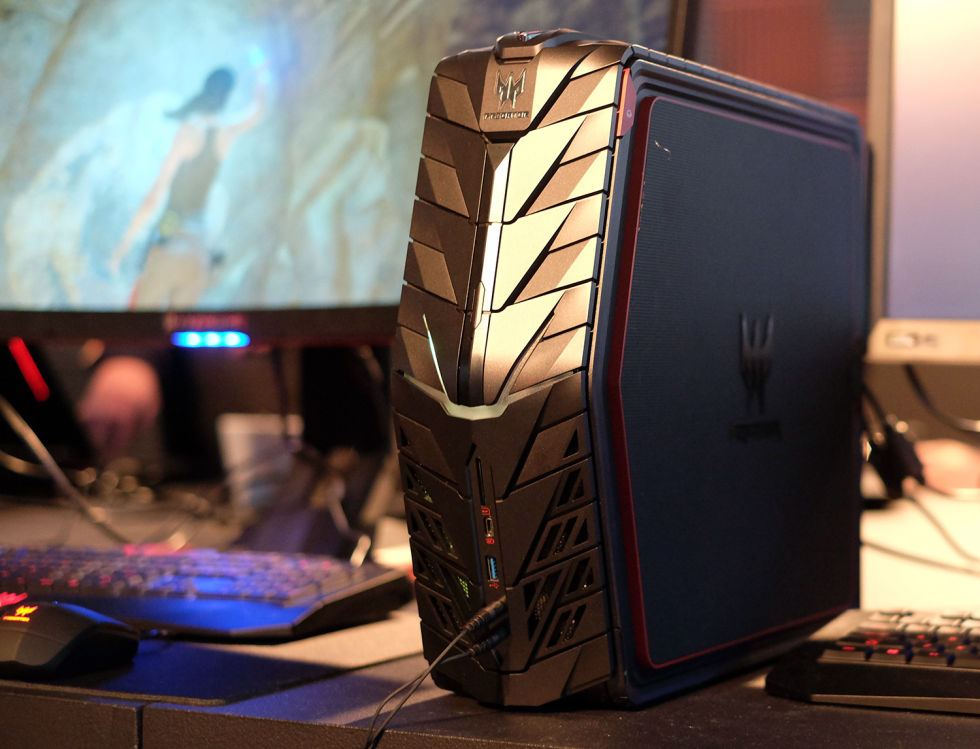
Say what you will about Valve's Steam Machines and Steam OS—they're not great—but at the very least they have encouraged PC makers to rethink PC design for the living room. And now, with HTC wanting to turn front rooms into VR labs with its excellent Vive VR headset, there's a small but growing demand for sensibly sized PCs that'll slot in next to a PlayStation or an Xbox. Acer's new Predator G1 gaming desktop doesn't quite manage to slim down to PlayStation 4 proportions, but it does cram Nvidia's monster Titan X graphics card into a chassis just bigger than briefcase. Compared to a typical gaming desktop, or Acer's own Predator G6, it's positively tiny. The question is: how has Acer done it?

The Tardis effect

Acer says the Predator G1's case was built a bit more like a games console than a regular tower PC, with a clear airflow path through the case that helps cards like the Titan X stay cool under load. However, taking off the side panel, there's nothing too mad going on. It has a metal cage around the GPU, designed to function as a heatsink and as a way to protect the card during transit, but the Predator G1 uses conventional fans rather than water-cooling or any other comparable "next-level" antics.

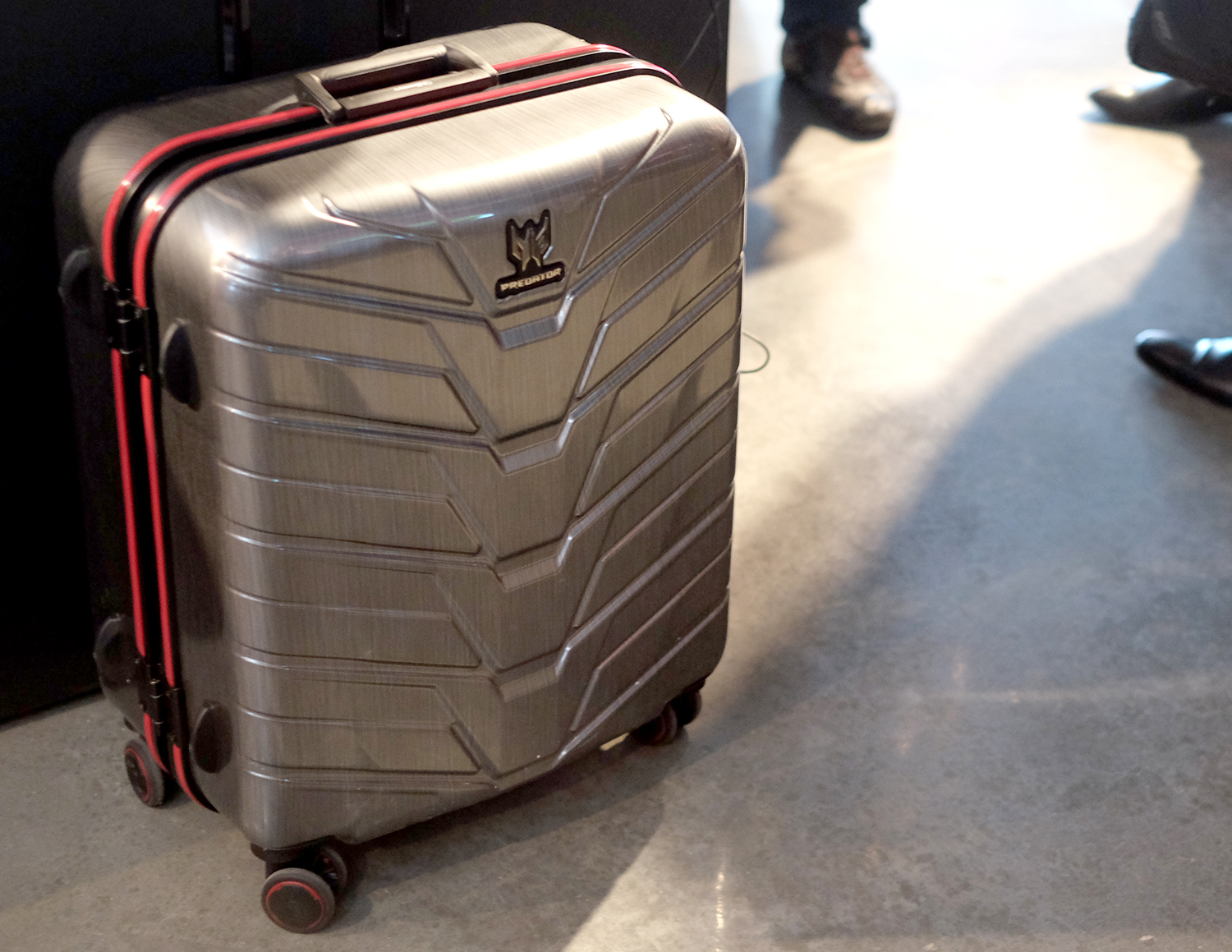
While there's an obvious appeal for people who want a VR setup suitable for a living room environment, Acer's also pitching the G1 at those after a semi-portable system. Indeed, the first 1,000 buyers will receive a matching piece of luggage designed with the signature Predator series armoured look. No, it's still not small enough to get past Ryanair's draconian hand luggage restrictions thanks to the extra cushioning inside it to protect the PC—and I wonder how much room is actually left for clothes in the thing afterwards—but hey, if you're in the market for a small gaming PC anyway, it's a nice bonus.

Read 11 remaining paragraphs | Comments

Acer Predator 17X with desktop-class GTX 980 graphics card is a beast

Acer takes on Asus with the Predator 17X. But it isn’t cheap. Or pretty.

Some say the desktop PC is virtually dead already, but reality disagrees. A powerful desktop is the best way to get a VR-ready system, because even the best laptop GPUs can't keep up with those on the desktop—well, except one. The Acer Predator 17X strains at the limits of what's possible in a laptop right now, packing a desktop-class Nvidia GTX 980 GPU in a frame remarkably similar to the normal Predator 17, which can't go further than the GTX 980M. The performance difference is huge.

The 17X isn't the first consumer laptop with a GTX 980—both MSI's Dominator Pro-G and Asus' mad watercooled GX700 feature the same graphics card. But the 17X is a tad more practical. Up close, it looks like a normal gaming laptop, which means it's big, thick, and heavy. But it can can get by with a familiar fan setup rather exotic watercooling.

That said, the cooling system isn't entirely ordinary. Rather than use two fans like the normal Predator 17, the Predator 17X has three. There's an additional fan towards the front, used to pull in cool air from the front edge of the laptop before it's filtered through the insides and flushed out through some rear vents.

Read 11 remaining paragraphs | Comments

UK intel agencies spy indiscriminately on millions of innocent folks

Docs revealed by court order show only flimsiest safeguards against abuse.

(credit: Wikipedia)

The UK's intelligence agencies (MI5, MI6, and GCHQ) are spying on everything you do, and with only the flimsiest of safeguards in place to prevent abuse, according to more than a thousand pages of documents published today as a result of a lawsuit filed by Privacy International.

The documents reveal the details of so-called "Bulk Personal Datasets," or BPDs, which can contain "hundreds to millions of records" on people who are not suspected of any wrongdoing.

These records can be “anything from your private medical records, your correspondence with your doctor or lawyer, even what petitions you have signed, your financial data, and commercial activities,” Privacy International's legal officer Millie Graham Wood said in a statement. "The information revealed by this disclosure shows the staggering extent to which the intelligence agencies hoover up our data."

Read 21 remaining paragraphs | Comments