Dinosaurs weren’t wiped out by that meteorite after all

New evidence shows that dinosaurs were dying out 24 million years before bolide impact.

For some reason, the scientists neglected to mention "fighting with a giant ape" as one possible cause of the dinosaur population decline. (credit: King Kong)

It's the most dramatic mass extinction in the history of Earth. About 66 million years ago, a giant meteorite smashed into the Gulf of Mexico, sending toxic gases into the atmosphere and causing extreme climate change that wiped out most dinosaurs. Except that's not the whole story. Mass extinction, like modern love, is complicated. A new study from a group of UK researchers reveals that most dinosaur clades were already in decline long before the Chicxulub impact that changed Earth's ecosystems forever.

After an exhaustive statistical analysis of dinosaur fossil frequency over time, the researchers published their findings in Proceedings of the National Academy of Sciences. What they found was that dinosaur populations were declining about 24 million years before the bolide from space smashed into our planet. The researchers show that dinosaurs from three major sub-clades—Ornithischia, Sauropodomorpha, and Theropoda—reached a deadly tipping point about 90 million years ago. That's when dinosaur species began going extinct at a higher rate than they were speciating, or spawning new species. Put simply, new dinosaur species weren't evolving to replace the ones that went extinct.
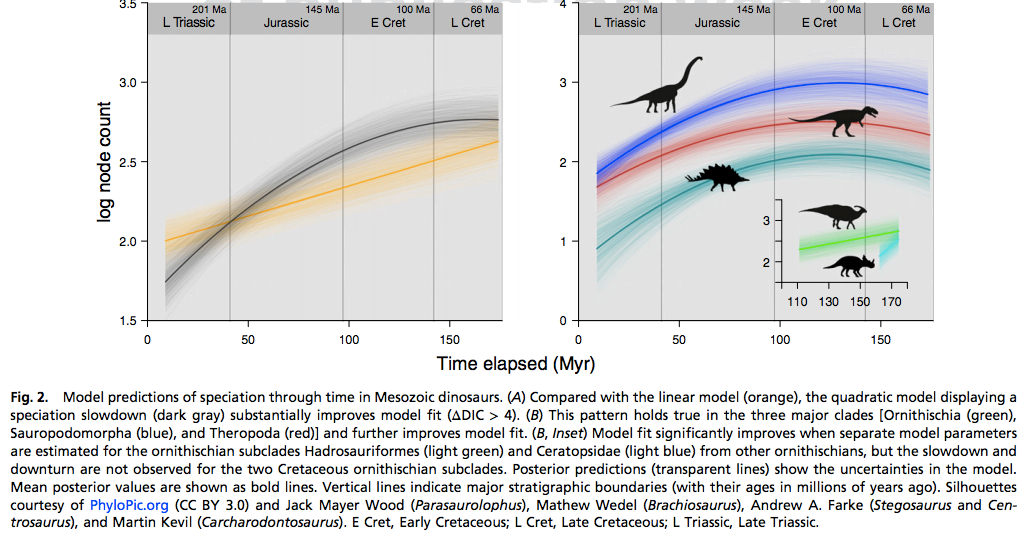
Extinction is a normal part of the lifecycle of any species, but in a healthy clade you expect to see new species evolving at the same or higher rate than they are going extinct. This wasn't so among most dinosaurs for millions of years before the Chicxulub event. That said, a few lucky dinosaur subclades, Hadrosauriformes and Ceratopsidae, actually saw speciation rates rising during the tens of millions of years before the meteorite impact. Indeed, there is evidence that Hadrosaurs lived for hundreds of thousands of years after the meteorite impact. And of course, early mammals were running around and happily speciating in the millions of years before and after the meteorite impact.

Read 4 remaining paragraphs | Comments
Dutch divers discover 400-year-old dress in a sunken ship

Preserved under a layer of sand, it offers a glimpse of 17th-century aristocratic life.

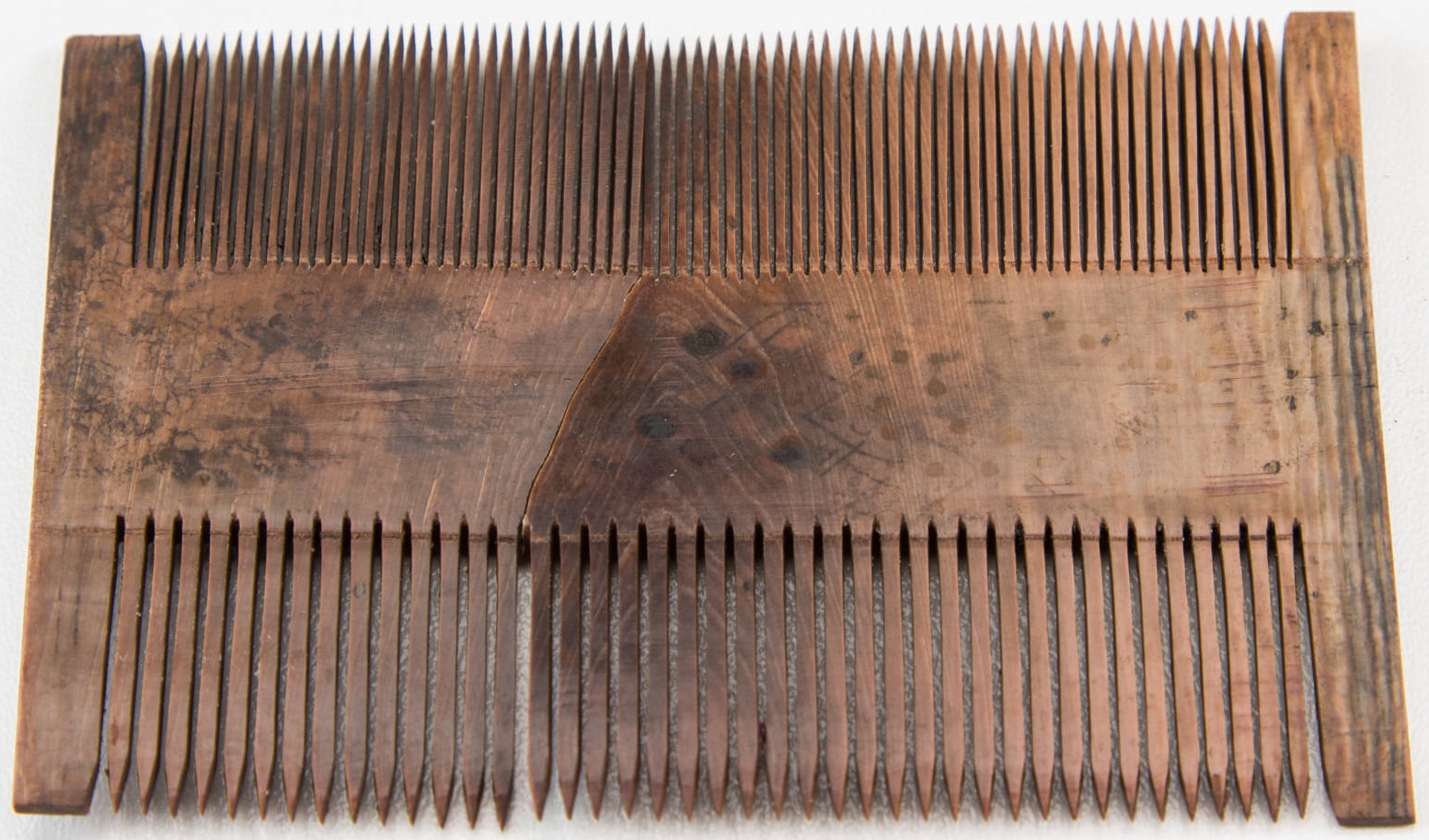
It wasn't exactly what divers searching for sunken ships expect to find. When the Texel Divers Club glimpsed a package in the sand-buried remains of a sunken ship off the island of Texel in the Wadden Sea, they brought it to the surface—only to discover it held a wealthy lady's most prized possessions: a silk damask dress, velvet embroidered purse, perfume ball, lice comb, stockings, and books bound in beautiful leather.

Preserved beneath a layer of sand since the 17th century, the dress was probably for everyday wear and was of a style frequently seen in paintings from the late Renaissance. Made of rich silk damask, it likely belonged to a woman of the upper classes. Despite its fanciness, experts believe it was for everyday wear because it wasn't beaded or embroidered with golden or silver threads. The woman's books were stamped with the emblem of King Charles I, of the Stuart royal family from England, which suggests she may even have been royalty. It's exceedingly rare to find such a well-preserved collection of textiles and makes this find one of the most important of its kind in Europe.

The find is also a boon for historians who want to understand what everyday life was like during this era. What we see in paintings is not always an accurate record of people's lives. Finding this cache of typical (albeit expensive) clothing verifies that privileged women of the era really did dress in the ways we might expect and carry tiny metal balls of scented, dried flowers to mask body odors that would have been common in a culture where people didn't bathe very often—and never got any medical remedies for all the funguses and bacterial infections that flourish on human bodies.

Read 2 remaining paragraphs | Comments

Bay Area Ars readers: Join us TONIGHT, 4/20, to talk about the science of meat

Learn about the history of meat-eating from Stanford anthropologist Krish Seetah.

Why do we butcher animals the way we do? Why do we eat some animals and not others? When did we start associating meat with cultural traditions? Find out at Ars Technica Live on April 20 in Oakland, California. (credit: Proletariat Butchery)

We're excited to announce our first episode of Ars Technica Live, a monthly interview series with fascinating people who work at the intersections of tech, science, and culture. Join us tonight in Oakland, California--that's Wednesday, April 20--from 7 to 9pm, for a discussion with anthropologist Krish Seetah about the complicated history of meat-eating and animal butchery.

Filmed before a live audience in Oakland tiki bar Longitude (347 14th St., Oakland, California), each episode of Ars Technica Live is a speculative, informal conversation between your fine hosts Annalee Newitz and Cyrus Farivar and an invited guest. The audience—that would be YOU—is also invited to join the conversation and ask questions. These aren’t soundbyte setups; they are deepcuts from the frontiers of research and creativity.

April’s event is about the scientific study of meat-eating, from the first archaeological traces of humans hunting other animals, to our contemporary obsession with locally sourced meat and paleo diets. Guest Krish Seetah is a Stanford anthropologist and former butcher who is working on a book about the history of meat.

Read 3 remaining paragraphs | Comments

Facebook’s bots are already revolting

Op-Ed: The social network is betting billions on users talking to bots instead of people.

I am delighted to sell you flowers. Please use this Messenger window to tell me where to deliver them. (credit: Caprica)

Facebook has become a social network for cyborgs. It happened yesterday at Facebook developer conference F8 while everyone was busy eye-rolling over Mark Zuckerberg's keynote about saving the world. The company has launched a bot revolution, and ironically (or not), these bots will eventually replace tech workers in the exact emerging markets that Zuck vowed to rescue with his largesse.

The core of Facebook's idea is to chase its ever-expanding audience, which is flocking to Messenger. Last year, Messenger was the fastest growing app in the US, and now it has almost a billion users. Though Facebook itself claims 1.59 billion monthly active users, it's obvious that Messenger has grown massively since becoming a standalone app in 2014. So Facebook is turning Messenger into a platform with open APIs. And just as developers once built apps on top of Facebook, they'll now build bots on top of Messenger.

What does that mean? Facebook obviously doesn't have the answer yet—that's why they're inviting developers to figure it out for them. That said, there are a few hints of the bot ecosystem to come. In its announcement of the Messenger Platform, the company explains:

Read 9 remaining paragraphs | Comments

Massive undersea crab swarm caught on video for the first time

Scientists couldn’t believe their eyes when thousands of crabs gathered under their sub.

In the densest patch of crabs, there were over 77 of the creatures per square meter. This picture was taken by the UAV camera. (credit: Pineda et. al.)

When three scientists descended over a thousand feet underwater in an exploration vessel off the coast of Panama, they expected to see many kinds of life. They'd chosen to explore the Hannibal Seamount, a flat-topped undersea mountain that's the ocean equivalent of a tropical jungle, rich with a diversity of animals and plants found nowhere else. Their submersible, the Deep Rover 2, has the look of a giant, transparent bubble; with the help of spotlights, they could peer out from every angle. But as they approached the northwest flank of the seamount, they saw something inexplicable on the ocean floor.

Submarine footage of the crab swarm. (video link)

It looked like an underwater dust storm. As they got closer, the researchers realized it was an enormous swarm of crabs, kicking up sediment from the seafloor. They had never seen anything like it.

Read 9 remaining paragraphs | Comments

Review: Hardcore Henry is the crazy cyborg beatdown movie you always wanted

Funny, bloody action flick pits a killing machine against a telekinetic Russian gangster.

Do not mess with anyone whose knuckles are literally made of metal. (credit: Hardcore Henry)

If you need an antidote for the overblown blah of Batman v Superman, your medicine has arrived in the form of Hardcore Henry, a surprisingly great sci-fi shoot-em-up that moves at the pace of a first-person shooter on speed—and crack, and some LSD for good measure. It’s the comic-violent tale of deadly cyborgs, dope-smoking clones, and a telekinetic gangster-corporate oligarch in Russia. And it has a great soundtrack, too.

Shot entirely from the perspective of Henry with head-mounted GoPro cameras, the movie begins with a familiar cyborg premise. We watch through Henry’s eyes as he boots up, looks down in confusion at the newly installed power ports in his chest, then watches as an engineer screws on his new bionic arm and leg. The engineer tells Henry that she’s his wife, and she hopes one day he’ll remember how much they loved each other. But there’s no time for lovey-dovey, nor to install Henry’s voice box, because the lab is immediately attacked by bad guys. As they run for their lives, Henry discovers that the lab is actually in a zeppelin, and he and the engineer barely have time to launch themselves in the sole remaining escape pod.

In the middle of all this, we realize that the engineer—who jokes that Henry “never liked” her work—has done kind of a half-assed job covering Henry’s bionic arm with skin. She’s left his knuckles bare, so that four gleaming metal joints show through. Of course, these perma-brass knuckles will come in handy, because Henry is going to spend this entire movie wordlessly pounding the crap out of people using every weapon on his body and in his arsenal.

Read 10 remaining paragraphs | Comments

New technique for pirating from 3D printers is the next frontier in theft

Attackers can reverse engineer 3D printer outputs with audio recordings.

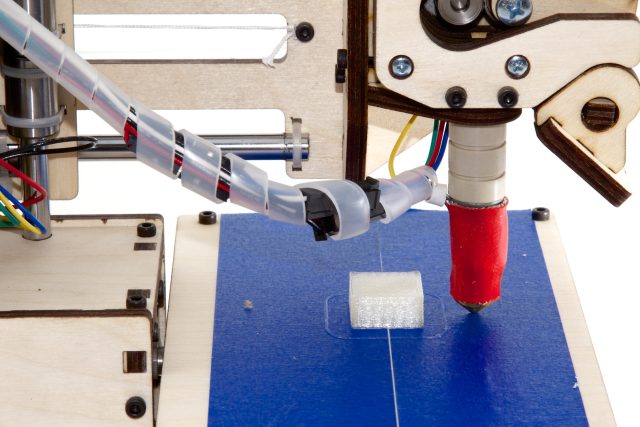
I'm in ur Printrbot bed, sniffin ur noises. (credit: Lee Hutchinson)

Let's say the manufacturer up the street is making widgets with a 3D printer and you'd like to get in on that action. If you want to clone those coveted 3D objects, all you need is an audio recorder in the room with the printer. Using just the noises emitted by the printer's stepper motors, you have up to a 92 percent chance of perfectly replicating the object. According to a new paper published in Science, researchers have even replicated a key using this technique.

A group of "cyber-physical systems researchers" will present the hack next week at a conference devoted to cyber-physical systems in Vienna. It's the next frontier in IP piracy, which could conceivably lead to a future Pirate Bay full of files that describe everything from the latest mobile device parts to human bones for transplant.

Mara Hvistendahl reports in Science that the researchers used a consumer grade Printrbot to make three objects: a tiny square, a tiny triangle, and a standard-sized key. She continues:

Read 1 remaining paragraphs | Comments

All the weird facts you never considered about life in space

Spacehack founder’s new book is about the beauty—and awkwardness—of being an astronaut.

Designer and citizen scientist Ariel Waldman has been obsessed with space for quite a while. While working for NASA, she founded Spacehack, a group for citizen scientists who want to participate in space observation with DIY satellites, astro data-crunching apps, and more. In 2013, she was appointed to the National Academy of Sciences Committee For Human Spaceflight.

Now she's written What's It Like in Space?, a delightful mini-coffee table book about all the awkward and beautiful moments you can have in space, based on dozens of interviews with people who have actually been there. We've got a gallery of pages from the book, which combines art with short observations to create an experience that people of all ages can enjoy.

This is the perfect book to fill your brain with wonder and remind you that going to space isn't all about watching our beautiful blue marble and discovering amazing new things. Sometimes it's about mopping pee out of your spacesuit or finding a comfortable sleeping position while strapped to a wall in zero-G. Waldman balances the breathtaking glory of spacewalks with everyday life on the ISS. And along the way, you'll learn that astronaut ice cream is a lie. A lie!

Read 1 remaining paragraphs | Comments

Cuckoldry is incredibly rare among humans

New study finds that only 1-2% of men unknowingly raise children who aren’t theirs

Science proves that there's only about a 1% chance that your wife is having Satan's baby instead of yours. (credit: Rosemary's Baby)

Reading the internet, or even perusing the scientific literature, you'd get the idea that people are constantly cheating on their spouses. Indeed, scientists have estimated that anywhere from 10-30 percent of men are unknowingly raising children who are not their own. This situation is referred to as cuckoldry, or scientifically as "extra-pair paternity." Now, however, it appears that our estimates of cuckoldry rates were way off.

A new survey published in Trends in Ecology and Evolution sums up a number of recent studies that show the actual rate of cuckolds in the general population, based on genetic testing and ancestor research, is 1-2 percent. This challenges evolutionary psychologists who have suggested that human women "routinely ‘shop around’ for good genes by engaging in extra-pair copulation to obtain genetic benefits." This idea came in part from studying socially monogamous songbirds, which mate for life but have roughly 1 in 10 babies as a result of "extra pair" matings.

Scientists were so unwilling to believe that human women were different from songbirds that some suggested the discrepancy between expected and actual rates of cuckoldry was a recent development caused by birth control. One study asserted that women who cheat may be getting pregnant less often than they would have historically. But that assumption turned out to be wrong as well. As the study authors write, human extra-pair paternity rates "have stayed near constant at around 1% across several human societies over the past several hundred years."

Read 3 remaining paragraphs | Comments

How would you feel if a robot asked you to touch its buttocks?

A group of researchers found out and advanced the field of robot interaction design.

The researchers told study participants that they were taking part in an anatomy lesson. As each body part was named, they were asked to touch it on the robot's body. Meanwhile, researchers measured their levels of physiological arousal. (credit: Jamy Li)

Humans didn't evolve in an environment full of machines, and as a result we have a lot of instinctive reactions to robots that mirror our reactions to other humans. Studies have shown that people have a hard time being rude to a robot's face, just as we do with other people. We even use the same part of our brains to recognize robot and human faces. A research group at Stanford recently wondered if our instinctive reactions to robots would extend to the way we touch their bodies. And they did a series of tests in which subjects were asked to touch robots in "accessible" regions like the hands and then "inaccessible" ones like the buttocks and genitals.

The researchers will present the results of their work this week at the Annual Conference of the International Communication Association in Fukuoka, Japan. They wanted to focus on people's reactions to touch because there is already a large body of evidence showing that humans have complex reactions to touching each other, ranging from emotions to physiological changes we aren't always aware of. As robots take on the roles of caretakers, workplace helpers, and service workers, it's important to explore whether touch should be incorporated into how we design robot interfaces. But first, we need to understand whether humans react to robot touch the way they react to human touch.

To answer that question, the researchers used a human touching scale developed back in the 1960s by Sidney Jourard. Jourard used the term "body accessibility" to rank body parts based on how willing people were to allow others to touch them. As the researchers wrote:

Read 6 remaining paragraphs | Comments