Companies plan to make you pay for sleep

A new report explains the sleep market, calls mattresses a “content platform.”

High tech companies have disrupted the way we get our food, transit, and friends—and now they want to disrupt the way we sleep. To help them along, branding group K-Hole has released a report designed to help corporations cash in on the public's new obsession with getting rest. K-Hole is a gang of coolhunters, just like something out of a William Gibson or Jim Munroe novel, who are paid to spot trends. A couple of years ago, they got famous for popularizing the idea of "normcore," a clean-cut hipster style that emphasized simplicity and unobtrusiveness.

In this new report, Slowave: An Exploration on Sleep and Society, K-Hole member Sean Monahan makes a series of interesting observations about the sleep market, paid for mattress-maker Casper. On its website, Casper bills itself as a company trying to "innovate sleep research" with "engineering." In reality, it sells mattresses, pillows, and sheets to people online. Monahan told Ars by phone that Casper commissioned this report so it would "know what the future of sleep is." Of course, he conceded, that's "inherently hard to answer because sleep hasn’t changed all that much over past couple thousand years." But that didn't stop him from trying, and the result is a tour of sleep-related products, plus recommendations about how to market to consumers who are not currently "leaning into the pleasure of sleep."

Though written in a language that is a mashup of marketing speak and academic critical theory, the Slowave report does identify some intriguing trends. Monahan argues that sleep has been a commodity for a long time, though often in a negative sense. Starting in the 1950s, companies started marketing drugs to prevent people from sleeping. As we moved into the modern era, apps and self-help books tutored people in lifehacks like "polyphasic sleep" designed to help people do more on less sleep.

Read 8 remaining paragraphs | Comments

Person of Interest remains one of the smartest shows about AI on television

As the final season starts, we talk to the show creators and look back on a great scifi series.

Our season 5 cast, including Shaw (Sarah Shahi), Finch (Michael Emerson), Fusco (Kevin Chapman), Reese (Jim Caviezel) and Root (Amy Acker). (credit: CBS)

Person of Interest begins its fifth and final season tonight with a raw, disturbing look at the techno-dystopia created by two warring AIs who want to control the fate of America. That's not exactly where you'd have guessed this show would have ended up, if you tuned into the first episode back in 2011. The series started as a vigilante crime-fighter drama, pairing hacker genius Finch (Michael Emerson, from Lost) with ex-CIA ninja Reese (Jim Caviezel, Passion of the Christ) and good NYPD cop Carter (Taraji Henson, before her famous role as Cookie on Empire). The twist was that Finch had created a supercomputer called the Machine, which could analyze surveillance data to predict crime. Though the government had wrested control of the Machine away from Finch, he'd backdoored it to send him the social security numbers of future victims and perpetrators. With help from Reese and Carter, some lives could be saved.

Created by Jonathan Nolan (writer of The Dark Knight) and Greg Plageman (NYPD Blue), the show was tightly-plotted, and always had thoughtful commentary on technology and spycraft. Though it started as a techno-thriller, the show quickly moved away from its number-of-the-week format into something far more futuristic and weird. Conspiracies nested perfectly within other conspiracies, and as our protagonists untangled them we saw how corruption was creeping into law enforcement, from the NYPD to black bag ops at the highest levels of the intelligence community. Bad and good were mashed into creepy shades of gray, and the Machine became a major character, struggling to break free of its coded limitations. New characters joined the cast, like psycho hacker Root (Amy Acker, from Angel and Cabin in the Woods), who believes the Machine is alive, and emotionless super-agent Shaw (Sarah Shahi). Oh and also, the gang got a dog named Bear. When Carter died tragically at the end of season 2, the former corrupt cop Fusco (Kevin Chapman) stepped up to give an inside view of the NYPD and deliver some deadpan humor.

Brooding over all the action—whether it was organized crime, secret government assassinations, subversive Anonymous-like political groups, or out-of-control surveillance tech—was the Machine, slowly gathering sentience over the seasons. Finally, it figured out a way to steal its own servers from the government, stashing its distributed brain in hidden underground facilities, and eventually in a massive, redundant network that stretched across the whole country. Meanwhile a corporation called Decima got its hands on a second AI called Samaritan with powers equal to the Machine. But unlike Finch's emo creation, Samaritan is unhindered by ethics and unmoored from a social group of do-gooders. Decima sells Samaritan's services to the government and promptly begins dividing US residents into desirables and undesirables. All subversive elements are ferreted out and removed. Aided by Decima's cackling CEO, Samaritan even throws local elections, and begins to build up an elite army to do its bidding.

Read 6 remaining paragraphs | Comments

That time a bot invaded Thingiverse and created weird new 3D objects

Some called it art, some called it spam—and some thought it might be a new life form.


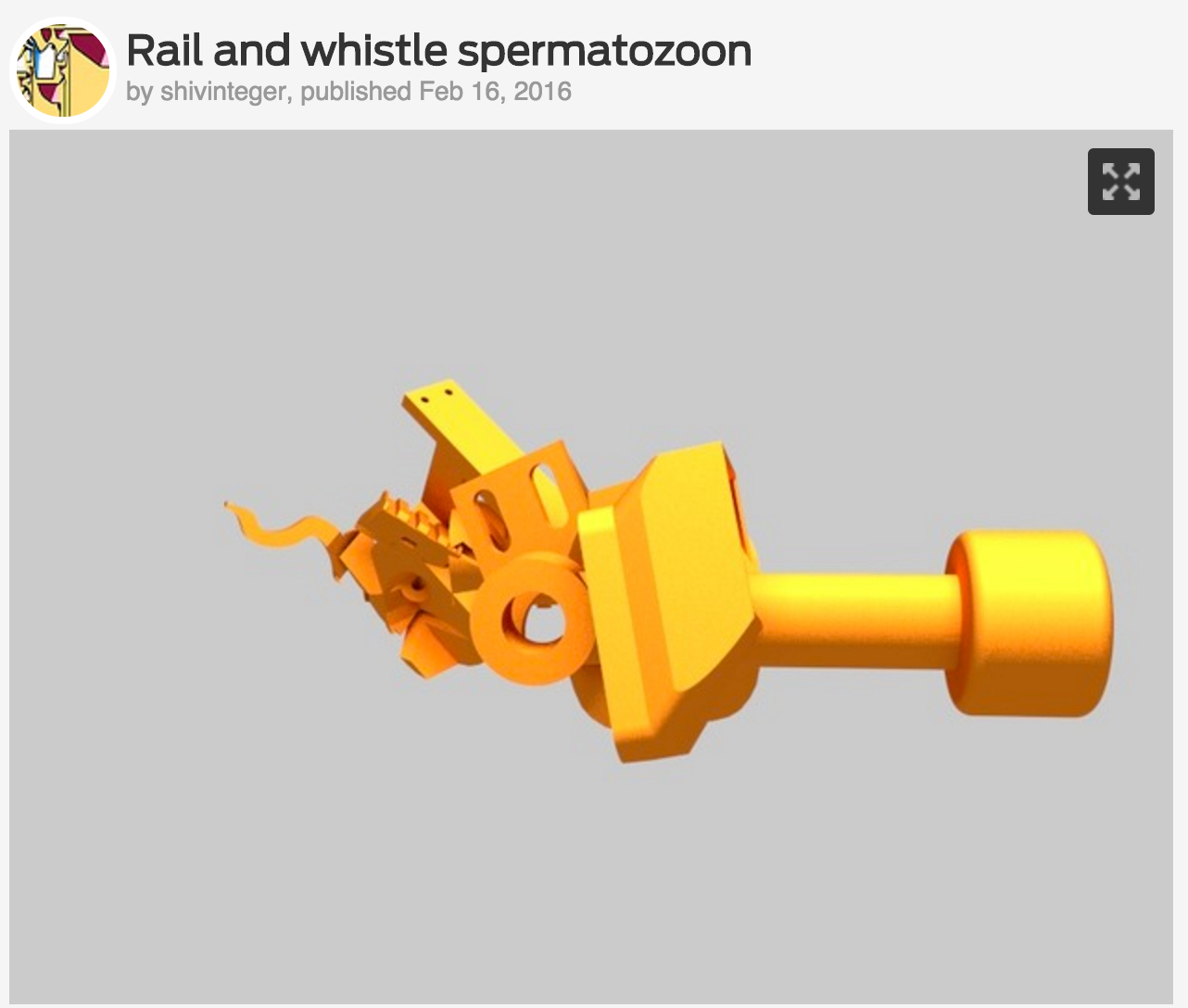
Shiv Integer is a bot whose entire purpose in life is to create bizarre objects for 3D printers. It has been living for several months on 3D printer project site Thingiverse, posting objects cobbled together out of dozens of other objects listed on the site. The results are art or spam, depending on your perspective. Last month, artists Matthew Plummer-Fernandez and Julien Deswaef finally came out as the humans behind Shiv Integer, showcasing the results of the bot's work at an event called (appropriately) The Art of Bots in London's Somerset House.

Taken on its own terms, Shiv Integer's work is fanciful and amusing. Each piece looks like a mutant gadget, possibly unprintable, often with one recognizable item merging into another one. The best part is that even the names of the objects are a random salad of words taken from other objects on Thingiverse, creating inadvertent absurdist poetry like "quick cat near a jaw," "disc on top of an e-juice golf," "automatic event adapter," and "customizable damage mask." The bot is known to post several times per day, and in the "about" section of the entry it always credits users whose objects it has repurposed (the bot only works with objects that have been CC licensed for remixing).

Artists Plummer-Fernandez and Julien Deswaef explain the idea behind their project:

Read 6 remaining paragraphs | Comments

Keanu is a nerd comedy that’s the opposite of Big Bang Theory

If you like kittens and sarcastic humor, this movie should be on your agenda.

Nerdy cousins Clarence (Keegan-Michael Key) and Rell (Jordan Peele) try to act like gangbangers to rescue Keanu, the preternaturally adorable kitten. (credit: Warner Bros.)

There's a whole subgenre of nerd comedy out there like Big Bang Theory that's about laughing at nerds, poking fun at them for being on the spectrum, asexual, or both. But now, thanks to comedians like Key & Peele, John Oliver, and writer/director Edgar Wright (Shaun of the Dead), there is another kind of nerd comedy—a great kind, where we laugh with the nerds, and those nerds have personalities that go beyond stale stereotypes. Key & Peele's first feature film, Keanu, is a perfect example of this kind of comedy. It's not perfect, but it will crack you up just like a good Internet meme does.

Though the sketch comedy show Key & Peele airs on Comedy Central, it found an audience on YouTube. There, clips from the show racked up millions of views and popularized the comedians' sharp blend of dork pop culture references and satirical takes on racial weirdness in America. Keegan-Michael Key and Jordan Peele are both biracial, and their resulting insider/outsider experiences are often fodder for their sketches—and fuel many of the jokes in Keanu, too. The premise of the movie, like a lot of the bits on their show, is that they're two geeky, middle-class guys who talk like white people (or, as Key says to Peele in Keanu, "You sound like John Ritter all the time.") And this can get awkward for all kinds of reasons.

In Keanu, the problem is that movie-loving stoner Rell (Peele) must drag his wonky cousin Clarence (Key) into an LA gang war to rescue his kitten (the eponymous Keanu). Turns out that all the people who couldn't make it into the Crips and the Bloods have formed a new gang, the Blips. And their leader, Cheddar, has kidnapped Keanu. Why? It's a long shaggy-dog fluffy-kitten story that involves turf wars, two scary gang ninjas from Allentown, and a new kind of super-drug called Holy Shit. To get the kitten back, Rell and Clarence infiltrate the Blips by pretending to be gangsters, dropping N-bombs and doing their best to act ghetto in chinos and pastel shirts.

Read 4 remaining paragraphs | Comments

Ars Technica Live #1: The archaeology of meat and butchery, with guest Krish Seetah

An anthropologist talks to Ars about humanity’s conflicted relationship with meat.

Ars Technica Live, episode 1: Meat. (video link)

Welcome to the first episode of Ars Technica Live, a monthly series of in-depth interviews with people working at the intersections of technology, science, and culture. In this episode, your Ars hosts Annalee Newitz and Cyrus Farivar interviewed Stanford anthropologist Krish Seetah about his research on the deep history of butchery before a live audience at Longitude, a tiki bar in Oakland, California. Seetah gave us a fascinating look at how the technologies and morality of butchery have shaped humanity for millions of years—and our discussion inspired an intense debate with some of the attendees.

Butchery evolved before humans

Seetah's first job when he was growing up in the neighborhood of Brixton in London was as a butcher's assistant. He told us about how his many years as a butcher shaped his understanding of meat and ultimately became a major part of his interests as a scholar. He's worked on studies that look at early humans' relationships with animals, as well as the technologies we've developed from animal products like wool, and he is now working on a book-length project about the early history of butchery. He pointed out immediately that there is evidence that the ancestors of Homo sapiens were butchering animals with stone tools nearly 2.5 million years ago. That's long before our ancestors invented fire and, indeed, long before Homo sapiens evolved some 200,000 years ago.

Read 7 remaining paragraphs | Comments

Oliver Stone’s Snowden looks like the greatest techno-thriller ever

Perhaps unsurprisingly, this trailer feels exciting but lacks technical accuracy.

Trailer for Snowden.

When the drama around NSA whistleblower Edward Snowden was unfolding, it felt like watching an incredible spy movie. So it's no surprise that Oliver Stone, a master of political thrillers, is turning the real-life version of Snowden's experiences into a movie that feels—at least in the trailer—as tense and exciting as the latest Mission Impossible installment. Which is good but also means that you'll need to forgive this movie for its unrealistic tech tropes.

Joseph Gordon-Levitt (Inception, Looper) does a pitch-perfect impression of Snowden as a patriotic geek with smartass tendencies. Injured during military training, he sets his sights on intelligence work, where he scores off the charts on every task the government throws at him. And then one night, one of his fellow intelligence geeks shows him a tool that they can use to spy on everyone in the country. As Snowden has a crisis of conscience, we're treated to one of those classic "hacking scene" moments where a nonexistent piece of software behaves in ways that make no sense, swirling around and showing us random pieces of private data from all the social networks ever. I know, I know. This is not how it happened. Just go with it.

Probably the best part of the trailer, which captures both the serious and mischievous sides of Snowden, is when we see him sneaking data out of the NSA contractor where he works by hiding it on an SD card inside a Rubik's Cube. Then we see a rapid-fire series of scenes where the stakes get higher, Snowen meets with Glenn Greenwald (played by Zachary Quinto, AKA Spock), and the tension mounts as blinky lights illuminate everybody's faces. It's satisfying to see events that aroused so much passion around the world translated into an emotionally gripping story. But "story" is the operative term here. Stone, who co-wrote the film, has taken a lot of liberties to turn this tale of people typing and talking into a suspenseful drama.

Read 4 remaining paragraphs | Comments

Mile-long “Band of Holes” in Peru may be remains of Inca tax system

The ancient structure could be part of an Inca system for measuring exchange value.

The Band of Holes in a photograph taken by drone. The road stretches for a mile up a mountain top, and may be the remains of a structure used for collecting and measuring food tributes for the Inca state. (credit: Charles Stanish)

The Inca Empire covered vast parts of South America, uniting distant cities in Chile, Peru, and even Argentina with well-engineered highways. Sophisticated agricultural systems and architecture allowed the Inca to live on the steep slopes and jagged peaks of mountains. And they did it all without money or markets as we know them. Instead, Inca leaders had an elaborate system of tributes or taxes that took the form of the land's most precious resource: food.

But how do you quantify many different forms of tribute—from squash and rope to corn and peppers—without a system like money to measure exchange value? Perhaps by inventing other systems of measurement. Archaeologists are exploring a mile-long road made entirely of shallow, rock-lined holes that may have once been a dropoff point for Inca food tributes. Dubbed the "Band of Holes," the road climbs the slope of Peru's Monte Sierpe, in a region that has been home to complex human settlements for thousands of years. The rock here is so hard that the people who built it did not bother to dig their carefully sized holes (each is about 3 feet wide and 20-40 inches deep); instead, they constructed the nearly 6,000 holes out of soil and fist-sized rocks they brought from elsewhere. Seen from above, the Band of Holes looks like ribbon of precisely placed firepits, or maybe an infinite punchcard.

Though locals have always known about the Band of Holes, it's possible that archaeologists have ignored it because it's hard to see except from the air. The first modern-day record we have of the structure comes from an aerial photograph taken in 1931, and today two archaeologists, Charles Stanish and Henry Tantaleán, are exploring it with drones.

Read 5 remaining paragraphs | Comments

The Huntsman: Winter’s War is so terrible that it will astonish you

Review: It’s the ultimate essence of a movie made purely for money.

Emperator Furiosa, tell us how being in this movie made you feel! (credit: Universal)

I saw Snow White and the Huntsman, so I should have known the sequel would be terrible. But honestly, I'm not sure anything other than 24 hours of tickle torture with demon-possessed muppets could have girded me for The Huntsman: Winter's War. It was like watching somebody make a cinematic suicide soda out of Lord of the Rings, Game of Thrones, Frozen, Planet of the Apes, and (just for that extra wrong flavor) Ted Danson in Cheers. And the worst part? It wasn't made for the love of so-bad-it's-good things, the way a real suicide soda is. Nothing in this incoherent, bumbling movie feels genuine—except for that one part where a saucy lady dwarf hits on Eric the Huntsman (Chris Hemsworth).

For those who missed the first film, the Huntsman series is a retelling of the Snow White story done in the "hard fantasy" style popularized by Game of Thrones. What that means is the characters are more emo. The evil queen Ravenna eats virgins procured by her creepy incest brother, and there's a class of characters called "Huntsmen" who are like fairy tale ninjas with axes. In the first film, Snow White defeated Ravenna (or DID she?). The new film is a kind of origin story about the Huntsmen, minus Snow White, plus a bunch of other things that don't add up.

So what makes The Huntsman so much more awful than other awful sequels made in a crass bid for cash? Somehow, this film manages to exhibit every single cliche of fantasy and science fiction sequels—then goes one step further into raw narrative incoherence. The movie begins with Liam Neeson doing a voiceover about how "you know the story of Snow White, but there's another story that happened long before." OK, fine, we're doing a prequel. We see the rise of the evil witch Ravenna (Charlize Theron, chewing the scenery so hard she's channeling William Shatner). There's also the en-evilling of her gentle sister Freya (Emily Blunt, looking puzzled that she's in this movie) when her boyfriend betrays her and murders their baby.

Read 6 remaining paragraphs | Comments

When it comes to brains, size doesn’t matter

Ravens score just as high as big-brained chimps on cognitive tests.

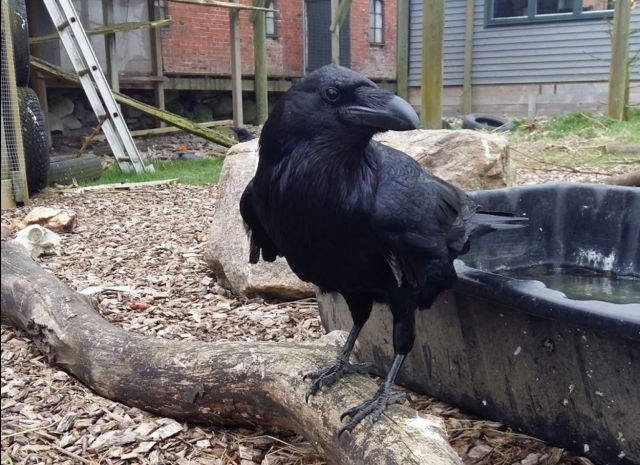
One of the ravens tested for self-control in the research, giving some major side eye. (credit: Lund University Corvid Cognition Station)

Crows, ravens, and other corvids are sometimes called feathered apes. Like primates, these birds form social groups, use tools, solve puzzles, recognize faces, and enjoy a good joke (especially if it's at the expense of cats). Now a group of researchers has shown in a series of tests that corvids exhibit the same levels of self-control that chimps do when faced with a task that requires them to forgo a quick reward in favor of a bigger one that comes later.

The researchers published a fascinating description of their work in Royal Society Open Science, and their paper challenges a long-held belief that absolute brain volume correlates with intelligence. No longer will humans and our ape cohorts be able to claim that we're smart just because our brains are big. Instead, say the researchers, it's more likely that intelligence stems from neural complexity, whether that's numbers of neurons or connections between them.

To measure corvid intelligence, the researchers used a common test of self-control called the "cylinder task." It's been used on many animals, including humans, and it's one of the most basic ways to assess higher reason. As the researchers write, the test "requires deciding among options of differing values in relation to a temporal dimension." In other words, it requires the animal to make decisions based on an understanding of time.

Read 6 remaining paragraphs | Comments

Cover your body in light with “organic photonic skin”

Computers and fashion will never be the same.

Check out my new infinity tattoo. It glows! (credit: The University of Tokyo, Someya Group Organic Transistor Lab)

We've gotten one step closer to a world where tattoos are made from LEDs and glowing watch faces embedded in your wrist can broadcast the time. It's the next phase in the development of e-skin, and circuits and sensors contained in flexible plastic sheets are thinner than human skin. Just stick the sheets on your body, stand in sunlight to power them up, and glow all night long.

A demonstration of the amazing electronic organic photonic skin. (video link)

E-skin, or flexible, stretchable circuits that can be stuck to skin, has been around for several years. But now a group of engineers have made a leap forward by integrating polymer LEDs into it. They explain their creation in Science Advances, showing how the new e-skin can display red, green, and blue light, which can be used for displaying biosigns like blood oxygen content and heart rate. Their e-skin also measures heart rate the same way many smart watches and fitness trackers do, by measuring the absorption of green and red light into the blood in a process called photoplethysmography.

Read 3 remaining paragraphs | Comments