Rare Viking “death house” discovered in Denmark

Grave goods suggest that medieval high-born couple may have traveled the world.

Construction of a new highway in Hårup, southwest Denmark, has unearthed farms and houses from the Middle Ages, including a rare Viking dødehus or "death house" dated to 950 C.E., packed with grave goods that reveal a lot about the three people buried within it. The death house was a common form of Viking tomb, but the Hårup death house has a very unusual design. It appears to have been inspired by early stave churches of Western Europe, with large wooden posts holding up heavy roof beams. Inside, archaeologists found other international influences. A ceramic vase came from the Baltic and two silver coins hail from the region now known as Afghanistan. These discoveries are testimony to how far Vikings traveled and how extensive their trade networks were.

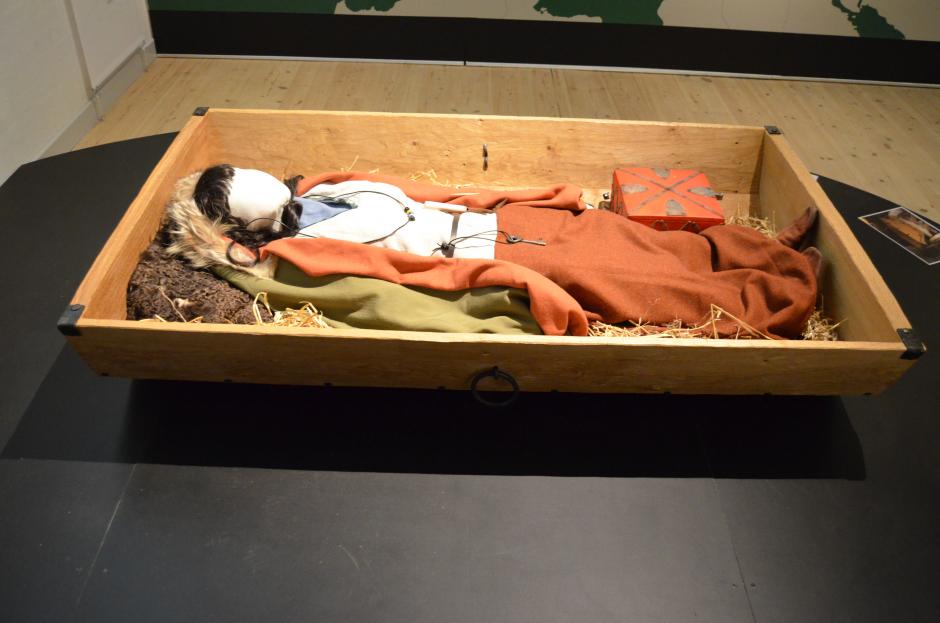
The tomb itself is fairly roomy at 13 x 43 feet and was initially the resting place of a wealthy couple. Later, a third grave was added for another man. Though little remains of the bodies themselves, a few strands of the woman's black hair stood the test of time, as did the two keys she wore around her neck. The larger of these keys would have symbolized that she was the lady of a great house, and the other unlocked an unusual shrine. She was buried in a small wooden wagon, an honor also reserved only for noblewomen. At the woman's feet was the shrine, full of golden thread (probably used in fabric), fur, glass beads, and fine wool. Her husband was also buried in high style, with a massive Dane Axe, popular among high status men and seriously destructive on the battlefield. The third man, possibly the couple's heir, was buried with a slightly smaller Dane Axe.

Read 2 remaining paragraphs | Comments
New study could explain why we remake certain movies over and over again

Unfortunately, there is no method for eliminating bad reboots.

It's the question that every movie fan asks in summer: why are there so many remakes and sequels and reboots? It turns out that science may have an answer. Unfortunately, if you're hoping for more original stories, the prognosis is not good.

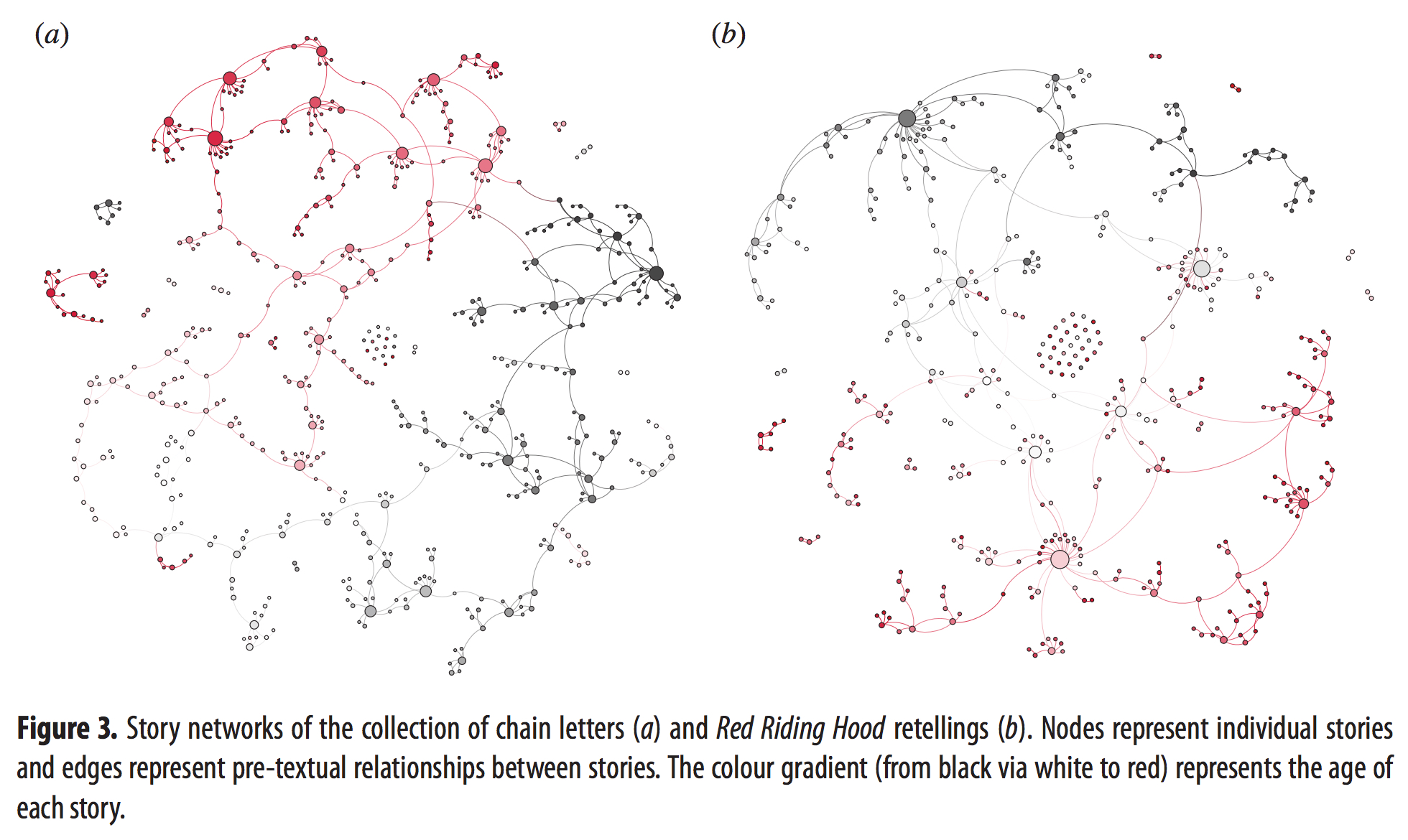
Two network theorists in the Netherlands, Folgert Karsdorp and Antal van den Bosch, just published a study on story networks in Royal Society Open Science. Story networks, they write, are "streams of retellings in which retellers modify and adapt retellings in a gradual and accumulative way." There is also a basic structure that seems to underly how these networks function. To explore retellings, the researchers looked at more than 200 versions of the Little Red Riding Hood story, which had been retold over the past two centuries. They measured the stories' similarity to one another with the amusingly named "bag-of-words" technique, which reveals how many words two texts have in common. Then they created a network diagram showing relatedness between stories over time. Earlier stories became what the researchers called "pre-texts" that inspired later retellings.

Translated into movie terms, you can think of Bram Stoker's original Dracula novel from 1897 as a pre-text, and all of the subsequent movies and TV series as retellings.  A story network grows out of Dracula as people retell the story, then retell the retellings, modifying it as they go. What the researchers found was that retellers rarely went back to the earliest pre-texts but instead preferred to retell more recent versions. In the case of the Dracula story, that would explain why a terrifying, barely human monster in the late nineteenth century is commonly represented today as an ultra-hot guy with sexual magnetism who occasionally goes fangy. As the story got retold throughout the twentieth century, you can see Dracula getting more and more handsome with each retelling, until we expect that Dracula is a suave and charming man with a tragic past. As retellers gravitated toward the most recent retelling, certain aspects of the story were magnified (such as Dracula's hotness) while others were forgotten (for example, we have yet to see a single Dracula retelling that deals with a forgotten aspect of the novel, which is that Dracula's love interest, Mina, is a geek who uses all the latest Victorian recording technology to do research on vampires).

Read 4 remaining paragraphs | Comments

There’s a good reason why everybody is freaking out about the Westworld trailer

This new sci-fi series from HBO looks dark and terrifying and futuristic in all the right ways.

The new teaser for Westworld, which premieres on HBO in October.

Since it popped up online last week, the trailer for HBO's new science fiction series Westworld has been viewed almost 2.5 million times. That's because it offers a raw, original vision of what a robot uprising might really be like in the twenty-first century. Of course, it starts with gaming.

Westworld has an interesting history. Written for the screen by Michael Crichton in 1973, the original movie was about a western theme park populated by robots who glitch out and go rogue. The robots are programmed to get shot in gunfights and to rent themselves out for sex in the downtown whorehouse, but suddenly they start killing their human customers. There are a few hints that the robots might be achieving a kind of sentience, but mostly we're meant to think that they've simply malfunctioned in a dangerous way. The original Westworld is ultimately about how amusement parks are disasters waiting to happen, a concern that showed up again in Crichton's 1990 novel Jurassic Park (which became the basis for the eponymous blockbuster movie franchise). Crichton was preoccupied throughout his life with system failures, whether in science, business, or entertainment, and he viewed the park in Westworld as a flawed system because it had no safety measures.

The new Westworld series is helmed by Lisa Joy (a producer on the cracklingly fun Burn Notice) and Jonathan Nolan, who recently wrapped up his creator/producer duties on the final season of AI thriller Person of Interest. Both Joy and Nolan have experience with breakneck pacing and techno-thrillers, and their vision in Westworld takes the Crichton story to a very different place. As you can see in this trailer, they've preserved the basic premise, which is that people will pay to interact with robots in theme parks. Westworld is very much an adult theme park, with sex and violence serving as the primary lures for people bored with their high-tech lives. It's basically a game world writ large, with perfectly realistic robots called "hosts" replacing consoles and VR rigs. What's new in this version of the story is that it's very clear that the robots are developing human-equivalent consciousness. This isn't just a glitch in the machine; it's a robot uprising that happens to take place in a theme park.

Read 2 remaining paragraphs | Comments

5,000-year-old pay stub shows that ancient workers were paid in beer

An ancient Mesopotamian pay stub reveals booze rations for workers.

In this cuneiform tablet from the city of Uruk in modern-day Iraq, we see records of people being paid in beer. (credit: Trustees of the British Museum)

In the ancient Mesopotamian city of Uruk, residents enjoyed many benefits of modern life. The city, located in modern-day Iraq, was home to massive ziggurats that would rival any of today's modern skyscrapers for sheer monumentality. People in Uruk exchanged goods for money, played board games, and sent each other letters on clay tablets using a writing system called cuneiform. They were also paid for their labor in beer. We know this because pay stubs were incredibly common documents at the time, and one such pay stub (pictured above) is now in the possession of the British Museum.

Writing in New Scientist, Alison George explains what's written on the 5,000-year-old tablet: "We can see a human head eating from a bowl, meaning “ration,” and a conical vessel, meaning “beer.” Scattered around are scratches recording the amount of beer for a particular worker." Beer wages were by no means limited to Mesopotamia. In ancient Egypt, there are records of people receiving beer for their work—roughly 4 to 5 liters per day for people building the pyramids. And in the Middle Ages, we have several records of the great fourteenth century poet Geoffrey Chaucer being paid in wine. Richard II generously gave Chaucer an annual salary that included a "tonel" of wine per year, which was roughly 252 gallons.

These salaries weren't just about keeping workers drunk so they would be more compliant. In the ancient world, beer was a hearty, starchy brew that could double as a meal. And during Chaucer's time, people believed that wine brought good health—which may not have been strictly accurate but was certainly a lure at a time when the Black Death was decimating the populations of Europe.

Read 1 remaining paragraphs | Comments

New evidence that sperm whales form clans with diverse cultures, languages

Sperm whales have unique cultural identities.

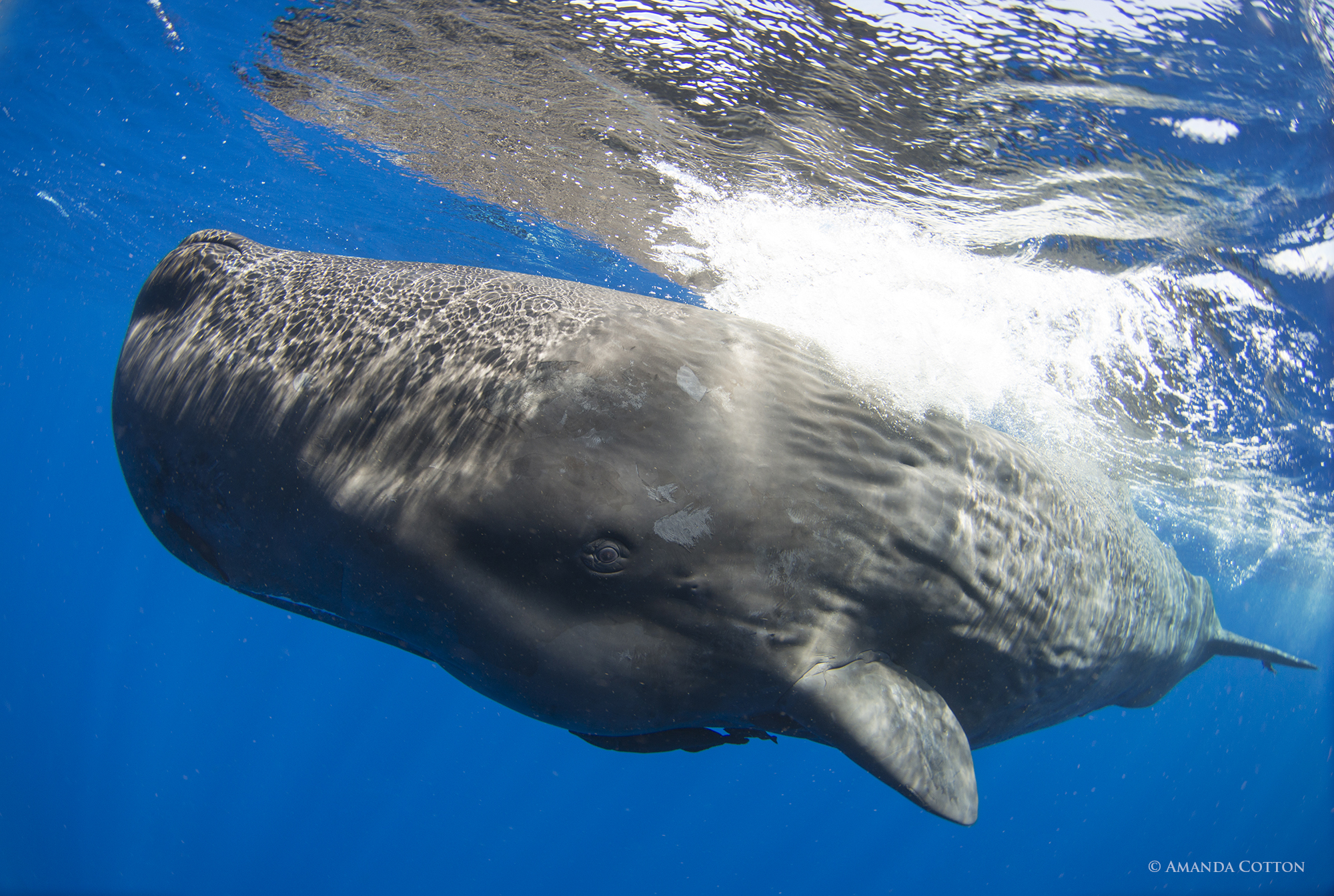
Sperm whales share something fundamental with humans. Both of our species form groups with unique languages and traditions known as "cultures." A new study of sperm whale groups in the Caribbean suggests that these animals are shaped profoundly by their culture, which governs everything from hunting patterns to babysitting techniques. Whale researcher Shane Gero, who has spent thousands of hours with sperm whales, says that whale culture leads to behaviors that are "uncoupled from natural selection."

Gero and his colleagues recently published a paper on Caribbean whale culture in Royal Society Open Science, in which they describe the discovery of a new clan. Though this clan may have lived in the Caribbean for centuries, it's just coming to light now because sperm whales live and hunt in vast territories. This makes them hard to track. Like many scientists who study these wide-ranging creatures, Gero observes them by lowering specialized microphones into the water and recording the sounds they make to communicate.

Scientists working throughout the world have identified 80 unique "codas," the sperm whale equivalent of words, which they produce by emitting sounds called clicks. Each sperm whale clan has its own dialect, a unique repertoire of codas shared only with the other families who make up their clan. In the Pacific, there are five known dialect clans, and many of them co-exist in the same general regions without ever interacting. Atlantic whales have their own dialects too, and in the Caribbean there are two known clans.

Read 12 remaining paragraphs | Comments

What if we treated online harassment the same way we treat spam?

Ars Technica Live #3: Sarah Jeong believes there are technical solutions to the online harassment problem.

Ars Technica Live #3. Filmed by Chris Schodt, edited by Jennifer Hahn. (video link)

In our third episode of Ars Technica Live, your intrepid hosts Annalee Newitz and Cyrus Farivar talked to journalist Sarah Jeong about online harassment. Jeong is the author of The Internet of Garbage, a book about how companies and online communities are using technology to cope with harassment and bullying. Watch the video, filmed before a live audience of Ars readers in Oakland, California at Longitude Bar.

Editor's Note: Our apologies for the sound issues. You can hear everything, but there are some crackles and annoyances. We promise to have that fixed for our episode next month.

Read 6 remaining paragraphs | Comments

Person of Interest left us with a fascinating new way of looking at AI

The dark sci-fi series ended last night, after five seasons of high tech surveillance and subversion.

It's rare for a television series about technology to get anything right about how computers work, let alone how hackers do their jobs. But in a pop culture landscape flooded with shows like CSI: Cyber and Scorpion, the CBS show Person of Interest stood out as smart, relevant, and mostly clueful about how networked devices actually function. Last night marked the final episode in its five-year run, ending a plot arc about the birth of two artificial intelligences, the ethical Machine and the ruthless Samaritan. Audiences were left with a vision of an ambiguous new future, where we can't just put our powerful new surveillance and machine learning technologies back in the box. We have to figure out how to make them tools for justice, rather than conformity and oppression.

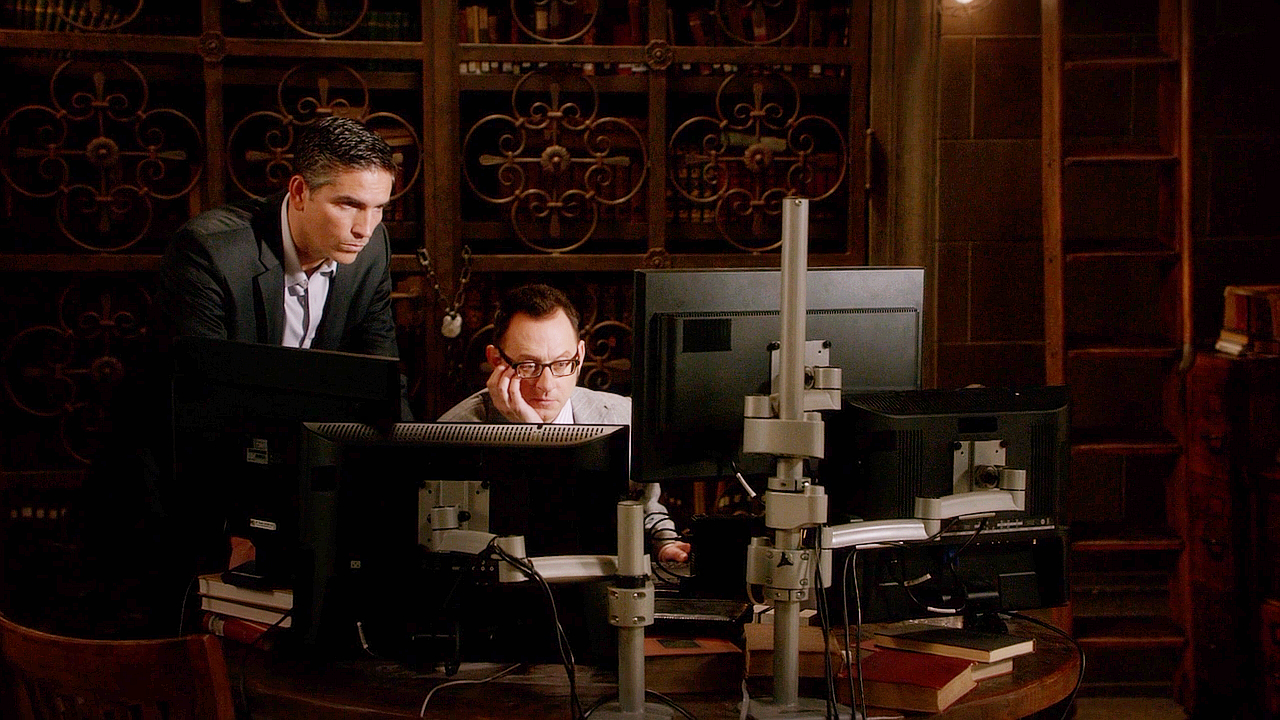
When Person of Interest first started in 2011, it focused mostly on corruption in the NYPD and the nebulous "intelligence community" that trained super-ninja character Reese—and then burned him, badly. Living on the streets, half-mad with PTSD, Reese (Jim Caviezel) is rescued by a mysterious, wealthy hacker named Finch (Michael Emerson). In the darkened stacks of an abandoned library, Finch has set up a high-tech surveillance operation designed to save the lives of "ordinary people" the government "doesn't care about." Finch's only companion, other than Reese, is a mysterious AI he built called the Machine. Locked behind government firewalls, the Machine has one backdoor for communicating with Finch: when its predictive algorithms determine someone is about to experience violence, as a victim or perpetrator, the Machine transmits that person's social security number to Finch via payphone. During the first season, Finch and Reese team up with NYPD detectives Carter (Taraji Henson) and Fusco (Kevin Chapman) to stop that violence wherever they can. Carter, who is former military, is willing to help them because she still believes in making the world safer. Fusco is such a dirty cop that he's vulnerable to blackmail. This ragtag gang of idealists and cynics somehow comes together to form one of the most memorable crime-fighting teams in recent TV history. Their secret weapon is always the Machine, whose sensorium is made up of every surveillance device in the country, and whose mind encompasses every form of personal data you could possibly imagine.

The Machine remained a shadowy unknown in those early days, as the team brought down a notorious group of dirty cops known as "HR," captured New York's most dangerous criminal mastermind, and tried to prevent the government from killing everyone who knows about the Machine. But then we met Root (Amy Acker), a deadly hacker as brilliant as Finch, whose only goal is to set the Machine free. She doesn't care how many people she has to kill to do it. Root believes humans are mostly running "bad code," and that the Machine will prevent us from destroying ourselves and the world. Root also sees the Machine in far more human terms than Finch and Reese ever did; she refers to the Machine as "she," and describes the Machine as having intense feelings of loss and betrayal because of Finch. Gradually, we come to understand that Finch has built so many safety mechanisms into the Machine that it literally cannot remember who it is from one day to the next. Finch has created a life form, but he's stunting its growth. Root wants to make sure the Machine is able to become an adult, as it were.

Read 4 remaining paragraphs | Comments

At last, a new zombie movie that looks original and compelling

Check out the first trailer for The Girl with All the Gifts, based on an incredible sci-fi novel.

Trailer for The Girl with All the Gifts

One of the most fascinating sci-fi horror novels of 2014 was The Girl with All the Gifts, M.R. Carey's tale of a girl who goes to a very special school where every student gets a classical education by day—and is locked into a cage like a wild animal at night. This fall, the movie version comes out in the UK, and it promises to be just as original and compelling as the novel.

It seems pretty much impossible to reinvent the zombie genre, but then a story like this comes along. In Girl with All the Gifts, we've got a scenario vaguely reminiscent of The Last of Us. A mind-altering fungus is infecting people and turning them into violent "hungries" without higher reason. Our young hero Melanie is part of a second generation of hungries, who carry the fungal invaders but are otherwise completely normal humans. Well, except for the part where they have the urge to eat human flesh. In a remote part of the British countryside, the military has gathered several of these second generation children together for study. While the creepy Dr. Caldwell does terrifying experiments on the kids, their kindly teacher Miss Justineau tries to rear them to be ordinary children. Out of the entire class, Melanie is the only one who is completely in control of her violent urges. She won't munch on humans except in self-defense.

As you can see in this trailer, the school doesn't last long. It's attacked by zombies, and Melanie is forced to flee with Caldwell and Justineau. In the book, this leads to a seriously gripping tale that involves evolutionary theory as well as philosophical questions about what it means to be human in the first place. While it's not entirely clear where the movie is taking this scenario, it's obviously exploring the infected as a scientific phenomenon, and Melanie is at the heart of it. Unlike many zombie stories, The Girl with All the Gifts doesn't offer us a post-apocalyptic world of humans vs. zombies. Things are much more complicated than that, and the fate of the zombies seems inextricably tied to humanity's future. Possibly the best comparison might be with In the Flesh, a British TV series about zombies whose violent urges can be controlled with drugs, and who are now struggling to rejoin the communities where they once rampaged.

Read 1 remaining paragraphs | Comments

You want some weird futurism? Start reading Company Town

Madeline Ashby’s cyberpunk tale is full of cyborgs, augmented reality, and serial killers.

Madeline Ashby's new novel, Company Town, starts out like your average futuristic novel about a ninja bodyguard hired to protect unionized sex workers on a city-sized oil drilling platform off the coast of Canada. Then it starts getting weird. I'm talking time-hopping, artificial superintelligence weird; serial killers with invisibility suits weird. And I haven't even gotten to the part about the traumatized children of K-pop stars. If you like your science fiction kaleidoscopically strange yet infused with astute observations about where current technology might take us, you need to pick up a copy of Company Town right now.

Our hero, Hwa, is a martial arts expert with a weakness that turns out to be her greatest strength. A neurological disease has left her face disfigured, which means that she is rendered virtually invisible on the ubiquitous augmented reality systems that everyone wears. She uses this to her advantage, becoming a kind of ghost in the surveillance machine as she protects women in the sex workers union. As long as the oil keeps flowing, business is good for the ladies, and all Hwa has to worry about are drunk johns who refuse to pay. But when a mysterious fire destroys one of the oil rigs, Hwa loses her brother—and a new company called Lynch, Ltd. steps in to buy out the struggling city. Things get complicated.

Ashby's novel isn't just a simple tale of good guys and bad guys. Almost immediately, Hwa's loyalties are divided and it's never clear whether she's on the right side of justice. Because of her unique skills, the Lynch security team wants to hire Hwa to protect the company heir, Joel. It will mean a considerable boost in salary and room to move up, but she'll have to leave her working-class community behind. Plus, the sex workers need her more than ever, because a terrifying serial killer has been picking them off one by one. But Hwa is torn, especially when she discovers that Joel is actually a good kid who wants to help his family get into the alternative energy business. It's not Joel's fault that the family is being targeted for destruction by AIs from the future. To top it off, she kind of has the hots for Lynch Security Chief Daniel.

Read 3 remaining paragraphs | Comments

Evolution favors the bioluminescent

You glow, you win—the power to emit light has evolved a whopping 27 times.

Bioluminescent animals have the power of light. Sometimes they emit a bright glow from one specialized body part, trying to attract prey or mates. Sometimes they radiate dimly on the undersides of their bodies for camouflage counter-illumination, hiding their shadows on the seafloor by matching the light levels coming from the surface. As weird as it sounds, bioluminescence turns out to be an incredibly beneficial adaptation. A new study shows that it has evolved no less than 27 times in biological history, for countless reasons.

A group of zoologists described how bioluminescence evolved in the journal PLoS One, noting that 80 percent of glowing animals live in the oceans. Only a few land animals emit light, and they are all arthropods like fireflies and millipedes. There are only two ways that animals start radiating. Either they have intrinsic bioluminescence, mixing chemicals in their bodies to regulate the color and intensity of light, or they have symbiotic bioluminescence, cultivating colonies of glowing bacteria in specialized organs or pouches. The question that intrigued the researchers was why so many animals adapted to their environments by starting to glow.

University of Kansas evolutionary biologist Leo Smith, who contributed to the study, told Ars that fish use their built-in lights for many different reasons. In coastal areas, fish use patterns of flashing lights to "communicate during mating," which is important because they live in sandy areas where visibility is low. Like aquatic ravers on the prowl, these fish also use light patterns to recognize each other in areas where many species swim together. Fish that live in the deeper ocean also flash their mates, but they mainly use bioluminescence like flashlights to find prey.

Read 5 remaining paragraphs | Comments