Welcome to the age of ancient DNA sequencing

New tech gives us a sharp view of how farming swept across Eurasia during the Neolithic.

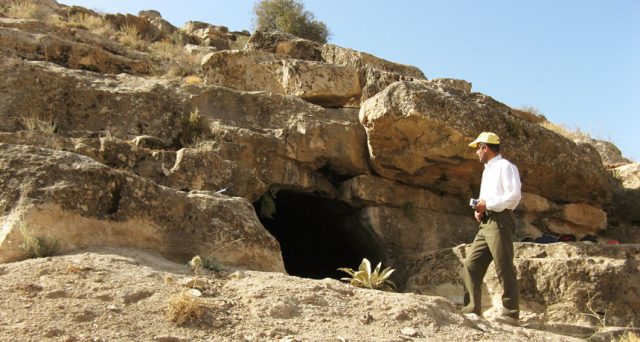
A cave in Iraq where the bones of ancient human farmers were found. Their DNA was sequenced to unlock the mystery of who the earliest farmers were in the region. (credit: FEREIDOUN BIGLARI)

The greatest technological revolution in human history arguably happened about 12,000 years ago, when humans first stopped living as hunter gatherers and became farmers. This so-called Neolithic Revolution transformed human culture, our genomes, and our ecosystems. But the origins of farming have remained a mystery. Was there one eureka moment, when an early Neolithic person realized the seeds they scattered in fall had sprouted into grains two seasons later? Or, more intriguingly, did several groups of people start farming independently?

Two new studies published this month in Science and Nature magazines use DNA analysis of ancient human bones to conclude that farming arose in multiple regions simultaneously. The Science study focused on four farmers who lived between 9,000 and 10,000 years ago in the mountainous Zagros region of Iran. The Nature study analyzed 44 individuals (farmers as well as hunter-gatherers) from Armenia, Turkey, Israel, Jordan, and Iran who lived between 14,000 and 3,500 years ago. By sequencing parts of these ancient people's DNA, researchers could determine their likely ancestry as well as what populations are descended from them today. The researchers conclude that there are at least two groups of ancient humans who discovered farming separately in the Middle East and then exported the Neolithic revolution across large parts of the continent.

The secrets of ancient DNA

Over the past decade, modern DNA sequencing techniques have allowed scientists to recover strands of genetic material from decayed bones that have been infused with microbes over thousands of years. Now, those techniques are widely accessible and highly refined. It starts with how researchers pick their bones. If possible, they'll extract DNA from the petrous bone in the inner ear, a goldmine for genetic material that can yield roughly 100 times more ancient DNA than other parts of the skeleton. Then researchers use a process called in-solution hybridization, which uses special probes made from DNA or RNA that attach to the desired ancient human DNA, fishing it out of a soup of other genetic material from other organisms that accumulated in the decomposing bone. Techniques like these are making it easier than ever for us to sequence ancient DNA and reconstruct the human past.

Read 6 remaining paragraphs | Comments

A new app reveals apocalyptic history behind novel Frankenstein

Relive the summer of 1816, when a volcanic eruption made Europeans fear the world was ending.

An iOS app called Summer of Darkness was released earlier this summer, just in time for the 200th anniversary of Mary Shelley's Frankenstein. What few people remember is that Shelley wrote Frankenstein during a terrifying summer in the Swiss Alps, after a massive volcanic eruption at Mount Tambora in Indonesia caused weather across the globe to turn grim and cold. Many Europeans believed this disaster-induced climate change meant the world was ending. Summer of Darkness recreates this historical moment with daily updates from the writings of four famous authors who traveled together that summer.

Trailer for Summer of Darkness, a literary history app by Andrew Sempere and Anindita Basu Sempere.

Shelley spent the apocalyptic months between May and September touring the Swiss Alps. She was joined by a group of literary friends, including poets Lord Byron and Percy Bysshe Shelley, who would soon become her husband, as well as writer John Polidari. Spurred by a writing challenge from Byron and the terrible weather, the group wrote ghost stories. Two of those stories, Shelley's Frankenstein and Polidari's Vampyr, gave birth to new genres of popular fiction. Meanwhile, Byron and Percy wrote poetry together in a blaze of productivity kindled by their new friendship.

Summer of Darkness offers a fascinating look at the lives of these writers, as well as the events that inspired their creativity that year. The app was built by designer Andrew Sempere and author Anindita Basu Sempere, an American couple who have been living in Switzerland for many years, surrounded by the same landscapes that Shelley and her friends saw two centuries ago. As you read snippets of letters, poems, memoirs, and stories by the group, the app provides beautifully rendered maps to show where exactly each person was as the summer unfolded. Brief flashes of rain and lightning illuminate the screen behind the text, providing a delightful but non-invasive hint of atmosphere. You receive updates to unlock material as the summer unfolds in real time, and if you download the app now you can consume all the past updates in one glorious binge. New updates continue into September.

Read 4 remaining paragraphs | Comments

Wonder Woman and American Gods lead the pack for best trailers of Comic-Con

Check out our favorite trailers from San Diego Comic-Con.

American Gods' Shadow Moon (Ricky Whittle) just got out of jail and now has to deal with a world full of gods, and he's not exactly happy about it. (credit: Starz)

For five crazy days last week, San Diego Comic-Con unleashed the power of fandom on an innocent Southern California city. Along with brilliant cosplay, panels with creators and stars, and zillions of collectibles, Comic-Con is home to trailer launches. Attendees and people watching from home get the first glimpse of upcoming sci-fi movies and TV. You can watch all the trailer launches if you want, but Ars has rounded up the best right here.

Wonder Woman trailer from SDCC.

Wonder Woman

Fans have been waiting for this movie pretty much since the 1970s Lynda Carter series went off the air. We shall never, ever speak of David E. Kelly's depressing attempt to create a Wonder Woman show in 2011, and my guess is that we'll rarely discuss the mediocre Batman v. Superman movie from earlier this summer that introduced this new version of Wonder Woman to the world. But if this trailer is any indication, Director Patty Jenkins (Monster) may pull off a genuinely cool Wonder Woman movie. Wonder Woman will be the first-ever movie featuring one of DC's oldest superheroes, whose adventures began back in the 1930s. A supernaturally strong Amazon from a secret island of warrior women, Wonder Woman fought the Nazis in World War II and always tries to solve conflicts with non-lethal weapons.

Writer/producer Zack Snyder, famous for big budget cult flicks like Watchmen and Suckerpunch (and infamous for Batman v. Superman), has made our peace-loving princess into a sword-wielding, armored badass. Which isn't such a bad thing. Gal Gadot plays Wonder Woman with grace and gravitas, and Chris Pine (Star Trek) is perfectly fine as the World War I soldier who washes up on the beach and into Wonder Woman's arms. I like the fact that this movie is set during World War I, which is a conflict our heroine hasn't explored before. If Jenkins can marry the powerful character development of Monster with Snyder's visuals from Suckerpunch, this movie is going to rock.

Read 11 remaining paragraphs | Comments

2,000-year-old toilet paper gives us a whiff of life on the Silk Road in China

Pit stop analysis shows ancient travelers were often thousands of miles from home.

Archaeologists scraped fecal bits off these ancient wipe sticks, discovered in a 2,000-year-old latrine at a pit stop along the Silk Road in Dunhuang, China. (credit: Hui-Yuan Yeh)

For almost 1,500 years, the many trade routes known today as the Silk Road joined eastern China with western China, India, the Middle East, Europe, and the Swahili Coast of Africa. These trade routes created their own culture, uniting empires and connecting distant civilizations through trade goods like books, textiles, and precious substances. But the most important use for the Silk Road was immigration. Now, a new analysis of 2,000-year-old toilet wipes found near Dunhuang in western China has revealed that these immigrants traveled vast distances on roads maintained by the Han in 100 CE. Unfortunately, these wanderers brought their diseases with them.

In a new paper published this week in the Journal of Archaeological Science: Reports, a group of archaeologists in China and England describe how they found preserved fecal matter on wipe sticks used in a latrine at the Silk Road's Xuanquanzhi rest stop. Archaeologists excavated the rest stop roughly 20 years ago and discovered that it was one of many such oases maintained by the Han government during the early centuries of the Silk Road. Weary travelers with the right documents could stop there to refresh themselves and their pack animals. They could also, apparently, use the bathrooms. What made the Xuanquanzhi rest stop special was its location near the deadly hot Taklamakan Desert. The arid region has preserved countless treasures from the heyday of the Silk Road, including a bundle of sticks wrapped in rags near the Xuanquanzhi latrines.

While analyzing a collection of excavated goods from Xuanquanzhi, a group of archaeologists realized that these were no ordinary sticks. "These have been described in ancient Chinese texts of the period as a personal hygiene tool for wiping the anus after going to the toilet. Some of the cloth had a dark solid material still adhered to it after all this time," Cambridge anthropologist Piers Mitchell wrote.

Read 6 remaining paragraphs | Comments

Bay Area: Join us TONIGHT 7/27 to talk about science fiction and future tech

Science fiction author Hannu Rajaniemi will discuss tomorrow’s machines.

If you're in the San Francisco Bay Area tonight, July 27, join Ars editor Annalee Newitz and writer Tiffany Kelly for the filming of our fourth episode of Ars Technica Live, a monthly interview series with fascinating people who work at the intersection of tech, science, and culture. Our guest next week is science fiction author Hannu Rajaniemi, who will discuss how we imagine the future of technology. Doors open at 7pm, and the discussion starts at 7:30.

Filmed before a live audience at Oakland's legendary Longitude tiki bar, each episode of Ars Live is a speculative, informal conversation between Ars Technica hosts and an invited guest. The audience, drawn from Ars Technica’s readers, is also invited to join the conversation and ask questions. These aren’t soundbyte setups; they are deep cuts from the frontiers of research and creativity.

Doors open at 7pm, and the live filming is from 7:30 to 8:00pm (be sure to get there early if you want a seat). Then you can stick around for informal discussion at the bar, along with delicious tiki drinks and snacks. Can't make it out to Oakland? Never fear! Episodes will be posted to Ars Technica the week after the live events.

Read 4 remaining paragraphs | Comments

This short film got its indie director a job writing the new Pacific Rim movie

The digital debut of Stryka, the tale of a lizard alien who lives in Brooklyn.

The digital debut of Emily Carmichael's short film Stryka, starring Aimee Mullins and Rupert Friend. (video link)

In just a few years, Emily Carmichael has gone from making an animated webseries for Penny Arcade to writing Pacific Rim: Maelstrom and directing Powerhouse, the next big project from Steven Spielberg. Today on Ars Technica, we’re proud to host the digital debut of Stryka, one of Carmichael’s short films that rocketed her from gamer geekdom to Hollywood. It’s the tale of a neurotic alien lizard living in Brooklyn, just trying to get by on small time heists. She has just one problem. Her partner in crime just isn’t bringing the zing anymore, and she’s been secretly doing jobs on the side with someone else.

What’s immediately apparent is that Carmichael has an uncanny ability to make a completely alien world feel familiar. Even though main character Stryka (Aimee Mullins) is covered in horns and speaks in clicks, her problems are relatable. She’s torn between two thieves, Callen (Homeland's Rupert Friend) and Peterson (John Behlmann), very different men who both want to work with her. Meanwhile her mother keeps calling to nag about what she’s doing with her life. The scenes with Stryka’s coin-op shrink give us the perfect window on the rather mundane inner life of a lizard thief.

Read 10 remaining paragraphs | Comments

How archaeologists found the lost medieval megacity of Angkor

Recent technology reconstructs the urban grid of a city overtaken by jungle.

Angkor Wat today, as viewed across the moat that surrounds the 12th century Hindu temple to Vishnu built under the rule of Suryavarnam II. (credit: Bjørn Christian Tørrissen)

The ornate, pinecone-shaped towers of Angkor Wat in Cambodia float above a vast temple complex of shrines, pools, houses, and a perfectly square moat. Today, only a small number of monks remain within the temple walls. The remaining structures have been reclaimed by trees whose roots wind around the stone like cellulose tentacles. Archaeologists have long wondered what life was like here when Angkor was the cosmopolitan heart of the Khmer Empire in the 12th and 13th centuries. Why did so many people abandon this place in the 15th century, never to return?

Unlike a majority of archaeological endeavors, the answers didn't ultimately come from digging up the ground. Instead, our first glimpse of Angkor as it once was came just a few years ago from a sophisticated laser scanning machine mounted on a helicopter.

Invisible city

For centuries, the Angkor region's wealth of artifacts drew looters, archaeologists, and looter-archaeologists. They focused their attention, both good and ill, on Angkor Wat and a few other nearby moated temple complexes. Based on those ruins, the first European explorers to encounter Angkor in the 19th century assumed Khmer urbanites lived in what were basically moated cities of a few thousand people. These European explorers thought Angkor Wat was something like a medieval walled city in Europe, which typically held fewer than 10,000 people. They explained all the moated complexes in the Angkor area by suggesting that maybe the royal family and their people were moving from one moated city to the next over time. But as archaeologists learned more in the intervening century, something about those population numbers seemed off. Beyond the moated cities were vast canal systems and reservoirs hinting at something bigger.

Read 19 remaining paragraphs | Comments

Ashley Madison admits using fembots to lure men into spending money

The hookup site for cheaters admits its mistakes and tries to rebrand.

Oh no! You discovered my secret! (credit: Bionic Woman)

After nearly a year of radio silence, the infidelity hookup site Ashley Madison has finally released a statement about what's next for the company. Among other things, the company's new executive team admits that it used fembots to lure men into paying to join the site, which promised the men discreet affairs with willing women.

In fall 2015, Ashley Madison made headlines when a hacker or hackers known as Impact Team released massive data dumps from the company's source code, member databases, and then-CEO Noel Biderman's e-mail. The member database contained the names of 34 thousand people trying to have extra-marital affairs, and the revelations induced at least one man to commit suicide. In the wake of the data breach, a number of people have filed lawsuits against the company, and the company is currently under investigation by the US Federal Trade Commission.

Last year, as part of an investigation into the data dump, I published a series of articles at Gizmodo exposing how the company used female chatbots called "hosts" or "engagers" to trick men into paying for Ashley Madison's services. The scam was simple: when a man signed up for a free account, he almost immediately got a chat or private message from a "woman" whose profile showed a few sexy pictures. To reply to his new lady friend, the man had to pay for an account. In reality, that lady was a few lines of PHP code.

Read 6 remaining paragraphs | Comments

Bitch Planet is a dark, futuristic satire about women in prison

A dystopian comic about women sent to jail on another planet.

With its deliberately shocking name and over-the-top imagery of scantily clad women fighting in prison, Bitch Planet looks like the comic book version of a 1960s exploitation movie. If you've ever watched Russ Meyer's classic flick Faster Pussycat! Kill! Kill!, you know what I'm talking about. But this comic book, written by Kelly Sue DeConnick and drawn by Valentine De Landro (the two also co-created the concept), manages to do something unexpected. Somehow, by depicting sensationalized violence and extreme future scenarios, DeConnick and De Landro manage to tell a surprisingly subtle story about the dangers of political conformity.

Image Comics recently published the first Bitch Planet collection, Extraordinary Machine, which delivers a fairly complete arc while still leaving us on a good cliffhanger. The tale begins with a seriously creepy look at Bitch Planet, the isolated planet where "non-compliant" women are sent to "live out [their] lives in penitence and service." The prisoners are all tattooed with NC, for non-compliant, which has already become a popular geek tattoo in the real world. Mostly, the prison is run remotely from Earth by a team of wise cracking guys who deploy giant holographic women to order the inmates around, and punish them with stints in solitary where the wall screens are filled with mocking faces that tell the mostly innocent women how guilty and evil they are. Still, there are a few guards around to beat the crap out of anyone who dares to question how tight their prison garb is—and to murder some of the women for mysterious reasons. De Landro's art is both satirical and horrifically disturbing, and he's brilliant at including little details like ads or signs in the panel backgrounds that show us what this future Earth is like.

It's made of people

Slowly we realize that all this insanity is happening because Earth has fallen under the power of an authoritarian group known as the Council of Fathers, who rule with an iron fist but pretend to be kindly, priest-like elders. To please the Fathers, the Bitch Planet warden devises a scheme to enter a team of female prisoners into the "Megaton," a brutal rugby-like game that has become Earth's most popular sporting event. Indeed, the Council of Fathers requires all men to watch Megaton, because they believe this bloody, dangerous sport helps "exorcise" men's warlike urges so they can form peaceful political coalitions. Except, of course, the Fathers' rule is hardly peaceful. There are rigid economic divisions between men, and there are several scenes where we see powerful men humiliating and abusing their male underlings. Women, as you might guess, have no rights at all in this future. They are forced to become wives and mothers, or eke out a perilous existence on an economic ladder where they can only ascend a few rungs from the bottom.

Read 4 remaining paragraphs | Comments

Mammals were almost destroyed with the dinosaurs 65 million years ago

Some inherent feature of mammal biology allowed them to adapt after global disaster.

Watch out! (credit: Donald E. Davis,)

You've heard the story about how an astroid smashed into the Gulf of Mexico roughly 65 million years ago, lighting fires on the ground and sending sun-blocking debris high into the atmosphere. In the millennia that followed, harsh environmental conditions wiped out over 75 percent of species on the planet. Most dinosaurs met their demise, and mammals rose in their ashes. This dark period of die-outs is called the K-T mass extinction, and it marks the boundary between the Cretaceous and Tertiary periods in the geological record. But a new study challenges that picture by suggesting that mammals were killed off at rates similar to those of the dinosaurs. Mammals simply recovered better than their counterparts among the Dinosauria.

Writing in the Journal of Evolutionary Biology, a group of British biologists offers a portrait of the K-T mass extinction that diverges from conventional wisdom in a couple of ways. First, their reassessment of fossil evidence shows that mammal species suffered just as much as dinosaurs during the asteroid climate disaster. And second, biodiversity returned to the planet faster than previously thought. In some areas, rich ecosystems were thriving in as little as 200 thousand years after the asteroid impact. Previous studies have estimated that it took at least a million years for diverse ecosystems to return.

The researchers say our understanding of the catastrophe 65 million years ago has been warped both by an incomplete fossil record and observation bias. The animals that are most likely to be wiped out by mass extinctions are those that have small, localized populations, which are the same animals that are least likely to appear in the fossil record because there were so few of them. So we've underestimated how many mammal species died during the K-T because we didn't account for rare species that lived in small areas at low population size.

Read 6 remaining paragraphs | Comments