Data analysis of GitHub contributions reveals unexpected gender bias

Women’s contributions to open source are more likely to be accepted than men’s.

GitHub's octocat knows how to fly a jet pack but still has some gender issues. (credit: GitHub)

With over 12 million users, GitHub is one of the largest online communities for collaborating on development projects. Now a team of researchers has done an exhaustive analysis of millions of GitHub pull requests for open source projects, trying to discover whether the contributions of women were accepted less often than the contributions of men. What they discovered was that women's contributions were actually accepted more often than men's—but only if the women had gender-neutral profiles. Women whose GitHub profiles revealed their genders had a much harder time.

The researchers are American computer scientists whose work was approved by an Institutional Review Board (IRB), a group that determines whether experiments on human subjects are ethical or not. They've published a pre-print of their GitHub analysis on PeerJ today and offered a deep look at how they did it.

Finding men and women on GitHub

First, they needed a dataset. Luckily the GHTorrent dataset contains public data on GitHub users, pull requests, and projects up to April 1, 2015. The group writes that they "augmented this GHTorrent data by mining GitHub’s webpages for information about each pull request status, description, and comments." But they had just one problem. GitHub profiles do not include gender information. So the researchers determined the genders of over 1.4 million users by linking their e-mail addresses with G+ profiles that list a gender. They write:

Read 16 remaining paragraphs | Comments

A smart fan that decides whether you are worthy of being cooled

The “Ethical Things” project crowdsources ethical decisions, with disturbing results.

Watch the ethical wisdom of crowds in action and weep for the future of humanity.

Now that we have an "Internet of Things" and devices that make ethical decisions, the next step was bound to be weird. Designer Simone Rebaudengo has created a smart fan with a built-in ethical dilemma: it can only fan one person at a time. To decide who will benefit from its cooling powers, the fan outsources its problem to Mechanical Turk, and the crowd decides which person in the machine's range deserves fanning.

Rebaudengo's invention is an art project called "Ethical Things." Its inspiration came from battlefield robots and autonomous cars, both of which are loaded up with algorithms that help the machines make life-or-death decisions all the time. But what about the more mundane ethical decisions we have to make every day? That's where the fan comes in. "If a 'smart' coffee machine knows about its user's heart problems, should it accept giving him a coffee when he requests one?" asks Rebaudengo. His fan is a humorous way of imagining a future of ordinary connected devices that nevertheless face these kinds of moral dilemmas because they have so much access to data about the humans who own them.

Rebaudengo writes:

Read 1 remaining paragraphs | Comments

Fans rejoice: Bryan Fuller named showrunner on new Star Trek series

He has already hinted at what might be in store.

Maybe we'll be hanging out on the USS Reliant for this series. (credit: Paramount)

Ever since Paramount announced last year that it would be launching a new Star Trek TV series, rumors have swirled about what it might be like. Now we know that the show is in good hands, at least when it comes to the writing. Bryan Fuller, who also worked on Deep Space Nine and Voyager, will be taking the helm as showrunner.

Despite his long association with the Star Trek franchise, Fuller is probably best known for creating his own original visions on television in beloved cult series like Pushing Daisies and Hannibal. He has a flair for the weird, and he's drawn to stories that are driven by characters as well as gripping plots. He's currently working on a miniseries of Neil Gaiman's classic novel American Gods for Starz.

Obviously we can't get too excited until we know what Fuller has planned, but I think cautious optimism is in order. Fuller knows the Trek universe, and he's a smart writer who isn't afraid to strike out in interesting new directions.

Read 6 remaining paragraphs | Comments
Corvids could save forests from the effects of climate change

Crows, jays, and nutcrackers have co-evolved with trees for good reason.

A raven with a large seed, about to bury it in a field. (credit: Callum Hoare / Flickr)

To you, crows and jays might be noisy, obnoxious birds who eat garbage. But for large-seeded trees like pines, hickories, oaks, and chestnuts, they could be life-saving heroes. That's because these birds can actually relocate forests that are threatened by changing climates and habitat loss.

In a new paper published in ornithology journal The Condor, a group of US scientists describe how corvids' unique food-gathering strategies have transformed forests around the world. Now, environmental scientists are actively using the animals as part of their reforestation strategies.

Scatter-hoarding

Corvids, a family of birds that includes crows, ravens, jays, magpies, and nutcrackers, are called scatter-hoarders. They roam large territories to scavenge seeds, fruit, and even meat, storing as many morsels as possible to eat later. That's the "hoard" part. But they don't have one giant stash full of loot the way squirrels do. Instead, they hide each treat in a separate place, occasionally moving it around to prevent other animals from finding it. That's the "scatter" part. Corvids are incredibly intelligent, with excellent visual memory, and scrub jays can remember up to 200 different cache locations at any given time.

Read 11 remaining paragraphs | Comments

There was a massive population crash in Europe over 14,500 years ago

New evidence shows a whole group of Europeans vanished, replaced by people of unknown origins.

Europe wasn't a very hospitable place fifteen millennia ago. The westernmost landmass of the Eurasian continent had endured a long ice age, with glaciers stretching across northern Europe and into the region we now call Germany. But suddenly, about 14,500 years ago, things started to warm up quickly. The glaciers melted so fast around the globe that they caused sea levels to rise 52 feet in just 500 years. Meanwhile, the environment was in chaos, with wildlife trying vainly to adjust to the rapid fluctuations in temperature. Humans weren't immune to the changes, either.

A new, comprehensive analysis of ancient European DNA published today in Current Biology magazine by an international group of researchers reveals that this period also witnessed a dramatic shift in the human populations of Europe. Bloodlines of hunter-gatherers that had flourished for thousands of years disappeared, replaced with a new group of hunter-gatherers of unknown origin.

Researchers discovered this catastrophic population meltdown by sequencing the mitochondrial DNA of 35 people who lived throughout Europe between 35 and 7 thousand years ago. Mitochondrial DNA is a tiny amount of genetic material that's inherited virtually unchanged via the maternal line, and thus it serves as a good proxy for relatedness over time. Two people from the same maternal stock share almost the same mitochondrial DNA, even if separated by thousands of years, because this kind of DNA evolves very slowly.

Read 6 remaining paragraphs | Comments

I am weirdly excited about this new Seth Rogen space comedy

What could go wrong?

Seth Rogen demonstrates his Kylo Ren lightsaber joint.

Seth Rogen, Bill Hader, and Zach Galifianakis are set to star in a new astronaut movie called The Something, and I'm unreasonably excited about it.

I say "unreasonably" because the movie is written and directed by Rodney Rothman, who wrote 22 Jump Street and Grudge Match, a decidedly mixed bag when it comes to awesomeness. Still, the first-time director has pulled together an impressive cast for a comedy and that could make all the difference.

All we know about the plot so far is that it's about a group of three male astronauts who have been drifting in space for years... until they come upon another spaceship. Given that the official summary emphasizes that the astronauts are all male, my guess is that we can expect some lady alien shenanigans in that other spaceship. Or lady somethings, anyway.

Read 5 remaining paragraphs | Comments

US takes first steps toward approving babies with three genetic parents

Here’s how mitochondrial replacement works and how it could save lives.

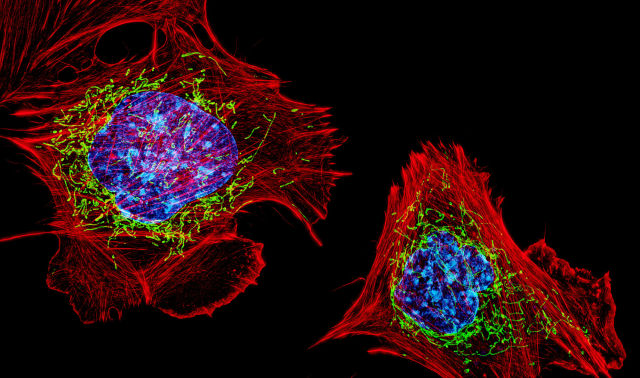
In this magnified image of mouse cells, the nucleus is blue, the mitochondria are green, and the cell walls are red. Every cell has hundreds or even thousands of mitochondria producing energy. (credit: D. Burnette, J. Lippincott-Schwartz/NICHD)

Today a panel of scientists released a report recommending that the US Food and Drug Administration (FDA) approve testing for a medical procedure known as mitochondrial replacement, which could prevent dangerous genetic diseases in newborns. The procedure, already approved in Great Britain, still has a long way to go before final approval in the US.

A microscopic organ transplant

Though critics say it will send us down a slippery slope of "gene editing," there is in fact no gene editing involved in mitochondrial replacement. Instead, it's more like a microscopic version of an organ transplant.

Mitochondria are called "organelles" because they play an organ-like role in the cell. A bit like a miniature stomach, mitochondria break down molecules to provide energy for the entire body. Mitochondria are also the only part of the cell that contains DNA, other than the nucleus. Some biologists believe this is because mitochondria were once separate cells, absorbed in a process called endosymbiosis during a very early phase in cellular evolution, which nevertheless retained a shred of DNA over the billions of years since that merging.

Read 7 remaining paragraphs | Comments

Want your kids to be better off than you? Move to a high-density city

Compact cities offer a better chance at upward mobility, according to a new study.

Mega-City One is the land of opportunity. (credit: Lionsgate)

Imagine a high-density city, and you probably think of something like Mega-City One, full of pollution, poverty, and huge, ugly housing projects. But the reality, according to new research in urban studies, is that high-density city plans offer residents more economic opportunities. Especially for people who want to give their children better lives, high-density cities are the most likely to deliver on the American Dream.

Measuring sprawl and economic mobility

Upward mobility is on the decline in the US. Once billed as a land of opportunity for the poor and hardworking, the country now offers little hope to people born in poverty. Writing in the latest issue of Landscape and Urban Planning, the researchers note that the "chance of upward mobility for Americans is just half that of the citizens of Denmark and many other European countries." A study from the Brookings Institution found that "39 percent of children born to parents in the top fifth of the income distribution will remain in the top fifth for life, while 42 percent of children born to parents in the bottom fifth income distribution will stay in that bottom fifth."

But some parts of the country are better off than others. As the researchers explain:

Read 7 remaining paragraphs | Comments

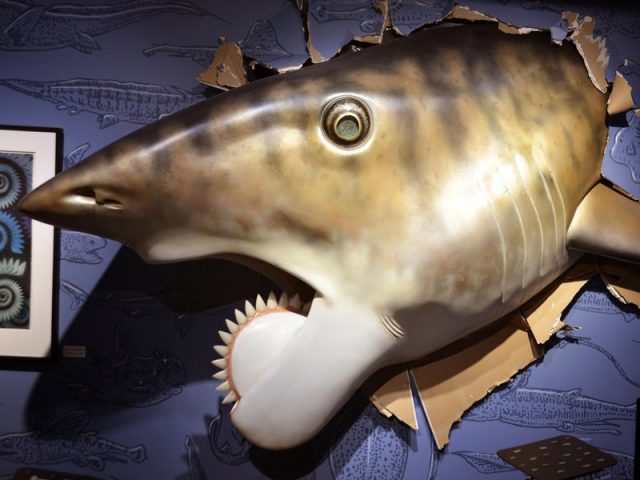
Yes, this prehistoric fish actually had a buzzsaw of spiraling teeth

It takes an artist to capture the true weirdness of the ancient animal’s face.

LOOK INTO MY TEETH AND DESPAIR. (credit: Ray Troll)

Nicknamed the "buzzsaw shark," this 270 million-year-old creature is actually an extinct relative of the ratfish called a Helicoprion. Its bizarre tooth arrangement has confused scientists for over a century, but one artist finally got it right.

Ray Troll, whose art show about Hilicoprion has been touring the US for the past three years, has been on the front lines of scientific research about one of the strangest fossils ever found. When geologist Alexander Petrovich Karpinsky discovered the creature's tooth whorl in 1899, at first he thought it was a kind of ammonite because the teeth looked so much like the ammonite's spiral shell.

Paleo expert Brian Switek writes that it took Karpinsky a little while to realize that it was actually part of a larger animal. Over the next century, many different paleontologists offered explanations for what it might be, including a defensive formation on Helicoprion's nose, a ridge on its back, or even sticking out of its mouth like a spiky, curled tongue.

Read 3 remaining paragraphs | Comments

The Martian, Sherlock Holmes, and why we love competence porn

We’re rooting for the smartest, most rational characters in the room.

Mark Watney knows how to do everything, including turn his rover into a super-car that he lives in for several weeks. (credit: Fox Movies)

The best part of The Martian isn't the breathtaking rescue, nor the awe-inspiring dust storm. It's watching Mark Watney grow potatoes. Instead of freaking out over his imminent doom, Mark calmly figures how to grow plants in the Martian regolith by fertilizing them with his own poop, and watering them with a DIY device that makes water by heating hydrogen from his leftover rocket fuel, and combining it with oxygen from the Hab environment.

Mark makes The Martian a classic of competence porn by always coming up with a hackerish solution to every problem, just like James Bond or Ellen Ripley with her exoskeleton in Aliens. And he's not the only competence porn star burning up our monitors right now. From Sherlock to The Americans, competence porn is filling us with the satisfaction that comes from watching people attack problems with brains and cunning rather than fists. Well, OK, there are some fists, too.

The birth of the trickster smartass

Clever characters who can weasel their way out of any situation go back to the earliest days of western literature, when ancient Greek hero Ulysses, star of the Odyssey, outsmarted the cyclops and figured out how to listen to the sirens' song without killing himself. In the east, the character Sun Wukong (AKA the Monkey King) plays a similar role, using his trickster cunning to keep the bad guys down. Indeed, most competence porn heroes have an element of the Monkey King's trickster ways—they may use logic to defeat death, but they'll tell a few jokes and pull a few beards along the way.

Read 15 remaining paragraphs | Comments