Giant armadillos roamed South America thousands of years ago

New DNA analysis reveals how these creatures evolved.

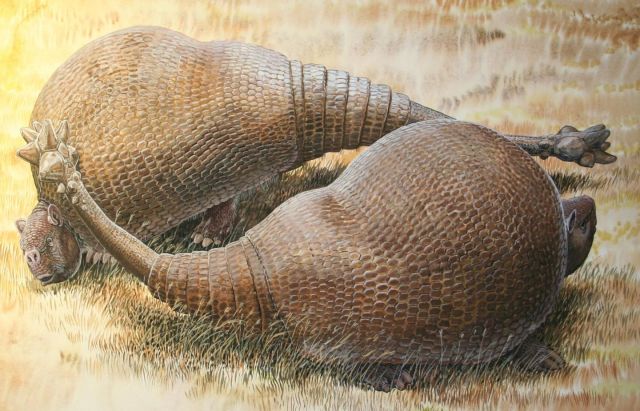
Two giant Glyptodonts, covered in solid shields of armor, smash each other's little faces with spiked club tails. Just another day in the Pleistocene. (credit: Peter Schouten)

If you missed the Pleistocene in the Americas, you never got to see all the fantastic megafauna we once had here: mastodons, sabre tooth cats, giant sloths, hippo-rhino-looking Toxodons...and 3,000-pound armored beasts called Glyptodonts. Now a new DNA analysis reveals that Glyptodonts are extinct cousins of present-day armadillos. Except these creatures were the size of small cars and could smash you with their spiky, clubbed tails.

At least, some species of Glyptodont could smash you—others did not have clubbed tails, though all of them would have looked to our modern eyes like freakishly outsized armadillos. What's interesting is that these creatures evolved to their massive sizes in a relatively short time. The researchers, who published their findings in Current Biology, say the last common ancestor of Glyptodonts and today's armadillos was a 175-pound animal who toddled around South America about 35 million years ago.

Since that evolutionary divergence, some Glyptodonts, such as the massive Doedicurus (the one with the clubbed tail), grew to 1.5 tons in weight.

Read 3 remaining paragraphs | Comments

A map of the most vulnerable places on the planet

Newly analyzed satellite data shows which ecosystems will be harmed the most by climate change.

Enlarge / Global snapshot of the Vegetation Sensitivity Index (VSI), which measures environmental sensitivity to a changing climate, using satellite data gathered between 2000-2013 at 5km resolution. Areas in green are covered in vegetation that is the least sensitive to changes. Areas in red show the highest sensitivity. Grey areas are barren land or ice covered. Water is blue. (credit: Sedon, et. al.)

Climate change isn't just one, uniform transformation of the planet. Over time, some areas are going to get hotter, some wetter, some cloudier—and vice versa. This map, produced using a new system for analyzing satellite data, reveals which parts of the planet will be most affected by these changes.

Published in Nature, the map shows what the researchers call a vegetation sensitivity index (VSI). The VSI is a new measure of environmental vulnerability that combines several sources of data. The first source of data comes from the enhanced vegetation index—a measurement of plant cover on the ground, built with data from a satellite-based, moderate-resolution imaging spectroradiometer.

The researchers added information about how well each region's plant life could withstand changes in temperature, moisture, and cloud cover.

Read 4 remaining paragraphs | Comments

Remains at Iron Age fort tell a story of a horrible massacre

Victims’ mouths stuffed with animal teeth in a “humiliation worse than death.”

A Roman coin found at the site of Sandby Borg, whose inhabitants probably included a number of unemployed Roman soldiers. (credit: Max Jahrehorn Oxides)

On Öland, an icy, barren island off the coast of Sweden, archaeologists have unearthed the remains of a 1,500-year-old fort whose inhabitants were brutalized in such an extreme way that legends about it persist to this day. As researchers piece together the fort's final days, it sounds like they're telling a horror story.

Possibly hundreds of people sheltering behind the fort's defenses were executed and abandoned, their bodies left to rot in place without burial. Their wounds were indicative of execution. And some of their mouths were stuffed with goat and sheep teeth, possibly a dark reference to the Roman tradition of burying warriors with coins in their mouths.

None of their considerable wealth was looted, which is highly unusual. Researchers have found barely hidden valuables in every house they've excavated. Even the livestock was left behind after the slaughter, locked up to die of starvation. This is even more bizarre than the lack of looting. On an island with scarce resources, it would have been considered a waste for victors (or neighbors) to leave healthy horses and sheep behind after battle.

Read 10 remaining paragraphs | Comments

Humans started having sex with Neanderthals over 100,000 years ago

Paleolithic sexytimes reveal that Homo sapiens made it out of Africa earlier than we thought.

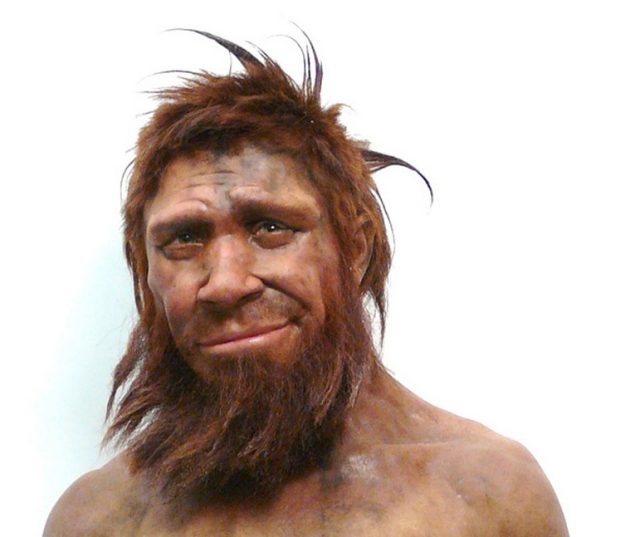
Would you do it with a Neanderthal? I mean, maybe, if he looked like this and knew his way around a Linux box.

By now it's pretty obvious that Homo sapiens and Homo neanderthalensis were hot for each other. The two groups of early humans were not separate species—they were kissing cousins, separated by just a few hundred thousand years of evolution. Now we know they started hooking up far earlier than scientists believed was possible.

The standard narrative about how modern humans met Neanderthals is pretty simple. A group of early humans, possibly Homo erectus, hiked out of Africa over 600,000 years ago and settled all over Europe and the Middle East. Over time, they evolved into Neanderthals, Denisovans, and probably several other groups. Meanwhile, back in Africa, the common ancestor of Neanderthals and Homo sapiens was busily evolving into—you guessed it—Homo sapiens sapiens. Around 70 thousand years ago, modern humans started streaming in huge numbers out of Africa, into Europe and the Middle East, possibly spurred on by chilly weather caused by the Toba eruption in Indonesia. There, they met up with their long-lost cousins and immediately started humping.

Genetic analysis has confirmed that said humping took place. Seems like that should be the end of the story, except that even during the Pleistocene, relationships were complicated.

Read 6 remaining paragraphs | Comments

New evidence: Easter Island civilization was not destroyed by war

Researchers debunk a longstanding myth using elliptical Fourier analysis on ancient tools.

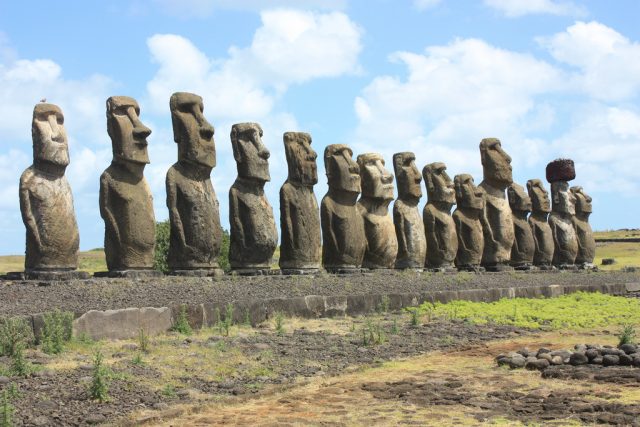
These moai on Easter Island were so imposing that Europeans couldn't believe they'd been created by just a couple thousand people. (credit: Arian Zwegers)

Hundreds of years ago, an advanced, seafaring civilization called Rapa Nui built more than 800 monuments that were so massive and ambiguous that they remain a mystery to this day. The Easter Island statues, or moai, are enormous stone figures placed along the coastline as if surveying the island's interior lands. One of archaeology's greatest mysteries is what happened to the Rapa Nui of Easter Island.

Now, new evidence from archaeological investigations has overturned a popular myth about the demise of the Rapa Nui civilization on the island. For centuries, observers believed that the Rapa Nui suffered a catastrophic population crash. But there is no scientific evidence to support this idea, say a group of researchers in the latest issue of the journal Antiquity. That story about environmental collapse and warfare you read about in Jared Diamond's bestseller Collapse? Totally wrong.

Origins of the myth

First of all, the Rapa Nui haven't been wiped off the face of the Earth: the Rapa Nui people still make up over half the Polynesian population today. Their ancestors likely arrived on Easter Island, now part of Chile, roughly a millennium ago. They came in the sophisticated canoes that allowed Polynesians to bring their cultures to dozens of islands in the Pacific Ocean, from Hawaii to Samoa and New Zealand. And they also brought their moai, many of which were quarried on other islands that the Rapa Nui controlled.

Read 12 remaining paragraphs | Comments

Yes, there is a scientific device that measures lactation output

Scientists used a colostrometer to discover that cow milk quality varies with the seasons.

This preternaturally adorable cow just finished being milked at the UNH Fairchild Dairy Teaching and Research Center, one of the sites of the research study. (credit: UNH)

This isn't about the cow milk that you and I enjoy. It's about the most important kind of milk, which baby mammals drink right after they are born. Like humans, cows produce a nutrient-rich milk called colostrum in the days after birth—it's full of proteins and antibodies that are crucial for calves' future health. But not all colostrum is made equal.

A new study of cow colostrum at the University of New Hampshire used a specialized device called a colostrometer to measure the density of cow colostrom. The denser this thick, yellow liquid is, the more likely it is to be packed with key antibodies like Immunoglobulin G (IgG) that help build up the infant animal's immune system. The device itself isn't particularly fancy—you simply dunk it in a tube of colostrum to see whether it floats.

Here are two extremely matter-of-fact British farmers explaining how to measure colostrum quality with a refractometer (a more general-purpose device) and a colostrometer.

By measuring colostrum quality in their research herd, the scientists discovered that cows have lower-quality colostrum in winter. They believe that this is because warmer temperatures cause the cows' blood vessels to dilate and become more permeable, allowing the antibody IgG to pass into the blood—and from there, into the cow's colostrum. They also found that a cow's lactation history was a key indicator of future colostrum quality.

Read 3 remaining paragraphs | Comments

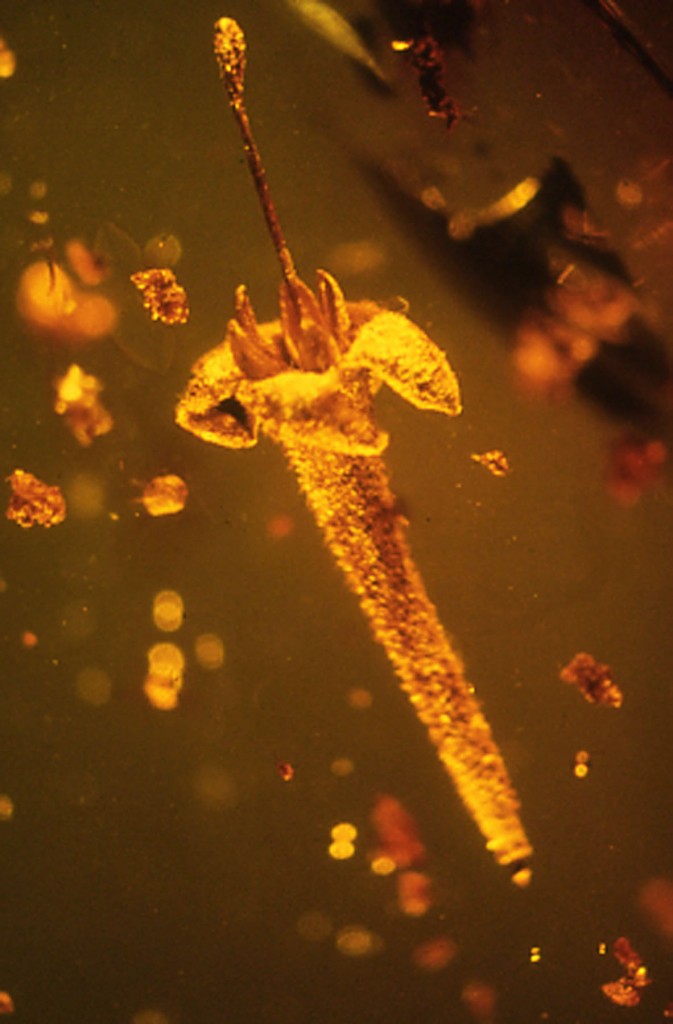
This flower, preserved in amber, may be 45 million years old

Gorgeous photos reveal a rare, perfect fossil of a newly discovered plant species.

This delicate flower has been preserved in amber, with each petal and tiny hair intact, for as many as 45 million years. Scientists discovered the flower in a cave in the Dominican Republic along with a treasure trove of insects preserved in amber. Now the flower has been identified by an expert as a member of the vast Asterid clade of flowers, whose members include the coffee plant as well as potatoes, peppers, and the poisonous Strychnine tree.

Amber is fossilized tree sap, and pinning an exact date on it is extremely difficult. In a paper published this morning in Nature Plants, biologists George Poinar and Lena Struwe carefully used two methods of dating the material to suggest that this flower might have been fossilized as early as 45 million years ago or as late as 15 million. They came up with such a broad spread of dates largely because we still don't have very many fossils from these kinds of plants, which makes precise dates difficult.

The researchers had to date the flower by proxy by examining other life forms found in the amber cache, including the common single-celled organisms known as foraminifera and coccoliths. There are distinct evolutionary and population changes in foraminifera and coccoliths over time, and paleontologists often use these tiny animals to place fossils during specific geological periods. What's certain is that this flower bloomed long before the age of apes during the mid-Tertiary period.

Read 3 remaining paragraphs | Comments
Is your house making you sick?

New study explores evidence for “hygiene hypothesis” in urbanized areas.

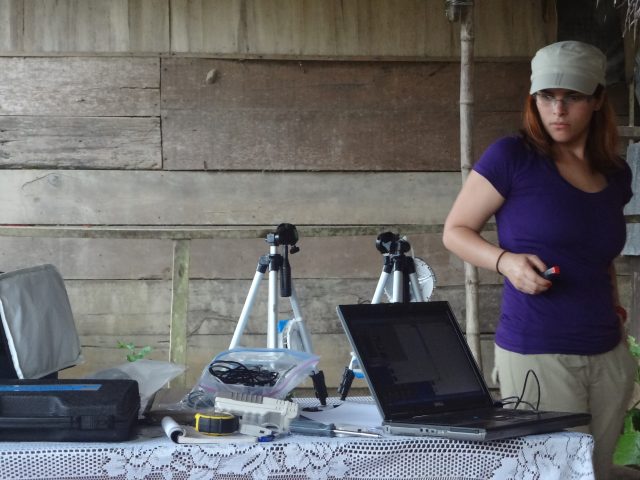
Researcher Jean F. Ruiz-Calderon, collecting environmental data. (credit: Humberto Cavallin)

If you live in a city, each room of your house has its own distinct broth of microbes splattered all over its walls—most of it from your skin, mouth, and gut. But if you live in a rural area, this broth contains a lot more microbes from the environment outside. Now, scientists in the burgeoning field of "microbial biogeography" say this could help us understand why people in cities tend to develop diseases that are very different from people in the country.

Your body is full of microbes—indeed, a recent estimate suggests there are more single-celled aliens in your body than there are human cells. The average human male has about 30 trillion cells, and 40 trillion microbes living inside him. But these little invaders don't stop at the envelope of your flesh. They're constantly being sloughed off with your skin, dribbling out of your mouth, and getting pooped out of your colon. Which is where microbial biogeography comes in. It's the study of all the microbes that live in our environments, whether they come from us, other animals, or elsewhere in the natural world. Taken together, the microbes in an environment—whether it's your gut or the forest floor—are called a microbiome.

There have already been efforts to sequence microbiomes in people's homes, in the soils and waters of many different environments, and (memorably) on the New York City subway. From these experiments, we've learned that our environments are crawling with different kinds of microbes, many of which co-evolved with us and contribute to our good health. Now a new study conducted in and around Brazil reveals that the microbiomes in our homes change dramatically from country to city, and even from room to room in urban homes.

Read 15 remaining paragraphs | Comments

Time to try the Vorkosigan Saga—you’ve never read science fiction like this

Gentleman Jole and the Red Queen explores a futuristic marriage in a new space colony.

Detail from a front plate in the hardback of Gentleman Jole and the Red Queen, by Lois McMaster Bujold. (credit: Dave Seeley)

If you're already a fan of Lois McMaster Bujold's award-winning Vorkosigan Saga novels, then this month's release of Gentleman Jole and the Red Queen will bring much rejoicing. If you're new to the series, this novel is an excellent excuse to start reading. It's one of the most realistic and funny novels you'll ever read about space colonization. Somehow it manages to be gripping, despite its focus on balancing military budgets, dealing with defense contractors, and the weirdness of long-term marriage.

Mild spoilers for the Vorkosigan Saga follow.

Meet the Vorkosigans

Bujold began her galaxy-spanning series in the 1980s with a pair of novels, Shards of Honor and Barrayar, about a young starship captain named Cordelia Naismith from the planet Beta. A peaceful, politically progressive planet—basically, Copenhagen in space—Beta sends out scientist-explorers like Cordelia to gather data for its exoplanetary "geological survey." While studying a supposedly uninhabited planet, Cordelia meets the military officer Aral Vorkosigan, from the patriarchal, conservative planet Barrayar, where women tend to be housewives and men destroy themselves on the battlefield. Against all odds, and in the midst of a deadly war, the two fall in love.

Read 15 remaining paragraphs | Comments
30 percent of science teachers give misinformation about climate change

Kids get on average a single hour of (often wrong) instruction on the subject.

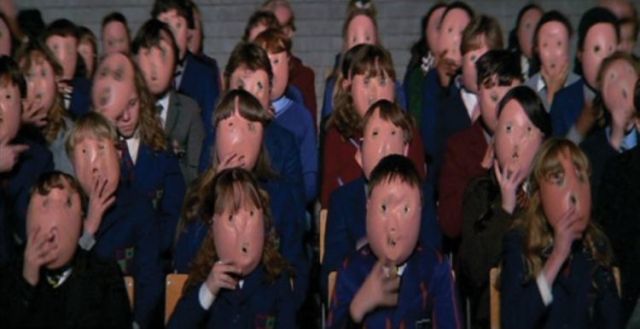
Teens are left confused and misguided by science teachers. (credit: The Wall)

Though roughly 95 percent of scientists agree that climate change is caused by humans, you might not know it if you were learning about the environment in middle school or high school. In a recent randomized study of thousands of science teachers, a group of US researchers found that nearly a third of teachers tell students that the current observed trends in global climate change are "natural."

Published today in the journal Science, the results of the study reveal that science education on the subject is unevenly distributed. Teachers are all over the map when it comes to what they're teaching about climate change, with 30 percent telling students that "recent global warming 'is likely due to natural causes,'" and another 12 percent not emphasizing potential human causes of climate change. Additionally, 31 percent of teachers appeared to be giving students "mixed messages," teaching that Earth's climate changes could be caused by humans or by natural processes.

Making this scenario even more dismal is the fact that the average teacher only devotes one or two hours to climate change in their lesson plans. That means many students will graduate from high school having been exposed to perhaps only a single hour of teaching about climate change, which is arguably one of the most important drivers of both economic and scientific transformation in our time.

Read 3 remaining paragraphs | Comments