Review: Asus’ $700 Zenbook Flip isn’t quite worthy of the laptop it replaces

Trackpad woes and a lesser screen ruin one of the best midrange laptops.

Asus’ ZenBook UX305C was almost a perfect midrange laptop, at least by my estimation. The cheaper models were missing extras like touchscreens or backlit keyboards and they weren’t as fast as Dell’s XPS 13 or the MacBook Pro, but they offered enough speed for most people and Asus got a lot of stuff right: $700 for a 1080p IPS screen, a sturdy build, a decent keyboard and trackpad, and a respectable 256GB of storage and 8GB of RAM. There are better laptops and there are cheaper laptops but that one sat right at the intersection of both.

Asus’ follow-up to the UX305C is a slightly different riff on the same idea. The Zenbook Flip UX360CA (hereafter Zenbook Flip or just Flip) still uses Intel’s Skylake Core M processors, still includes 8GB of RAM and a 256GB SSD, still uses a 1080p screen, is still really thin, and still starts at $700. But it’s got a Lenovo Yoga-style 360-degree hinge and a standard touchscreen, turning what was once a basic laptop into a basic laptop that can pretend to be a tablet.

A lot of what I liked about the old Zenbook design is still here, but a few things have been improved and, sadly, a few things have gotten worse.

Read 24 remaining paragraphs | Comments
Apple Maps debacle is why Apple has a public beta program now

“To all of us living in Cupertino, the maps for here were pretty darn good.”

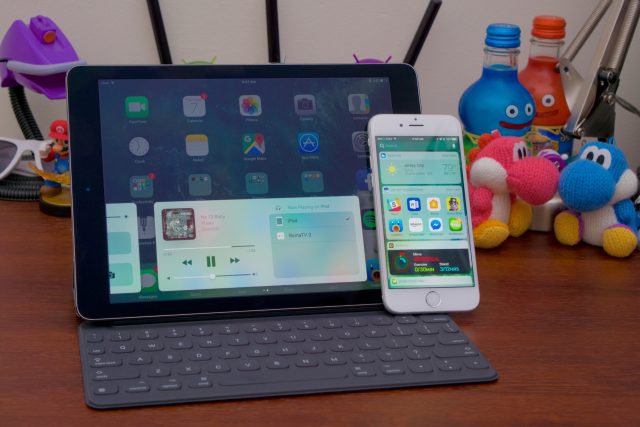
Enlarge / Devices running the iOS 10 beta. (credit: Andrew Cunningham)

Public betas are now a given for major and minor iOS and macOS releases for Apple, but that wasn't the case just a couple of years ago. The reason? Apple Maps, according to a Fast Company piece with quotes from Apple CEO Tim Cook, Software Engineering SVP Craig Federighi, and Internet Software and Services SVP Eddy Cue.

To recap, the Maps app in iOS switched from using Google's data to Apple's in iOS 6 back in 2012. The transition did not go well; the reception from the press and the public was bad enough that it prompted a rare apology and led to the departure of longtime iOS software head Scott Forstall.

"We made significant changes to all of our development processes because of [Maps]," Cue told Fast Company. "To all of us living in Cupertino, the maps for here were pretty darn good. Right? So [the problem] wasn’t obvious to us. We were never able to take it out to a large number of users to get that feedback. Now we do."

Read 3 remaining paragraphs | Comments

Starting this fall, Apple will pay up to $200,000 for iOS and iCloud bugs

Bug bounty program will start small and slowly expand over time.

Enlarge / Apple will soon begin offering bounties for bugs found in some of its hardware and software. (credit: Andrew Cunningham)

As part of a security presentation given at this year's Black Hat conference, Apple today announced that it would be starting up a bug bounty program in the fall. The program will reward security researchers who uncover vulnerabilities in Apple's products and bring them to the company's attention. Google, Microsoft, Facebook, and many other companies have offered bug bounty programs for some time now, but this is Apple's first.

For now, Apple is intentionally keeping the scope of the program small. It will initially be accepting bug reports from a small group of a few dozen security researchers it has worked with in the past. For now, bounties are only being offered for a small range of iDevice and iCloud bugs. The full list is as follows:

  • Secure boot firmware components: Up to $200,000 (~£150,000)
  • Extraction of confidential material protected by the Secure Enclave: Up to $100,000.
  • Execution of arbitrary code with kernel privileges: Up to $50,000.
  • Access from a sandboxed process to user data outside of that sandbox: Up to $25,000.
  • Unauthorized access to iCloud account data on Apple servers: Up to $50,000.

As the program continues and Apple works the, um, bugs out of its processes, the company will expand the list of eligible security researchers as well as the list of hardware and software bugs for which bounties are offered.

Read 4 remaining paragraphs | Comments
Apple thwarts jailbreakers with iOS 9.3.4 update

Update fixes a single issue credited to prominent jailbreaking group Team Pangu.

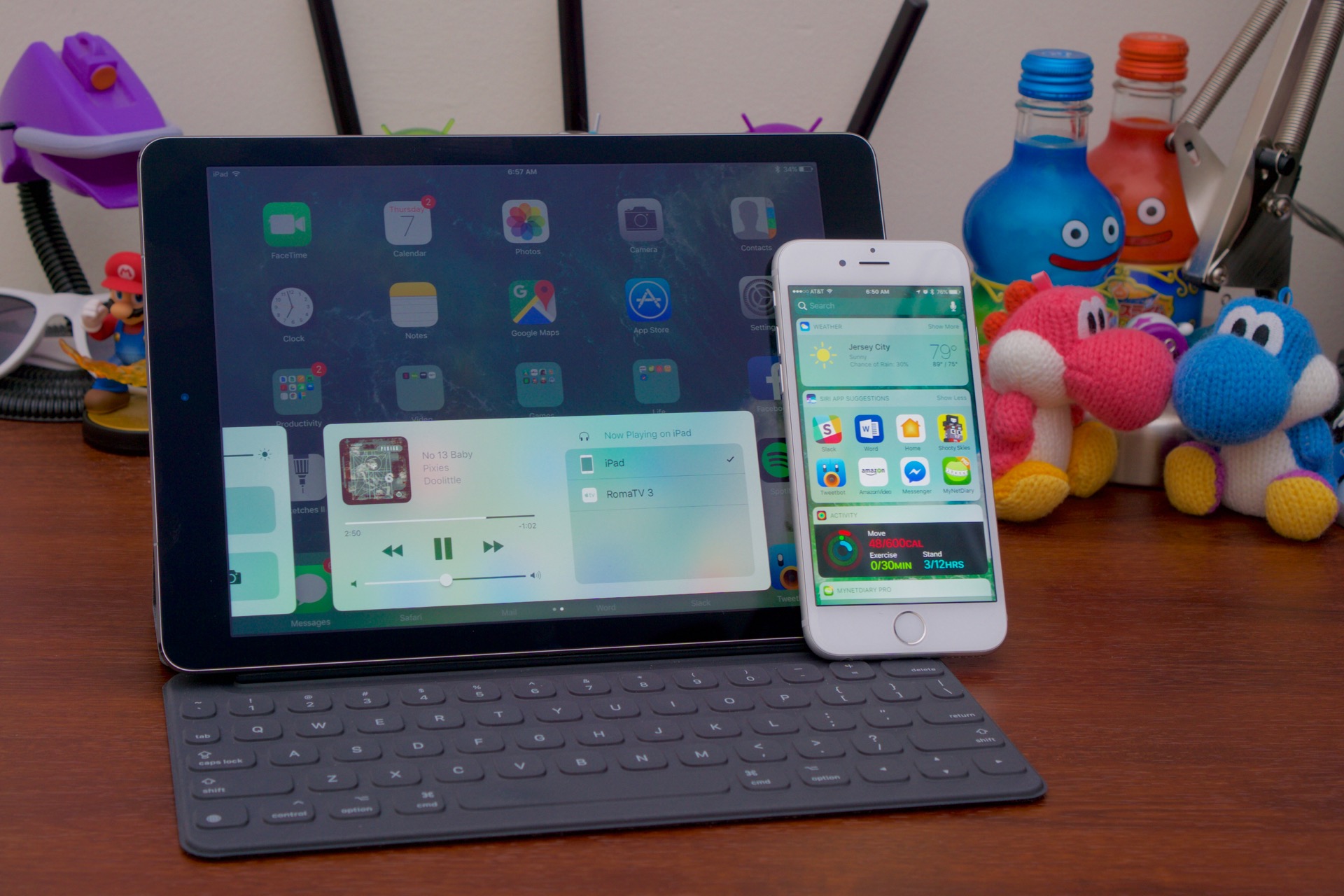
(credit: Andrew Cunningham)

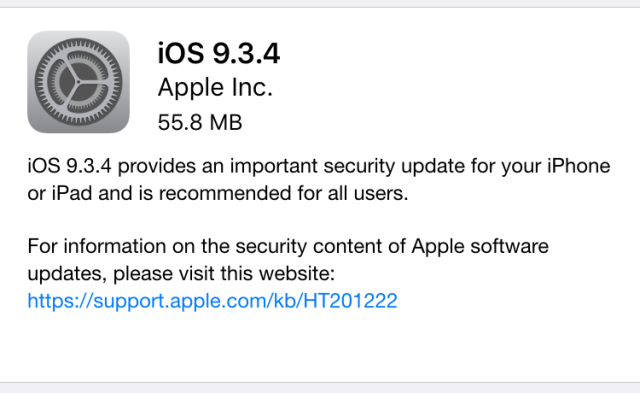
iOS 9.3.3 went through several beta tests before it was released a couple of weeks ago, but Apple apparently didn't catch everything. Today the company released iOS 9.3.4, an update for all devices that run iOS 9: the iPhone 4S and newer; iPad 2 and newer; all iPad Minis and iPad Pros; and the fifth- and sixth-generation iPod Touches.

The update only appears to fix a single issue, discussed in the security notes for the update. Apple has patched a memory corruption problem that could lead to arbitrary code execution. The company credits Team Pangu, a prominent developer in the jailbreaking community, with finding the bug. Apple doesn't explicitly mention jailbreaking, but this means that the recently released jailbreaking tools for iOS 9.3.3 almost certainly won't work in iOS 9.3.4.

We recommend against jailbreaking, because you're usually running old software with known vulnerabilities, and you're inviting additional problems by installing unvetted apps on your device. iOS is also much more permissive than it once was, which in many cases lessens or entirely removes the need for jailbreaking.

Read on Ars Technica | Comments

Review: A $60 Amazon phone that’s way better than Amazon’s actual phone

Selling your lock screen to Amazon cuts this cheap phone’s price in half.

Amazon’s Fire Phone was, by any reasonable metric, a colossal failure. Amazon took a $170 million write down on unsold inventory and contracts with its suppliers, and the phone’s $649 starting price tumbled below $200 in just four months. The Fire Phone's reputation was mostly deserved—Amazon’s fork of Android cut it off from the Google Play ecosystem, and its hardware was built around a couple of gimmicks that didn’t actually address actual needs. Talk of a follow-up phone persisted for a while, but no phone ever surfaced. Until now.

Kind of.

Amazon is getting back into smartphones, but instead of dumping money into R&D and maintaining its own forked OS and ecosystem, the company is taking a page from its e-readers by slapping ads and preinstalled apps onto existing budget-friendly phones. In exchange, buyers get a $50 discount on a handful of already-inexpensive phones, assuming they’re already paying $99/year for an Amazon Prime subscription (one could conceivably skirt this requirement by signing up for a Prime trial and then canceling).

Read 31 remaining paragraphs | Comments

Apple makes a really good ad for Microsoft’s Surface Pro

The slogan that can replace “the tablet that can replace your laptop.”

Apple has a new 30-second ad out for the iPad Pro. The tablet, which it explicitly and repeatedly calls a "computer," has "a keyboard that can just get out of the way" and "a screen you can touch and even write on." Apple stops just short of calling the iPad "a tablet that can replace your laptop," but if you lift the voiceover verbatim (the iPad Pro is mentioned by name in the text but not in the voiceover) and play it over footage of a Surface Pro 4, you have a pretty good ad for a Microsoft product.

Stretching the traditional definition of "computer" has always been part of the pitch for the iPad Pro. Apple CEO Tim Cook calls the iPad Pro "the perfect expression of the future of computing," despite his company's history of downplaying the appeal of convertibles and the convergence between touch and mouse-and-keyboard operating systems. But right now Apple's actions are speaking louder than words.

Since last updating the MacBook Pro, Apple has introduced two different sizes of iPad Pros and a new iPad Mini 4, as well as cutting the price of the still-appealing iPad Air 2. Most of the Mac lineup is as stale as it's ever been, and all but two of those computers are at least one full processor generation behind the rest of the PC industry (and the most recent Skylake chips from Intel are on the cusp of being replaced by something else).

Read 1 remaining paragraphs | Comments
Apple begins wrapping up Swift 3 and lays out plans for Swift 4

The language is open source, but Apple is still in the driver’s seat.

Enlarge (credit: Apple)

The final version of Swift 3.0 will be released alongside iOS 10 and macOS Sierra in the fall, but the fact that Apple develops Swift out in the open now means that we know more about its progress than we do about Apple's operating systems. Chris Lattner, a senior director of the Developer Tools Department at Apple, today posted a lengthy note to the Swift mailing list that looks back at the development of Swift 3.0 and sets some expectations for Swift 4.0 next year.

The note is worth reading in its entirety for those interested in programming in Swift and in contributing to the language itself—the Swift 3.0 retrospective focuses mostly on the benefits and drawbacks to going open source. Lattner describes the "vibrant community" as "fantastic," though he does note that open-source development "is slower and less predictable than 'closed design.'" Lattner says "the end result is significantly better, and therefore the tradeoff is worth it," even if "it is impossible to make everyone happy." The latter sentiment should ring true to anyone who has ever worked on any open source project.

Apple plans to release two major Swift updates between now and fall of 2017—Swift 3.1 in the spring and Swift 4.0 in the fall, along with whatever other minor bugfix releases are necessary. For Swift 4.0, Apple would like to focus on source and ABI stability first, and move on to other features once work on those two things is complete. After that, Lattner outlines a number of goals that the team would like to accomplish if time permits:

Read 1 remaining paragraphs | Comments
Report: Apple’s negotiating tactics sunk its long-rumored TV service

Apple asked for too much in exchange for too little, TV executives tell the WSJ.

(credit: Andrew Cunningham)

In the months leading up to the announcement of the new Apple TV box last year, there were multiple reports that said the company was also working on a streaming TV service as a way to entice cord-cutters and "cord-nevers" into its ecosystem. Those reports suggested that the service would include some 25 channels and cost $30 or $40 a month, and it would stream live content as well as offer a Netflix-esque back catalog of shows on demand.

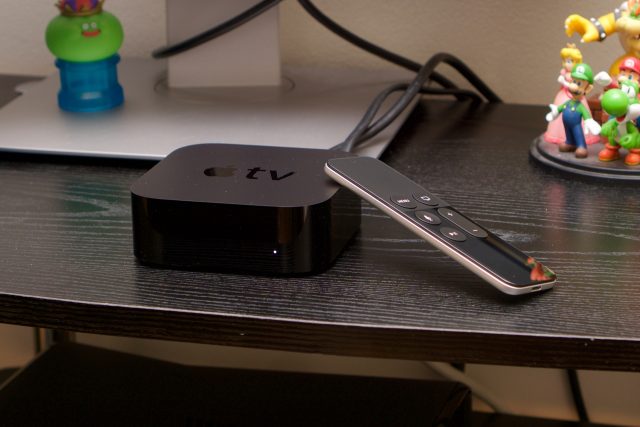
But it never came to pass. When the new Apple TV launched, Apple pushed apps as the future of TV rather than an all-in-one service. A new report from the Wall Street Journal today says that Apple's negotiating tactics were to blame and that the service didn't come to pass in part because Apple was offering too little money and making too many demands.

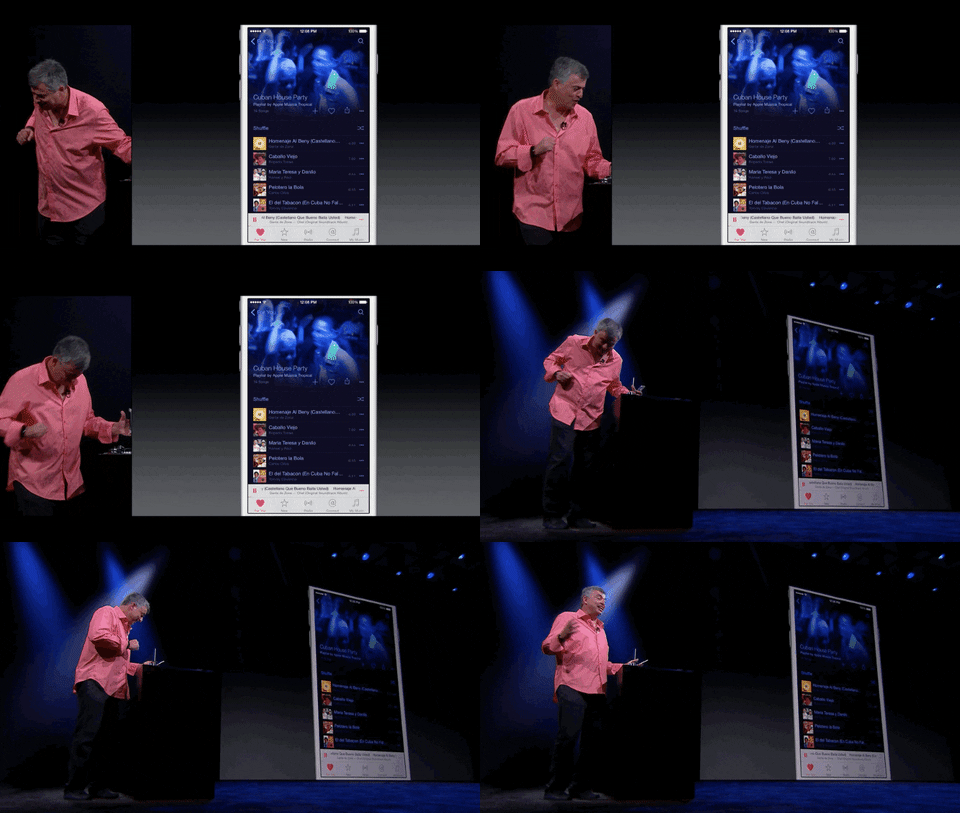
The report, which it should be noted is sourced mostly from anonymous TV industry executives and not from anyone on Apple's side of the negotiating table, lays most of the blame at the feet of SVP of Internet Software and Services Eddy Cue. The executives say he showed up to a meeting with Time Warner late and underdressed ("jeans, tennis shoes with no socks, and a Hawaiian shirt," which to be fair does sound pretty much like the Eddy Cue we see at Apple events) and that his list of requests included on-demand seasons of popular shows and Tivo-esque cloud-based recordings of shows that would allow for ad skipping.

Read 2 remaining paragraphs | Comments

Apple sells its billionth iPhone, year-over-year decline be damned

“Fewer iPhones than last year” is still a bunch of iPhones.

Enlarge / Over one billion of these things have been sold. (credit: Andrew Cunningham)

Apple has sold fewer iPhones in the last two quarters than it did last year, but it's still selling plenty of them. Apple CEO Tim Cook proclaimed today that the company has sold one billion iPhones since the launch of the original device back in 2007.

Recent slump aside, the iPhone's astronomical growth rate means that nearly half of those iPhones have been sold within the last two years; about 472 million of those phones were sold between Q3 of 2014 and Q3 of 2016.

For his part, Cook expects the iPhone's slump to be temporary, and he has blamed the year-over-year drop on the abnormally high number of upgraders who bought an iPhone 6 after it came out—the 6 and 6 Plus were Apple's first large-screened phones and there was a lot of pent-up demand. New iPhones (possibly without headphone jacks) are due in the fall, and we'll need to wait until then to see if new models can restart the phone's steady growth.

Read on Ars Technica | Comments

Intel’s Core M Compute Stick is an actually usable computer with caveats

Mini-review: $380 stick bridges the gap between the Atom sticks and the NUC.

Back in January at CES, Intel showed us a full range of mini desktop PCs that it has been releasing steadily over the course of the year. The first was a new, inexpensive version of its Compute Stick, followed by a new, mainstream Skylake NUC, and finally a quad-core NUC box that wasn't quite like anything the company had done before.

Now Intel has sent us the last device we learned about at the beginning of the year: a Core m3-powered version of the Compute Stick that sits somewhere between the Atom version and the Skylake NUC on the price and performance spectrum. It looks more or less like the Atom version we've already seen, but it introduces a few neat ideas (and enough performance) that it's actually plausible as a general-use desktop computer.

The bad news is the price tag, which at $380 (with Windows, $300 without, and XXX with Windows and a Core m5) is pretty far outside the sub-$150 impulse-buy zone that the other Compute Sticks exist inside. So how well does it work? What compromises do you make when you shrink a decent laptop's worth of power into a stick? And how big is the niche for a relatively powerful, relatively expensive stick-sized desktop, anyway?

Read 19 remaining paragraphs | Comments