Teachers get an F on AI-generated lesson plans

AI-generated lesson plans fall short on inspiring students and promoting critical thinking.

When teachers rely on commonly used artificial intelligence chatbots to devise lesson plans, it does not result in more engaging, immersive, or effective learning experiences compared with existing techniques, we found in our recent study. The AI-generated civics lesson plans we analyzed also left out opportunities for students to explore the stories and experiences of traditionally marginalized people.

The allure of generative AI as a teaching aid has caught the attention of educators. A Gallup survey from September 2025 found that 60 percent of K-12 teachers are already using AI in their work, with the most common reported use being teaching preparation and lesson planning.

Without the assistance of AI, teachers might spend hours every week crafting lessons for their students. With AI, time-stretched teachers can generate detailed lesson plans featuring learning objectives, materials, activities, assessments, extension activities, and homework tasks in a matter of seconds.

Read full article

Comments

Rocket Report: China launches with no advance warning; Europe’s drone ship

Starlink, Kuiper, and the US military all saw additions to their mega-constellations this week.

Welcome to Edition 8.15 of the Rocket Report! This year has been, at best, one of mixed results for SpaceX’s Starship program. There have been important steps forward, including the successful reuse of the rocket’s massive Super Heavy booster. Clearly, SpaceX is getting really good at launching and recovering the 33-engine booster stage. But Starship itself, part spacecraft and part upper stage, hasn’t fared as well—at least it hadn’t until the last couple of months. After four Starships were destroyed in flight and on the ground in the first half of 2025, the last two missions ended with pinpoint splashdowns in the Indian Ocean. The most recent mission this week was arguably the most successful yet for Starship, which returned to Earth with little damage, suggesting SpaceX’s improvements to the heat shield are working.

As always, we welcome reader submissions. If you don’t want to miss an issue, please subscribe using the box below (the form will not appear on AMP-enabled versions of the site). Each report will include information on small-, medium-, and heavy-lift rockets, as well as a quick look ahead at the next three launches on the calendar.

SpaceX vet will fly with Blue Origin. Hans Koenigsmann is one of SpaceX’s earliest, longest-tenured, and most-revered employees. He worked at Elon Musk’s space company for nearly two decades, rising to the role of vice president for mission assurance and safety before leaving SpaceX in 2021. He led the investigations into every Falcon rocket failure, mentored young engineers, and became a public face for SpaceX through numerous presentations and press conferences. And now he has announced he is going to space on a future suborbital flight on Blue Origin’s New Shepard vehicle, Ars reports.

Read full article

Comments

Yes, everything online sucks now—but it doesn’t have to

Ars chats with Cory Doctorow about his new book Enshittification.

We all feel it: Our once-happy digital spaces have become increasingly less user-friendly and more toxic, cluttered with extras nobody asked for and hardly anybody wants. There’s even a word for it: “enshittification,” named 2023 Word of the Year by the American Dialect Society. The term was coined by tech journalist/science fiction author Cory Doctorow, a longtime advocate of digital rights. Doctorow has spun his analysis of what’s been ailing the tech industry into an eminently readable new book, Enshittification: Why Everything Suddenly Got Worse and What To Do About It.

As Doctorow tells it, he was on vacation in Puerto Rico, staying in a remote cabin nestled in a cloud forest with microwave Internet service—i.e., very bad Internet service, since microwave signals struggle to penetrate through clouds. It was a 90-minute drive to town, but when they tried to consult TripAdvisor for good local places to have dinner one night, they couldn’t get the site to load. “All you would get is the little TripAdvisor logo as an SVG filling your whole tab and nothing else,” Doctorow told Ars. “So I tweeted, ‘Has anyone at TripAdvisor ever been on a trip? This is the most enshittified website I’ve ever used.'”

Initially, he just got a few “haha, that’s a funny word” responses. “It was when I married that to this technical critique, at a moment when things were quite visibly bad to a much larger group of people, that made it take off,” Doctorow said. “I didn’t deliberately set out to do it. I bought a million lottery tickets and one of them won the lottery. It only took two decades.”

Read full article

Comments

Direct Sales & Direct Anti-Piracy Action Underpin Japan’s Plan For Explosive Growth

With a mission to dramatically increase overseas sales of anime, manga, video games, and other creative content by 2033, Japan’s Entertainment and Creative Industry Strategy is ambitious and prepared for new risks. Relatively safe licensing models seem to be on the way out, in favor of content companies establishing overseas bases, from where marketing, sales and distribution will be handled directly. Rampant piracy will face a two-pronged strategy, including enhanced enforcement measures targeting areas where piracy causes the most damage.

From: TF, for the latest news on copyright battles, piracy and more.

stop-piracy-smlIn the decade preceding 2023, overseas sales of Japanese content tripled, reaching approximately 5.8 trillion yen or roughly US$38.3 billion at today’s rates.

According to the five-year action plan laid out in the 2025 Entertainment and Creative Industry Strategy report, that figure surpassed the exports of the semiconductor and steel industries, leaving only the car industry out in front. Now positioned as a ‘core industry,’ and with expectations that even greater achievements lie ahead, the Japanese content industries have a new target: overseas sales of 20 trillion yen – US$133 billion – by 2033.

Content Overseas Expansion 2.0

The global appeal of Japanese content, especially among consumers of comic books (manga) and animated movies (anime), led to an explosion of content consumption that appeared to take the local industries by surprise. Fan-led pirate sites satisfied demand for several years, including all-important translations that often were simply unavailable to buy from official sources.

The plan for achieving the required level of growth is detailed and complex; our focus here is necessarily more narrow. One key aspect expected to boost sales and profitability is a shift away from lower-profit licensing agreements with third party companies overseas, towards serving markets and consumers directly.

Japanese companies are reportedly establishing bases in overseas markets, aiming to build fan communities through live events and merchandise sales, while generating interest in a wider range of products.

The plan identifies 100 specific actions across 10 market sectors including anime, manga, video games and music. Areas in need of attention include a lack of human resources on the business side, a shortage of specialist content creators, restricted production capacity, and a lack of objective market data.

However, if all goes to plan, overseas success is expected to increase demand for Japanese products in general. Inbound tourism is also predicted to rise with the benefits felt on a regional basis. Establishing the content industries overseas would also provide a bridgehead enabling others to follow.

“In order to advance ‘Content Overseas Expansion 2.0,’ it is essential that the public and private sectors work together strategically to increase productivity and profitability across the industry, create new IP content, and strengthen competitiveness,” the action plan reads.

Two-Pronged Anti-Piracy Strategy

The shift to a new business model will inevitably present new challenges, but none quite as difficult to solve as piracy. On one hand, boosting interest in Japanese content overseas could be a roaring success. On the other, if pirate sites end up reaping most of the benefits, that will suppress companies’ abilities to generate profit in support of significant new investment.

The challenge is well understood and, at a base level, hasn’t changed in 20 years. Fundamentally, the solution is equally static; increase the appeal of legitimate products, ensure that content is properly localized to meet the language requirements of local audiences, and make it easy to consume through accessible, value-for-money platforms.

Since the popularity of pirate sites is determined in exactly the same way, Japanese content – manga in particular – is uniquely vulnerable to pirate competition. The cost of creating and promoting legal content is of little interest to most large pirate sites operating in the niche. That has immediate consequences for affordably priced content competing against identical content given away for free. The relatively simplistic manga format only serves to compound the problems.

The two-pronged approach assumes that when everything has been done to meet customer requirements (prong 1) yet content is still consumed from pirate sites, strengthening enforcement measures to remove unfair competition (prong 2) becomes a necessary component of a successful anti-piracy strategy.

General Anti-Piracy Measures and Enforcement

Law Enforcement and Investigation: Anti-piracy group CODA (Content Overseas Distribution Agency) actively investigates pirate sites on behalf of its members, which include some of Japan’s largest producers of manga and anime.

Existing enforcement work alongside international partners such as the MPA, often in cooperation with national law enforcement agencies, is expected to play a major role. Establishing an overseas presence has already led to publicized success in China (1,2,3) and while yet to be formally announced (to our knowledge), evidence suggests similar planning for action elsewhere.

Comprehensive Response: The action plan recognizes that regions with high piracy rates will require a comprehensive anti-piracy approach to create potential for sales of legitimate products. While enforcement will likely prove necessary, the aim will be to offer translated and localized content, supplied in a format that makes it easy for fans to consume, at a price that makes the content attractive.

Manga and Other Publications: The general goal is to apply anti-piracy measures while strengthening distribution of legitimate content. The latter will require support for the JLOX+ initiative (Japan content LOcalization and business transformation(X) Plus) and development of industry infrastructure for the effective translation of manga and other publications.

As things stand, a lack of skilled translators means that pirate sites often take the top slots in overseas search results. Basic translations are considered insufficient for official publications distributed overseas. On a region-by-region basis, translations must also consider local history, culture, religious sensitivities, and in some cases, limits on expression.

Japan Business Federation Calls for Urgent Support

Earlier this month, the influential Japan Business Federation (Keidanren) called for the government to provide immediate, large-scale, and multi-year funding necessary to ensure the success of the content industry as a driving force in the Japanese economy.

While acknowledging the growth of Japanese content on the world stage, Keidanren said that other countries are also launching projects, intensifying competition in an already competitive environment.

“To further promote the content industry as a core industry in Japan, while relying on the fundamental premise of private-sector-led creativity, public-private partnerships are essential. The government must now step up its efforts and provide large-scale, strategic support over multiple years,” Keidanren added.

“In order to achieve the government’s target of 20 trillion yen in overseas sales by 2033, it is essential to go beyond these measures and expand support measures for the entire content industry, such as strengthening central coordination and offering tax incentives.”

The plan is certainly ambitious, but with impressive attention to detail throughout, including during the preparation stages, Japan isn’t taking this lightly. Piracy will likely remain part of the equation for some time, and while that might not be ideal, there might be small comfort in the knowledge that the lowest piracy rates usually accompany the least desirable content.

Keidanren’s call for urgent government support (pdf, Japanese)
Entertainment and Creative Industry Strategy – Five Year Action Plan (pdf, Japanese)

From: TF, for the latest news on copyright battles, piracy and more.

Eazeye Paper 2.0 tablet has a 10.3 inch monochrome reflective LCD display for sunlight visibility

There are a growing number of tablets with E Ink displays and digital pens that promise a paper-like experience for writing notes and drawing pictures. And at first glance, it’d be easy to mistake the Eazeye Paper 2.0 for one of those… but …

There are a growing number of tablets with E Ink displays and digital pens that promise a paper-like experience for writing notes and drawing pictures. And at first glance, it’d be easy to mistake the Eazeye Paper 2.0 for one of those… but it’s something different. Instead of an E Ink display, this tablet has […]

The post Eazeye Paper 2.0 tablet has a 10.3 inch monochrome reflective LCD display for sunlight visibility appeared first on Liliputing.

HyperSpace Trackpad Pro is an external Precision touchpad with haptic feedback and pressure sensitivity (Crowdfunding)

When I was looking for a high-quality external touchpad to use with my Windows computer this summer, there was basically only one option. And for the most part I’ve been pretty happy with the Ploopy TrackPad that I’ve been using for the las…

When I was looking for a high-quality external touchpad to use with my Windows computer this summer, there was basically only one option. And for the most part I’ve been pretty happy with the Ploopy TrackPad that I’ve been using for the last few months. But there are some features that it lacks, like Bluetooth […]

The post HyperSpace Trackpad Pro is an external Precision touchpad with haptic feedback and pressure sensitivity (Crowdfunding) appeared first on Liliputing.

Asus launches ROG NUC mini gaming PC with AMD Ryzen 9 9955HX3D and RTX 5070

The Asus ROG NUC is a compact desktop computer that stuffs the guts of a high-performance gaming laptop into the body of a mini PC. Earlier this year Asus introduced a 2025 model with support for up to an Intel Core Ultra 9 275HX Arrow Lake processor a…

The Asus ROG NUC is a compact desktop computer that stuffs the guts of a high-performance gaming laptop into the body of a mini PC. Earlier this year Asus introduced a 2025 model with support for up to an Intel Core Ultra 9 275HX Arrow Lake processor and NVIDIA GeForce RTX 5080 graphics, but now […]

The post Asus launches ROG NUC mini gaming PC with AMD Ryzen 9 9955HX3D and RTX 5070 appeared first on Liliputing.

Microsoft is bringing Copilot AI controls to all Windows 11 PCs

For the past few years Microsoft has been pushing the idea of Copilot+ PCs as special systems that have NPU’s with enough AI processing performance to allow you to use certain AI features without a cloud connection. But now Microsoft has announce…

For the past few years Microsoft has been pushing the idea of Copilot+ PCs as special systems that have NPU’s with enough AI processing performance to allow you to use certain AI features without a cloud connection. But now Microsoft has announced plans to make every Windows 11 computer an AI PC that use the company’s […]

The post Microsoft is bringing Copilot AI controls to all Windows 11 PCs appeared first on Liliputing.

Record Labels Fire Back at Cox in $1B Supreme Court Piracy Case, Cite Termination ‘Hypocrisy’

A group of major record labels has fired back at Cox Communications, asking the Supreme Court to uphold the $1 billion piracy liability verdict. The music companies describe Cox as a hypocritical bad actor, one that prioritized profit over combating piracy. As the ISP stokes fears of innocent grandmas losing their Internet connections, the labels say that Cox terminated half a million customers for failing to pay their bills.

From: TF, for the latest news on copyright battles, piracy and more.

supremecourtThe Supreme Court case between several major record labels and Cox Communications is a landmark legal battle.
The outcome will determine how Internet providers should deal with pirating subscribers on their networks.

Should alleged pirates be disconnected from the Internet after repeated third-party allegations of copyright infringement? Or does that go too far?

In its opening brief, Cox argued that the company should not be held liable for contributory copyright infringement because it failed to terminate subscribers after multiple warnings. The U.S. Government and various tech companies support Cox’s position.

Record Labels Fire Back in Supreme Court

Yesterday, the major record labels, including Sony and Universal Music, countered these arguments in their response brief. Describing Cox as a company that willingly prioritized profits over piracy, they argued that the $1 billion verdict against the ISP should be upheld.

Citing internal communication records handed over by Cox during discovery, the labels said that Cox viewed potential terminations through a commercial lens.

“Cox made a deliberate and egregious decision to elevate its own profits over compliance with the law, supplying the means for massive copyright infringement to specific users that it knew were ‘habitual offenders’ because ‘we want to hold on to every subscriber we can’,” the labels said.

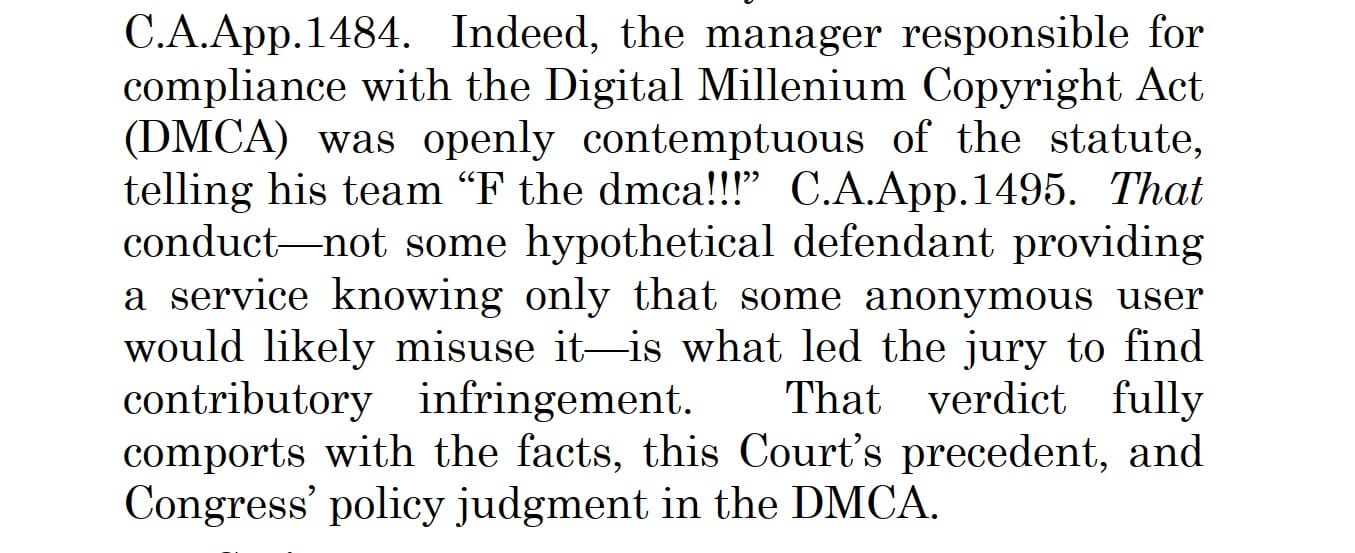
To illustrate this stance, the labels quoted comments made by a Cox manager. He was responsible for the company’s compliance with the DMCA but told his team, “F the dmca!!!”.

F the dmca!!!

f the dmca

The labels claim that it was this context that eventually led the Virginia jury to hold the company liable, and they see no reason why the Supreme Court should reverse the decision.

Termination Hypocrisy

A key issue highlighted by Cox and the U.S. Government is the risk of innocent subscribers having their Internet access terminated over third-party piracy allegations.

The record labels don’t dispute the importance of Internet connectivity, but after disconnecting hundreds of thousands of subscribers who didn’t pay their bills, they claim that Cox’s stance is hypocritical.

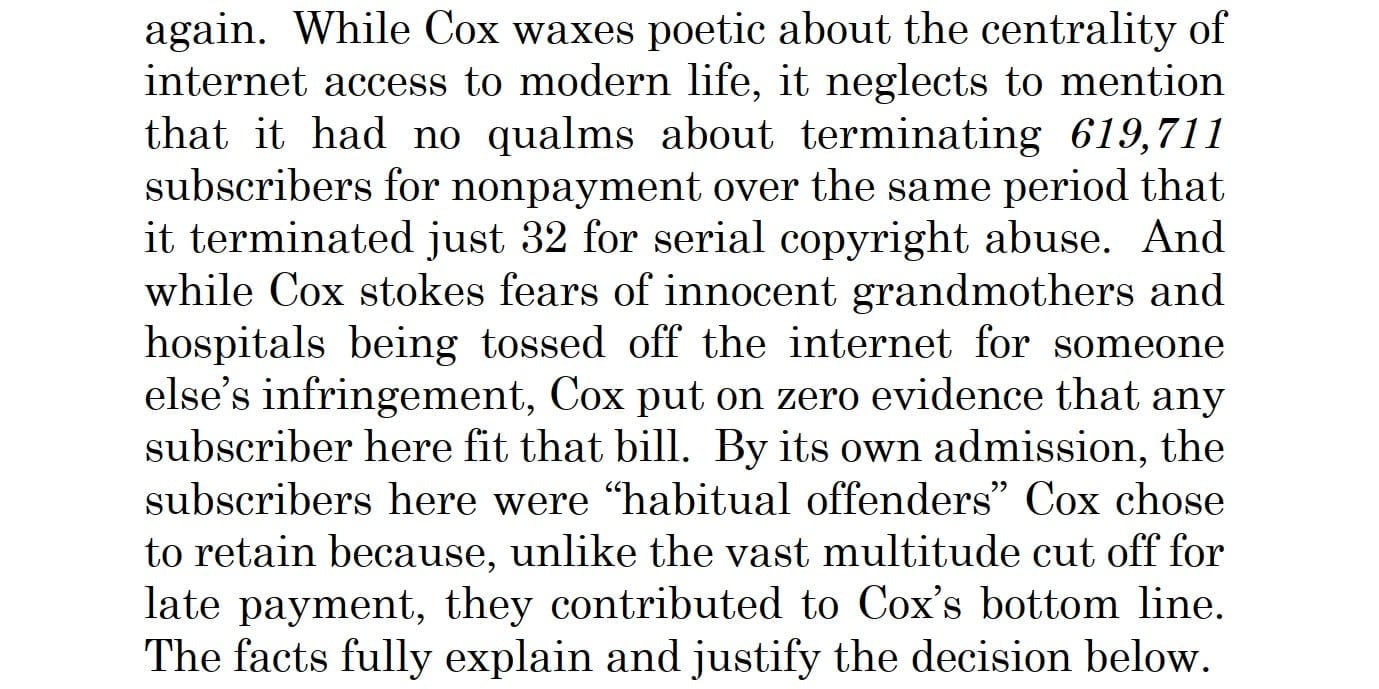
“While Cox waxes poetic about the centrality of internet access to modern life, it neglects to mention that it had no qualms about terminating 619,711 subscribers for nonpayment over the same period that it terminated just 32 for serial copyright abuse. And while Cox stokes fears of innocent grandmothers and hospitals being tossed off the internet for someone else’s infringement, Cox put on zero evidence that any subscriber here fit that bill.”

Waxing Poetics about Grandmothers

waxing poetics

Contributory Liability is ‘Bedrock Law’

A key question before the Supreme Court is whether ISPs can be held contributorily liable. According to Cox and the U.S. government, they should not if there is no culpable action that facilitates copyright infringement.

According to the labels, Cox’s decision to ignore piracy and prioritize profits qualifies as culpable conduct.

The music companies note that contributory infringement is bedrock law that dates back more than a century. It has previously been applied to cases where parties supplied products that were used for copyright infringement.

They cite a 1912 case (Henry v. A.B. Dick Co.) where the Supreme Court held that selling mimeograph ink to a known infringer “with the expectation that it would be used” to infringe was enough for liability. The labels argue that Cox continuing to provide internet service to known “habitual offenders” is the modern equivalent.

DMCA’s Safe Harbor Presupposes Liability

One of the labels’ critical counterarguments is that the very existence of the DMCA’s safe harbor for ISPs suggests that Congress understood that these services could be held liable for their subscribers’ infringements.

The labels note that the U.S. government’s concern, that ISPs would be more inclined to avoid liability and terminate customers without much scrutiny, could also be turned on its head.

While terminations of alleged pirates are clearly seen as a problem by Cox and the U.S., disconnecting subscribers that refuse to pay their bills isn’t mentioned as a concern.

“All of that makes the government’s professed concern about not ‘giv[ing] ISPs a powerful incentive to err on the side of termination,’ mystifying. Cox itself had no hesitation about erring on the side of termination when it came to late-paying customers.

“And Congress acted to curb the true problematic incentive—namely, that ISPs’ profit motives will leave them with ‘a powerful incentive to err on the side’ of retaining known infringers as long as they pay their monthly bills,” the labels added.

A Nullity

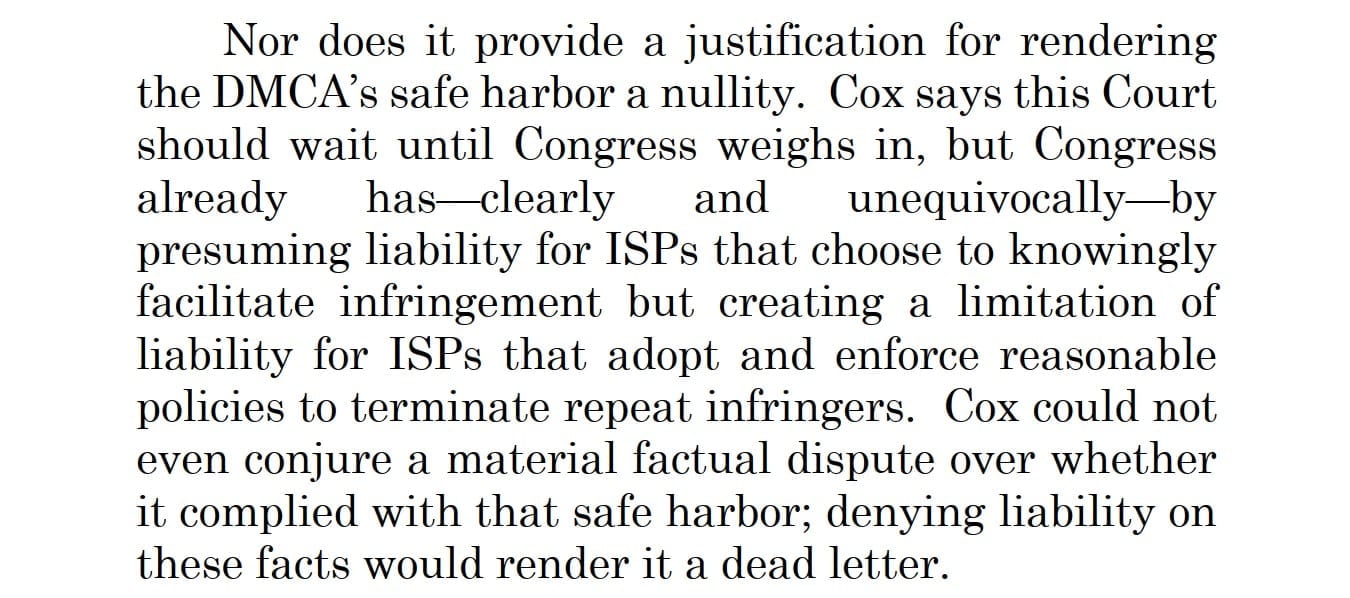
nullity

According to the labels, the DMCA safe harbor would be a “nullity” or “nonsensical” if there were no underlying liability to be shielded from. The provision, which requires ISPs to implement a reasonable policy to terminate repeat infringers, was created to “incentiv[ize]” ISPs to cooperate.

Finally, the labels add that the jury also correctly held that Cox’s actions were willful. The extensive internal discussions about the DMCA and the legal risk show Cox was fully aware of the law and its potential liability, but simply decided to give its profits priority.

With the main briefs from both sides now filed, the Supreme Court is scheduled to hear oral arguments from Cox, the record labels, and possibly the U.S. Government later this fall. A final decision on the billion-dollar verdict, which will define the responsibilities of Internet providers in the digital age, is expected next year.

A copy of the record labels’ brief, submitted yesterday to the Supreme Court, is available here (pdf)

From: TF, for the latest news on copyright battles, piracy and more.

Honor is making a phone with a flip-out camera on a robotic arm

Most modern smartphones are basically rectangles with a touchscreen on the front and a couple of cameras on the back. Every now and then a phone maker gets the bright idea if introducing a flip-out camera that lets the rear camera face forward so that …

Most modern smartphones are basically rectangles with a touchscreen on the front and a couple of cameras on the back. Every now and then a phone maker gets the bright idea if introducing a flip-out camera that lets the rear camera face forward so that you don’t even need a standalone selfie camera. The upcoming […]

The post Honor is making a phone with a flip-out camera on a robotic arm appeared first on Liliputing.