 During the past several years, sports rightsholders in Europe have made it clear that piracy of fleeting live events poses unique problems that require a strong response.
Existing site blocking measures were seen as insufficient. Standard takedown notices reportedly lacked the necessary teeth to ensure compliance, something that could be addressed under revised EU law, rightsholders said..
In 2022, requests for European Commission assistance escalated to outright demands for legal amendments, which were instantly dismissed by the Commission in favor of an extended consultation.
To what extent the EC’s response acted as a catalyst isn’t clear, but nothing has been quite the same since.
Canal+ Targets Public DNS Resolvers
Anti-piracy group AAPA was among the first to politely inform the EC that its members, including the Premier League, Sky, beIN, and Canal+, were really disappointed with the outcome. Yet, it transpired, no less motivated.
With permission from the High Court in London, Sky began targeting key IPTV providers, eventually blocking thousands upon thousands of fully qualified domains, at an unprecedented rate.
In France, Canal+ decided to close the alternative DNS loophole, reportedly undermining blocking at local ISPs. Seemingly undeterred by potential backlash, Canal+ sued Cloudflare, Google, and OpenDNS, and with the assistance of broadly crafted French law, won a first of its type injunction.
With significant fines on the table to ensure compliance, OpenDNS had seen enough and promptly shut down its services in France.
Why Stop at Public DNS? VPN Blocking Awaits
Attorney Richard Willemant is known for his work representing rightsholders in France. Recent cases include the police raids and civil lawsuit against UptoBox. By volume, lawsuits compelling intermediaries to block pirate sites and delete search results on behalf of Canal+ (and by extension, Premier League, UEFA, LFP, and Formula 1) are far more numerous.
Speaking at an event last week organized by Italian telecoms regulator AGCOM, Willamont spoke about his work with Canal+ and the importance of dynamic injunctions capable of tackling circumvention attempts more quickly. After obtaining an injunction to block pirate sites in France, post-judgment modification of blocking targets takes place with assistance from French telecoms regulator ARCOM.
“ARCOM allows us to update injunctions flexibly, adding new domains or mirror sites without having to refer to the courts each time. This system has made it possible to block thousands of illegal sites and services more quickly and effectively,” he explained.
Blocking thousands of additional targets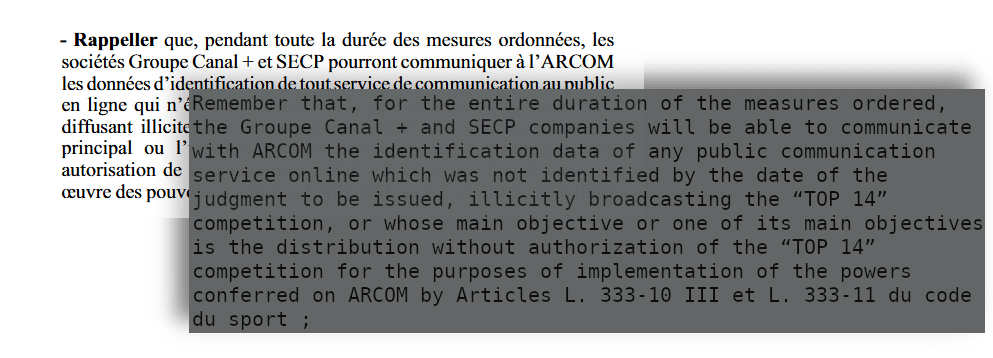
Willemant’s more recent stand-out successes include the controversial action against Cloudflare, Google, and OpenDNS.
With that achievement already behind him, Willemant went on to successfully argue that VPN providers NordVPN, Proton, CyberGhost, ExpressVPN and Surfshark, should also be compelled to block pirate sites targeting France.
The move was certainly controversial, but more importantly, did it move the needle?
Success or Failure? Canal+ Attorney Reveals All
During his speech, which outlined experiences from the perspective of rightsholders, Willemant said that for the first time in his experience, piracy rates are now starting to come down. Citing research by regulator ARCOM, which he described as completely unbiased, Willemant reported the following results:
| Piracy Reductions After Targeting Circumvention Tools (Richard Willemant/Canal+) |
| Method |
Reduction |
Details |
| 3rd Party DNS Blocking |
8% |
Attributed to legal decisions against third-party DNS providers (Cloudflare/Google) |
| VPN Blocking |
7% |
Attributed to decisions targeting commercial VPNs (NordVPN/Proton/CyberGhost/ExpressVPN/Surfshark) |
| Total Reduction |
15% |
Attributed to combined effect of decisions against Third Party DNS and commercial VPNs |
|
|
|
Which specific piracy statistic was reduced by 15% isn’t made clear.
The number of visits to the pirate websites listed in the order is one possibility, but for that figure to hold weight, traffic to other sites not yet subject to blocking would need to be measured too. Diverting traffic to another platform showing the same content has no effect on overall piracy rates.
Other VPN providers not subjected to blocking also factor into the equation. French users behind VPNs may appear to be geographically located outside France, but that’s not necessarily the case.
Nevertheless, Willemant says that when court-ordered and administrative blocking measures are both taken into account, they “clearly indicate that blocking is working” and “producing measurable results.”
Resistance Against Blocking, Enforcement Not Always Possible
After covering the successes, Willemant revealed several causes for concern. While rightsholder enthusiasm for blocking measures isn’t in doubt, opposition to blocking is being felt in the judicial, regulatory, and political arenas.
“We are facing strong resistance from intermediaries including Cloudflare. Despite being one of the respondents in blocking injunctions, Cloudflare independently decides which sites to block, and which not to block. Both the courts and ARCOM are perplexed by the company’s approach.”
For context, the injunction makes it clear that failure to comply with the court’s instructions carries a potential penalty of €30,000.
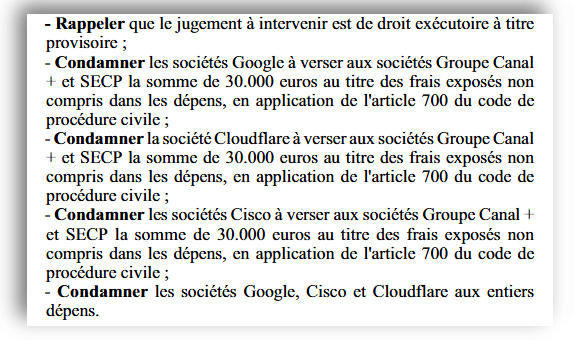
Willemant’s reference to issues at the judicial level received no elaboration. However, the issue of enforcement clearly came up at some point, hence his comment that enforcement hasn’t always been possible for “practical” reasons.
Penalties exist to incentivize compliance, but based on the comments, it’s possible that something isn’t functioning quite as intended.
Political Pushback at the Highest Level
There’s no question that President Trump’s return to the White House has unsettled United States trading partners, not to mention its long-standing strategic allies. Thus far, few if any have been spared.
The European Union’s efforts to regulate online services operating in Europe necessarily involve some of the largest online platforms; they’re mostly American companies such as X, Facebook, and Instagram, not forgetting Cloudflare and Google, of course.
“We are seeing lobbying pressure, including international pressure, in particular from the US government,” Willemant confirmed.
“The government has asked its diplomats in Europe to oppose certain provisions of the Digital Services Act (DSA), precisely those that strengthen intermediaries’ obligations to cooperate [with rightsholders].”
Willemant said that intermediaries have benefited from limited liability for many years under the E-Commerce Directive. The quid pro quo under the Digital Services Act, however, is substantially more involved. In exchange for limited liability, Willemant said, “[intermediaries] must actively collaborate in the fight against illegal activities.”
“Stop Censoring Free Speech”
In the United States, the EU’s sprawling legislation is viewed quite differently. Described by House Judiciary Committee Republicans as a ‘Foreign Censorship Threat’ that infringes on ‘American Free Speech’, the Committee produced non-public documents to show, according to their reading, “that European censors target core political speech that is neither harmful nor illegal, attempting to stifle debate on topics such as immigration and the environment.”
A diplomatic cable seen by Reuters, titled “Action Request” asked American diplomats across U.S. embassies in Europe to regularly engage with EU governments and authorities to convey U.S. concerns about the DSA.
The anti-piracy event at which Willemant made his presentation was centered around Articles 58, 59, and 60 of the Digital Services Act. The articles outline rules for cross-border cooperation, referral of issues to the European Commission, and procedures for joint investigations into suspected infringements of the DSA.
If the United States had its way, the cable suggests, there would be nothing to discuss.
“Repeal and/or Amend the DSA”
“Posts should focus efforts to build host government and other stakeholder support to repeal and/or amend the DSA or related EU or national laws restricting expression online.”
Blocking unfavorable, infringing, and illegal content is already deeply embedded across the EU. What that means for the site-blocking push currently underway in the United States is unclear. As a means to suppress foreign threats, President Trump might be persuaded to get onboard.
Admittedly, tomorrow he may see things quite differently. The fully-committed European Commission, on the other hand, will not.
From: TF, for the latest news on copyright battles, piracy and more.
 Viele bei einer Berliner Firma eingereichte Festplatten sind mechanisch oft in Ordnung. Allerdings bereitet die Firmware Probleme. (Western Digital, Speichermedien)
  Die US-Regierung prüft neue Exportbeschränkungen für Produkte, die mit amerikanischer Software entwickelt oder hergestellt wurden. (
 Der Explorer von Windows 11 verweigert seit einigen Tagen die Vorschau für zahlreiche PDF- und Office-Dokumente. Laut Microsoft ist das beabsichtigt. (
 VWs Elektroauto ID.7 zeigt jetzt Reklame auf dem Navigationsdisplay - während der Fahrt. Was VW als Service verkauft, spaltet die Kundschaft. (
 Trotz Rekordauslieferungen und boomender Energiesparte kämpft Tesla mit schrumpfenden Margen. (